新型储能

Search documents
中车株洲所/海辰储能/科华数能入围大唐300MW风电项目储能系统采购
中关村储能产业技术联盟· 2025-10-29 08:05
Group 1 - The article highlights the procurement results for the energy storage system of the 300 MW wind power project in Su Ni Te Left Banner, with the first candidate being CRRC Zhuzhou Electric Locomotive Research Institute Co., Ltd. with a bid of 502,830,000 CNY [2] - The second candidate is Xiamen Haichen Energy Storage Technology Co., Ltd. with a bid of 535,500,000 CNY, and the third candidate is Xiamen Kehua Data Co., Ltd. with a bid of 549,000,000 CNY [2] - Bidders must have a cumulative performance of no less than 1 GWh in lithium iron phosphate battery energy storage system integration over the past three years, including at least two projects with a capacity of 100 MWh or more [2] Group 2 - The article references the "14th Five-Year Plan" which emphasizes the development of new energy storage and the acceleration of smart grid and microgrid construction [6] - It mentions the third-quarter financial report of Sungrow Power Supply Co., Ltd., showing a revenue of 22.869 billion CNY and a net profit increase of 59.76% year-on-year [6]


创业板新能源ETF(159387)大涨超4%,原因为何?
Mei Ri Jing Ji Xin Wen· 2025-10-29 06:35
Core Viewpoint - The new energy sector is leading the market, with the ChiNext New Energy ETF (159387) rising over 4%, driven by strong performance in the energy storage business and supportive policies [1]. Performance Summary - Sunshine Power achieved revenue of 22.869 billion yuan in Q3 2025, a year-on-year increase of 20.83% but a quarter-on-quarter decrease of 6.65%. The net profit attributable to shareholders was 4.147 billion yuan, up 57.04% year-on-year and 6.1% quarter-on-quarter. The company's energy storage system revenue was approximately 11 billion yuan, indicating strong performance and an upward revision of global energy storage installation expectations for the coming years [2]. Growth Summary - The easing of US-China relations and Nvidia's announcement of high demand in 2026 are expected to boost energy storage growth. The increase in electricity consumption in North American data centers highlights the need for energy storage solutions to manage load fluctuations, further opening growth opportunities in the sector [3]. Price Summary - The price of electrolyte reached 98,000 yuan per ton on October 27, up 39,000 yuan from 59,000 yuan on September 28, indicating a tight supply and potential for further price increases. The price of lithium iron phosphate cathodes also rose from 34,900 yuan per ton on September 28 to 36,100 yuan per ton on October 27, supported by demand and cost factors [4]. Policy Summary - The "14th Five-Year Plan" emphasizes the development of new energy sources, including wind, solar, and nuclear, and promotes new energy storage to achieve carbon peak goals. Local policies, such as those from the Henan Provincial Development and Reform Commission, aim for a cumulative energy storage installation of 15 GW by 2030 and support for independent storage systems. The fourth quarter of 2025 is expected to see a surge in domestic energy storage demand due to the implementation of various provincial policies [5].

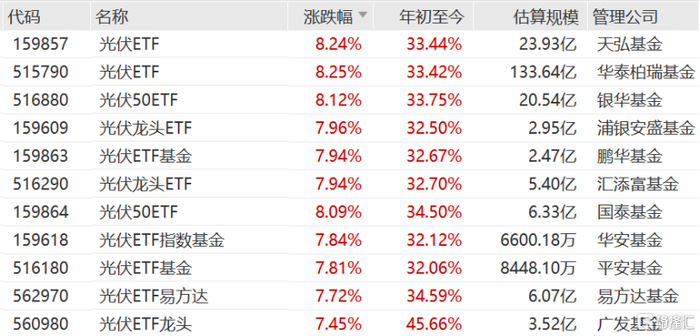
光伏产业链午后爆发!阳光电源涨超16%,隆基绿能涨停,光伏ETF、光伏50ETF涨超8%
Ge Long Hui A P P· 2025-10-29 06:07
Core Viewpoint - The photovoltaic industry chain has experienced a significant surge, with major companies and ETFs showing substantial gains, driven by positive market sentiment and strong performance indicators from key players in the sector [1][3]. Industry Summary - The global photovoltaic market is projected to maintain strong growth momentum, with expectations of new installations reaching 630 GW by 2025 and 1,078 GW by 2030, driven by the transition to low-carbon energy systems and the demand for energy security [4]. - The Chinese energy storage market is also expanding, with a reported 214.7 GWh of new overseas orders in the first nine months of 2025, marking a year-on-year increase of 131.75% [4]. - The photovoltaic industry is currently at the bottom of its cycle, with signs of significant improvement in Q3 performance across various companies, indicating a potential recovery in profitability [5][6]. Company Performance - Major companies such as Sunshine Power reported a Q3 net profit of 4.147 billion yuan, a year-on-year increase of 57.04%, while Ganfeng Lithium turned a profit in the first three quarters [3]. - Leading companies in the silicon material sector, such as GCL-Poly and Tongwei, have shown significant improvements in their Q3 financial results, indicating a recovery in the industry [5]. - The price of photovoltaic components has started to rebound, with leading integrated component manufacturers expected to benefit first from this upward cycle [6].

电池板块领涨,储能电池ETF(159566)、新能源ETF易方达(516090)等助力布局板块龙头
Mei Ri Jing Ji Xin Wen· 2025-10-29 05:11
Core Viewpoint - The new energy sector, including batteries and energy storage, is experiencing significant growth, driven by favorable policies and market conditions outlined in the recently released "14th Five-Year Plan" [1] Group 1: Market Performance - The China Securities New Energy Index rose by 3.3% - The National Securities New Energy Battery Index increased by 3.0% - The China Securities Photovoltaic Industry Index saw a rise of 4.0% - The China Securities Shanghai Environmental Exchange Carbon Neutrality Index grew by 2.1% [1] Group 2: Policy Impact - The "14th Five-Year Plan" emphasizes the development of new energy storage and the establishment of market and pricing mechanisms suitable for the new energy system [1] - Analysts suggest that the top-level design will lead to a turning point for the energy storage industry, enhancing the necessity for storage solutions as electricity prices decrease due to the full market entry of new energy [1] Group 3: Industry Growth Potential - New profit models such as capacity pricing and peak-valley arbitrage are expected to significantly improve the profitability of energy storage projects - The industry is anticipated to enter a period of rapid growth in demand [1]
储能电池ETF(159566)标的指数涨超3%,“十五五”规划建议强调大力发展新型储能
Mei Ri Jing Ji Xin Wen· 2025-10-29 02:54
Core Viewpoint - The new energy sector has seen a significant surge, particularly in battery, energy storage, and smart grid concept stocks, driven by the recent release of the "14th Five-Year Plan" which emphasizes the development of new energy storage systems [1] Group 1: Market Performance - The Guozheng New Energy Battery Index rose by 3.1% as of 10:10 AM, with key stocks such as Keli Yuan and State Grid Yingda hitting the daily limit, Jinpan Technology increasing over 10%, and Sunshine Power rising over 8% [1] - The recent focus on energy storage has led to increased market attention on the energy storage battery ETF (159566), which has seen net inflows for four consecutive trading days [1] Group 2: Industry Trends - The demand for energy storage is significantly increasing due to the growing energy consumption from new energy and AI technologies [1] - The new energy market's entry into trading has resulted in lower electricity prices, enhancing the necessity for energy storage solutions [1] - New profit models such as capacity pricing and peak-valley arbitrage are improving the profitability of energy storage projects, indicating a period of rapid growth in industry demand [1] Group 3: Investment Opportunities - The Guozheng New Energy Battery Index focuses on the core segments of the energy storage industry, with energy storage systems accounting for approximately 65% of the index [1] - Companies within the index are expected to benefit from the growth opportunities arising from increased energy storage demand [1]
广发证券:价格机制加快理顺 甘肃新型储能增长动能强劲
Zhi Tong Cai Jing· 2025-10-29 02:18
Core Viewpoint - Gansu Province is projected to have a power generation capacity exceeding 90 million kilowatts by the end of 2024, with renewable energy accounting for over 60% of this capacity [1][2]. Gansu's Power Status - Gansu is a typical power-exporting province, with the current power export ratio reaching 28.0% [2]. - The province has a significant scale of new energy storage installations, ranking fifth nationally, and has begun to implement market-oriented operations in the electricity spot market and ancillary services [2]. Energy Storage Cost and Revenue - The levelized cost of storage (LCOS) for lithium battery storage in Gansu is calculated to be 0.29 yuan per kilowatt-hour, based on an average of daily charge and discharge cycles [3]. - Revenue from energy storage is derived from multiple sources, including spot market price differences, ancillary services, and capacity pricing [4]. - Spot market price difference is expected to expand rapidly, reaching 0.27 yuan per kilowatt-hour by 2025 [4]. - The average annual frequency regulation income for a typical 100MW storage station is estimated at 1.7 million yuan, with total ancillary service revenue projected at 120 million yuan in 2024 [4]. - Capacity pricing is set at 38.5 yuan per kilowatt-hour per year, with a competitive mechanism introduced to enhance efficiency [4]. Investment Outlook - Gansu's energy storage sector is expected to see a significant increase in demand, with projections indicating a 60% growth rate, reaching 12GWh by 2026 [5]. - The internal rate of return (IRR) for capital in Gansu's energy storage projects is estimated at 9.9% [5]. - The province's energy storage stations are anticipated to yield improved profitability, benefiting the entire energy storage industry chain [6]. - Recommended leading companies in the energy storage battery and materials sector include CATL, EVE Energy, Hunan YN, and Fulin Precision [6]. - Companies with operational advantages in energy storage are expected to achieve higher returns and market share, with recommendations for Haibo Sichuang, State Grid Technology, Sungrow Power, and Canadian Solar [6]. - The ability to trade electricity is becoming a core technical barrier for energy storage station operations, with a recommendation for Guoneng Rixin [7].

昇辉科技2025年前三季度扣非净利润同比增长51.15%
Zheng Quan Ri Bao Wang· 2025-10-28 13:48
Core Insights - Shenghui Intelligent Technology Co., Ltd. reported a revenue of 637 million yuan for the first three quarters of 2025, with a net profit attributable to shareholders of 26.576 million yuan, marking a year-on-year increase of 51.15% [1] Financial Performance - The company achieved an operating income of 637 million yuan in the first three quarters of 2025 [1] - The net profit, excluding non-recurring gains and losses, was 26.576 million yuan, reflecting a growth of 51.15% compared to the previous year [1] Acquisition Progress - Shenghui Technology announced the progress of its acquisition of Hep Energy Environmental Technology Co., Ltd., indicating that the transaction's timeline has been delayed [1] - The company stated that it will not be able to issue a notice for a shareholders' meeting within six months following the board resolution announcement due to the slower-than-expected progress [1] - The acquisition aims to integrate quality assets and expand Shenghui Technology's business into the field of flexible transformation of thermal power, enhancing its competitiveness and overall profitability in the new energy storage sector [1]

华安电新,张志邦:国内储能涨价传导顺畅,海外大储订单稳中向好
Huaan Securities· 2025-10-28 11:25
Demand Side - Domestic energy storage installation in 2025 reached 2.84 GW and 8.19 GWh, with a bidding scale of 11.7 GW and 42.6 GWh in September, showing a year-on-year increase of 161%[5][19] - India's energy storage installation is expected to exceed 1.7 GWh for the entire year, with a bidding capacity of 43.28 GWh for standalone storage projects[5][37] - Germany's energy storage installation in August was 346 MWh, with a year-on-year decrease of 17.7%[5] Supply Side - The average bidding price for 2-hour and 4-hour energy storage systems in September 2025 was 0.641 and 0.464 CNY/Wh, respectively, representing a month-on-month increase of 31% and 8%[4] - The average EPC price for 2-hour and 4-hour energy storage systems was 1.062 and 0.904 CNY/Wh[4] - The cumulative bidding scale for domestic energy storage from January to September 2025 reached 91.6 GW and 342.6 GWh, surpassing the total for 2024[19] Market Trends - The average storage duration in China is expected to reach 3 hours by 2026, with the current average at 2.15 hours in 2023 and 2.39 hours in 2024[13] - The independent energy storage projects are rapidly increasing, with over 85% of the bidding volume post-531 policy being independent storage[23] - The 2027 target for new energy storage installations in China is set at 180 GW, with a current gap of approximately 110 GW[25]
2025 年储能市场热度不减:特斯拉、宁德时代、阳光电源披露储能出货数据
鑫椤储能· 2025-10-27 07:51
Core Viewpoint - The global new energy storage market is experiencing significant growth in 2025, driven by domestic and international demand, with strong performance in China's grid-connected projects, global shipment volumes, and leading companies' financial results [1]. Group 1: Global and Chinese Market - In the first three quarters of 2025, China saw 713 new energy storage projects connected to the grid, with a total capacity of 32.737 GW (84.922 GWh); Q3 alone added 11.337 GW (31.122 GWh), indicating robust growth [2]. - Global shipments in Q3 reached 165-180 GWh for energy storage batteries and 90-105 GWh for energy storage systems, further confirming the industry's high activity level [2]. Group 2: Performance of Leading Companies - **Tesla**: In Q3, Tesla installed 12.5 GWh of energy storage, achieving a gross margin of 24.4%, surpassing its automotive business. Energy and storage revenue reached $3.42 billion (up 44% YoY), accounting for 12% of total revenue for the first time [3]. - **Sungrow Power Supply**: The company aims for a shipment target of 40-50 GWh, with H1 revenue at 17.802 billion yuan (up 127.78% YoY) and a gross margin of 39.92%. Q1 shipments were 12 GWh (up 470%), with 15%-20% of business from the U.S. [4]. - **CATL**: In Q3, CATL's energy storage shipments reached 36 GWh, with total shipments nearing 180 GWh. The company is ramping up production to alleviate delivery bottlenecks [5]. - **EVE Energy**: In the first three quarters, EVE's energy storage shipments were 48.41 GWh (up 35.51% YoY), exceeding its power battery shipments of 34.59 GWh (up 66.98% YoY). Q3 shipments were estimated at 19.7 GWh, with a revenue of 45.002 billion yuan (up 32.17% YoY) [7]. - **Pylon Technologies**: In Q3, Pylon's sales reached 1,078 MWh (up 156%), with sodium battery sales exceeding 100 MWh. Revenue for the first three quarters was 2.013 billion yuan (up 42.52% YoY), with Q3 net profit at 33.9397 million yuan (up 94.01% YoY) [8]. Group 3: Market Outlook - The global new energy storage market is set for high growth in 2025, with leading companies leveraging capacity, product offerings, and international expansion to maintain their competitive edge. Future industry growth will be further supported by technological innovations and capacity releases [8].






国内和海外需求共振,储能市场高景气!央企现代能源ETF(561790)冲击3连涨
Sou Hu Cai Jing· 2025-10-27 03:54
Core Insights - The Central State-Owned Enterprises Modern Energy Index has seen a strong increase of 1.70%, with notable gains from stocks such as China Xidian up 6.61% and Shanghai Electric up 6.40% [3] - The National Development and Reform Commission has released a plan aiming for a new energy storage capacity of over 180 million kilowatts by 2027, enhancing project economics through supportive policies [5] - The demand for energy storage is expected to maintain a high growth rate, with projections indicating a 30%-40% increase in global energy storage installations over the next two years [4] Group 1: Market Performance - The Central State-Owned Enterprises Modern Energy ETF (561790) has increased by 1.63%, marking a three-day consecutive rise, with a latest price of 1.25 yuan [3] - The ETF has seen a weekly cumulative increase of 2.85% as of October 24, 2025, ranking in the top third among comparable funds [3] - The ETF's trading volume reached 416.82 million yuan with a turnover rate of 9.1% [3] Group 2: Policy and Economic Outlook - The new energy storage plan outlines a target of 180 million kilowatts by 2027, with supportive measures from provinces like Henan to enhance project viability [5] - The energy storage market is experiencing robust demand, driven by new pricing policies and increased investment from social capital [4] - The lithium battery demand is projected to exceed 2700 GWh next year, with a year-on-year growth rate of over 30% [4] Group 3: Industry Composition - The top ten weighted stocks in the Central State-Owned Enterprises Modern Energy Index account for 47.72% of the index, including major players like Yangtze Power and China Nuclear Power [6] - The Central State-Owned Enterprises Modern Energy ETF closely tracks the index, which includes 50 listed companies involved in green energy and fossil energy sectors [5]