
新旧动能转换

Search documents
消费“主引擎”动能更强劲
Sou Hu Cai Jing· 2025-10-21 02:08
Core Insights - China's final consumption expenditure contributed 53.5% to economic growth in the first three quarters, an increase of 9.0 percentage points compared to the previous year, reinforcing its role as the "main engine" of economic growth [1][2] Group 1: Economic Policies and Measures - The government has implemented a series of macro policies to stimulate consumption, including the allocation of 300 billion yuan in special bonds to support the replacement of old consumer goods [2] - The "old-for-new" policy has led to significant retail growth in categories such as home appliances and communication devices, with retail sales in these sectors maintaining double-digit growth [2][3] - The domestic travel during the Mid-Autumn and National Day holidays reached 888 million trips, showcasing the resilience and vitality of China's consumer market [2] Group 2: Consumer Trends and Market Dynamics - Service consumption, particularly in leisure and travel, has shown strong performance, indicating a high enthusiasm for offline activities among consumers [3] - New consumption models, such as online shopping, have also seen substantial growth, highlighting their importance in supporting overall market expansion [3] - Upgraded consumer goods, including communication devices and home appliances, have experienced over 20% growth, reflecting a steady progression in consumer upgrading [3] Group 3: Future Outlook and Recommendations - The government aims to enhance internal growth momentum by implementing targeted measures to boost consumption, stabilize employment, and increase income channels for residents [4][5] - Suggestions include issuing consumption vouchers and organizing promotional activities to further stimulate consumer spending [5] - Long-term strategies should focus on increasing income levels for low- and middle-income groups and improving the social security system to alleviate concerns related to consumption [5]
经济结构不断调优 新旧动能有序转换——透过“三季报”看中国经济稳步前行
Ren Min Ri Bao· 2025-10-21 01:12
Core Viewpoint - The overall economic performance in the first three quarters of 2023 shows a stable growth trend, with GDP growth of 5.2% year-on-year, indicating resilience and potential in the economy despite external challenges [1][2][5]. Economic Growth - GDP in the first three quarters grew by 5.2%, accelerating by 0.2 percentage points compared to the previous year and by 0.4 percentage points compared to the same period last year, with an economic increment of 39,679 billion yuan, which is 1,368 billion yuan more than last year [2]. - In the third quarter, GDP growth was 4.8%, with a quarter-on-quarter increase of 1.1%, showing a slight recovery from the second quarter [1][9]. Employment and Prices - The average urban unemployment rate for the first three quarters was 5.2%, consistent with the first half of the year [2]. - The Consumer Price Index (CPI) slightly decreased by 0.1%, while the core CPI, excluding food and energy, rose by 0.6%, with a notable increase of 1.0% in September [2]. International Trade - The foreign trade sector demonstrated strong resilience, with the total import and export volume reaching a historical high for the same period, and a year-on-year growth of 6.0% in the third quarter [2][10]. - Foreign exchange reserves remained above 3.3 trillion USD, and the RMB exchange rate showed a stable upward trend [2]. Industrial Performance - The added value of the equipment manufacturing and high-tech manufacturing industries accounted for 35.9% and 16.7% of the total industrial added value, respectively [4]. - Key physical indicators such as industrial electricity generation and cargo turnover increased by 1.6% and 4.8%, respectively, in the first three quarters [2]. Policy Impact - The implementation of proactive macroeconomic policies has effectively stabilized the economy and supported long-term development, with consumer spending contributing 53.5% to economic growth, an increase of 9.0 percentage points from the previous year [6][9]. - Investment in equipment and tools rose by 14.0%, significantly contributing to overall investment growth [7]. Future Outlook - The economic growth in the first three quarters lays a solid foundation for achieving annual targets, with favorable conditions such as the cultivation of new productive forces and effective macroeconomic policies [10][11]. - Positive indicators, including a rising manufacturing purchasing managers' index and increased consumer activity during holidays, reflect the resilience and vitality of the economy [10].
前三季度中国GDP同比增长5.2% 经济运行保持稳中有进态势
Yang Guang Wang· 2025-10-21 01:11
Core Insights - China's GDP for the first three quarters reached 10,150.36 billion yuan, with a year-on-year growth of 5.2%, indicating a stable and resilient economic performance [1] - The contribution of final consumption expenditure to economic growth was 53.5%, an increase of 9.0 percentage points compared to the previous year, highlighting the importance of consumer demand [2] - The industrial sector showed a positive growth trend, with industrial added value increasing by 5.8% year-on-year, contributing 1.7 percentage points to economic growth [1] Economic Performance - The GDP growth rate of 5.2% is among the highest globally, positioning China as a stable and reliable driver of global economic growth [1] - The economic increment for the first three quarters was 3,967.9 billion yuan, which is 136.8 billion yuan more than the previous year [1] - The contribution of the equipment manufacturing and high-tech manufacturing sectors to industrial added value reached 35.9% and 16.7%, respectively [1] Consumer Demand - The government has allocated 300 billion yuan in special long-term bonds to support the consumption of new products through trade-in programs, significantly boosting consumer demand [2] - The number of applications for vehicle trade-ins exceeded 8.3 million by September 10, indicating strong consumer interest in upgrading to higher-quality products [2] - Retail sales of high-efficiency and smart appliances have seen rapid growth, reflecting a shift towards higher-quality consumer goods [2] Employment and Inflation - The urban unemployment rate remained stable compared to the first half of the year, indicating a steady labor market [2] - The core Consumer Price Index (CPI), excluding food and energy, rose by 0.6%, with a notable increase of 1.0% in September, suggesting effective policies to stimulate domestic demand [2] Future Outlook - There are favorable conditions to achieve the annual economic targets, emphasizing the need for effective policy implementation and the balance between short-term growth and long-term development [3] - Continued efforts are required to facilitate the smooth transition between old and new economic drivers and to deepen reforms in key areas [3]
如何评价前三季度经济运行表现?国家统计局解读
Sou Hu Cai Jing· 2025-10-20 23:57
Core Viewpoint - The article emphasizes the steady progress of China's economy as reflected in the third quarter reports, highlighting a GDP growth of 5.2% year-on-year and a resilient economic structure amid external challenges [3][4][9]. Economic Performance - In the first three quarters, GDP increased by 5.2% year-on-year, with a total economic increment of 39,679 billion yuan, which is 1,368 billion yuan more than the previous year [4][9]. - The urban unemployment rate averaged 5.2%, remaining stable compared to the first half of the year, while the core Consumer Price Index (CPI) rose by 0.6% [4][9]. - The total import and export volume reached a historical high, with a year-on-year growth of 6.0% in the third quarter [10]. High-Quality Development - The proportion of value added from high-tech manufacturing and equipment manufacturing reached 16.7% and 35.9%, respectively, indicating a shift towards high-quality development [5]. - Non-fossil energy consumption increased by approximately 1.7 percentage points, reflecting progress in green and low-carbon transformation [5]. Economic Resilience - Despite external pressures and domestic demand challenges, China's economy grew by 5.2%, showcasing its resilience compared to other major economies [5][10]. - The manufacturing sector showed signs of recovery, with the Purchasing Managers' Index (PMI) indicating improved supplier delivery times [8][10]. Policy Impact - The implementation of proactive macroeconomic policies has stabilized the economy and provided support for long-term growth [6][11]. - A total of 300 billion yuan in special bonds were allocated to stimulate consumer demand, contributing to a 53.5% growth rate in final consumption expenditure [7]. Future Outlook - The third quarter's GDP growth of 4.8% remains higher than most major economies, with favorable conditions for achieving annual targets [9][10]. - Positive indicators, such as rising industrial product prices and increased consumer activity during holidays, suggest ongoing economic vitality [10].

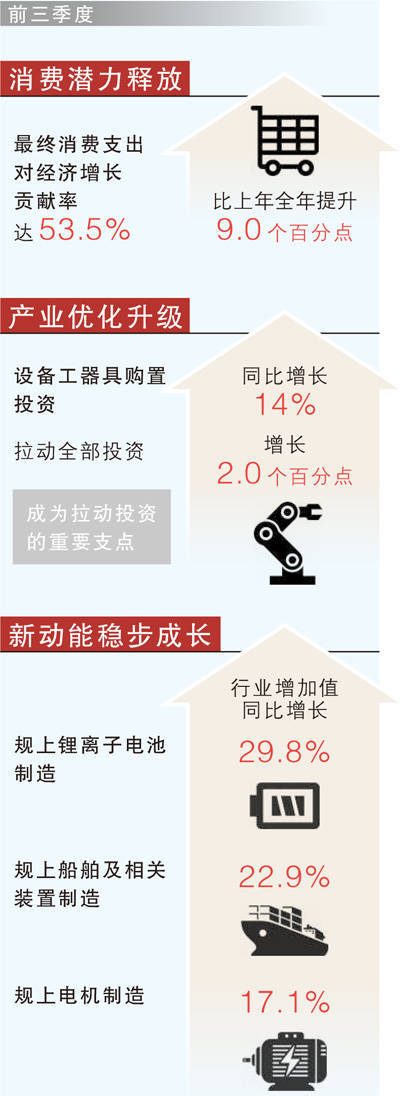
经济结构不断调优 新旧动能有序转换 透过“三季报”看中国经济稳步前行(经济新方位)
Ren Min Ri Bao· 2025-10-20 21:57
Core Viewpoint - The overall economic performance in the first three quarters of 2023 shows a stable growth trend, with GDP growth of 5.2% year-on-year, indicating resilience and progress despite external challenges [2][5][10]. Economic Growth - The GDP for the first three quarters increased by 5.2% year-on-year, with a total economic increment of 39,679 billion yuan, which is 1,368 billion yuan more than the previous year [2][9]. - In the third quarter, GDP growth was 4.8% year-on-year, with a quarter-on-quarter increase of 1.1%, reflecting a slight recovery from the second quarter [1][9]. Employment and Prices - The average urban unemployment rate for the first three quarters remained stable at 5.2%, consistent with the first half of the year [2][10]. - The Consumer Price Index (CPI) saw a slight decrease of 0.1% year-on-year, while the core CPI, excluding food and energy, increased by 0.6% [2][10]. International Trade - The external trade demonstrated strong resilience, with the total import and export volume reaching a historical high for the same period, and a year-on-year growth of 6.0% in the third quarter [2][10]. - Foreign exchange reserves remained above 3.3 trillion USD, with a stable appreciation of the RMB [2][10]. Industrial Performance - The added value of the equipment manufacturing and high-tech manufacturing industries accounted for 35.9% and 16.7% of the total industrial added value, respectively [4]. - Key physical indicators showed stable growth, with industrial electricity generation increasing by 1.6% year-on-year [2][4]. Policy Impact - The proactive macroeconomic policies have effectively supported economic stability and long-term growth, with a contribution rate of final consumption expenditure to economic growth reaching 53.5%, an increase of 9.0 percentage points from the previous year [6][9]. - Investment in equipment and tools rose by 14.0% year-on-year, significantly contributing to overall investment growth [6][7]. Future Outlook - The economic growth in the first three quarters lays a solid foundation for achieving annual targets, with new productive forces expected to create new growth points [10][11]. - Positive indicators, such as the manufacturing purchasing managers' index (PMI) showing continuous recovery, suggest ongoing economic resilience and vitality [10][11].
“向新逐绿”势能足 前三季度锂电产业增加值同比增近三成
Zhong Guo Zheng Quan Bao· 2025-10-20 20:11
Group 1: Industry Growth and Performance - The manufacturing value added in lithium-ion battery manufacturing, shipbuilding, and electric motor manufacturing increased by 29.8%, 22.9%, and 17.1% year-on-year in the first three quarters of this year, indicating strong growth in the new energy sector in China [1] - The production and sales of power and other batteries in China reached 1121.9 GWh and 1067.2 GWh respectively, with year-on-year growth of 51.4% and 55.8% [2] - CATL reported a revenue of 283.07 billion yuan and a net profit of 49.03 billion yuan for the first three quarters, representing a year-on-year increase of 9.28% and 36.20% respectively [2] Group 2: Market Demand and Future Outlook - The demand for lithium batteries is expected to grow significantly next year, with CATL's Secretary predicting high growth in both power and energy storage markets [4] - The trend towards larger battery capacities for electric vehicles is anticipated to continue, driven by user preferences for longer ranges [4] - CATL is expanding its production capacity significantly across multiple domestic bases, with plans for over 100 GWh of new energy storage capacity in Shandong alone by 2026 [4] Group 3: Technological Advancements and Product Development - New products and technologies are emerging in the lithium battery sector, with liquid lithium batteries remaining the mainstream product and solid-state batteries being a future focus [6] - Companies are increasingly collaborating to expand their business, as seen in the strategic partnership between CATL and Li Auto to enhance battery technology and global reach [7] - Guoxuan High-Tech is entering the small power battery market, aiming to capitalize on the growing demand for lithium batteries in electric two-wheelers [7]

“稳、进、韧”前三季度中国经济顶压前行
Shang Hai Zheng Quan Bao· 2025-10-20 18:13
Group 1 - The core viewpoint of the articles highlights the resilience of China's economy amid global challenges, with a focus on the positive impact of service consumption and government policies on economic growth [1][3][4] - In the first three quarters, the total retail sales of consumer goods increased by 4.5% year-on-year, while service retail sales grew by 5.2%, indicating a faster growth rate in the service sector [1] - The contribution rate of final consumption expenditure to economic growth reached 53.5%, an increase of 9.0 percentage points compared to the previous year, reinforcing its role as the main engine of economic growth [3] Group 2 - The government has implemented several policies to stimulate consumption, including the issuance of 300 billion yuan in special bonds to support the replacement of old consumer goods, which has shown positive effects [1][2] - The manufacturing purchasing managers' index has shown signs of recovery, and key industrial product prices have been rising, which is beneficial for improving corporate profitability [4] - The macroeconomic policies are expected to enhance the stability of economic growth, with a focus on structural monetary policy tools and support for high-tech industries [4][5]
上市企业营收亮眼,14家新面孔上榜!佛山企业百强榜发布
Nan Fang Du Shi Bao· 2025-10-20 12:48
Core Insights - The 10th re-election meeting of the Foshan Enterprise Association and the Foshan Entrepreneurs Association was held on October 18, where the "2025 Foshan Key Enterprises Development Report" was released, highlighting the resilience and vitality of Foshan's manufacturing sector despite slight revenue declines [1][5]. Group 1: Company Performance - A total of 144 companies were included in the "Foshan Top 100 Enterprises" list, with 14 new entrants this year [3][5]. - Notable performers include Foshan Ge Yan Metal Co., Ltd. and Guangdong Fuhua Machinery Equipment Manufacturing Co., Ltd., both of which rose over 20 positions compared to last year [4]. - Eight companies, including Foshan Cheng'an Group Co., Ltd. and Igor Electric Co., Ltd., improved their rankings by more than 10 positions [4]. Group 2: Manufacturing Sector Growth - The total revenue of the 144 companies reached 1,771.66 billion yuan, showing a slight year-on-year decline, while the revenue of the "Foshan Top 100 Enterprises" and "Manufacturing Top 100" both increased, indicating strong resilience [5]. - The manufacturing sector remains a core pillar of Foshan's economy, with 57 manufacturing companies in the top 100, accounting for 63.03% of total revenue [5][6]. Group 3: Industry Distribution - The electrical machinery and equipment manufacturing sector is a significant contributor, with 18 companies generating 52.51% of total revenue, amounting to 604.71 billion yuan, reflecting a year-on-year increase of 40.67 billion yuan [6]. - The manufacturing sector is characterized by a clear trend of "new and old kinetic energy conversion" [6]. Group 4: Innovation and Standards - The total added value of the 144 companies was 290.91 billion yuan, equivalent to 21.77% of Foshan's GDP for 2024 [7]. - Research and development investment among the top companies reached 38.66 billion yuan, representing 2.81% of total revenue, with manufacturing companies investing 36.61 billion yuan, or 3.44% of their revenue [7]. Group 5: Regional Performance - Shunde District leads with 33 companies in the top 100, generating 857.23 billion yuan in revenue, which is 51.36% of the total, an increase of 2.48% from the previous year [8]. - Nanhai District has 42 companies, maintaining its position with 490.36 billion yuan in revenue, accounting for 29.38% of the total, a decrease of 2.24% [8]. Group 6: Listed Companies - Among the 144 companies, there are 46 broadly defined listed companies, which include 37 listed companies and their subsidiaries [11]. - The 32 broadly defined listed companies in the "2025 Foshan Top 100 Enterprises" generated 910.29 billion yuan, making up 54.55% of the total revenue of the top 100 [13].



粤开宏观:三季度经济增速为何放缓?四季度经济前景如何?
Yuekai Securities· 2025-10-20 12:40
Economic Growth Overview - In Q1 and Q2 of 2025, China's GDP grew by 5.4% and 5.2% year-on-year, respectively, but slowed to 4.8% in Q3, resulting in a cumulative growth of 5.2% for the first three quarters[1] - The nominal GDP growth for Q3 was 3.7%, with a cumulative nominal GDP growth of 4.1% for the first three quarters[10] Reasons for Q3 Slowdown - The slowdown is attributed to reduced macro policy support in the second half of the year, with a decrease in funding from 162 billion yuan in Q1 to 138 billion yuan in Q3 for consumption incentives[11] - The effectiveness of certain policies, such as the trade-in program for durable goods, has diminished, leading to a decline in retail sales growth from 5.1% in H1 to 3.0% in September[11] - There is a lack of internal growth momentum, with the average consumption propensity dropping from 68.6% in Q2 to 68.1% in Q3[11] Positive Economic Indicators - Industrial capacity utilization has stabilized, with the Producer Price Index (PPI) showing a year-on-year improvement, and profits for large industrial enterprises turning positive[14] - Exports remained resilient, with a year-on-year growth of 8.3% in September, supported by diversified markets and competitive pricing[15] - High-tech industries saw a 9.6% increase in production value, with significant growth in sectors like integrated circuits and industrial robots[16] Q4 Economic Outlook - The economic performance in Q4 will depend on the introduction of new policies, with a potential GDP growth of 4.8% if policies are strengthened, or a decline to 4.6% if current trends continue[23] - Achieving the annual growth target of around 5% is considered highly likely, with projections estimating a final growth rate of 5.0% to 5.1%[23] Policy Recommendations - It is suggested to increase fiscal policy efforts, with a recommendation for the 2026 fiscal deficit to be no less than 4%[24] - Monetary policy should leverage the Federal Reserve's rate cuts to further reduce reserve requirements and interest rates[27] - A comprehensive approach to real estate policy is recommended to stabilize the market, including the establishment of a "Real Estate Stability Fund" of approximately 2 trillion yuan[29]
“粮食安全看山东”之肥城—山东福宽生物:玉米精深加工的国企标杆与创新领航者
Zhong Guo Fa Zhan Wang· 2025-10-20 12:30
Core Viewpoint - Shandong Fukuan Biological Engineering Co., Ltd. has established itself as a leading player in the corn deep processing industry, focusing on technological innovation and comprehensive supply chain management to enhance food security and drive industrial upgrades [1][5]. Group 1: Company Overview - Founded in March 2004, the company is a wholly-owned state enterprise under Beijing Shou Nong Food Group, with a registered capital of 450.88 million yuan [1]. - The company processes 1.1 million tons of corn annually, producing 700,000 tons of starch, 200,000 tons of fructose syrup, and 150,000 tons of maltose syrup, achieving an annual output value of 5 billion yuan [1]. - In 2023, the company ranked 269th in the "Top 500 Agricultural Enterprises in China" [1]. Group 2: Supply Chain and Storage - The company has developed a dual security system of "transparent storage + intelligent warehousing" to ensure raw material supply [2]. - It operates a 14,000 square meter raw material warehouse, a 12,000 square meter finished product warehouse, and a 6,000 square meter cold storage facility, with plans for a modern storage matrix covering 102.5 acres [2]. - Advanced equipment and smart control systems are employed for precise storage management, ensuring product quality and production continuity [2]. Group 3: Innovation and Technology - The company has accumulated 37 domestic patents over nearly two decades, focusing on breakthroughs in core technologies for deep processing [3]. - A significant project in collaboration with universities has successfully overcome foreign technology monopolies in the production of rare sugars, enhancing the added value of corn by 17 times [3]. - The project is expected to capture 60% of the global export market for alulose, positioning Shandong as Asia's largest production base for this product [3]. Group 4: Product Quality and Market Position - Fukuan Biological has established a diverse product system, including traditional deep processing products and high-end functional sugars, capturing over 15% of the domestic functional sugar market [4]. - All products meet multiple quality and safety certifications, including ISO9001 and ISO22000, ensuring high standards of food safety [4]. - The company has received numerous accolades, including being recognized as a "National Key Leading Enterprise in Agricultural Industrialization" in 2025 [4]. Group 5: Future Outlook - The company aims to continue its commitment to green, efficient, innovative, and win-win development, contributing to the transformation of old and new kinetic energy in Shandong and enhancing national food security [5].