消费市场复苏

Search documents
春节消费旺季大幕拉开,各地促消费政策密集出台,为全年消费市场"开门红"注入强劲动力
Mei Ri Jing Ji Xin Wen· 2026-02-05 05:59
Group 1 - Yum China reported a strong performance for the full year 2025, achieving an operating profit of $1.3 billion, representing an 11% year-on-year growth [1] - The company opened 1,706 new stores in 2025, expanding its network to 18,101 locations across over 2,500 towns in China [1] - In Q4 2025, Yum China's operating profit saw a significant increase of 25% year-on-year, with same-store sales growing for the third consecutive quarter [1] Group 2 - The Chinese government, along with nine other organizations, has launched the "2026 Spring Festival Special Activity Plan," promoting various food-related events to stimulate consumption during the holiday season [2] - The current consumption promotion activities are characterized by strong government leadership and multi-faceted collaboration, aiming to enhance consumer potential and create a festive atmosphere [2] - The Hong Kong Stock Connect Consumption ETF closely tracks the CSI Hong Kong Stock Connect Consumption Theme Index, which includes leading companies in traditional services and high-growth assets, with a rolling P/E ratio of 17.9 and a dividend yield of 3.6% as of February 4 [2]
百胜中国涨超9%,名创优品涨超5%,港股通消费ETF、港股消费ETF、恒生消费ETF上涨
Ge Long Hui· 2026-02-05 05:42
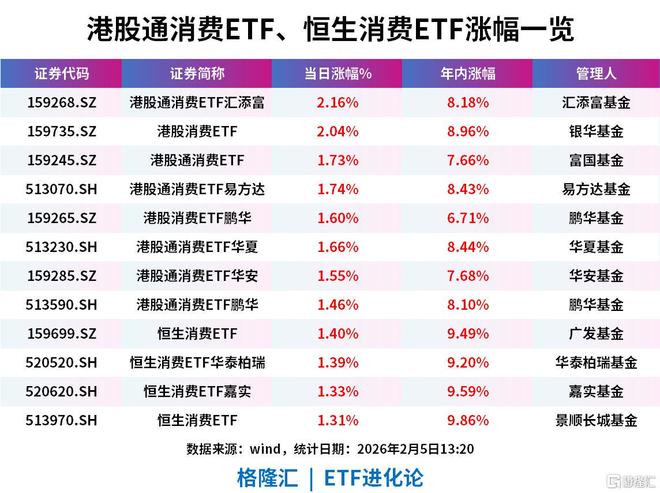
Core Viewpoint - The Hong Kong stock market's consumer stocks have seen significant gains, driven by strong performances from companies like Yum China and Miniso, which have positively influenced various consumer ETFs [1][5]. Group 1: Stock Performance - Yum China experienced a rise of over 9%, reaching a new high since October 2023, following the announcement of its strong financial results for 2025 [5]. - Miniso's stock increased by over 5% after announcing a share buyback program [6]. - Multiple consumer ETFs, including those managed by Huatai-PB, E Fund, and others, have also shown positive growth, with increases ranging from 1.31% to 2.16% on the day [2]. Group 2: Financial Highlights - Yum China's operating profit for the year reached $1.3 billion, reflecting a robust year-on-year growth of 11%, with plans to open 1,706 new stores, expanding its network to over 18,101 locations across more than 2,500 cities in China [5]. - The fourth quarter of 2025 saw a significant 25% year-on-year increase in operating profit for Yum China, with same-store sales rising for the third consecutive quarter [5]. Group 3: Market Trends and Consumer Sentiment - The upcoming Chinese New Year is expected to boost consumer spending, supported by various government-led promotional activities aimed at stimulating consumption [7]. - The integration of diverse sectors such as commerce, culture, tourism, and exhibitions is anticipated to enhance consumer engagement and spending during the festive season [7].

海欣食品(002702) - 2026年1月28日投资者关系活动记录表
2026-01-28 08:40
Group 1: New Retail Channel Development - The company has successfully entered the Sam's Club retail channel and launched customized products, enhancing brand image and product value [1] - The collaboration with new retail channels is based on a customized model, which helps avoid direct price competition and improve brand image [1] - Future plans include deepening cooperation with leading retailers and exploring more customized, high-quality product lines [1] Group 2: Market Recovery Expectations - The company observes a clear trend of consumers pursuing cost-effectiveness, with stable demand for low-priced products [2] - Overall market recovery is expected to be gradual, with the company closely monitoring changes in the dining and retail sectors to adapt product and channel strategies [2] Group 3: Core Development Plans for the Next 2-3 Years - The company’s development plans focus on four main areas: optimizing hot pot products, expanding deep processing of aquatic products, developing snack food categories, and exploring baking-related businesses [3] - The realization of these plans depends on positive progress in market and channel factors, which introduces uncertainty [3] Group 4: Cost Control and Financial Management - The increase in sales expense ratio is attributed to a contraction in revenue scale, leading to a higher expense proportion [4] - Future plans include enhancing detailed management and budget control of expenses, ensuring efficient allocation of marketing and channel investments [4] - The company aims to improve expense ratios as new channels and products gradually scale up, making cost control a continuous operational focus [4] Group 5: Product Development Challenges - The company is focusing on new product development in the hot pot category, emphasizing quality and optimizing existing products while developing exclusive new products based on channel needs [5] - Continued investment in research and development is prioritized to achieve breakthroughs in product formulation and technology, enhancing product competitiveness [5]

港股异动 | 吉宏股份(02603)盈喜后涨超8% 预期2025年度归母净利同比增长50%-60%
智通财经网· 2026-01-20 01:44
Core Viewpoint - Jihong Co., Ltd. (02603) expects significant profit growth for 2025, leading to a stock price increase of over 8% following the earnings announcement [1] Group 1: Financial Performance - The company anticipates a net profit of approximately 331 million to 349 million yuan for 2025, representing a year-on-year increase of 79.40% to 89.26% [1] - The net profit attributable to shareholders is expected to be around 273 million to 291 million yuan, reflecting a growth of 50.00% to 60.00% year-on-year [1] - The net profit after deducting non-recurring gains and losses is projected to be about 240 million to 258 million yuan, indicating a year-on-year increase of 49.98% to 61.35% [1] Group 2: Business Segments - The packaging business has seen substantial growth due to the recovery of the consumer market, which has increased packaging demand from downstream clients [2] - The company benefits from long-term strategic partnerships with leading firms in the fast-moving consumer goods sector, enhancing operational efficiency and profitability [2] - In the cross-border social e-commerce sector, the company focuses on technology-driven innovation and supply chain management, leading to significant revenue and profit growth [2]

消费热潮席卷A股!零售板块集体狂欢,这些股票开启“涨停模式”
Hua Xia Shi Bao· 2026-01-20 00:32
Core Viewpoint - The A-share consumer sector has experienced a strong rebound since the beginning of 2026, driven by continuous policy support, with retail stocks like Xinhua Department Store leading the surge [2][5]. Group 1: Retail Sector Performance - Xinhua Department Store's stock has achieved a four-day limit-up streak, closing at 20.70 yuan per share on January 19, 2026, with a year-to-date increase of 52.77%, significantly outperforming the broader market and retail sector index [3]. - Other retail stocks, such as Guangbai Co., Sanjiang Shopping, and Maoye Commercial, have also shown significant gains in January, with increases of 27.81%, 18.49%, and 18.21% respectively [5]. - The trading activity for Xinhua Department Store has been notable, with turnover rates reaching as high as 22.45% on January 16, indicating high market interest and trading volume [3]. Group 2: Company Fundamentals - Xinhua Department Store, as the largest retail enterprise in Ningxia, has a diverse business model that includes retail, logistics, and commercial property leasing, contributing to its strong market presence [4]. - The company's revenue has shown steady growth, with figures of 58.83 billion yuan in 2022, 60.65 billion yuan in 2023, and projected revenues of 61.16 billion yuan for 2024 [4]. Group 3: Policy Support - The central government's economic work conference has prioritized domestic demand and the construction of a strong domestic market as key tasks for 2026, which is expected to boost the consumer market [7]. - Specific policies, such as large-scale equipment updates and consumer goods replacement programs, have been implemented to stimulate consumption, providing a strong impetus for the retail sector [7][8]. - Additional supportive measures include financial policies aimed at enhancing consumer capacity and promoting service sector growth, further solidifying the foundation for consumer market recovery [8].


吉宏股份发盈喜 预期2025年归母净利约2.73亿-2.91亿元,同比增长50%—60%
Zhi Tong Cai Jing· 2026-01-19 10:56
Core Viewpoint - The company expects to achieve a net profit of approximately 331 million to 349 million yuan in 2025, representing a year-on-year growth of 79.40% to 89.26% [1] Financial Performance - The net profit attributable to shareholders is projected to be around 273 million to 291 million yuan, reflecting a year-on-year increase of 50.00% to 60.00% [1] - The net profit after deducting non-recurring gains and losses is estimated to be between 240 million to 258 million yuan, indicating a year-on-year growth of 49.98% to 61.35% [1] Business Growth Drivers - Packaging Business: The continuous recovery of the consumer market has led to a steady increase in packaging demand from downstream clients. The company benefits from long-term strategic partnerships with leading enterprises in the fast-moving consumer goods sector, enhancing operational efficiency and significantly improving profitability [1] - Cross-Border Social E-commerce: The company emphasizes technology-driven innovation and continuously improves its supply chain management system. It maintains a high level of digital operational capability while expanding sales regions and replicating business models, resulting in substantial growth in revenue and profit, further boosting overall performance [1]
吉宏股份:2025年净利润同比预增50%至60%
Zheng Quan Shi Bao Wang· 2026-01-19 10:35
Core Viewpoint - Jihong Co., Ltd. (002803) expects a net profit attributable to shareholders of 273 million to 291 million yuan for 2025, representing a year-on-year growth of 50% to 60% [1] Group 1: Packaging Business - The recovery of the consumer market has led to a steady increase in packaging demand from downstream customers [1] - Group-level refined management has improved operational and resource utilization efficiency, significantly enhancing profitability [1] Group 2: Cross-Border E-Commerce Business - The company continues to drive growth through technology, enhancing its supply chain management system [1] - High-level digital operational capabilities have been maintained, with ongoing expansion of sales regions and replication of business models [1] - Revenue scale and profits have seen substantial growth, further boosting the overall performance of the company [1]
吉宏股份(002803.SZ):预计2025年净利润同比增长50%—60%
Ge Long Hui A P P· 2026-01-19 10:35
Core Viewpoint - The company, Jihong Co., Ltd. (002803.SZ), expects a significant increase in net profit for 2025, projecting a growth of 50.00% to 60.00% compared to the previous year, driven by strong performance in its packaging and cross-border e-commerce businesses [1]. Group 1: Financial Projections - The estimated net profit attributable to shareholders for 2025 is between 272.90 million and 291.09 million yuan [1]. - The net profit after deducting non-recurring gains and losses is projected to be between 239.90 million and 258.09 million yuan, reflecting a growth of 49.98% to 61.35% year-on-year [1]. Group 2: Packaging Business - The recovery of the consumer market has led to a steady increase in packaging demand from downstream clients [1]. - The company benefits from long-term strategic partnerships with leading enterprises in the fast-moving consumer goods sector, enhancing operational efficiency and profitability through refined group management [1]. Group 3: Cross-Border E-Commerce Business - The company emphasizes technology-driven innovation and continuously improves its supply chain management system [1]. - There is a significant increase in revenue scale and profit due to the expansion of sales regions and replication of business models, contributing to the overall performance enhancement of the company [1].
吉宏股份:预计2025年净利润同比增长79.40%—89.26%
Xin Lang Cai Jing· 2026-01-19 10:04
Core Viewpoint - The company expects a net profit of 331 million to 349 million yuan for the year 2025, representing a year-on-year growth of 79.40% to 89.26% [1] Group 1: Business Performance - The company has achieved significant growth in both revenue and profit during the reporting period [1] - The packaging business has benefited from the continuous recovery of the consumer market, leading to a steady increase in packaging demand from downstream customers [1] - The company has established long-term strategic partnerships with leading enterprises in the fast-moving consumer goods sector, enhancing operational efficiency and profitability through group management [1] Group 2: Cross-Border E-commerce - The company emphasizes technology-driven innovation and continuously improves its supply chain management system [1] - High levels of digital operational capability have been maintained, contributing to substantial growth in revenue and profit [1] - The company is deepening its sales area expansion and replicating its business model, further enhancing overall performance [1]
烟火气升腾 消费潮涌动
Xin Lang Cai Jing· 2026-01-04 19:01
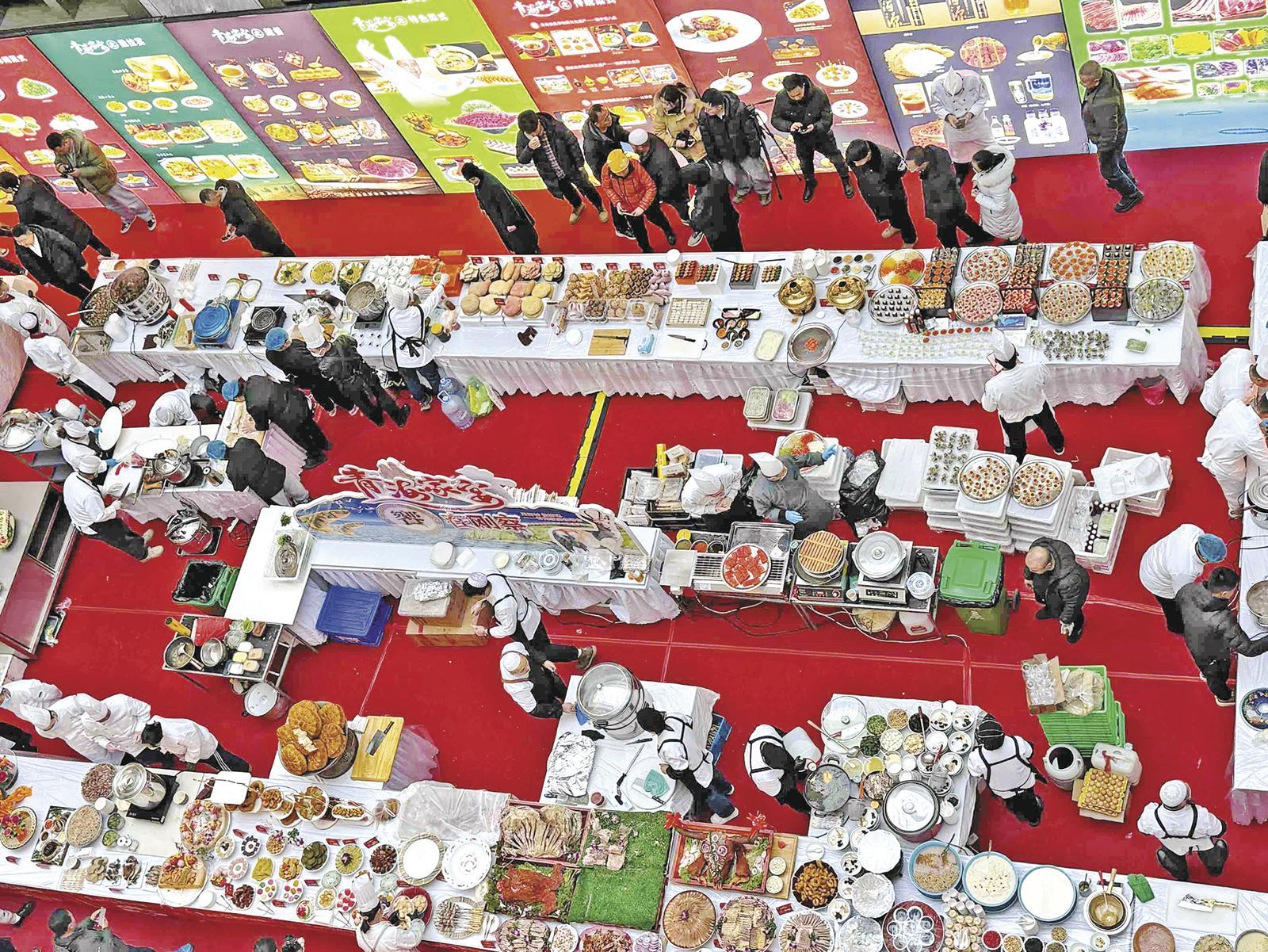
Core Viewpoint - The consumption market in Qinghai Province is experiencing a significant revival during the New Year period, driven by coordinated promotional activities and government policies aimed at stimulating consumer spending [5][9][12]. Group 1: Consumption Activities - Various promotional activities have been organized across the province, including the "2026 Qinghai Consumption Promotion Activities Plan," which aims to enhance consumer engagement during key holiday periods [5][8]. - Notable events include "Qinghai Family Feast" and "2026 Qinghai Online New Year Goods Festival," which are designed to attract consumers and stimulate spending [5][8]. - Local governments are leveraging their unique resources to create diverse consumption scenarios, resulting in a province-wide consumption promotion pattern [8][9]. Group 2: Commercial Highlights - Major shopping centers in Xining are hosting innovative events, such as "Starry New Year's Eve" and "潮燃城东," which have attracted large crowds and boosted sales [10][11]. - During the New Year period, key commercial enterprises in Xining reported a sales revenue of 23.38 million yuan, marking a year-on-year increase of 5.62% [12]. Group 3: Policy Support - The implementation of the 2026 consumption upgrade program, which includes subsidies for replacing old appliances and vehicles, has been a crucial factor in driving consumer spending [13]. - The program has seen participation from over 200 automotive and 1,243 home appliance retailers, with daily subsidies being allocated to encourage purchases [13]. - Monitoring data indicates that supply channels for agricultural products and supermarkets remain stable, ensuring adequate inventory and pricing during the holiday season [13].