
港股通

Search documents
智通港股通活跃成交|5月19日
智通财经网· 2025-05-19 11:04
深港通(南向)十大活跃成交公司 | 公司名称 | 成交金额 | 净买入额 | | --- | --- | --- | | 阿里巴巴-W(09988) | 43.40 亿元 | -9.89 亿元 | | 小米集团-W(01810) | 33.93 亿元 | -6092.60 万元 | | 腾讯控股(00700) | 20.48 亿元 | +1.48 亿元 | | 美团-W(03690) | 9.80 亿元 | -1.48 亿元 | | 盈富基金(02800) | 8.04 亿元 | +7.97 亿元 | | 中芯国际(00981) | 7.94 亿元 | +1.61 亿元 | | 泡泡玛特(09992) | 7.06 亿元 | +2.89 亿元 | | 三生制药(01530) | 6.92 亿元 | +1.05 亿元 | | 中国海洋石油(00883) | 4.15 亿元 | -6902.30 万元 | | 华虹半导体(01347) | 4.05 亿元 | +1.38 亿元 | 智通财经APP获悉,2025年5月19日当天,阿里巴巴-W(09988)、小米集团-W(01810)、腾讯控股(00700) 位居沪港 ...






南向资金今日大幅净买入84.59亿元。港股通(沪)方面,阿里巴巴-W、建设银行分别获净买入14.37亿港元、8.62亿港元;腾讯控股净卖出额居首,金额为6.2亿港元;港股通(深)方面,盈富基金、泡泡玛特分别获净买入7.97亿港元、2.89亿港元;阿里巴巴-W净卖出额居首,金额为9.89亿港元。
news flash· 2025-05-19 09:33
Group 1 - Southbound funds had a significant net purchase of 8.459 billion yuan today [1] - In the Hong Kong Stock Connect (Shanghai), Alibaba-W and China Construction Bank received net purchases of 1.437 billion HKD and 0.862 billion HKD respectively [1] - Tencent Holdings had the highest net sell amount at 0.62 billion HKD [1] Group 2 - In the Hong Kong Stock Connect (Shenzhen), the Yingfu Fund and Pop Mart received net purchases of 0.797 billion HKD and 0.289 billion HKD respectively [1] - Alibaba-W had the highest net sell amount in this segment, totaling 0.989 billion HKD [1]

异动盘点0519|布鲁可、卫龙、蜜雪大涨;光伏走低、物流股拉升;周五QUBT涨超39%,CRWV涨超22%
贝塔投资智库· 2025-05-19 04:17
Group 1: Hong Kong Stock Market Highlights - Midea Group opened up 2% against the market trend after being included in the Hang Seng Index [1] - Yuan Da Pharmaceutical opened over 3% higher, with its first "zero radiation" nuclear medicine factory set to commence production in June [1] - Bruker surged over 6% after being added to the Hang Seng Composite Index, with institutions stating it meets the criteria for inclusion in the Hong Kong Stock Connect [1] - Xuanwu Cloud rose over 22% following a strategic partnership with Tencent Cloud, focusing on AI-driven retail and cloud communication growth [1] - Mixue gained over 5% after being included in the Hang Seng Composite Index, with expectations of being added to the Hong Kong Stock Connect next month [1] - Konnate Optical increased nearly 3% as it plans to invest $4 million in establishing a resin lens production line in Japan [1] - Solar stocks declined, with Q1 solar product exports dropping over 30%, indicating potential pressure on the industry chain [1] - Weilang Delicious rose over 5% after completing a placement that raised over HKD 1.1 billion, with CICC noting the scale of the placement is relatively controllable [1] - Logistics stocks continued to rise, with notable increases in shares of Guangdong-Hong Kong-Macau Holdings, Guangdong Transportation, Kerry Logistics, and ZTO Express [1] Group 2: US Stock Market Highlights - Pony.ai surged nearly 14%, with expectations of achieving positive gross margins for complete vehicles this year [2] - Walmart increased nearly 2% as the company plans to raise prices on certain products in the US [2] - QUBT rose over 39% after turning profitable in Q1 [2] - CoreWeave jumped over 22%, with NVIDIA holding a 7% stake [2] - Bilibili increased over 2%, with Goldman Sachs projecting a 71% year-on-year growth in gaming revenue for Q1 [2] - Hesai Technologies rose over 6% at one point, closing nearly 2% higher amid rumors of a secret application for a Hong Kong listing [2] - Novo Nordisk fell nearly 3% following the announcement of the CEO's departure [2] - Applied Materials (AMAT) dropped over 5% as Q2 revenue fell short of expectations, with a bleak outlook for Q3 [2]


中金:恒指及港股通一季度调整影响分析
中金点睛· 2025-05-18 23:35
点击小程序查看报告原文 2025年5月16日盘后,恒生指数公司公布了其定期的一季度指数调整结果(此次审议考察截至2025年3月31日,一般在 考察日期后的8周内公布)。此次调整范围涵盖港股主要旗舰指数如恒生、国企指数和恒生科技指数;此外直接决定港 股通可投资范围的恒生综合指数也有局部调整。我们综合分析影响供投资者参考。 指数调整及影响:美的集团与中通快递-W纳入恒指,比亚迪股份纳入恒生科技 ► 成分股变化:美的集团与中通快递-W纳入恒生指数;比亚迪股份纳入恒生科技,阅文集团被剔除。 1) 恒生指数: 此次调整纳入美的集团与中通快递-W,纳入权重分别为0.33%与0.44%,调整后成分股数量增至85只。 2) 恒 生国 企: 此次无纳入剔除,成分股数量维持50只不变。 3) 恒生科 技 : 此次调整纳入比亚迪股份,纳入权重为8%;阅文集团被剔除,剔除前权重为0.49%。成分股维持在30 只不变。 ► 被动资金流向测算:关注对网易-S、比亚迪股份与中通快递-W等的正面影响;对阅文集团与万洲国际的负面影响。 基于Bloomberg汇总,追踪恒生指数的ETF资金规模约为290.5亿美元,追踪国企和恒生科技指数ETF规 ...



港股通2024年年报分析:港股盈利企稳,科技、医药量价齐升
Shenwan Hongyuan Securities· 2025-05-14 14:16
Group 1 - The report indicates that the profitability of Hong Kong stocks is stabilizing and leading the recovery compared to A-shares, with total revenue growth of 2.4% and net profit growth of 7.4% in the 2024 annual report [3][8][9] - The report highlights that the gross profit margin TTM is 9.3% and ROE TTM is 12.4%, both showing slight improvements compared to the first half of 2024 [3][8][12] - The report notes that the capital expenditure for non-financial sectors in Hong Kong stocks is declining significantly, with a year-on-year decrease of 23.3% [29][30] Group 2 - The report states that sectors such as technology, consumption, and pharmaceuticals are experiencing simultaneous increases in both volume and price, with TMT and pharmaceutical sectors showing significant profit margin improvements [31][34][36] - The financial and real estate sectors, along with TMT, have shown revenue growth rates of 1.8%, 9.7%, and 9.0% respectively, indicating a positive trend [31][32] - The report emphasizes that the ROE for TMT, consumption, and pharmaceuticals has improved by 1.3, 1.9, and 1.5 percentage points respectively, indicating a positive contribution from both sales net profit margin and asset turnover [34][35] Group 3 - The report identifies that the computer and media sectors have shown significant fundamental improvements, while the real estate, power equipment, and coal sectors have experienced profit deterioration [42][43] - The overall net profit growth for Hong Kong stocks is recorded at 7.4%, with significant contributions from non-bank financials, media, and transportation sectors [42][43] - The report highlights that the gross profit margin TTM has improved in sectors such as media, social services, and transportation, while deteriorating in power equipment, coal, and steel sectors [45][47] Group 4 - The report points out that the industry concentration in Hong Kong stocks is notably high, with several sectors like oil and petrochemicals, retail, and media having a CR3 concentration exceeding 80% [51][53] - The report indicates that major companies such as Tencent, Meituan, and Alibaba have contributed significantly to the profit growth of their respective sectors [51][57] - The report also notes that the number of companies with improved net profit growth in the transportation and computer sectors remains significant, while retail and social service sectors lag behind [51][56]
港股新手速成课堂——港股概念梳理和框架介绍
2025-05-12 01:48
Summary of Key Points from the Conference Call Industry Overview - The conference call primarily discusses the Hong Kong stock market, particularly focusing on the differences between Hong Kong (HK) and A-share markets, the AH premium index, and the implications for investors [1][2][3]. Core Insights and Arguments - **AH Premium Index**: The Hang Seng AH Premium Index reflects price differences between companies listed in both A-shares and H-shares, with a significant weight of approximately 70% in the financial sector. This index does not fully capture the valuation differences between A-shares and H-shares [1][4][15]. - **Types of Stocks**: There are three main types of stocks in the HK market: H-shares (registered in mainland China), red-chip stocks (registered overseas but controlled by state-owned enterprises), and Chinese private enterprises (non-state-owned). Each type has different tax implications for dividends [1][5][8]. - **Dividend Tax Rates**: The dividend tax rate for H-shares is 20%, while for red-chip stocks, it is 28%. This tax difference significantly impacts investment decisions, especially for investors using the Stock Connect program [1][8][10]. - **Market Capitalization**: The total market capitalization ratio of HK to A-shares is approximately 1:2, with certain sectors like social services and media having a larger market cap in HK compared to A-shares, while sectors like agriculture and chemicals have fewer options in HK [1][16]. - **Investor Structure**: The HK market is predominantly institutional, with increasing inflows from mainland investors. This trend is expected to gradually eliminate the offshore market discount and improve overall valuation levels [3][29][32]. - **Valuation Correlation**: HK stock valuations are significantly correlated with the China-US interest rate differential. Changes in this relationship have been observed since Q4 2023, indicating a shift in the valuation framework [31][32]. Important but Overlooked Content - **Stock Connect Mechanism**: Stocks must first be included in the Hang Seng Composite Index to be eligible for the Stock Connect program. Stocks included in this program typically perform better than those excluded, although performance is influenced by market sentiment [1][19][22]. - **Performance of Stocks**: Historical data shows that stocks included in the Stock Connect program generally outperform those that are removed, but this is not guaranteed and is subject to market conditions [22]. - **Market Sentiment Indicators**: The implied equity risk premium (ERP) is used to gauge market sentiment, with current levels fluctuating between 6% and 8%. This metric is crucial for understanding the overall valuation landscape of the HK market [33][36]. - **Changes in Market Structure**: Over the past decade, there have been significant changes in both the structure of listed companies and the investor base in the HK market, with a notable increase in growth-oriented sectors and mainland capital inflows [41][42]. This summary encapsulates the essential insights and data points from the conference call, providing a comprehensive overview of the current state and dynamics of the Hong Kong stock market.

华安恒指港股通交易型开放式指数证券投资基金基金份额发售公告
Zhong Guo Zheng Quan Bao - Zhong Zheng Wang· 2025-05-09 01:04
Group 1 - The fund name is Huaan Hang Seng Index Hong Kong Stock Connect Exchange-Traded Open-Ended Index Securities Investment Fund, with a subscription code of 520943 [15] - The fund is a stock-type open-ended index fund, with an initial share value of 1.00 RMB [16] - The total fundraising target for the fund is capped at 2 billion RMB, excluding interest and subscription fees [17][18] Group 2 - The subscription period for the fund is from May 14, 2025, to May 21, 2025, with both online and offline cash subscription options available [2][27] - Investors can subscribe multiple times during the fundraising period, but the total subscription amount is subject to the 2 billion RMB limit [33] - The fund will utilize a "full proportional confirmation" method to manage subscription applications exceeding the fundraising cap [18] Group 3 - The fund's investment objective is to closely track the underlying index while minimizing tracking deviation and error [19] - The investment scope includes liquid financial instruments, primarily focusing on the underlying index constituent stocks and their alternatives, as well as other approved financial instruments [20] - The fund must invest at least 90% of its net asset value in the underlying index constituent stocks and at least 80% of its non-cash assets [20][21] Group 4 - The fund is managed by Huaan Fund Management Co., Ltd., with Guosen Securities Co., Ltd. serving as the custodian [3][57] - The fund's subscription fees will not exceed 0.80% of the subscription amount [29] - Investors must hold a valid securities account to participate in the fund's subscription [34]

“摘帽”后H股一度大涨188% 山东墨龙随即遭股东及一致行动人减持超1亿股
Mei Ri Jing Ji Xin Wen· 2025-05-08 16:39
Core Viewpoint - Shandong Molong has recently experienced a significant stock price increase following the removal of its risk warning and its re-inclusion in the Hong Kong Stock Connect program, leading to substantial share reductions by major shareholders [1][2]. Group 1: Shareholder Actions - On May 8, Shandong Molong announced that its major shareholder, Zhimo Holdings, along with its concerted parties, reduced their holdings by 107 million H-shares, accounting for 13.39% of the total share capital [1]. - After the reduction, Zhimo Holdings and its concerted parties hold a total of 44.81 million shares, representing 5.62% of the total share capital [1]. Group 2: Stock Performance - Following the announcement of the removal of the risk warning and re-entry into the Hong Kong Stock Connect, Shandong Molong's stock price surged, with H-shares increasing by approximately 15% on April 30 and May 2, and a dramatic rise of 188.51% on May 6 [2]. - The A-shares also saw a significant increase, closing at 5.27 yuan per share after consecutive trading days of hitting the upper limit [2]. Group 3: Financial Performance - In 2024, Shandong Molong reported an operating income of approximately 1.356 billion yuan, a year-on-year increase of 2.95%, while the net profit attributable to shareholders was a loss of 44 million yuan, narrowing the loss by 92.29% compared to the previous year [3]. - The sale of equity stakes in Shouguang Baolong and Weihai Baolong contributed approximately 260 million yuan to the net profit, classified as non-recurring gains [3]. - For the first quarter of 2025, the company achieved an operating income of 291 million yuan, a year-on-year growth of 50.51%, but the net profit attributable to shareholders decreased by 97.50% to 5.42 million yuan [3].
“出通”叠加业绩变脸,高视医疗(02407)拿什么拯救大幅放缓的流动性?
智通财经网· 2025-05-08 09:08
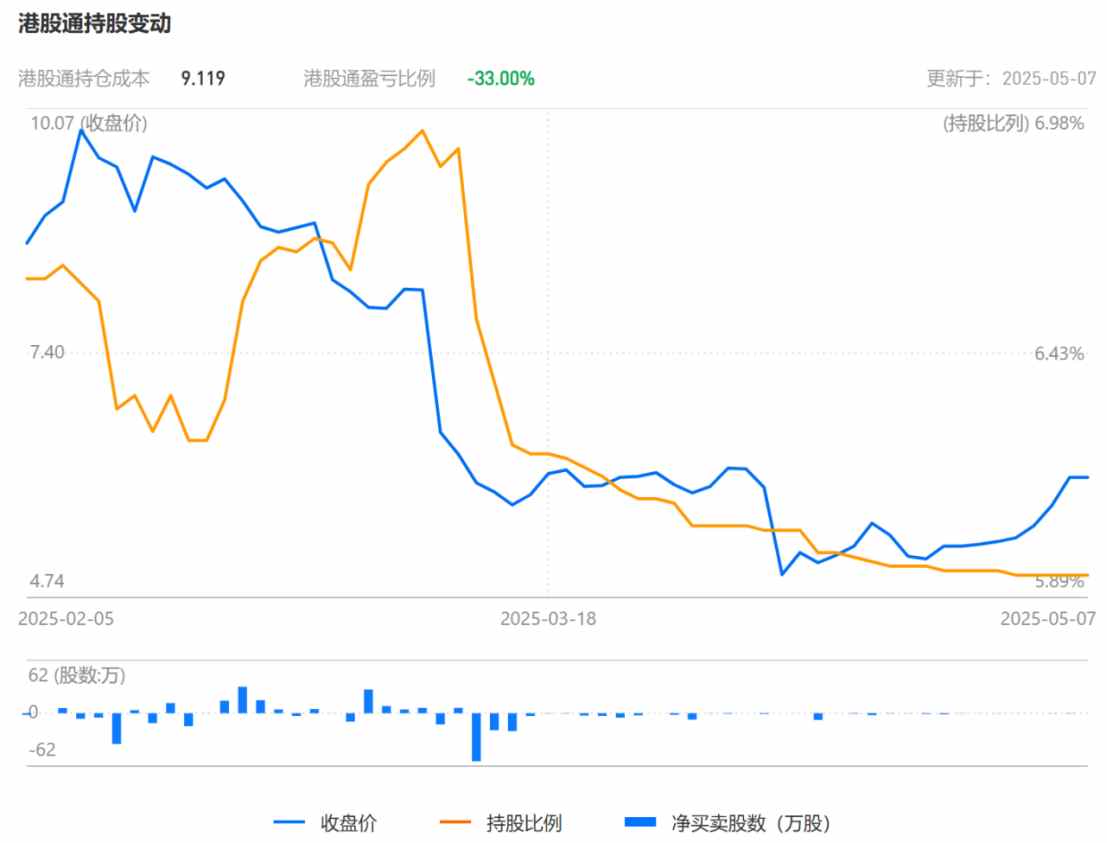
Core Viewpoint - The stock price of Gaoshi Medical (02407) experienced a significant decline of 15.99% on April 7 due to external factors, but has since begun a slow recovery, closing at HKD 6.05 on May 7, surpassing the closing price on April 6. However, the overall decline in April was 3.53%, underperforming the Hang Seng Healthcare sector, which saw a gain of 1.10% during the same period [1]. Group 1: Stock Performance and Market Context - The Hang Seng Index dropped 13.2% on April 7, marking the largest single-day decline since the Asian financial crisis, while the Hang Seng Healthcare Index fell by 19.01% [1]. - In the following 10 trading days, the Hang Seng Healthcare Index rebounded to 2978.74 points, outperforming Gaoshi Medical, attributed to active southbound capital providing liquidity [1][2]. - In April, the Hong Kong Stock Connect channel recorded a turnover of nearly HKD 2.3 trillion, accounting for 43.8% of the market's total turnover, with a net buy of over HKD 166.6 billion, setting a new monthly record [2]. Group 2: Impact of Stock Connect Removal - Gaoshi Medical's stock price recovery lagged behind the sector due to its removal from the Stock Connect, which took effect on March 10. Stocks added to the Stock Connect saw an average price increase of 0.72%, while those removed, including Gaoshi Medical, experienced an average decline of 14.24% [3]. - The average market capitalization of Gaoshi Medical during the review period was HKD 2.464 billion, falling short of the HKD 4 billion threshold by HKD 1.536 billion, leading to its exclusion from the Stock Connect [3]. Group 3: Financial Performance and Challenges - For the fiscal year 2024, Gaoshi Medical reported revenue of RMB 1.428 billion, a year-on-year increase of 1.6%, but a gross profit decline of 4.1% to RMB 663 million, with net profit attributable to shareholders dropping by 46.75% to RMB 92.394 million [8]. - The decline in profitability was attributed to factors such as exchange rate fluctuations and the implementation of national procurement policies for artificial crystals, resulting in a gross margin reduction [8]. - The company faced significant goodwill impairment due to poor performance of acquired companies, with cumulative impairments reaching RMB 23.257 million by the end of 2024 [9]. Group 4: Research and Development Investment - To enhance competitiveness, Gaoshi Medical increased its R&D expenditure by 48.29% to RMB 78.418 million in 2024, with R&D spending as a percentage of self-owned product revenue rising to 5.5% [10][11]. - Despite efforts to shift from distribution products to self-owned products, the revenue from distribution products increased to 68.55% in 2024, indicating challenges in optimizing the revenue structure [12].
纳入港股通标的 股价涨超4倍 数据看背后风险信号
Zheng Quan Shi Bao· 2025-05-07 17:55
Core Viewpoint - The recent surge in Shandong Molong's H-shares, driven by its inclusion in the Hong Kong Stock Connect and the removal of risk warnings on its A-shares, has led to a significant price increase, raising concerns about potential pullback risks after rapid gains [1][2][4]. Group 1: Stock Performance - Shandong Molong's H-shares experienced a maximum increase of 451.09% from its lowest price since April 30, with a record single-day gain of 188.51% on the day it was included in the Hong Kong Stock Connect [2][4]. - The A-shares of Shandong Molong were rebranded from "ST Molong" to "Shandong Molong" after the removal of risk warnings, leading to consecutive trading days of price limits, with over 46,430 lots of buy orders on May 7, amounting to over 200 million [2][4]. - The premium rate between Shandong Molong's A-shares and H-shares fluctuated significantly, reaching a maximum of 245.52% earlier this year, but turned negative (-6.73%) on the day of the H-shares' surge [2][3]. Group 2: Market Trends - Historical data indicates that stocks included in the Hong Kong Stock Connect typically see significant price increases, with average gains exceeding 1.5% on the day of inclusion over the past three years [3][4]. - Conversely, stocks removed from the Hong Kong Stock Connect tend to experience notable declines, with an average drop of 5.2% on the day of removal, and some stocks seeing declines over 30% [3][4]. Group 3: Risks of Price Retracement - The influx of mainland investors following the inclusion in the Hong Kong Stock Connect can lead to increased market activity and price volatility, often resulting in a "chasing the rise" effect among short-term investors [4][5]. - Historical trends show that stocks that surge over 20% on the day of inclusion have a high probability of retracement, with 63.16% experiencing declines the following day, and 83.33% seeing declines within five days [4][5]. - Shandong Molong's H-shares demonstrated this risk, with a peak increase of over 50% on May 7, followed by a closing drop of over 6%, indicating a pullback of more than 35% from the day's high [5].