
贸易逆差

Search documents
特朗普威胁:再不达成协议,印度关税就会是25%
Hu Xiu· 2025-07-30 06:55
与此同时,美国贸易代表 Jamieson Greer 周一在接受媒体采访时则透露,达成一项难以捉摸的印度贸易 协议将需要两国之间进行更多讨论。他表示,美方当然愿意继续与印度方面会谈,并承认印度"已表达 了开放部分市场的强烈兴趣"。 美方最新表态发生在印度商务部长上周释放乐观信号之后,当时印方表示有希望在特朗普设定的8月1日 最后期限前与美国达成协议。 一、贸易逆差与关税壁垒成美方核心关切 本文来自:华尔街见闻,作者:叶桢,原文标题:《轮到印度了!特朗普威胁:再不达成协议,印度关 税就会是25%》,题图来自:视觉中国 随着美国与欧盟、日本、英国等主要伙伴达成贸易协议,美国总统特朗普将焦点转向印度,发出迄今最 明确的关税威胁,称如果无法达成协议,他准备对印度进口商品征收高达25%的关税。 当地时间周二,当被问及印度是否将面临20%至25%的关税时,特朗普回答说:"是的,我认为是这 样",并补充道,"他们将支付25%"。这一言论迅速加剧了外界对谈判前景的担忧,尽管他同时表示印 度是他的"朋友"。 此前环球时报报道称,印度财政部长西塔拉曼在接受专访时表示,农业和乳制品是印美贸易谈判中的两 大红线,"我们绝不会做任何可 ...
放弃8月1日前与美国敲定贸易协议?印度准备应对高额关税
Jin Tou Wang· 2025-07-30 05:19
当地时间周二7月29日,特朗普威胁印度再不达成协议,就将面临25%的关税,这一言论加剧了外界对 谈判前景的担忧。根据此前美国商务部发布的数据来看,2024年美国从印度进口了870亿美元商品,而 印度从美国进口了价值420亿美元的商品,贸易逆差不断扩大。 周二,据媒体援引两名印度政府消息人士透露,印度方面决定在华盛顿8月1日截止日期前暂缓新的贸易 让步。据了解,印度准备应对美国可能征收的20%-25%关税,同时计划在美国代表团8月中旬访问时, 寻求通过全面双边协议解决贸易分歧。目标是在9月或10月前敲定全面双边协议。 截止7月30日上午11点56分,现货黄金现报3328.62美元/盎司,涨幅0.07%。 目前距离特朗普政府设定的8月1日加征"对等"关税的期限越来越近,这期间,美国与欧盟、日本、英国 等主要伙伴先后达成了贸易协议,并与中国方面关税暂停措施展期90天,但与印度之间的谈判目前尚未 达成。据了解,特朗普政府设定的关税最后期限是在华盛顿时间8月1日凌晨12:01。 ...
轮到印度了!特朗普威胁:再不达成协议,印度关税就会是25%
Hua Er Jie Jian Wen· 2025-07-30 01:01
Group 1 - The core focus of the article is on President Trump's explicit threat to impose tariffs of up to 25% on Indian imports if a trade agreement is not reached, highlighting the growing tensions in US-India trade relations [1][2] - The US trade representative indicated that more discussions are needed to reach a trade agreement with India, acknowledging India's interest in opening parts of its market [1][2] - The US has long been dissatisfied with the trade relationship with India, primarily due to the increasing trade deficit and market access barriers, with the trade deficit reportedly doubling over the past decade [2][4] Group 2 - If the tariff threat materializes, it could significantly impact the substantial bilateral trade between the US and India, with US imports from India valued at $87 billion and exports to India at $42 billion last year [4] - Key sectors that would be affected include pharmaceuticals, smartphones, and apparel, which are major exports from India to the US, potentially leading to increased costs for US importers and consumers [4] - There have been conflicting signals from both sides regarding the progress of negotiations, with Trump claiming that India agreed to zero tariffs, which was quickly refuted by Indian officials, indicating the complexity of the discussions [4]
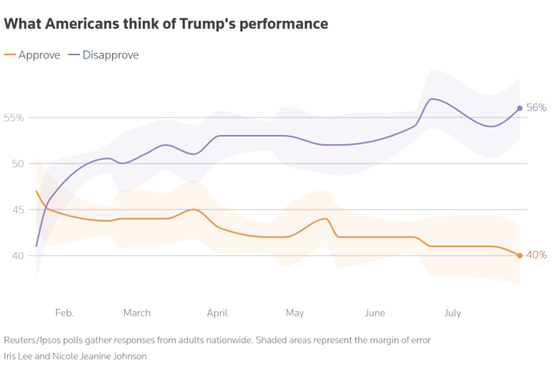
40%,特朗普支持率跌至第二任期新低,经济和移民政策引担忧
Feng Huang Wang· 2025-07-30 00:21
Group 1 - The core viewpoint of the article indicates that President Trump's approval rating has dropped to 40%, marking a new low during his second term, with concerns from the public regarding his handling of economic and immigration policies [1][6]. - The poll conducted over three days surveyed 1,023 adults across the U.S., with a margin of error of plus or minus 3 percentage points, revealing a significant polarization in public opinion towards Trump [4]. - Compared to a previous poll conducted in mid-July, Trump's approval rating for economic management increased from 35% to 38%, while his immigration approval rose from 41% to 43% [5]. Group 2 - Trump's administration has adopted aggressive strategies in both economic and immigration policies, which have led to mixed evaluations from the public [5][6]. - The article highlights Trump's trade policy, including the implementation of a 10% minimum baseline tariff and the potential for higher tariffs on imports if negotiations fail, which introduces significant uncertainty into the U.S. economy [5]. - Since January, Trump's overall approval rating has declined by approximately 12 percentage points, from 56% to 44%, reflecting widespread dissatisfaction with his second term [6].

关税谈判欧洲跪了,哪些资产会下跌?
大胡子说房· 2025-07-29 11:28
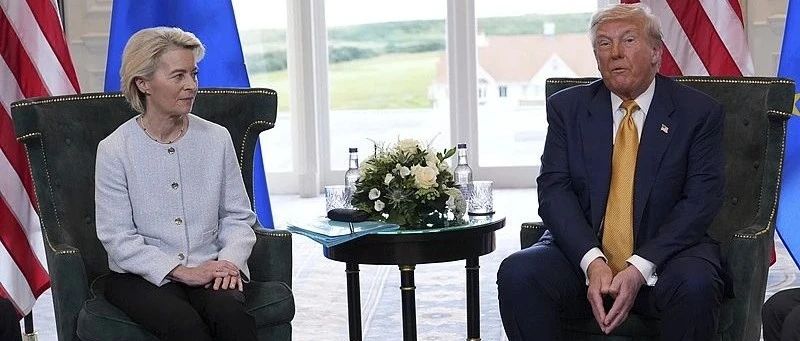
Core Viewpoint - The recent trade agreement between the U.S. and the EU is perceived as unfavorable for Europe, as it involves a 15% tariff on EU products while requiring significant investments and purchases from the U.S. [2][10][15] Group 1: Agreement Details - The U.S. will impose a 15% tariff on EU products, aligning with the rate set for Japan [2] - The EU is expected to invest an additional $600 billion in the U.S. and purchase $750 billion worth of U.S. energy products [2][14] - The agreement is seen as a trade-off where Europe accepts higher tariffs in exchange for investment commitments [3][4] Group 2: European Response - EU Commission President Ursula von der Leyen acknowledged that while the 15% tariff is not ideal, it is the best outcome they could achieve [5] - There are significant dissenting voices within Europe, with leaders like the French Prime Minister criticizing the agreement as detrimental to European interests [20][21] - The agreement is compared to historical unequal treaties, suggesting that Europe is sacrificing its own benefits [22][23] Group 3: Strategic Implications - The agreement reinforces Europe's energy dependence on the U.S., especially in light of recent geopolitical tensions [33][34] - The U.S. may leverage this energy dependency to impose higher prices on European imports [34][37] - The U.S. is expected to pursue similar agreements with other nations, particularly Japan, using its strategic advantages [41][43]

丰田董事长称愿意将美国制造的汽车进口到日本
news flash· 2025-07-29 00:34
Core Viewpoint - Toyota's Chairman Akio Toyoda expressed willingness to import vehicles produced in the U.S. to Japan, indicating potential expansion of model offerings in the Japanese market [1] Group 1: Import Strategy - Akio Toyoda mentioned that many models are not sold in Japan, hinting at the possibility of introducing the Camry and pickup trucks, which are no longer produced or sold in Japan [1] - The agreement allows U.S.-made passenger cars that meet Japanese safety standards to be imported without additional safety testing, facilitating the import process [1] Group 2: Trade Implications - If Toyota imports products manufactured in the U.S. to Japan, it could potentially reduce the trade deficit between the two countries [1] - The tariff agreement has made it easier to import American-made vehicles, increasing the range of options available to consumers, which is seen as beneficial [1]

6月份香港整体出口和进口货值分别同比上升11.9%和11.1%
Zhi Tong Cai Jing· 2025-07-28 09:00
Core Insights - Hong Kong's overall export and import values both recorded year-on-year increases in June 2025, with exports rising by 11.9% and imports by 11.1% [1] - The trade deficit for June 2025 was HKD 58.9 billion, equivalent to 12.4% of the import value [1] - For the first half of 2025, overall export value increased by 12.5% compared to the same period in 2024, while import value rose by 12.6% [1] By Country/Region Analysis - In June 2025, exports to Asia increased by 17.2%, with significant rises to Malaysia (52.6%), the Philippines (48.3%), Vietnam (37.6%), mainland China (18.3%), and India (12.5%) [2] - Conversely, exports to South Korea decreased by 10.9%, and exports to the Netherlands and the United States also saw declines of 35.5% and 12.1%, respectively [2] - For the first half of 2025, exports to Vietnam surged by 54.4%, Malaysia by 34.6%, and Taiwan by 33.0% [2] By Major Product Category Analysis - In June 2025, significant increases in export values were noted for "electrical machinery, instruments, and apparatus" (up HKD 35.8 billion, 20.2%) and "office machines and automatic data processing equipment" (up HKD 4.7 billion, 10.4%) [4] - Import values for the same categories also rose, particularly for "electrical machinery, instruments, and apparatus" (up HKD 28.4 billion, 14.6%) and "communication, recording, and sound equipment" (up HKD 8.3 billion, 17.7%) [4] - For the first half of 2025, exports of "electrical machinery, instruments, and apparatus" increased by HKD 139.2 billion (13.4%), while "office machines and automatic data processing equipment" saw a remarkable rise of HKD 129.7 billion (55.4%) [4] Comments - The Hong Kong government spokesperson noted that the export performance in June remained robust, with a significant year-on-year growth of 11.9% [5] - Exports to mainland China and most other Asian markets continued to expand significantly, while exports to the US and EU declined [5] Future Outlook - The steady growth of the mainland economy and the increasingly close economic ties between Hong Kong and various markets are expected to support trade performance [6] - However, the global trade policy outlook remains uncertain, prompting the Hong Kong government to monitor the situation closely [6]
经济再平衡视角下美国关税战的政策预判
Jin Rong Shi Bao· 2025-07-28 02:34
Core Points - The underlying reason and strategic intent of the Trump administration's tariff war is to achieve economic rebalancing, which has been difficult due to conflicting policy goals within the U.S. [1] - The U.S. has experienced a long history of economic imbalance and attempts at rebalancing, with significant events such as the 2008 financial crisis and the COVID-19 pandemic impacting these efforts [2] Industry Structure - Before 2008, the U.S. faced severe deindustrialization, with manufacturing jobs declining by 33% over ten years, reaching approximately 11.51 million by the end of 2009 [3] - From 2008 to 2019, the U.S. government focused on revitalizing manufacturing and high-tech industries, resulting in a rise in manufacturing employment to about 12.8 million by the end of 2019 [3] - The COVID-19 pandemic disrupted this recovery, leading to a drop in manufacturing jobs to 11.68 million in Q2 2020, with a slow recovery thereafter [3] Trade Sector - The U.S. has historically faced a trade deficit, with the current account deficit reaching approximately $816.6 billion in 2006, accounting for 5.91% of GDP [4] - The trade deficit improved somewhat from 2008 to 2019 due to various government policies aimed at curbing imports and promoting exports, but it has since widened again, with a projected current account deficit of $1.1336 trillion in 2024 [4] - The U.S. has a significant reliance on imports for labor-intensive and some capital-intensive products, which has hindered balanced economic growth [4] Savings and Investment Structure - Prior to 2008, the U.S. exhibited high consumption and low savings, with a savings-investment gap peaking during the financial crisis [5] - The U.S. savings rate rebounded to 20% by 2015 but has since declined to 17% by 2024, while the investment rate has increased, leading to a widening savings-investment gap of $1.29 trillion [5] - The U.S. external debt reached $27.6 trillion by the end of 2024, constituting 93% of GDP, indicating a reliance on international financing [5] Challenges in Achieving Economic Rebalancing - The U.S. faces inherent contradictions in its economic rebalancing policies, which have not fundamentally altered the comparative disadvantages of its manufacturing sector [6] - The strong dollar and the U.S.'s ability to purchase goods globally have perpetuated trade deficits, as the country can print dollars to meet domestic demand [7] - Excessive government spending has counteracted improvements in trade deficits that could have resulted from increased household savings [8] - The mismatch between demand expansion and supply chain recovery during the pandemic has exacerbated trade imbalances, leading to a significant increase in the goods trade deficit [9] Potential Policy Directions Post-Tariff War - The U.S. may continue to use tariffs as leverage in negotiations with China, potentially fluctuating tariff rates based on trade discussions [10] - There is a possibility that the U.S. will seek support from other countries for U.S. debt and may consider debt restructuring to alleviate fiscal pressures [11] - The U.S. might intervene in foreign exchange policies to seek a weaker dollar while also exploring the inclusion of cryptocurrencies in its reserves to bolster confidence in the dollar [11] - The U.S. is likely to implement differentiated tariffs and create trade blocs to counter China's influence, aligning with allied nations to reshape global supply chains [12]
美欧达成15%关税协议,“严重损害欧洲利益”
第一财经· 2025-07-27 23:56
Core Viewpoint - The article discusses the recent trade agreement between the United States and the European Union, highlighting the key terms and implications for both economies [2][4]. Summary by Sections Trade Agreement Details - The U.S. will impose a 15% tariff on most EU exports, including automobiles, semiconductors, and pharmaceuticals, which is significantly lower than the previously threatened 30% tariff [5][6]. - The EU has agreed to invest an additional $600 billion in the U.S. and purchase $750 billion worth of U.S. energy products [2][4]. Market Reactions - Following the announcement, the euro appreciated against the dollar, indicating a positive market response and reduced uncertainty regarding trade conflicts [9][10]. - Investors view the agreement as a stabilizing factor for business operations and market sentiment [10]. Impact on Trade - The 15% tariff is expected to increase costs for EU exports to the U.S., potentially reducing the competitiveness of European products, particularly in the automotive sector [12][13]. - The agreement aims to reduce the U.S. trade deficit with the EU, which was $235.6 billion in 2024, by increasing U.S. exports and capital inflow from Europe [14][15]. Economic Implications - The agreement may lead to higher import costs for U.S. consumers and businesses, contributing to upward pressure on domestic prices and inflation [16]. - The U.S. defense industry is expected to benefit from increased sales of military equipment to Europe, potentially boosting employment and investment in related sectors [15]. Reactions from Stakeholders - German Chancellor Merz expressed relief that the agreement avoided a trade conflict that could have severely impacted Germany's export-driven economy [18]. - However, some European officials criticized the agreement as unbalanced and detrimental to EU interests, suggesting a need for diversification away from reliance on the U.S. market [20][21].
刚刚!美商务部,重大宣布
Zheng Quan Shi Bao Wang· 2025-07-27 14:40
Group 1 - The U.S. Secretary of Commerce, Wilbur Ross, announced that the deadline for imposing additional tariffs on August 1 will not be extended, indicating a firm stance from the U.S. government [1] - The negotiations between the U.S. and the EU aim to open European markets for U.S. exports, with the key issue being whether the EU's proposed agreement is sufficient to persuade President Trump to abandon the 30% tariff threat [1] - The EU has warned that if a satisfactory trade agreement is not reached before the August 1 deadline, it will implement countermeasures against U.S. tariffs, with potential measures set to take effect on August 7 [1] Group 2 - In 2024, the total goods trade between the U.S. and the EU is projected to be approximately $975.9 billion, which is higher than trade with any other single economy [2] - The U.S. trade deficit with the EU for goods in 2024 is expected to be $235.6 billion, reflecting a 12.9% increase from the previous year [2]