食品安全

Search documents
麻薯盒内有活老鼠?山姆致歉
中国基金报· 2025-12-09 11:01
Core Viewpoint - The incident involving a live mouse found in a mochi box purchased from Sam's Club has sparked significant public discussion, raising concerns about the company's food safety and quality control measures [2][6]. Summary by Sections Incident Details - A consumer reported finding a live mouse in a mochi box purchased through Sam's Club's "Express Delivery" service, leading to immediate complaints and a one-star review on the platform [5]. - Sam's Club responded by emphasizing their commitment to food safety and member experience, stating that they conducted a thorough investigation in collaboration with pest control professionals [2]. Company Response - Sam's Club has stated that they have strict pest control measures in place and found no evidence of pests during their internal checks [2]. - The company indicated that the mouse likely entered the product at the pickup location, which was outdoors and had conditions conducive to pest activity [2]. Consumer Reactions - The incident has led to widespread dissatisfaction among consumers regarding Sam's Club's quality control, with many expressing their concerns on social media [6][7]. - Previous incidents involving Sam's Club, such as finding foreign objects in food products and issues with product labeling, have also contributed to growing scrutiny of the company's quality standards [9]. Industry Context - The incident is part of a broader trend where major retail chains, including competitors like Hema, have faced quality control issues, indicating a potential industry-wide challenge in maintaining product standards [9].



麻薯中出现活老鼠?山姆回应来了
Di Yi Cai Jing· 2025-12-09 10:09
山姆引发食品安全风波。 日前有消费者投诉称,他使用山姆快递配送服务"极速达"在深圳山姆龙华店购买的麻薯中发现有活老 鼠,此事迅速引发争议。 对此,山姆方面12月9日回应称,收到相关反馈后,已第一时间联动专业虫害公司开展全链路核查。经 回溯商品制作、包装、仓库上架、拣货等环节的巡查记录与仓内监控视频,均未发现虫害痕迹或异常。 山姆方面表示,经了解,该订单地址的取货点位于室外。第三方专业虫害技术人员赴取货点现场勘察发 现,该地点周边有花木丛,为野生虫害提供了栖息条件,且现场发现相关活动痕迹。综合商品制作、储 运环节的虫害检查结果和第三方虫害技术人员鉴定结果,初步判断商品系在取货点放置期间,被周边虫 害偶然侵入所致。 山姆称已与消费者及时沟通并妥善解决问题,后续将加强包装管理和配送服务。 据悉,近年来食品安全事件频发,尤其是餐饮门店、超市卖场的食品安全、保质期问题等。食品安全问 题的发酵也会带来诸多品牌伤害和后续运营问题。 ...
江苏省南通市2025年食品安全监督抽检结果公告(第五期)
Zhong Guo Zhi Liang Xin Wen Wang· 2025-12-09 09:26
Summary of Key Points Core Viewpoint - The food safety supervision sampling results in Nantong City for 2025 indicate that out of 1550 batches of food tested, 1487 were found to be compliant, while 63 batches were deemed non-compliant, highlighting ongoing concerns regarding food safety standards in the region [2]. Group 1: Food Safety Testing Results - A total of 1550 batches of food were tested across 31 categories, including grains, pastries, alcoholic beverages, edible oils, meat products, dairy products, and snacks [2]. - The compliance rate for the tested food batches stands at approximately 95.9%, with 1487 batches passing the safety standards [2]. Group 2: Non-compliance Details - Specific non-compliant items included carrots with pesticide residues (0.2 mg/kg), peas with pesticide residues (0.15 mg/kg), and celery with pesticide residues (0.04 mg/kg) [3][4]. - Other non-compliant products included ginger and lychee, which exceeded the allowable limits for pesticide residues [4][5]. - The report includes detailed information on the non-compliant batches, including sampling numbers, production dates, and specific violations [3][4].
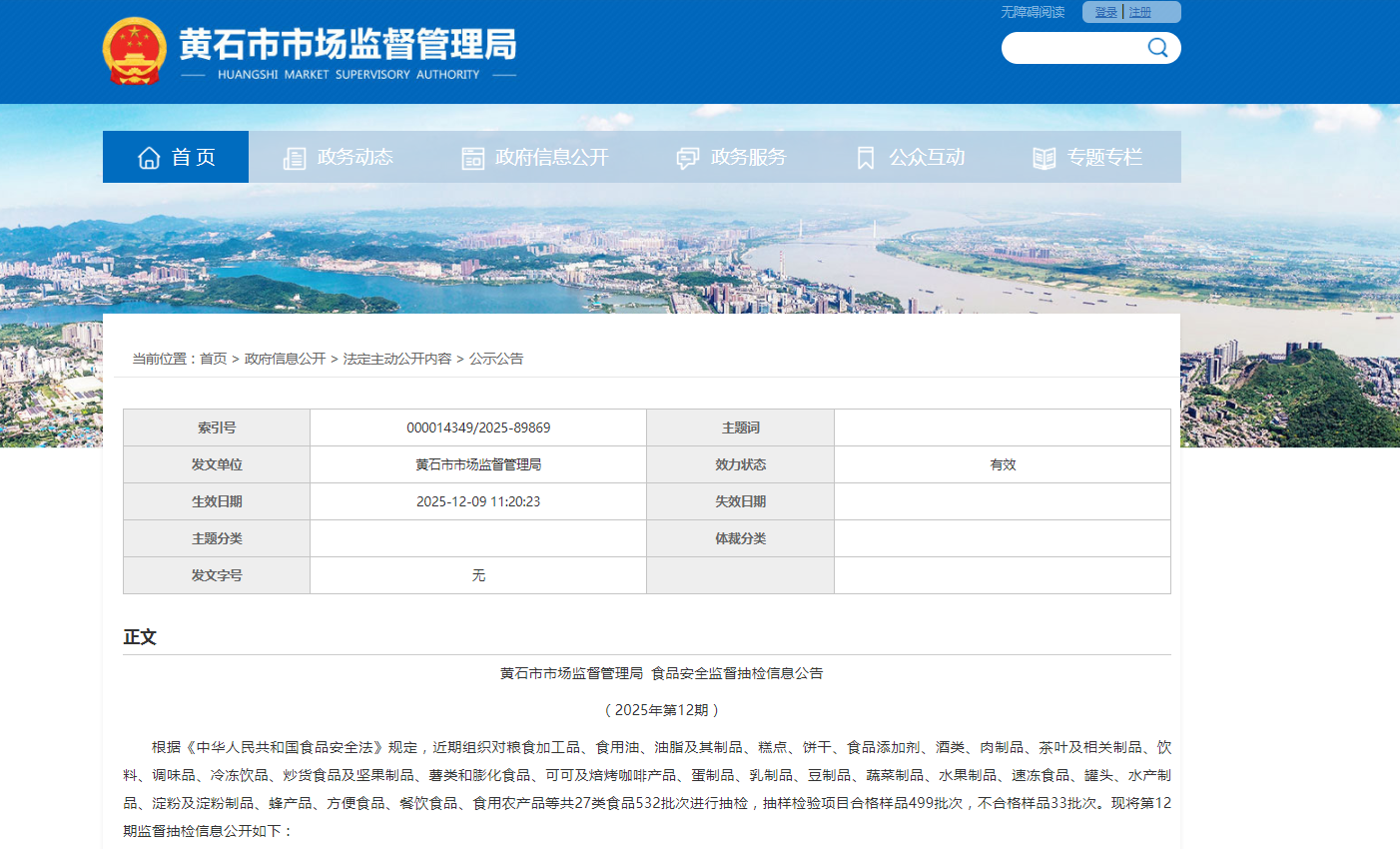
湖北省黄石市市场监督管理局食品安全监督抽检信息公告(2025年第12期)
Zhong Guo Zhi Liang Xin Wen Wang· 2025-12-09 09:00
Core Viewpoint - The recent food safety inspection in Huangshi City revealed that out of 532 food samples tested, 499 were compliant while 33 were found to be non-compliant, indicating a compliance rate of approximately 93.8% [4][5]. Summary by Categories Inspection Results - A total of 532 food samples were collected across 27 categories, including grains, oils, pastries, beverages, and more [4]. - The breakdown of the samples includes: 1 grain product, 6 oil products, 19 pastries, 7 biscuits, 19 beverages, 16 alcoholic products, 13 tea products, 11 frozen foods, and 280 agricultural products [4]. Non-compliance Details - Among the 33 non-compliant samples, issues included: - 1 batch of seasoning with excessive sulfur dioxide residue - 8 batches of agricultural products with contaminants such as chloramphenicol, enrofloxacin, cadmium, and thiamethoxam - 24 batches of catering food with detected coliform bacteria and anionic synthetic detergent [5]. Follow-up Actions - The Huangshi Market Supervision Administration has mandated immediate investigation and handling of the non-compliant products, including actions such as removal from shelves, recalls, and sales suspension [5].
山东省临沂市市场监督管理局关于33批次食品不合格情况的通告2025年第11期
Zhong Guo Zhi Liang Xin Wen Wang· 2025-12-09 09:00
Core Viewpoint - The Linyi Market Supervision Administration conducted a food safety inspection, testing 1,622 samples across 14 categories, revealing that 33 samples from 12 categories failed to meet safety standards due to pesticide residues, veterinary drug residues, and excessive food additives [2]. Group 1: Inspection Results - A total of 1,622 food samples were tested, including categories such as catering food, edible agricultural products, and grain processing products [2]. - Out of the tested samples, 33 failed to meet safety standards, indicating a failure rate of approximately 2.03% [2]. - Specific failures included the detection of 305.2 µg/kg of metronidazole in eggs, which should not be present, and 0.42 mg/kg of abamectin in cowpeas, exceeding the allowable limit of 0.2 mg/kg [2]. Group 2: Non-compliance Details - The inspection identified non-compliance in various food products, including eggs and cowpeas, with specific violations related to pesticide and veterinary drug residues [2]. - The testing revealed that the eggs from Linyi County's Wanjiafu Trading Co. had unacceptable levels of metronidazole, while cowpeas had excessive levels of abamectin [2]. - The results highlight ongoing concerns regarding food safety and the need for stricter compliance with food safety regulations [2].
蜜薯毒死蜱残留超标、白酒含甜蜜素!重庆通报27批次问题食品
Qi Lu Wan Bao· 2025-12-09 06:54
Core Viewpoint - The Chongqing Municipal Market Supervision Administration conducted a sampling inspection of 3,644 batches of 27 types of food, with 3,617 batches passing and 27 batches failing the safety standards [1] Group 1: Inspection Results - A total of 27 batches of food were found to be non-compliant with national food safety standards [1] - Specific non-compliant products include: - Premium sweet potatoes from a supermarket in Beibei District, which contained pesticide residue (chlorpyrifos) exceeding the limit [2] - Screwpine peppers from a shopping center in Kaizhou District, also with chlorpyrifos exceeding the limit [2] - Emperor bananas from a vendor in Fuling District, which had pesticide residue (imidacloprid) exceeding the limit [2] - Mangoes from a supermarket in Jiulongpo District, with pesticide residue (thiamethoxam) exceeding the limit [2] - Ginger from a department store in Changshou District, also with thiamethoxam exceeding the limit [2] - Corn liquor produced by a distillery in Wuxi County, which contained a non-compliant sweetener (sucralose) [3] Group 2: Regulatory Actions - The local market supervision departments have initiated investigations and enforcement actions against the non-compliant products as per the Food Safety Law of the People's Republic of China [3] - Risk control measures have been implemented, including tracing product distribution, recalling, and removing non-compliant products from shelves [3] Group 3: Knowledge on Non-compliant Pesticides and Additives - Chlorpyrifos is an organophosphate insecticide with a maximum residue limit of 0.02 mg/kg in tubers and peppers according to national standards [4] - Imidacloprid is an insecticide with a maximum residue limit of 0.05 mg/kg in bananas according to national standards [5] - Thiamethoxam is a neonicotinoid insecticide with a maximum residue limit of 0.2 mg/kg in root vegetables and 0.01 mg/kg in legumes and papayas according to national standards [6] - Sucralose, a common sweetener, is prohibited in the production of certain food items like liquor and fermented products according to national standards [7]
徐曙海主持召开市政府常务会议 因地制宜加快发展新质生产力 构建食品安全共治共享新格局
Zhen Jiang Ri Bao· 2025-12-08 23:54
12月8日,市长徐曙海主持召开市政府常务会议,认真学习贯彻《求是》杂志发表的习近平总书记 重要文章《因地制宜发展新质生产力》、《中华人民共和国文物保护法》,审议《镇江市市区既有住宅 加装电梯实施办法》、《镇江市用水统计管理办法》、《镇江市人民政府关于禁止燃放烟花爆竹的通 告》和《镇江市基层法治审核事项指导目录》等文件,听取2025年全市食品安全工作情况汇报,研究部 署下一阶段工作。 会议指出,习近平总书记关于因地制宜发展新质生产力的一系列重要论述,为进一步解放和发展生 产力、实现高质量发展提供了根本遵循和行动指南。要立足镇江产业基础和资源禀赋,坚持科技创新引 领,守牢实体经济根基,突出绿色发展底色,破除体制机制障碍,把加快发展新质生产力的部署要求落 到实处。要强化战略导向、攻坚核心技术,把科研优势转化成促进生产力发展的现实推动力;加强创新 主体培育,构建以企业为主导的产学研用深度融合机制;加强科技人才支撑,为新质生产力发展塑造核 心竞争优势。要优化产业结构布局,着力布局未来赛道、培育前沿动能,赋能传统产业、加快改造提 升,促进融合发展、催生多元业态,加快产业能级攀升。要擦亮生态优先底色,筑牢绿色发展屏障,拓 ...
假奶粉横行,平台难辞其咎
Xin Hua Ri Bao· 2025-12-08 21:10
Group 1 - A major case of counterfeit milk powder production and sales has been uncovered in Henan Province, with a total amount involved exceeding 6.5 million yuan [1] - The counterfeit products were made from maltodextrin, solid beverages, and industrial flavoring, mimicking 14 types of imported milk powders, and were sold across major e-commerce platforms nationwide [1] - The actual nutritional content of the counterfeit milk powder was nearly zero, posing significant health risks, especially to infants who are the primary consumers of such products [1] Group 2 - E-commerce platforms have a legal obligation to verify the credentials of food sellers and must report any illegal activities, yet counterfeit milk powder was able to be sold openly on these platforms [2] - The competitive environment among e-commerce platforms has led to relaxed entry requirements, allowing unscrupulous sellers to easily switch platforms and continue their illegal activities [2] - There are many public concerns regarding which brands were counterfeited, which platforms sold the fake products, and whether any recalls or compensations will be issued [2]
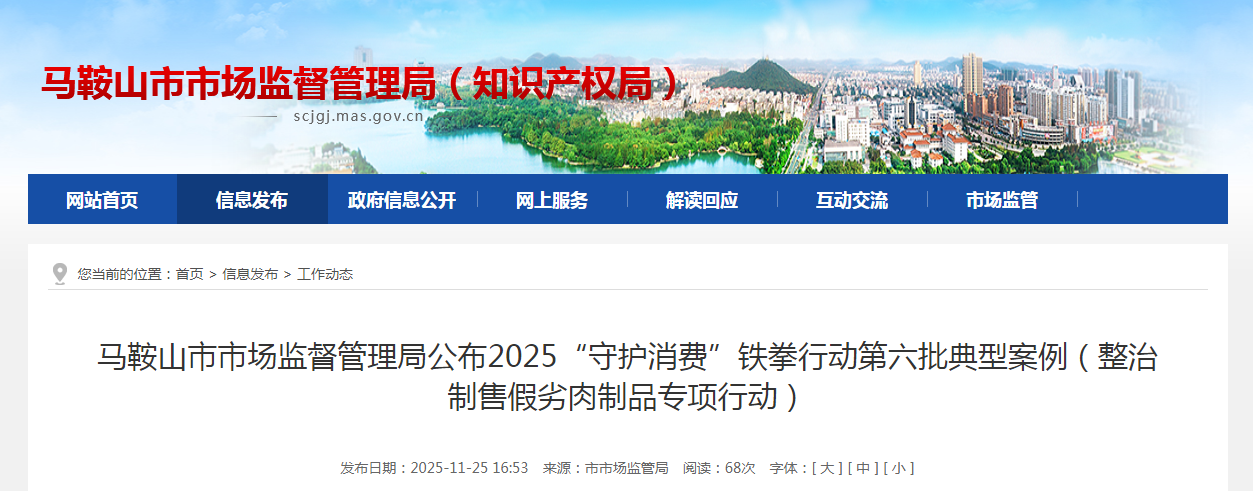
安徽省马鞍山市市场监督管理局公布2025“守护消费”铁拳行动第六批典型案例(整治制售假劣肉制品专项行动)
Zhong Guo Zhi Liang Xin Wen Wang· 2025-12-08 09:20
马鞍山市市场监督管理局公布2025"守护消费"铁拳行动第六批典型案例(整治制售假劣肉制品专项行动) 2025年以来,马鞍山市市场监管部门以推进"守护消费"铁拳行动为抓手,聚焦肉制品制假售假、超范围超限量使用添加剂及非法添加非食用物质等民生痛点 突出问题,严厉打击各类违法行为,依法查处了一批违法案件,进一步净化肉制品市场秩序。现将部分典型案例公布如下: 食用农产品中恩诺沙星残留超标,会对人体健康带来较大风险。根据食品相关法律法规的规定,食用农产品销售者必须建立进货查验记录制度,这是保障食 品安全、实现产品可追溯的重要法律义务。市场监管部门将通过日常监管、监督抽查、执法办案等措施,督促引导食用农产品经营者完善进货查验记录制 度,提升其法律意识,共同筑牢食品安全防线。 1、马鞍山市市场监管局查处马鞍山市雨山区荣美熟食店生产经营超范围使用食品添加剂的食品案 2025年8月21日,马鞍山市市场监管局依法查处马鞍山市雨山区荣美熟食店生产经营超范围使用食品添加剂的食品的违法行为,作出没收违法所得并罚款的 行政处罚。 2025年6月23日,马鞍山市市场监管局根据监督抽检不合格案件线索,依法对当事人生产经营超范围使用食品添加剂 ...
广东省汕尾市市场监督管理局2025年食品安全监督抽检信息(第九期)
Zhong Guo Zhi Liang Xin Wen Wang· 2025-12-08 09:18
Core Viewpoint - The food safety supervision and sampling inspection conducted by the Shantou Market Supervision Administration revealed that out of 723 samples, 712 were qualified while 11 were found to be unqualified, indicating issues such as microbial contamination and pesticide residue exceeding standards [1]. Group 1: Inspection Results - A total of 723 samples were inspected under the food safety supervision plan for 2025 in Guangdong Province [1]. - Among the samples, 712 were found to be compliant with food safety standards, while 11 samples were deemed unqualified [1]. - The unqualified samples exhibited problems including excessive microbial counts and pesticide residues [1]. Group 2: Regulatory Actions - The Shantou Market Supervision Administration has mandated local market regulatory departments to investigate and address the unqualified food products and their producers [1]. - Companies are required to identify the distribution of unqualified products and take measures such as recalling and removing these products from shelves [1]. - The relevant information regarding the unqualified products will be recorded in the food safety credit files of the producers and made publicly available on regulatory websites [1]. Group 3: Consumer Guidance - Consumers are advised to purchase food from reliable sources and retain shopping receipts [2]. - It is important for consumers to check packaging labels for compliance with legal standards, including production dates and safety certifications [2]. - Consumers are encouraged to report any unqualified products they encounter in the market to local complaint hotlines [2].