
6G

Search documents
焦点访谈|加速演进 我国6G已进入产业落地关键期
Yang Shi Wang· 2025-12-30 13:45
Group 1 - The core viewpoint of the article emphasizes that 6G technology is a key focus in China's "14th Five-Year Plan," with expectations for it to become a new economic growth point through deep integration with AI and smart sensing technologies [1][9] - The development of 6G is currently in a critical phase characterized by accelerated technological innovation and clearer industrial directions, aiming to empower various industries and consumer markets [1][9] - 6G is expected to achieve ultra-low latency and high reliability, enabling applications such as wireless industrial control, which surpass current capabilities of 5G [3][5] Group 2 - The integration of low Earth orbit (LEO) satellites into the 6G network is highlighted as a significant feature, enhancing global communication capabilities and reducing latency compared to high Earth orbit satellites [5][7] - The article discusses the rapid development of China's commercial space industry, which is crucial for establishing the satellite internet constellation necessary for 6G [7][9] - By 2025, 6G is anticipated to reach a pivotal point with the completion of the first phase of technology trials, laying the groundwork for competitive solutions and industry advantages [9][11] Group 3 - Various regions in China are actively establishing 6G ecosystems, with policies promoting integration with fields like autonomous driving and augmented reality [11][12] - The evolution of mobile communication technology in China has transitioned from 1G to 5G, creating new demands and applications, with 5G significantly enhancing user adoption and infrastructure [12][14] - The potential applications of 6G are vast, including immersive holographic interactions, remote medical surgeries, and smart factories, marking a shift from "Internet of Things" to "Intelligent Connectivity" [16]


市场分析:机器人传媒领涨,A股小幅整理
Zhongyuan Securities· 2025-12-30 11:28
Market Overview - On December 30, the A-share market opened lower but experienced a slight upward adjustment, with the Shanghai Composite Index facing resistance around 3979 points[2] - The total trading volume for both markets reached 21,617 billion yuan, above the median of the past three years[3] - The Shanghai Composite Index closed at 3965.12 points, unchanged, while the Shenzhen Component Index rose by 0.49% to 13,604.07 points[7] Sector Performance - Key sectors such as robotics, consumer electronics, cultural media, and energy metals performed well, while commercial retail, photovoltaic equipment, wind power equipment, and jewelry sectors lagged[3] - Over 60% of stocks in the two markets declined, with notable gains in industries like electric machinery and energy metals[7] Valuation Metrics - The average price-to-earnings (P/E) ratios for the Shanghai Composite and ChiNext indices are 16.28 times and 50.13 times, respectively, above the median levels of the past three years, indicating a suitable environment for medium to long-term investments[3] - The report emphasizes the importance of monitoring macroeconomic data, changes in overseas liquidity, and policy developments[3] Future Outlook - The central economic work conference has maintained a positive macro policy tone, shifting focus from total expansion to quality and sustainability[3] - The market anticipates that the Federal Reserve will continue its interest rate cut cycle in 2026, contributing to a more accommodative global liquidity environment[3] - The strengthening of the RMB is expected to enhance the attractiveness of RMB-denominated assets, facilitating capital inflows[3]

美利信持续发力夯实液冷业务 构筑中长期成长主线
Zheng Quan Ri Bao Wang· 2025-12-30 11:25
Core Viewpoint - The company, Meilixin Technology, has established a joint venture with Taiwan's Juyuan Innovation to enhance its liquid cooling business, while also engaging in discussions with Intel for advanced cooling solutions in high-performance computing [1][2]. Group 1: Liquid Cooling Business Development - Meilixin has formed a joint venture named Xinchang Zhileng (Anhui) Precision Technology Co., Ltd. with Juyuan Innovation, completing the registration on December 29 [1]. - The company has received a sample order for AMD's next-generation high-performance CPU water cooling board and aims for mass production by Q1 2026 [2]. - Intel's delegation visited Meilixin to discuss advanced cooling technologies, with plans to develop solutions for high-power AI servers [2]. Group 2: Market Potential and Strategic Positioning - Meilixin's liquid cooling products are expected to expand from communication base stations to computing and energy storage applications, with a focus on extreme cooling scenarios [3]. - The company is positioned to leverage synergies between its communication and liquid cooling sectors, targeting high-power base station cooling solutions [4]. - The domestic telecom operators are projected to invest nearly 20 billion in 5G-A plans by 2025, providing significant growth opportunities for Meilixin's communication and liquid cooling segments [4]. Group 3: Diverse Business Segments - Meilixin's operations span four main sectors: communication, automotive, semiconductor, and liquid cooling, with a concentrated push expected in 2026 [4]. - In the automotive sector, Meilixin has established a decade-long partnership with Tesla and is also supplying components to other major North American manufacturers [5]. - The semiconductor business has seen Meilixin stabilize its position within the supply chains of leading industry players, enhancing its capabilities from individual components to system-level modules [4].
剑指全球影响力,深圳“十五五”将建五大中心
2 1 Shi Ji Jing Ji Bao Dao· 2025-12-30 06:19
Core Insights - Shenzhen's "14th Five-Year Plan" emphasizes the establishment of five key centers: advanced manufacturing, industrial technology innovation, financial services, consumption, and logistics, aiming to enhance its global competitiveness [1][2] Group 1: Advanced Manufacturing - Shenzhen aims to become a global leader in advanced manufacturing by expanding emerging industries such as information technology, new energy, and smart home systems, while also upgrading traditional sectors like clothing and jewelry [1][5] - The city has achieved significant industrial performance, with the added value of advanced manufacturing and high-tech manufacturing accounting for 68.2% and 58.2% of the total industrial output value, respectively [5] - The focus on future industries includes the development of 6G technology, biomanufacturing, and quantum technology, which are expected to drive economic growth [6][7] Group 2: Financial Services - Shenzhen's financial sector has become the largest service industry, with an average annual growth rate of 6.9% during the "14th Five-Year Plan," contributing approximately 14% to the GDP [13] - The city is enhancing its financial services to support technological innovation and the real economy, with a significant increase in technology loans reaching 2.28 trillion yuan, a 14.24% growth from the beginning of the year [13][14] - Collaboration with Hong Kong is seen as a key strategy to boost Shenzhen's financial influence globally, leveraging both regions' strengths [14] Group 3: Consumption - Shenzhen has entered the "trillion-dollar club" for consumption, with plans to enhance its role as a global consumption center by developing international trade, exhibitions, and tourism [16] - The city aims to improve consumer conditions and innovate consumption scenarios to align with global supply and demand [16] Group 4: Logistics - Shenzhen Airport has become a major logistics hub, achieving over one million tons in annual cargo throughput, with 63 cargo routes, including 43 international destinations [18] - The city plans to enhance its logistics capabilities by building an international aviation hub and improving multi-modal transport networks to serve national and regional markets [18]

工智能迈向轨道:6G研究将卫星转变为边缘计算节点
Xin Lang Cai Jing· 2025-12-30 04:38
人工智能如水般流动 受水流跨越边界的启发,"空地流体人工智能"框架允许人工智能模型和数据在卫星和地面站之间持续流动。 研究人员将此描述为将传统的二维边缘人工智能架构扩展到太空。该框架基于三项核心技术:流体学习、流体推理和流体模型下载。每项技术都旨在确保人 工智能服务在卫星移动性和间歇性连接的限制下也能流畅运行。 (来源:中国航空报) 随着全球竞相迈向第六代移动通信网络(6G),真正的战场或许不在地球上,而是在轨道上。预计6G将于2030年左右实现商业化,研究人员已经开始重新 思考人工智能将如何在全球范围内运行。 国际电信联盟(ITU)已确定了6G的未来应用场景,例如"人工智能(AI)与通信的融合"和"无处不在的连接",这标志着网络功能正在发生转变,不再局限 于数据传输。 一个主要障碍依然存在:如何在广袤、偏远且服务不足的地区提供无缝的人工智能服务。仅靠地面网络可能不足以满足这些需求,尤其是在人工智能工作负 载日益繁重且对延迟更加敏感的情况下。 一项新的研究提出了一种超越地面的解决方案。香港大学和西安电子科技大学的研究人员提出了一种将边缘人工智能与空地融合网络(SGIN)相结合的框 架,使卫星同时成为通信枢纽和 ...

信通会议加码6G+算力+AI融合!
Mei Ri Jing Ji Xin Wen· 2025-12-30 01:32
相关ETF:科创50ETF(588000)。 展望后市,野村证券指出未来仍看好三条主线:1)AI算力链持续增长,相对看好谷歌/英伟达以及明年 Meta相关算力需求放量节奏,关注PCB/CCL、光模块板块作为核心受益赛道;2)持续看好国产替代加速 赛道,包括被动元件、模拟芯片等;3)持续看好AI端侧应用落地推动端侧SoC放量。 科创50ETF(588000)追踪科创50指数,指数持仓电子行业69.39%,计算机行业4.88%,合计74.27%,与 当前人工智能、机器人等前沿产业的发展方向高度契合。同时涉及半导体、医疗器械、软件开发、光伏 设备等多个细分领域,硬科技含量高,看好中国硬科技长期发展前景的投资者建议持续关注。 12月29日,科创50ETF(588000)微调,收跌0.14%。盘面上,芯原股份上涨5.71%,寒武纪上涨4.19%, 晶科能源上涨3.85%,中无人机上涨3.61%,芯联集成、天岳先进等涨超2%。 消息面上,全国信息通信监管工作会日前在北京召开,会议强调,要充分发挥需求的导向作用,系统推 进6G技术研发、标准研制和应用培育,深入实施工业互联网和人工智能融合赋能行动。要充分发挥网 络的基础作用 ...
心智观察所:围堵华为四年后,NEC注定要黯然离场
Guan Cha Zhe Wang· 2025-12-30 01:11
Core Viewpoint - NEC's withdrawal from the 4G and 5G public base station development market signifies the complete collapse of the Japanese telecommunications equipment industry, highlighting the challenges faced by Japanese companies in the face of fierce competition from Chinese firms like Huawei and ZTE [1][5]. Group 1: NEC's Strategic Withdrawal - NEC's president, Takashi Morita, announced that the company will no longer invest in the public base station development sector, marking a significant shift from their previous goal of capturing 20% of the global market by 2030 [1][3]. - The company's market share has dwindled, with NEC and Fujitsu together holding less than 2% of the global base station market, while Huawei, Ericsson, and Nokia control nearly 80% [3][4]. - The competitive landscape for 5G has fundamentally changed, requiring higher technical standards and larger scale effects, which NEC, with a market share of less than 1%, cannot sustain [3][4]. Group 2: Structural Crisis in Japanese Telecommunications - NEC's exit reflects a broader crisis within the Japanese telecommunications equipment sector, with other companies like Fujitsu also divesting from similar businesses [5]. - The historical reliance on a closed domestic market has weakened Japanese firms' ability to compete globally, leading to their marginalization as they struggle to match the performance and cost-effectiveness of international competitors [5][6]. - NTT Docomo, Japan's largest mobile operator, has shifted its procurement strategy to favor foreign suppliers like Ericsson, further indicating the decline of domestic brands [6]. Group 3: NEC's Strategic Shift to Private Networks - Despite exiting the public base station market, NEC is pursuing a strategic pivot towards providing private 5G network solutions in collaboration with Cisco, targeting enterprise clients in Europe and the Middle East [7]. - This shift reflects NEC's recognition of the competitive landscape, where the enterprise private network market is less concentrated and allows for more customized services, an area where NEC has expertise [7]. Group 4: Challenges of Open RAN - NEC's previous involvement in Open RAN technology, which aimed to democratize the telecommunications equipment market, has not yielded the expected results, with deployment lagging behind initial projections [8][9]. - The challenges faced by Open RAN include technical maturity, total cost of ownership uncertainties, and system integration complexities, which hinder its widespread adoption [9][10]. Group 5: Rise of Chinese Competitors - In stark contrast to Japanese firms, Chinese companies like Huawei and ZTE have solidified their positions in the global 5G market, with Huawei holding 58% and ZTE 31% of the domestic market [11]. - Chinese firms are not only competitive on price but also lead in technological innovation, with Huawei's solutions significantly enhancing capacity and reducing energy consumption [11][12]. - The rapid advancement of technologies like 5G-A and RedCap by Chinese firms has established a generational gap in capabilities compared to their Japanese counterparts [12][14]. Group 6: Future Outlook and Implications - As Japan grapples with its telecommunications industry's decline, China is positioning itself for future advancements in 6G technology, leveraging its existing infrastructure and technological capabilities [14][15]. - The competitive landscape in telecommunications is evolving, with the importance of scale and continuous innovation becoming critical for survival in a technology-driven market [18].

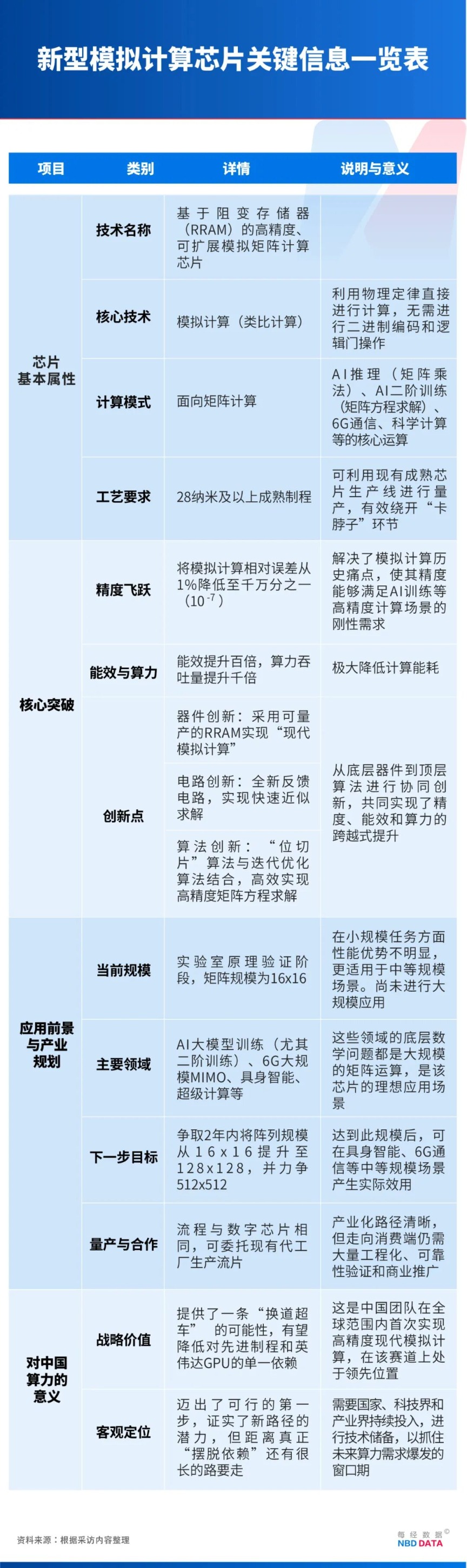
绕开光刻机“卡脖子” 中国新型芯片问世!专访北大孙仲:支撑AI训练和具身智能 可在28纳米及以上成熟工艺量产
Mei Ri Jing Ji Xin Wen· 2025-12-30 00:36
Core Viewpoint - A Chinese research team has developed a novel high-precision, scalable analog matrix computing chip based on resistive random-access memory (RRAM), achieving 24-bit fixed-point precision for the first time globally, which allows for reduced computational card usage for similar tasks [1][12]. Group 1: Technology and Innovation - The new chip represents a significant leap in precision, reducing the relative error from 1% to one part in ten million (10^-7), thus addressing the historical precision bottleneck of analog computing [7][15]. - The chip can support advanced applications such as 6G, embodied intelligence, and AI model training, and can be produced using mature processes of 28nm and above, circumventing the bottleneck of photolithography [1][12]. - The research team has introduced a new feedback circuit and utilized classic iterative optimization algorithms to enhance precision without sacrificing energy efficiency or speed [11][15]. Group 2: Market and Application Potential - The chip is particularly suited for applications requiring large-scale matrix operations, such as AI model training, 6G communications, and supercomputing tasks, which are fundamentally based on matrix calculations [10][20]. - The team aims to scale the matrix size from 16x16 to 128x128 within two years, with a long-term goal of reaching 512x512, which would enable practical applications in medium-scale scenarios [24][25]. - The technology provides a potential alternative to reliance on advanced processes and NVIDIA GPUs, positioning the team at the forefront of modern analog computing [10][26]. Group 3: Strategic Importance - This development offers a "detour" for China's computing capabilities, potentially reducing dependence on advanced manufacturing processes and foreign technology [10][26]. - The successful demonstration of this new path confirms its potential, although significant investment and collaboration across the technology and industry sectors will be necessary to fully realize its capabilities [10][26].
中原证券晨会聚焦-20251230
Zhongyuan Securities· 2025-12-30 00:14
Core Insights - The report highlights the positive performance of various sectors in the A-share market, particularly in financial, petrochemical, and aerospace industries, indicating a slight upward trend in the market [5][9][10] - The central economic work conference emphasizes a shift in policy focus from total expansion to quality and sustainability, with a strong emphasis on technology and industry [8][12][14] - The report suggests that the average price-to-earnings ratios for the Shanghai Composite Index and the ChiNext Index are above their three-year median levels, indicating a favorable environment for medium to long-term investments [9][10][12] Domestic Market Performance - The Shanghai Composite Index closed at 3,965.28 with a slight increase of 0.04%, while the Shenzhen Component Index decreased by 0.49% to 13,537.10 [3] - The A-share market has shown resilience with a trading volume of 21,578 billion, indicating strong investor interest [8][10] - The report notes that various sectors such as banking, petrochemical, and software development have performed well, while sectors like energy metals and pharmaceuticals have lagged [5][9] Industry Analysis - The humanoid robot sector is expected to become a key focus in the U.S. technology strategy, with recommendations to continue monitoring humanoid robots and AIDC supporting equipment [14] - The power sector is experiencing a collaboration between the largest power company and Google for AI initiatives, although the sector's performance has been below market expectations [16] - The solar industry is witnessing significant price increases in silicon wafers and batteries, with a focus on leading companies in the segment [18][19] Investment Recommendations - The report suggests focusing on companies with stable fundamentals, high dividends, and strong growth potential in sectors such as engineering machinery and high-speed rail equipment [15] - In the animation film industry, the report recommends attention to companies like Light Chaser Animation, which have a strong project pipeline and IP management capabilities [26][28] - The automotive sector is advised to focus on companies with innovative driving technologies and those positioned for growth in the intelligent and connected vehicle market [31]
硕贝德:公司没有“6G太赫兹原型机实现1Tbps传输速率”以及“量子加密天线”
Zheng Quan Ri Bao Wang· 2025-12-29 13:42
Core Viewpoint - The company, Shoubeide (300322), clarified on an interactive platform that it has not achieved "6G terahertz prototype machine with 1Tbps transmission rate" or "quantum encryption antenna" [1] Group 1: Company Developments - The company has completed the research and development of satellite communication antennas [1] - It has received mass production orders for low-orbit satellite communication antennas and is about to deliver in bulk [1] - The company has delivered over 100,000 units of high-orbit satellite communication antennas to leading domestic customers this year [1] Group 2: Industry Engagement - The company is closely following the development of 6G technology and actively engaging in related work [1]
