
新兴产业

Search documents
上海百强企业净利润增长24.84% 上榜民企营收合计首破3万亿元 信息技术产业领跑新兴产业
Jie Fang Ri Bao· 2025-09-24 02:04
Group 1 - The total revenue of the top 100 companies in Shanghai reached 10.03 trillion yuan in 2024, marking the third consecutive year of surpassing 10 trillion yuan, with a net profit of 665.57 billion yuan, reflecting a strong growth of 24.84% [1] - The top two positions in the ranking are held by China Baowu and SAIC Motor, while China State Construction Engineering and COSCO Shipping have risen to third and fourth places respectively [1] - Notably, Pinduoduo and Meituan have entered the top ten for the first time, ranking seventh and ninth, indicating the rise of new economy enterprises [1] Group 2 - The private sector has shown remarkable performance, with the total revenue of the top 100 private enterprises exceeding 3 trillion yuan for the first time, reaching 3.3 trillion yuan, an increase of 277.1 billion yuan, with a growth rate of 9.26% [1] - The net profit of private enterprises totaled 224.55 billion yuan, an increase of 92.07 billion yuan, with a growth rate of 69.50%, driven primarily by emerging industries [1] - The new emerging industries top 100 have also maintained a high growth trend, with total revenue reaching 2.2 trillion yuan and net profit of 195.37 billion yuan, reflecting a growth rate of 72.47% [2] Group 3 - The service industry top 100 achieved a total revenue of 4.7 trillion yuan, growing by 7.57%, with net profit increasing by 41.14% to 583.49 billion yuan, driven by strong performances in retail e-commerce, marine transportation, and insurance [3] - The manufacturing sector faced challenges due to the economic conditions in black metallurgy and automotive industries, but sectors such as smart terminals, pharmaceuticals, integrated circuits, new energy vehicles, and high-end equipment showed positive performance [3]




上海百强企业净利润增长24.84%
Jie Fang Ri Bao· 2025-09-24 01:59
Group 1 - The 2025 Shanghai Top 100 Enterprises list shows a total revenue of 10.03 trillion yuan for the listed companies in 2024, marking the third consecutive year of surpassing 10 trillion yuan; net profit reached 665.57 billion yuan, reflecting a strong growth of 24.84% [1] - The top two positions are held by China Baowu and SAIC Motor, while China State Construction Engineering and COSCO Shipping have risen to third and fourth place respectively; notable entries include Pinduoduo and Meituan, which have made their debut in the top ten at seventh and ninth positions [1] Group 2 - The private sector has shown remarkable performance, with the total revenue of the top 100 private enterprises exceeding 3 trillion yuan for the first time, reaching 3.3 trillion yuan, an increase of 277.1 billion yuan, representing a growth rate of 9.26%; net profit totaled 224.55 billion yuan, up by 92.07 billion yuan, with a growth rate of 69.50% [2] - The new emerging industries have driven the strong growth of private enterprises, with eight out of the top ten companies in net profit increase being from emerging industries, indicating the vitality of Shanghai's private sector [2] - The top 100 emerging industries achieved a total revenue of 2.2 trillion yuan, with net profit of 195.37 billion yuan, reflecting a growth rate of 72.47%; compared to 2021, when the total revenue was less than 900 billion yuan, this shows significant growth over five years [2] Group 3 - In terms of industry structure, the information technology sector is the absolute leader among emerging industries, with 47 listed IT companies achieving a total revenue of 1.5 trillion yuan, a year-on-year growth of 19.14%, contributing nearly 70% of the revenue for the emerging industries; net profit reached 191.84 billion yuan, with a growth rate of 88.25% [3] - The service sector's top 100 companies achieved a total revenue of 4.7 trillion yuan, growing by 7.57%, and net profit of 583.49 billion yuan, a significant increase of 41.14%, driven by strong performances in retail e-commerce, marine transportation, and insurance [3] - The manufacturing sector faced challenges due to the economic conditions in black metallurgy and automotive industries, but companies in smart terminals, pharmaceuticals, integrated circuits, new energy vehicles, and high-end equipment have shown improved performance, contributing positively to the sector's transformation and upgrade [3]
2025上海百强企业榜单发布,民企与新兴产业成增长引擎
Guo Ji Jin Rong Bao· 2025-09-24 01:17
Core Insights - The performance of Shanghai's top 100 enterprises continues to expand, with total revenue exceeding 10 trillion yuan for the third consecutive year, and net profit rising rapidly [1] Group 1: Revenue and Profit Performance - In 2024, the total operating revenue of Shanghai's top 100 enterprises reached 10.03 trillion yuan, a slight decrease of 0.42% year-on-year [1] - The net profit of Shanghai's top 100 enterprises reached 665.57 billion yuan, with a growth rate of 24.84% [1] - The threshold for entry into the top 100 increased to 10.73 billion yuan, up by 240 million yuan year-on-year [1] - The top 100 in the service industry, private enterprises, and emerging industries all showed varying degrees of revenue growth, with private enterprises growing by 9.26% and emerging industries by 11.48% [1] Group 2: Asset Growth - The total assets of Shanghai's top 100 enterprises exceeded 49 trillion yuan, with a growth rate of 6.29% [2] - The total equity reached 8.2 trillion yuan, growing at a rate of 6.14% [2] - The service industry top 100 had total assets of 40.6 trillion yuan, growing by 7.40%, while private enterprises had total assets of 5.1 trillion yuan, growing by 6.49% [2] Group 3: Private Enterprises and Emerging Industries - Private enterprises achieved a total operating revenue of 3.3 trillion yuan, marking a significant increase of 277.1 billion yuan, or 9.26% year-on-year [3] - The net profit of private enterprises reached 224.55 billion yuan, with a remarkable growth rate of 69.50% [3] - The top 10 enterprises in net profit among private enterprises accounted for a total of 168.41 billion yuan, with an increase of 105.94 billion yuan, reflecting a growth rate of 169.56% [3] - Notably, 8 out of the top 10 profit-increasing enterprises were from emerging industries, indicating their significant contribution to the overall profit growth of private enterprises [3] Group 4: Emerging Industries Performance - The emerging industries' top 100 achieved a total operating revenue of 2.2 trillion yuan, marking a new high [4] - The net profit for emerging industries reached 195.37 billion yuan, with a growth rate of 72.47% [4] - The average operating revenue of the top 100 emerging industries was approximately 22.21 billion yuan, with 35 enterprises exceeding 10 billion yuan in revenue [4] - Information technology companies within the emerging industries showed outstanding performance, with total operating revenue of 1.5 trillion yuan, growing by 19.14%, and net profit of 191.84 billion yuan, growing by 88.25% [5]
每日债市速递 | 国债期货收盘集体下滑
Wind万得· 2025-09-23 22:30
央行公告称,9月23日以固定利率、数量招标方式开展了2761亿元7天期逆回购操作,投标量2761亿元,中标量2761亿元。Wind数据显示,当日2870亿元 逆回购到期,据此计算,单日净回笼109亿元。 1. 公开市场操作 (*数据来源:Wind-央行动态PBOC) 2. 资金面 银行间市场周二资金面与上日变动不大,整体仍均衡,惟跨季资金价格稍涨,因需求升温,此外央行公开市场14天期逆回购仅恢复操作一日后再次暂停。 月内资金充裕,存款类机构隔夜回购加权利率维持在1.41%附近;匿名点击(X-repo)系统上,隔夜报价亦略降至1.41%。非银机构质押存单和信用债融入 隔夜资金的报价基本还在1.50%-1.55%区间。 海外方面,最新美国隔夜融资担保利率为4.14%。 (IMM) // 债市综述 // 3. 同业存单 (*数据来源:Wind-国际货币资金情绪指数、资金综合屏) 全国和主要股份制银行一年期同业存单最新成交在1.68%附近,较上日微升。 (*数据来源:Wind-同业存单-发行结果) 4. 银行间主要利率债收益率 普遍上行 | (*数据来源:Wind-成交统计BMW) | | --- | 5. 近期城投 ...


工信部:建立未来产业投入增长机制
Zhong Guo Zheng Quan Bao· 2025-09-23 20:16
Group 1 - The Ministry of Industry and Information Technology emphasizes the importance of achieving new industrialization during the 14th Five-Year Plan, focusing on high-quality development and the integration of technological and industrial innovation [1] - The plan includes fostering emerging industries and future industries, with actions to create new driving forces through technology innovation, large-scale development, and application scenario construction [1] - Key areas for future industries include humanoid robots, brain-computer interfaces, the metaverse, and quantum information, with the establishment of pilot zones for these industries [1] Group 2 - Traditional industries are encouraged to undergo renewal and upgrading, focusing on high-end, intelligent, and green development, while enhancing value creation [2] - The manufacturing sector is set to undergo digital transformation, with initiatives like "Artificial Intelligence + Manufacturing" to promote smart, green, and service-oriented manufacturing [2] - There is a commitment to building a mutually beneficial industrial ecosystem, optimizing the business environment, and deepening international industrial cooperation to ensure a stable and efficient global supply chain [2]
新华财经晚报:国内金饰价格突破1100元每克
Xin Hua Cai Jing· 2025-09-23 14:15
Domestic News - The National Internet Information Office has taken measures against the platforms of UC and Toutiao for failing to fulfill their responsibilities in managing content, leading to the spread of harmful information and disruption of the online ecosystem [1][1] - The State Administration for Market Regulation has urged Huolala to comply with the Anti-Monopoly Law and ensure fair market competition, protecting the rights of truck drivers and consumers [2][2] - The Ministry of Industry and Information Technology emphasized the need to cultivate emerging industries and establish a growth mechanism for future industry investments, focusing on areas like humanoid robots and quantum information [2][2] - In August, China's total electricity consumption reached 10,154 billion kilowatt-hours, a year-on-year increase of 5.0%, with the primary industry seeing a 9.7% increase [2][2] Industry Developments - Following the Federal Reserve's interest rate cut, international gold prices have continued to rise, with domestic gold prices reaching a record high of 1,100 yuan per gram [3][3] - The Guangxi government is establishing a state-owned enterprise group to promote the high-quality development of the critical metals industry, focusing on asset evaluation and optimizing equity structure [3][3] International News - The OECD has revised its global economic growth forecast for 2025 to 3.2%, an increase of 0.3 percentage points from its June prediction [4][4] - S&P Global reported a decline in Australia's Composite PMI from 55.5 in August to 52.1 in September [4][4]
中国技工新职业“数智化”趋势明显
Zhong Guo Xin Wen Wang· 2025-09-23 13:55
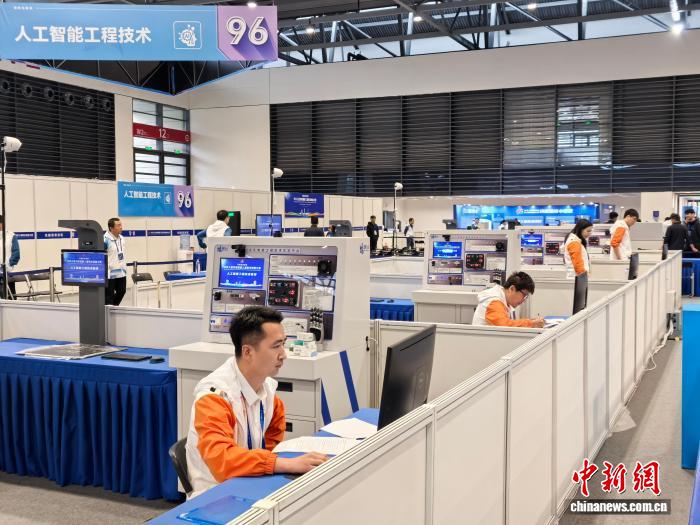
Core Insights - The trend of "digital intelligence" in new vocational skills in China is becoming increasingly evident, particularly highlighted by the recent National Skills Competition, which showcases emerging industries and advanced technologies as key employment areas for the future [1][3]. Group 1: New Vocational Trends - The National Skills Competition, recognized as China's highest-level vocational skills event, features new vocational categories such as artificial intelligence engineering, smart manufacturing engineering, industrial internet engineering, integrated circuit engineering, and service robotics application technology [1][3]. - Since 2019, over 90 new professions have been announced by China's Ministry of Human Resources and Social Security, with roles like integrated circuit engineering technicians and industrial internet engineering technicians becoming popular choices among university graduates [3][4]. Group 2: Industry Demand and Skills Development - The competition's focus on advanced technology fields, including smart manufacturing and digital technology, accounts for over 50% of the event's categories, indicating a strong industry demand for skilled workers in these areas [4]. - The competition also emphasizes the importance of practical skills, as demonstrated by participants in the integrated circuit engineering category who effectively used virtual simulation manufacturing equipment for wafer processing [4][5]. Group 3: Future Employment Pathways - The establishment of a dedicated service robotics application technology category aims to cultivate versatile, skilled professionals in the field, integrating mechanical equipment assembly, intelligent detection, and human-computer interaction technologies [5]. - The competition serves as a reflection of the potential career paths for future workers, with "digital intelligence" and emerging industries leading the way in new vocational opportunities [5].
工信部:实施培育新兴产业打造新动能行动 开辟脑机接口、元宇宙、量子信息等新赛道
智通财经网· 2025-09-23 11:40
李乐成表示,"十五五"时期,工业和信息化部将贯彻落实党中央、国务院决策部署,牢牢锚定实现新型 工业化这个关键任务,以推动高质量发展为主题,以发展新质生产力为重点,以推动科技创新和产业创 新深度融合为关键路径,以改革创新为根本动力,加快建设以先进制造业为骨干的现代化产业体系。一 是大力提升产业科技创新体系整体效能。强化企业科技创新主体地位,完善国家制造业创新中心建设布 局,建立健全中试平台梯次培育体系,大力发展科技服务业,打造世界领先科技产业园区。二是加力推 进传统产业焕新升级。深入实施制造业技术改造升级工程,强化标准引领、质量提升、品牌建设和数智 化、绿色化改造,大力发展智能制造、绿色制造、服务型制造。三是培育壮大新兴和未来产业。实施培 育新兴产业打造新动能行动,加快打造一批新兴支柱产业。建立未来产业投入增长机制,开辟脑机接 口、元宇宙、量子信息等新赛道。四是全面构建互利共赢产业生态。强化重点外资项目服务保障,深化 国际产业合作,共同构筑安全稳定、畅通高效、开放包容、互利共赢的全球产业链供应链体系。 龚正指出,工博会已成为全球规模最大的综合性工业品牌展会和促进国际经贸交流合作的重要平台。上 海要深入贯彻落实习 ...
大幅加仓!私募:无需过度担忧短期波动
券商中国· 2025-09-23 05:35
Core Viewpoint - The article highlights the significant increase in the positions of private equity firms in the A-share market, indicating a strong confidence among major institutions in the market's continued upward trend [2][3]. Group 1: Private Equity Positioning - The overall stock private equity position has surged to a new high for the year, with large private equity firms increasing their positions by 11.11% in a single week [2][5]. - As of September 12, 2025, the stock private equity position index reached 78.04%, up 2.96 percentage points from the previous week, reflecting an acceleration in overall allocation enthusiasm among private equity firms [3][4]. - 60.02% of stock private equity firms are fully invested, while 23.34% maintain moderate positions, indicating a strong market participation sentiment [3][6]. Group 2: Reasons for Increased Positions - The recent continuous rise in the A-share market has created a noticeable profit effect, providing direct motivation for private equity firms to increase their positions [4]. - Market sentiment has improved, with investor confidence steadily increasing and risk appetite rising [4]. - Emerging industries such as AI, semiconductors, and new energy are seen as having broad development prospects, presenting structural investment opportunities that are attracting institutional focus [4]. Group 3: Differentiation Among Private Equity Firms - The position indices for private equity firms of various sizes as of September 12 are as follows: over 100 billion, 78.22%; 50-100 billion, 86.49%; 20-50 billion, 74.22%; 10-20 billion, 75.88%; 5-10 billion, 76.28%; and below 5 billion, 78.85% [5]. - The highest position is held by private equity firms in the 50-100 billion range, reaching 86.49%, marking a three-year high, indicating their strong flexibility and research capabilities [5][6]. - Over 54.04% of large private equity firms are fully invested, reflecting a proactive market stance among leading institutions [6]. Group 4: Market Outlook and Volatility - Despite recent market fluctuations, with the CSI 300 down 0.44% and the Shanghai Composite Index down 1.3%, market activity remains vibrant, as evidenced by rising transaction volumes [7]. - The current market is viewed as being in a bull trend, with structural differentiation leading to potential short-term corrections in individual stocks, but the overall market trend remains positive [7][8]. - The article suggests that while some sectors have seen significant gains, the rotation among sectors is driven by the overall market valuation rising rather than fundamental changes in high-valuation stocks [8].

增量政策落地周年一线调研 | 投融资改革持续深化 资本市场回稳向好势头巩固
Shang Hai Zheng Quan Bao· 2025-09-22 12:35
Group 1 - The core viewpoint of the articles emphasizes the effectiveness of recent policies in enhancing the capital market's resilience and its ability to support technological innovation and emerging industries [1][2][3] - A series of significant policies have been implemented, including the reopening of the fifth set of standards for the Sci-Tech Innovation Board and the activation of the third listing standard for the Growth Enterprise Market, benefiting various innovative companies [1][2] - The capital market is increasingly attracting long-term funds, with social security funds, insurance funds, and public funds playing a crucial role in stabilizing the market and fostering new productive forces [3][4] Group 2 - The merger and acquisition (M&A) landscape is thriving, with notable transactions such as BGI's acquisition of Chip Semiconductor and Mindray Medical's control over Huatai Medical, indicating a trend towards industry consolidation and transformation [2] - The issuance of Sci-Tech bonds has exceeded 1 trillion yuan, primarily directed towards cutting-edge sectors like semiconductors and artificial intelligence, showcasing the capital market's support for technological advancements [2] - Public fund reforms are ongoing, with new models for floating management fees being introduced, allowing investors to benefit more directly from fund performance [5] Group 3 - The A-share market has shown strong resilience amid global uncertainties, with foreign investors increasing their holdings in domestic stocks and funds, reversing a two-year trend of net reductions [7] - The total market capitalization of A-shares surpassed 100 trillion yuan, with strategic emerging industries accounting for over 40% of the market value, reflecting a robust growth in key sectors [6][7] - The average daily trading volume in the A-share market has significantly increased, indicating heightened market activity and investor engagement [6]