未来产业

Search documents
竞逐新赛道,都有啥新招?
Xin Lang Cai Jing· 2026-01-04 22:08
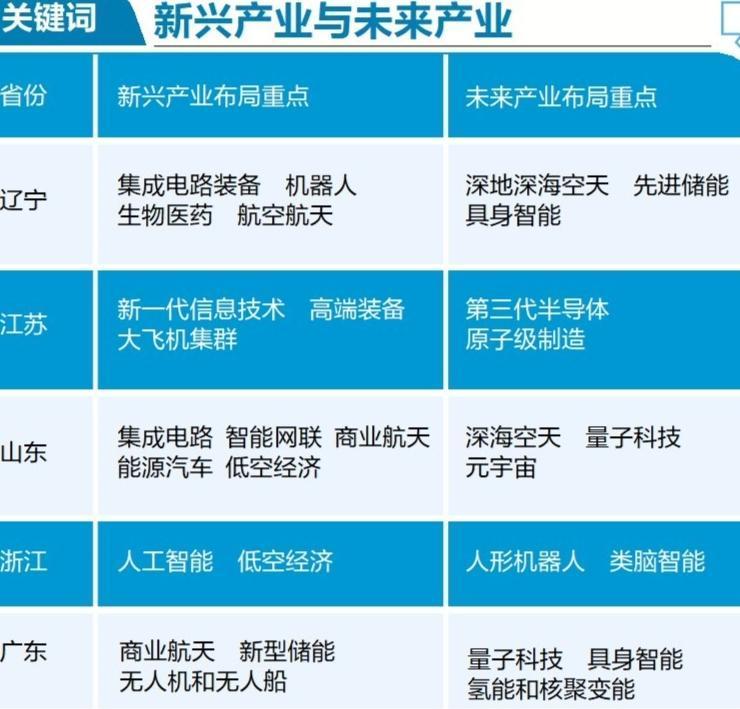
Group 1: Emerging and Future Industries - Various provinces are focusing on emerging and future industries, with specific emphasis on sectors like integrated circuits, robotics, and advanced energy storage [1][6] - Jiangsu aims to deepen integration into the Yangtze River Delta's aircraft manufacturing cluster and emphasizes atomic-level manufacturing [6] - Provinces like Shandong and Guangdong are prioritizing sectors such as quantum technology and hydrogen energy, indicating a trend towards high-tech and sustainable industries [1][7] Group 2: Digital Development - Provinces are actively developing digital infrastructure, with Liaoning focusing on data annotation industries and integrating AI into traditional industries [2][9] - Beijing aims to become a global benchmark city for digital economy, emphasizing core technologies like high-end chips and software [2][9] - Guangdong is enhancing its data trading platforms to foster industrial clusters, showcasing a strong market-driven approach [2][9] Group 3: Marine Economy - Coastal provinces are shifting their focus to marine economies, with Guangdong and Shandong aiming to create comprehensive marine industry ecosystems [8][19] - Liaoning and Jiangsu are leveraging their industrial bases to upgrade traditional marine industries towards high-end and green solutions [8][19] - The emphasis on marine economic development reflects a strategic pivot towards utilizing ocean resources for economic growth [8][19] Group 4: Consumption and Economic Growth - Guangdong is promoting the establishment of international consumption centers, aiming to enhance service industry standards and consumer environments [10][11] - Provinces like Beijing and Jiangsu are emphasizing high-energy consumption innovations, focusing on cultural and tourism integration to stimulate local economies [11][15] - The strategies aim to release local market potential and enhance consumer confidence through improved infrastructure and services [11][15] Group 5: Strategic Technology and Talent Development - Provinces are prioritizing the establishment of national laboratories and major scientific facilities to strengthen strategic technological capabilities [12][14] - There is a focus on integrating education, technology, and talent development to foster innovation and address regional needs [13][14] - Collaborative efforts across provinces aim to enhance the overall effectiveness and resilience of the national innovation system [12][14]

北交所策略周报:年末集中受理40家申报,主题投资继续活跃-20260104
Shenwan Hongyuan Securities· 2026-01-04 14:05
Group 1 - The North Exchange 50 Index decreased by 1.55% this week, with an average daily trading volume of 19.4 billion, reflecting a 2.8% decrease compared to the previous week [6][11][16] - The new stock, Hengdongguang, listed this week, with a first-day increase of 878.16% and a turnover rate of 53.79% [11][30] - The theme investment remains active, particularly in sectors such as humanoid robots, AI, commercial aerospace, and nuclear fusion, with notable performances from Tianming Technology (+65.8%) and Lifan Holdings (+29.9%) [11][12][13] Group 2 - A total of 40 companies were accepted for public offering this week, with several expected to achieve over 200 million yuan in net profit for 2024 [12][13] - The report highlights the potential for high-quality expansion in the North Exchange in 2026, with attention on companies like Jieli Technology and Xianlin Sanwei [12][13] - The report emphasizes the importance of timing in theme investments, particularly in the context of the upcoming "14th Five-Year Plan" and the spring market [13][14] Group 3 - The report indicates a shift in market style from small-cap stocks to growth sectors, with a focus on technology and cyclical industries for the first half of 2026 [13][14] - The North Exchange's PE (TTM) average is 82.98 times, with a median of 39.74 times, indicating a valuation landscape that investors should consider [4][24][26] - The report notes that the financing balance for margin trading on the North Exchange is 7.985 billion yuan, reflecting ongoing investor engagement [6][30] Group 4 - The new third board saw 8 new listings and 3 delistings this week, with a total of 5960 companies listed [47][49] - The report mentions that the new third board completed financing of 769 million yuan this week, indicating active capital movement [47][52] - The report provides insights into the fundraising plans of various companies, highlighting significant amounts raised in the medical and mechanical sectors [52][53]
持续提升制度包容性、适应性 资本市场精准赋能江苏高质量发展
Zheng Quan Shi Bao Wang· 2026-01-04 12:49
Core Viewpoint - The article highlights the ongoing reforms in China's capital market, particularly in Jiangsu province, aimed at enhancing support for technology innovation enterprises and facilitating their access to financing through various initiatives and policies [1][2][3]. Group 1: Financing Reforms and Initiatives - The China Securities Regulatory Commission (CSRC) has introduced multiple measures such as the "16 Articles on Science and Technology Innovation" and the "8 Articles on the Science and Technology Innovation Board" to improve financing channels for innovative companies [1]. - Jiangsu's capital market has seen a significant increase in the number of listed companies, with 29 new domestic listings expected by 2025, accounting for 25% of the national total [1]. - A record was set for the speed of financing for small and medium-sized technology innovation enterprises, with a new mechanism allowing for same-day application and acceptance, and a first-round inquiry completed in just one working day [2]. Group 2: Industry Development and Market Integration - Jiangsu's listed companies cover a comprehensive "1650" industrial system, indicating a deep integration between the capital market and local industrial layout [3]. - The semiconductor industry in Jiangsu is set to add two new listed companies by 2025, with one already marking a significant milestone as the first new stock on the Science and Technology Innovation Board this year [3]. - In the biopharmaceutical sector, several companies have expressed intentions to return to A-shares, supported by proactive services from the Jiangsu Securities Regulatory Bureau [3]. Group 3: New Industry Opportunities - The article emphasizes the importance of emerging industries, such as artificial intelligence and commercial aerospace, in driving future economic growth and innovation [4][5]. - Several companies in Jiangsu are planning to apply for the fifth set of standards on the Science and Technology Innovation Board, which supports hard-tech enterprises that may not yet be profitable but represent future technological directions [5]. Group 4: International Market Engagement - Jiangsu has seen an increase in companies successfully obtaining listings in Hong Kong, with a total of 9 A+H listed companies, reflecting the growing internationalization of the capital market in the province [6]. - A biopharmaceutical company in Jiangsu raised approximately HKD 9.89 billion in its IPO on the Hong Kong Stock Exchange, marking the largest financing scale in the Hong Kong medical sector since 2020 [6]. Group 5: Quality and Governance in Listings - The Jiangsu Securities Regulatory Bureau is focused on enhancing the quality of listed companies by providing targeted guidance and promoting a correct understanding of the listing process among enterprises [7]. - Over 20 specialized policy seminars and case analysis meetings have been conducted to help companies understand the latest listing requirements and stabilize their development expectations [7]. Group 6: Future Outlook - The Jiangsu Securities Regulatory Bureau aims to improve the inclusiveness and adaptability of capital market systems to support technological self-reliance and cultivate new productive forces [8]. - The bureau plans to implement measures that ensure support reaches enterprises effectively, translating reform policies into development momentum for high-quality growth in Jiangsu [8].
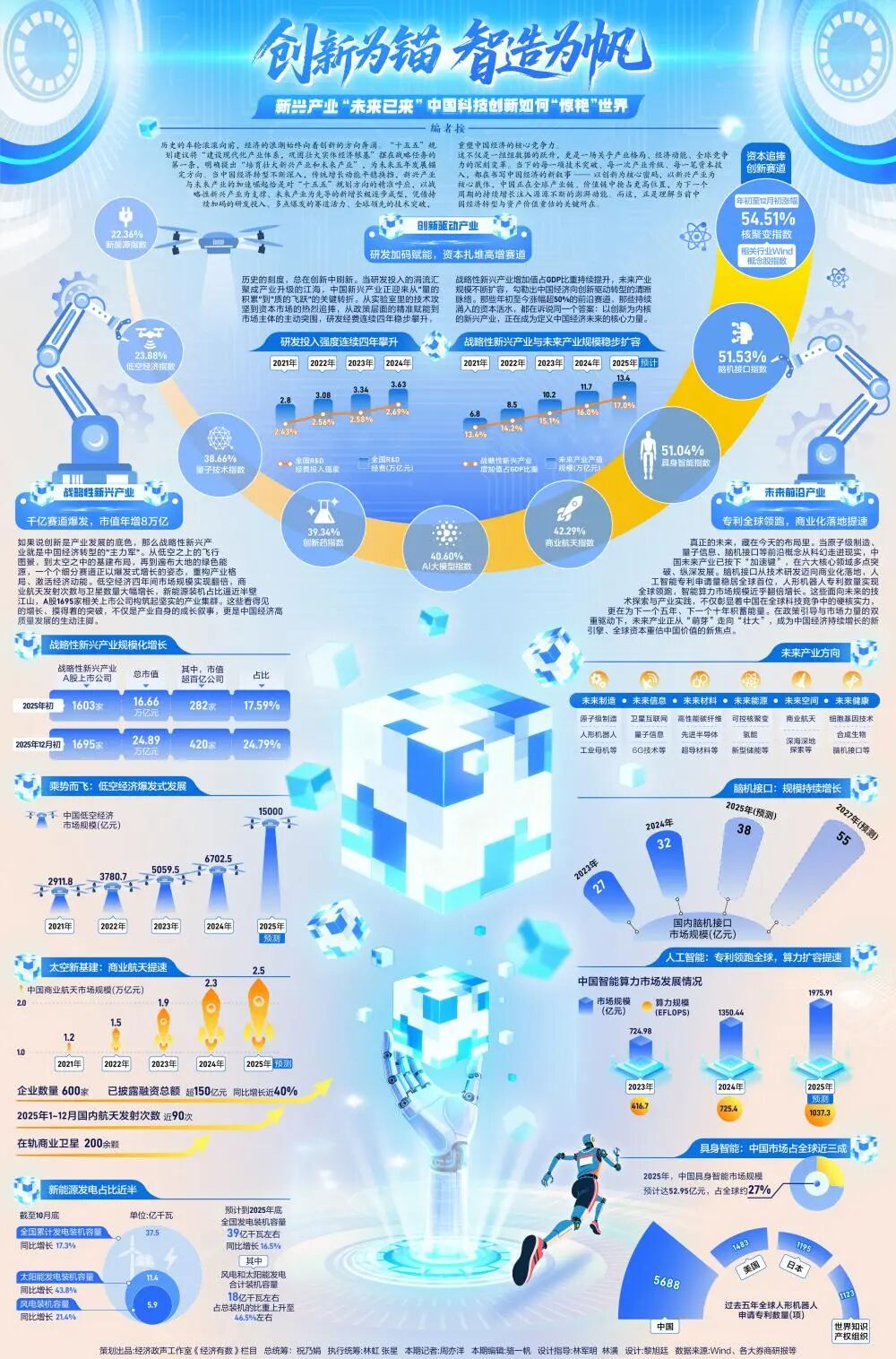
新兴产业“未来已来”,中国科技创新如何惊艳世界
2 1 Shi Ji Jing Ji Bao Dao· 2026-01-04 02:37
Group 1 - The core viewpoint emphasizes the importance of innovation in driving China's economic transformation and the rise of emerging industries as a response to the "14th Five-Year Plan" [1] - The plan highlights the construction of a modern industrial system and the strengthening of the real economy as strategic tasks, with a focus on nurturing emerging and future industries [1] - Continuous R&D investment and technological breakthroughs are reshaping China's core competitiveness in the global industrial and value chains [1] Group 2 - As of the end of October, China's installed power generation capacity reached approximately 3.9 billion kilowatts, with a year-on-year growth of 17.3% [3] - The share of renewable energy generation, particularly wind and solar power, has increased significantly, with solar power capacity growing by 43.8% year-on-year [3] - The humanoid robot market in China is projected to account for nearly 30% of the global market by 2025, with an expected market size of 5.295 billion yuan [3]
津沽新势能
Xin Hua She· 2026-01-04 01:02
Group 1: Future Industries - Tianjin is accelerating the development of future industries, focusing on synthetic biology and brain-machine interfaces, with 29 national key laboratories established and nearly 280 national and ministerial innovation platforms created [3][4] - He Yuan Biotechnology Co., a cell therapy company, has received approval for two domestically produced CAR-T drug indications and plans to expand production capacity and global layout [3] - The Tianjin University laboratory has developed a brain-machine interface system that allows for "thought control" through cell-driven technology [3] Group 2: Emerging Industries - Lenovo's new innovation technology park in Tianjin aims to achieve a production value of over 30 billion yuan by 2028, marking a significant strategic move for the company [6] - Tianjin has implemented strong measures to develop six industrial chains, including hydrogen energy and biomedicine, contributing to 30% of the industrial output value during the 14th Five-Year Plan period [6][7] - The Tianjin Yun Yao Aerospace Technology Co. has successfully developed a ship energy efficiency data management system, enhancing its position in the maritime engineering data alliance [6] Group 3: Traditional Industries - The Tianjin intelligent manufacturing base of CNOOC Engineering showcases advanced production methods, achieving significant energy savings and carbon emission reductions through automation [9] - The traditional brand "Ziyang" has undergone a digital transformation, revitalizing its production capabilities with smart manufacturing technologies [9] - Tianjin has 243 national-level green manufacturing units, with 12 key industrial chains accelerating their transition towards high-end, intelligent, and green development [10]

四川成都锦江区:构建未来产业体系 激活高质量发展动能
Xin Lang Cai Jing· 2026-01-03 23:23
Core Insights - Chengdu's Jinjiang District is actively developing a future industry system to stimulate high-quality economic growth through the "Future Industry High-Quality Development Action Plan (2025-2027)" [1] Group 1: Future Industry Development - The district is focusing on six cutting-edge tracks: intelligent 6G, brain-computer interfaces, quantum technology, embodied intelligence, low-altitude economy, and intelligent connected vehicles [3] - Jinjiang District has established a new development pattern featuring "1 leading area, 6 breakthrough tracks, and 'science and technology + application' dual-core drive" [1] Group 2: Technological Innovations - Chengdu XinNerve Technology Co., which specializes in brain-computer interface technology, has achieved a 91.67% accuracy rate in diagnosing autism, serving over 2,000 children since its establishment in the district [2] - The district has introduced key projects from institutions like Beijing University of Posts and Telecommunications to incubate significant technological achievements in intelligent 6G [3] Group 3: Ecosystem and Application - Jinjiang District is creating a dual-core geographical layout with "Chunxi Road + Science and Technology Bailu Bay" to facilitate the transformation of technological innovations into practical applications [4] - The Bailu Bay Technology Ecological Park is positioned as a new engine for future industries, leveraging leading enterprises and innovation platforms to streamline the conversion from technology to products [4] Group 4: Future Plans - The district aims to optimize future industry layout, build an ecosystem, and accelerate the transformation of achievements, striving to create a nationally influential future industry cluster and application demonstration area [5]
北京市科技型企业孵化器管理办法出台 市级孵化器在孵企业不少于30家
Xin Lang Cai Jing· 2026-01-03 22:19
Group 1 - The core focus of the incubators is on the development of high-tech industries and future industries, with capabilities in early-stage venture capital investment, self-funding investment, equity investment matching, and debt investment matching [1] - The newly issued "Management Measures for Technology-based Enterprise Incubators in Beijing" sets standards for municipal-level incubators, requiring them to have independent legal status, be registered and operational for at least one year, and focus on high-tech industry development [1] - Municipal-level incubators must provide entrepreneurial mentor training and guidance, possess early-stage investment capabilities, and have a professional and specialized operational team [1] Group 2 - The effectiveness of the incubators will be evaluated based on specific criteria, including having at least 30 incubated enterprises, with no less than 20% of newly registered enterprises in the previous year and at least 40% being technology-based SMEs [1] - At least five incubated enterprises should have been cultivated into national high-tech enterprises or unicorns in the previous year, with a national high-tech enterprise re-examination rate of over 75% [1] - The annual revenue or R&D expenditure of at least 30% of incubated enterprises should have increased by over 20% year-on-year [1] Group 3 - The application process for the 2025 municipal-level technology-based enterprise incubators in Beijing has commenced, with online application acceptance from January 26 to February 6, 2026 [2] - The recognition of municipal-level incubators is organized annually and is valid for three years, with the 2022 recognition period having expired and requiring re-evaluation according to the new management measures [2]
市级孵化器在孵企业不少于30家
Xin Lang Cai Jing· 2026-01-03 22:19
Group 1 - The core focus of the incubators is on the development of high-tech industries and future industries, with capabilities in early-stage venture capital investment, self-funding investment, equity investment matching, and debt investment matching [1] - The newly issued "Management Measures for Technology-based Enterprise Incubators in Beijing" sets standards for municipal-level incubators, requiring them to have independent legal status, be registered and operational for at least one year, and focus on high-tech industry development [1] - The management measures encourage incubators to employ full-time or dedicated technical managers and establish a full-process traceability mechanism for incubation and transformation [1] Group 2 - The effectiveness of incubators will be evaluated based on specific criteria, including having at least 30 incubated enterprises, with no less than 20% of newly registered enterprises in the previous year and at least 40% being technology-based SMEs [1] - At least five enterprises should be nurtured into national high-tech enterprises or unicorns in the previous year, with a review rate of national high-tech enterprises reaching over 75% [1] - A minimum of 30% of incubated enterprises should have a year-on-year revenue or R&D expenditure growth exceeding 20% [1] Group 3 - The application process for the 2025 municipal-level technology-based enterprise incubators has begun, with online applications accepted from January 26 to February 6, 2026 [2] - The recognition of municipal-level incubators is organized annually and is valid for three years, with the 2022 recognition period now expired, requiring re-evaluation according to the new management measures [2]
未来产业为什么要着手现在投入(读者点题·共同关注)
Ren Min Ri Bao· 2026-01-02 22:15
Core Viewpoint - The investment in future industries such as quantum technology, nuclear fusion, and brain-computer interfaces is essential despite their current low maturity and high uncertainty, as these innovations have the potential to drive significant societal advancements [1][2]. Group 1: Historical Context - Historical technological advancements like the steam engine and electricity, which initially faced skepticism, ultimately led to major industrial revolutions and societal progress [1]. - The current future industries may evolve into tomorrow's emerging and dominant industries, with significant investments from major economies to secure technological leadership and market influence [2]. Group 2: China's Practical Experience - China's technological breakthroughs today are the result of long-term investments made years ago, such as the successful push for 5G and the rapid growth of the new energy vehicle sector [3]. - The rapid pace of technological development necessitates a proactive approach to investment, as the window for opportunity in many fields is shrinking [3]. Group 3: National Strategy and Support - China ranks second globally in R&D expenditure and leads in the number of researchers, high-level international publications, and patent applications, providing a strong foundation for future industry development [4]. - The "14th Five-Year Plan" emphasizes the importance of forward-looking strategies for future industries, advocating for tailored approaches to avoid redundancy and overcapacity [4]. Group 4: Global Responsibility and Future Outlook - As the world's second-largest economy, China's exploration of future industries is not only vital for its own development but also aims to share technological advancements with humanity [5]. - The development of future industries is framed as a necessary endeavor, focusing on effective execution rather than questioning the need for such investments [5].
人形机器人跳秧歌、“苏超”万人喊加油,2025经济活力藏在哪?
Sou Hu Cai Jing· 2026-01-02 20:51
Group 1 - The core idea of the article emphasizes that China's economy is steadily advancing towards a "new and better" direction, driven by significant policy changes and technological advancements [2][19] - The "14th Five-Year Plan" is highlighted as a key policy document that focuses on investing in human capital, indicating a shift from merely accumulating resources to nurturing talent [4][19] - The military-to-civilian technology transfer is becoming increasingly evident, with advancements in defense technology spilling over into civilian applications, enhancing productivity and efficiency in various sectors [7][9] Group 2 - The rise of "new quality productivity" is discussed, showcasing how new technologies and models are being integrated into production processes, particularly through initiatives like "AI+" [9][11] - Emerging industries such as quantum technology, biomanufacturing, and hydrogen energy are gaining traction, with significant investment interest, reflecting a shift towards future-oriented sectors [11][19] - The "silver economy" is gaining momentum, driven by the increasing demand for smart products tailored for the elderly, indicating a growing market for age-friendly technologies [15][19] Group 3 - Cultural consumption is on the rise, with local sports leagues and creative products gaining popularity, showcasing a newfound confidence in Chinese culture and consumer preferences [17][19] - The article notes that the economic landscape is being shaped by a combination of policy support, technological innovation, and active consumer participation, creating a robust environment for growth [21] - The overall sentiment is optimistic, suggesting that as long as the current momentum continues, China's economic narrative will become increasingly vibrant and compelling [21]