
生成式人工智能

Search documents
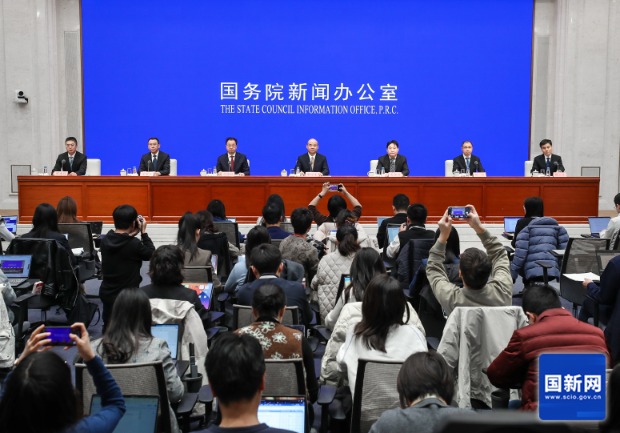
消费利好!六部门,联合解读
Zheng Quan Shi Bao· 2025-11-27 09:18
Core Insights - The State Council has introduced an implementation plan to enhance the adaptability of supply and demand for consumer goods, aiming to stimulate consumption and address mismatches in the market [1][7] Group 1: Key Consumption Areas - Three trillion-level consumption areas identified include elderly products, smart connected vehicles, and consumer electronics [2][5] - Ten billion-level consumption hotspots include baby products, smart wearable devices, cosmetics, fitness equipment, outdoor products, pet food, civilian drones, trendy toys, jewelry, and national trend clothing [2][5] Group 2: Market Trends and Growth Potential - The market for elderly products is projected to grow from 2.6 trillion yuan in 2014 to 5.4 trillion yuan by 2024, with a compound annual growth rate of 7.3% [5] - The demand for outdoor products and fitness equipment is increasing due to the rising health and fitness awareness among the population [5] Group 3: Implementation Strategies - The implementation plan includes measures to expand new technologies and innovative applications, enhance product supply, and create new consumption scenarios [7][8] - Emphasis on the application of new technologies such as generative artificial intelligence and 3D digital design to develop innovative consumer products [8] Group 4: Consumer Replacement Program - The consumer goods replacement program has generated over 2.4 trillion yuan in sales and benefited more than 360 million people in the first ten months of the year [10]

【特稿】调查显示德国使用人工智能人数显著增加
Xin Hua She· 2025-11-27 07:17
Core Insights - The use of generative artificial intelligence (AI) among Germans has significantly increased in recent years, with 65% of respondents having used it, up from 53% last year and 37% the year before [1][2] - The younger generation, particularly those aged 16 to 29, shows a high engagement with AI tools, with 91% using them in daily life [1] - Concerns about the risks associated with AI are prevalent, with 83% of respondents worried about the spread of misinformation and 89% believing that AI-generated content should be clearly labeled [2] Usage Statistics - 45% of AI users engage with the technology weekly, and 12% use it daily [1] - The primary applications of AI include information searching (72%), text processing (43%), inspiration seeking (38%), and translation (34%) [1] - The main reasons for using AI are to enhance productivity and for learning purposes, both at 61%, followed by 54% using it to simplify repetitive tasks [1] User Perception - 80% of users view AI merely as a tool without emotional connection, while 27% see it as a "coach" and 6% as a "friend" [2] - A significant portion of users (51%) tends to take AI-generated content seriously, especially video content, with 91% finding it increasingly difficult to discern truth from falsehood [2] - Concerns about data misuse are noted, with 50% expressing worries but few taking preventive measures [2]
东兴证券晨报-20251127
Dongxing Securities· 2025-11-27 07:13
Core Insights - The report highlights the trend of the logistics industry shifting from quantity competition to quality development, driven by the "anti-involution" movement, which aims to improve profitability and service quality [8][10] - The company has adjusted its business volume guidance for the year to 38.2-38.7 billion pieces, reflecting a year-on-year growth of 12.3%-13.8%, down from the previous guidance of 38.8-40.1 billion pieces [8][10] - The company's single ticket revenue has shown a slight increase of 1.7% year-on-year, reaching 1.21 yuan per ticket, indicating a recovery in revenue despite previous declines [9][10] Company Performance - In Q3 2025, the company achieved a business volume of 9.573 billion pieces, a year-on-year increase of 9.8%, while its market share decreased by 0.6 percentage points to 19.4% [8] - The adjusted net profit for Q3 was 2.506 billion yuan, reflecting a year-on-year growth of 5.0% [8] - The company reported a decrease in single ticket core costs by 0.04 yuan, with transportation costs dropping from 0.39 yuan to 0.34 yuan, contributing to improved profitability [9][10] Industry Trends - The logistics industry is experiencing a decline in overall volume growth, with industry growth rates dropping from 12.7% in September to 7.9% in October [8] - The report notes that the "Double Eleven" shopping festival saw lower-than-expected volume growth, further impacting industry dynamics [8] - The focus on quality over quantity is expected to continue, with the company anticipating a decline in volume growth but an increase in single ticket profitability in Q4 [10]






中国传媒大学新媒体研究院院长赵子忠:主流媒体的核心价值在于驾驭“人机共生”的新型影响力
Mei Ri Jing Ji Xin Wen· 2025-11-27 05:55
Core Insights - The "2025 Smart Media 50 People Conference" held in Chengdu focuses on the theme "Smart Media Empowering Parks, Integrating to Enhance Value" and showcases the commitment of mainstream media to embrace technological transformation [1][6] - The conference marks its fourth year and has attracted over a hundred experts from academia and leading media companies, highlighting the importance of AI integration in media [1][6] - The event featured the launch of the "Rain Swallow Communication Intelligent Platform" and several significant project signings, demonstrating the capabilities of mainstream media in the "Smart+" transformation [1][6] Industry Trends - The integration of AI technology into media is seen as a historical necessity, with the "Smart Media 50 People Conference" serving as a strategic initiative to explore this transformation [6][10] - The evolution of AI from a tool to an autonomous agent is reshaping media production relationships, indicating a shift towards "human-machine symbiosis" [2][8] - The concept of "Agentic Media" is anticipated to emerge by 2030, where AI will play a significant role in media operations, leading to a new theoretical framework [12][13] Technological Developments - The current phase of AI in media is characterized by early-stage research and application innovations, with a need for deeper understanding of AI's philosophical implications [8][10] - The future media landscape is expected to be built on advanced infrastructure, including supercomputing centers and large-scale databases, fundamentally changing content production and distribution [12][13] - The interaction model will evolve to include machine-to-human and machine-to-machine communication, expanding the boundaries of media [12][13] Media's Role and Value - The core value of media professionals remains their influence on society, which will be enhanced by AI, allowing for more precise and impactful content production [11][10] - Understanding the interplay between AI and the economy is crucial for financial media to navigate the challenges and opportunities presented by technological advancements [10][11] - The transformation of media will not lead to job losses but will create new roles and opportunities as the industry adapts to AI integration [12]

工信部:未来的消费不再是购买一件商品,而是订阅一种生活
Sou Hu Cai Jing· 2025-11-27 04:45
Core Viewpoint - China's consumer goods supply has entered a new development stage characterized by high quality and reasonable pricing, meeting the basic needs of the population, but structural mismatches in supply and demand still exist in certain sectors [1][5][9]. Group 1: Supply and Demand Issues - There are structural mismatches in supply and demand, with some products experiencing oversupply while high-quality offerings remain insufficient, particularly in high-end brands for jewelry, bags, and cosmetics [1][5][9]. - The transition from old to new growth drivers is ongoing, with a lack of innovative products that meet the quality and personalization demands of consumers [1][5][9]. - Certain consumer hotspots, such as elderly care, cultural tourism, and smart consumption, have strong demand, but the supply of personalized products like elderly care items and smart devices is inadequate [1][5][9]. Group 2: Implementation Plan - The Ministry of Industry and Information Technology (MIIT) has jointly issued an implementation plan to enhance the adaptability of consumer goods supply and demand, which includes the application of generative artificial intelligence and 3D digital design tools [1][5][9]. - The plan aims to develop AI terminal products that provide entertainment, health, and companionship services [1][5][9]. Group 3: AI Product Development - As of mid-2023, the user base for generative AI products in China has reached 515 million, with continuous expansion of application scenarios and a surge in new AI terminal products [6][10]. - The MIIT will focus on product and scenario innovation to accelerate the integration of AI technology in the consumer goods sector [6][10]. Group 4: Digital Transformation - The MIIT plans to promote the integration of AI and big data technologies to build a digital ecosystem that encompasses user needs, intelligent design, flexible production, and precise services [6][10]. - In the home appliance sector, there is support for developing smart appliance ecosystems based on user behavior data, which has already shown positive user feedback [6][10]. Group 5: Scenario Expansion - The MIIT has released 213 application scenarios for digital technology to enhance product variety, quality, and branding, aiming to identify solutions that address industry pain points and improve manufacturing efficiency [7][11]. - In the "AI + smart home" scenario, the MIIT will promote the development of interconnected smart home systems, creating immersive and proactive smart living experiences [7][11]. - In the "AI + health and elderly care" scenario, initiatives will focus on developing rehabilitation aids, health monitoring products, and humanoid robots to transition from mechanical care to emotional companionship [7][11].

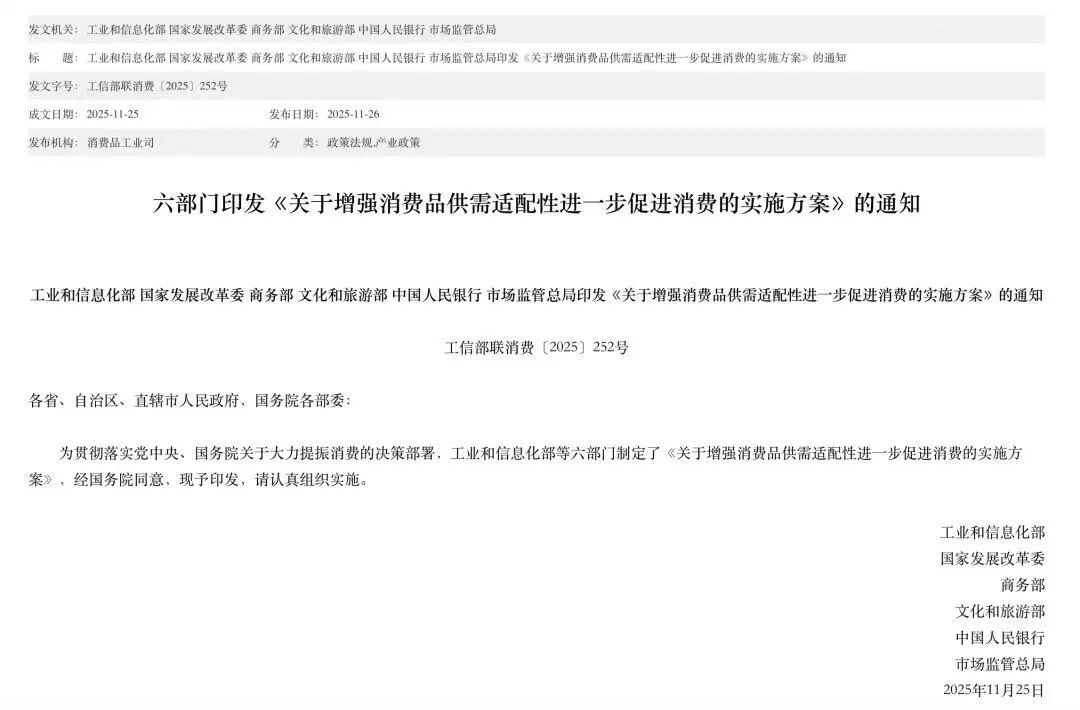
六部门合力优化供给 到2027年形成3个万亿级消费领域
Zheng Quan Shi Bao· 2025-11-26 18:16
Core Viewpoint - The Ministry of Industry and Information Technology and five other departments issued a plan to enhance the adaptability of supply and demand in consumer goods, aiming for consumption upgrades to lead industrial upgrades and achieve a dynamic balance between supply and demand [1][2]. Group 1: Development Goals - The plan outlines a two-step development goal: by 2027, the supply structure of consumer goods will be significantly optimized, forming three trillion-level consumption sectors and ten hundred-billion-level consumption hotspots; by 2030, a high-quality development pattern of mutual interaction between supply and consumption will be basically formed, with a steady increase in the contribution rate of consumption to economic growth [1]. Group 2: Key Tasks - The plan deploys 19 key tasks across five areas: expanding incremental supply, deepening existing supply, segmenting markets, empowering scenarios, and optimizing the environment [1]. - In expanding incremental supply, the focus is on innovation in technology and models, particularly in smart connected new energy vehicles, smart home products, and consumer electronics [2]. - The "Thousand Factories, Thousand Faces" transformation plan aims to cultivate flexible manufacturing factories in industries such as home appliances, furniture, and cosmetics, enhancing production responsiveness to personalized demands [2]. Group 3: Artificial Intelligence and Market Optimization - The plan emphasizes the role of artificial intelligence, promoting the application of generative AI and 3D digital design across the consumer goods sector, and encourages the development of smart home products and experience centers for elderly-friendly products [2]. - For optimizing existing markets, the plan aims to expand the supply of unique and new products, particularly in leisure, sports, and health consumption sectors, addressing new demands from event and outdoor economies [2]. Group 4: Targeted Supply Matching - The plan specifies supply matching requirements for different consumer groups, including children, students, fashion items, and elderly products, encouraging actions to promote quality elderly products and home modifications for the elderly [3]. - It also highlights the importance of a favorable consumption environment, reinforcing financial support through fiscal subsidies and special loans to support technological innovation and product upgrades in consumer goods companies [3]. Group 5: Implementation and Coordination - The Ministry of Industry and Information Technology will work with relevant departments to promote the plan, strengthen collaboration, and guide local regions and industry associations in its implementation, aiming to continuously create new consumer products, scenarios, and hotspots to unleash consumption potential [3].
重庆制造业筑基强市之路 2027年工业总量将达4万亿元
Zhong Guo Jing Ying Bao· 2025-11-26 17:06
Core Viewpoint - Chongqing is focusing on building a modern manufacturing cluster system called "33618" to enhance its industrial capabilities, aiming for an industrial output of 4 trillion yuan by 2027, with significant growth in key sectors such as intelligent equipment, food processing, and software services [1][2]. Group 1: Manufacturing Development - The manufacturing sector is the foundation of Chongqing's economy, with a target industrial output exceeding 2.7 trillion yuan by 2024 [1]. - The city has established a solid industrial base covering 39 industrial categories and all 31 categories of manufacturing [1]. - Chongqing's logistics system has achieved connectivity with 127 countries and regions globally, enhancing its industrial competitiveness [1]. Group 2: Key Industries - The three leading industries in Chongqing are experiencing significant growth, particularly in intelligent connected vehicles, with an expected production of 953,000 units in 2024 [2]. - The new generation of electronic information manufacturing is leading globally, with notebook computer production ranking first worldwide [2]. - The advanced materials industry has made breakthroughs, notably in nylon 66, breaking international monopolies [2]. Group 3: Industrial Cluster System - The "33618" modern manufacturing cluster system aims to promote high-quality development in manufacturing, focusing on three trillion-yuan leading industry clusters: intelligent connected vehicles, new generation electronic information manufacturing, and advanced materials [2]. - The system also includes upgrading to 500 billion yuan pillar industry clusters in intelligent equipment, food processing, and software services, along with developing six billion-yuan specialty industry clusters [2]. Group 4: Talent Development - The "14th Five-Year Plan" emphasizes the need for a high-quality technical talent pool to support industrial modernization and technological advancements [3]. - The third National Industrial and Information Technology Skills Competition focuses on integrating talent development with industry needs, promoting new technologies and processes [3].
重大利好来了!国务院同意→
Jin Rong Shi Bao· 2025-11-26 11:20
Core Viewpoint - The implementation plan aims to enhance the adaptability of consumer goods supply and demand, leading to consumption upgrades that drive industrial upgrades, thereby achieving a dynamic balance between supply and demand at a higher level [1][4]. Policy Framework - The plan is jointly issued by multiple government bodies, including the Ministry of Industry and Information Technology, the National Development and Reform Commission, and others, marking it as a significant policy document following the Fourth Plenary Session of the 20th Party Congress [1][2]. Goals and Targets - By 2027, the supply structure of consumer goods is expected to be significantly optimized, forming three trillion-level consumption sectors and ten hundred-billion-level consumption hotspots [4]. - By 2030, a high-quality development pattern characterized by positive interaction between supply and consumption is anticipated, with a steady increase in the contribution of consumption to economic growth [4]. Industry Focus Areas - The plan emphasizes the development of new fields and tracks, focusing on key industries such as smart connected vehicles, smart home products, consumer electronics, modern textiles, food, and green building materials [5]. - It encourages the integration of artificial intelligence across the entire consumer goods industry, promoting the development of AI-enabled products like household service robots and smart appliances [5]. Sports and Health Products - The plan aims to enhance the supply of leisure and sports products, targeting new demands from the sports economy, outdoor economy, and ice and snow economy [6]. - It supports the innovation and development of health products, including special dietary foods and high-end medical devices, while promoting the consumption of organic and geographical indication agricultural products [6]. Diverse Consumer Interests - The plan seeks to expand the supply of interest-based consumer products, including pet-related items, anime, and trendy products, while also promoting low-altitude tourism and private flying [7]. - It encourages the development of local intellectual property and innovative design in cultural products, as well as the transformation of traditional retail spaces to include trendy stores [7]. Customization and Experience - The plan emphasizes the need for precise matching of consumer needs, particularly in the baby and children's product sector, and encourages the development of high-end fashion brands and personalized services [8]. - It promotes the creation of immersive consumer experiences through the use of digital technologies, including virtual reality and the metaverse [10]. Financial Support and Services - The plan highlights the importance of financial support for the consumer goods industry, including policies for equipment upgrades and trade-in programs, as well as enhancing the adaptability and convenience of consumer financial services [11].
帝欧水华:拟5年内以自有及自筹资金实缴5亿注册资本金
Xin Lang Cai Jing· 2025-11-26 08:04
Core Viewpoint - The company is expanding into the generative artificial intelligence sector through its subsidiary, Shuihua Future, with a registered capital of RMB 500 million, aiming to complete the capital contribution within five years [1] Group 1: Capital Contribution - The registered capital for Shuihua Future is RMB 500 million [1] - The company plans to use its own and self-raised funds to fulfill the capital contribution over a period of five years [1] - The company will ensure the stability of its existing business while gradually advancing new project expansions [1] Group 2: Financial Management - The company emphasizes the importance of reasonable allocation of its own funds [1] - There is a focus on ensuring the safety of investment funds and maintaining efficiency and controllability in fund usage [1]

【特稿】调查:英国25%全科医生使用AI 多数未经培训
Xin Hua She· 2025-11-26 06:23
调查:英国25%全科医生使用AI 多数未经培训 乔颖 一项针对英国全科医生生成式人工智能(AI)使用情况的最新年度调查显示,如今英国有更多全科医生在 工作中使用生成式人工智能,但大部分没有接受过专业培训。相关研究人员说,这种情况存在风险,需 要警惕。 据英国天空新闻频道25日报道,这是针对英国全科医生使用生成式人工智能的最大规模年度调查。接受 调查的医生中,约有25%过去12个月在日常临床工作中使用了人工智能工具,而在去年调查中,这一比 例约为五分之一。使用者中,约35%借助人工智能写病历,27%将人工智能用于协助鉴别诊断,用于完 成治疗方案或转诊建议的分别占比24%。 研究人员今年年初在线调查了英国各地1005名全科医生在日常临床工作中使用ChatGPT等人工智能工具 的情况,得出上述结论。调查对象大致男女各占一半,54%的人年龄不低于46岁。研究人员来自瑞典乌 普萨拉大学、瑞士巴塞尔大学、瑞典卡罗琳医学院、英国曼彻斯特大学和美国哈佛大学医学院。 使用人工智能工具的医生中,71%表示这些工具总体上减轻了工作负担,但95%承认未接受过使用生成 式人工智能的专业培训,约85%表示雇主现阶段并未鼓励他们使用这一技 ...