劳动生产率

Search documents
内卷的解药不是涨价
海豚投研· 2025-06-27 11:59
Core Viewpoint - The article discusses the evolution of competition in the business landscape from price-cutting strategies to concerns about "low-price internal competition," highlighting the complexities of pricing, quality, and value addition in manufacturing and consumer goods [1][2]. Group 1: Pricing Dynamics - The article argues that the decline in prices is often linked to increased market scale and fragmented market structures, where larger consumer bases lead to heightened price sensitivity [5][6]. - It emphasizes that price reductions are not necessarily indicative of lower quality but can result from economies of scale and advancements in production technology [4][5]. - The case of air purifiers illustrates that while average prices fell by 34% since 2016, production volume increased by 53%, indicating a growing market demand [5][6]. Group 2: Value Addition and Quality - The article questions where the added value comes from when prices rise, suggesting that without improvements in product attributes or production processes, price increases may not lead to sustainable benefits for supply chains or employee wages [14][15]. - It highlights that true consumption upgrades occur when previously unaffordable products become accessible to a broader audience, rather than merely shifting consumer preferences to higher-priced items [15][16]. - The concept of "white label" products and alternatives arises from the competition based on cost rather than genuine value addition, which can lead to a race to the bottom in pricing [15][16]. Group 3: Market Structure and Competition - The article notes that as market structures stabilize and consolidate, price competition diminishes, leading to a more sustainable pricing environment among major players [9][10]. - It points out that in a mature market, companies may find themselves in a "consumption war," where the focus shifts from aggressive pricing to maintaining market share and profitability [9][10]. - The narrative suggests that the characteristics of entrepreneurs are often shaped by the industry dynamics they operate within, particularly in stable or stagnating markets [11][12]. Group 4: Labor and Productivity - The article argues that the solution to low-price internal competition is not to eliminate low-priced goods but to enhance labor productivity, drawing parallels to historical examples like Ford's assembly line innovations [23][24]. - It emphasizes that the value created in manufacturing comes from human knowledge and skills rather than just raw materials and production processes [19][21]. - The discussion includes the importance of recognizing and rewarding the intellectual contributions of workers, which can lead to higher market valuations for products and services [28][29].



内卷的解药不是涨价
虎嗅APP· 2025-06-23 23:45
Core Viewpoint - The article discusses the evolution of business competition from price-cutting strategies to concerns about low-price competition, emphasizing the need for value creation beyond just lowering prices [3][4]. Group 1: The Origin of Low Prices - Low prices in the market arise from large-scale standardized production, which reduces costs through economies of scale [5][6]. - The price of consumer goods, such as televisions and air conditioners, has significantly decreased due to advancements in production technology and increased market scale [6][7]. - The decline in average prices of household air purifiers by 34% since 2016 correlates with a 53% increase in production volume, indicating that market expansion drives price reductions [8][9]. Group 2: Value Addition - The article argues that simply raising prices does not guarantee increased profits or improved supply chain conditions if the product's core attributes remain unchanged [18][19]. - True consumption upgrades occur when previously unaffordable products become accessible to a broader audience, rather than merely shifting from one expensive brand to another [19][20]. - The emergence of "white label" products reflects a competitive market where price is prioritized over added value, highlighting the need for innovation and differentiation [20][21]. Group 3: Understanding Labor - Improving labor productivity, rather than eliminating low-priced goods, is essential for escaping the cycle of low-price competition [27][28]. - Historical examples, such as the introduction of assembly lines, demonstrate that technological advancements can significantly enhance productivity and reduce costs [27][28]. - The article emphasizes that the value of labor should be recognized and compensated appropriately, moving beyond traditional manufacturing roles [30][31]. Group 4: Conclusion - The article concludes that the key to overcoming low-price competition lies in enhancing human value and creativity, rather than relying solely on cost-cutting measures [33][34]. - It advocates for a shift in perspective, recognizing that the true value of products comes from human innovation and design, rather than just material costs [34][35].


花旗:美股长期基本面稳健 生产率提升成利润率上行主要驱动力
智通财经网· 2025-06-23 08:27
Group 1 - The core viewpoint of the report is that the increase in profit margins has supported the rise in U.S. stock valuation multiples, with over half of the improvement in EBITDA margins for S&P 500 companies since the financial crisis attributed to increased labor productivity [1] - The report indicates that there is a significant correlation between actual GDP and non-farm labor productivity with changes in S&P 500 EBITDA margins, with productivity growth having a leading relationship that better explains the significant changes in profit margins since the 2008 financial crisis [1][2] - Factors such as technological innovation, transition to asset-light models, and the increasing share of service-oriented businesses have positively impacted profit margins and driven structural increases in U.S. labor productivity, differentiating it from other developed economies like Germany and France [1] Group 2 - A linear regression model established by the company shows that non-farm labor productivity explains approximately 55% of the improvement trend in S&P 500 EBITDA margins since the financial crisis [2] - The unexplained EBITDA margins are closely related to three factors: inflation, capacity and capital, and output levels, with inflation differentials being particularly significant [2] - The report suggests that while productivity growth may stabilize post-pandemic, it could help maintain profit margins at high levels, although there are concerns about potential negative impacts from weakened consumer spending or increased tariffs [2] Group 3 - The company remains optimistic about the long-term fundamentals of the S&P 500 index, believing that continued improvements in labor productivity will support profit margins [3] - Challenges anticipated in 2025 include direct impacts from tariffs and indirect effects from policy uncertainty on consumer and business confidence, which is reflected in the downward adjustment of the company's EPS forecast for the S&P 500 index [3]

专访莫斯科副市长巴格丽娃·玛丽亚:大型体育赛事将为中小企业创造发展机会|十五运世界观
2 1 Shi Ji Jing Ji Bao Dao· 2025-06-13 08:00
Core Insights - The event hosted by the World Association of Major Cities in Guangzhou focused on urban sustainability, digital transformation, and inclusive development, with participation from 19 cities and 5 international organizations [1] - Moscow's economy is projected to grow nearly 8% in 2023 and at least 5% in 2024, driven by a diversified economic structure and significant infrastructure investments [2] - The city is addressing labor shortages through education and training initiatives, emphasizing lifelong learning and productivity improvements [3][4] Economic Growth and Investment - Moscow's economic resilience is attributed to its diverse industries, including finance, IT, construction, and services, which help maintain growth amid global uncertainties [2] - Continuous investment in major infrastructure projects, particularly in transportation, is creating new economic hubs and attracting private investment [2] - The city has established a supportive environment for high-potential industries, including technology parks and infrastructure to foster innovation [2] Labor Market and Education - The demand for workers in Moscow has surged due to rapid economic growth, leading to a historically low unemployment rate [3] - The city is focusing on enhancing educational programs to ensure that graduates possess relevant skills and a mindset for continuous learning [3][4] - Initiatives are in place to improve labor productivity by helping businesses optimize operations and better utilize technology [3][4] Sports Events and Economic Impact - Hosting large sports events is viewed as a strategic move for cities, providing long-term infrastructure benefits and economic opportunities [6] - Major events attract tourists, boosting sectors such as hospitality, retail, and dining, while creating opportunities for small and medium enterprises [6][7] - Tourism currently accounts for approximately 4% of Moscow's economy, driven by a vibrant calendar of events and cultural activities [7]
美国第一季度生产率终值环比下降1.5%
news flash· 2025-06-05 12:49
Core Viewpoint - The U.S. Bureau of Labor Statistics reported a 1.5% quarter-over-quarter decline in non-farm employee labor productivity for the first quarter [1] Group 1 - The final value of non-farm employee labor productivity for Q1 showed a significant decrease compared to the previous quarter [1]
盛松成:消费如何促进投资并形成良性循环 | 宏观经济
清华金融评论· 2025-05-20 10:30
Core Viewpoint - The article emphasizes the importance of increasing consumption rates in China to promote stable economic growth and enhance investment efficiency, highlighting the interdependent relationship between consumption and investment [1][10]. Group 1: Relationship Between Consumption and Investment - The traditional "three drivers" model (consumption, investment, net exports) often leads to a fragmented view of the relationship between consumption and investment, which are actually interrelated and should not be viewed in isolation [3][5]. - In the short term, consumption and investment may appear to compete for resources, but over the long term, investment can enhance future consumption by creating jobs and increasing income [6][10]. - The article argues that consumption is the ultimate goal of economic activity, as it relates to national welfare and the pursuit of a better life, thus reinforcing the need for a balanced approach to consumption and investment [5][10]. Group 2: Causal Relationship and Economic Models - The article discusses how investment can stimulate consumption by creating jobs and increasing disposable income, while strong consumer demand can drive investment decisions by businesses [6][21]. - It highlights that the relationship between consumption and investment can change over time, particularly in the context of China's economic transition from a planned to a market economy [10][22]. - Economic growth models, such as the Solow model, emphasize the importance of both consumption and investment, suggesting that an optimal balance is necessary for sustainable growth [12][13]. Group 3: Comparison of Consumption and Investment in China and the U.S. - Data from the World Bank indicates that China's capital formation as a percentage of GDP has fluctuated significantly, peaking at 46.7% in 2011, while U.S. capital formation has remained relatively stable between 20% and 26% [14][16]. - The article notes that during economic downturns, U.S. consumption tends to increase as investment declines, contrasting with China's rising capital formation during similar periods [16][17]. - The current consumption rate in China is still below the optimal level, indicating a need for a shift in the economic growth model from investment-driven to consumption-driven [17][22]. Group 4: Promoting a Positive Cycle Between Consumption and Investment - The 2023 Central Economic Work Conference report suggests two methods to promote a virtuous cycle between consumption and investment: stimulating potential consumption and expanding effective investment [19][20]. - The article asserts that consumption is crucial for economic stability, as it tends to be more stable than investment, especially during periods of economic uncertainty [21][22]. - It concludes that fostering a positive interaction between consumption and investment is essential for both short-term economic growth and long-term sustainable development [22].

中金:走出金融周期底部的政策与资产含义
中金点睛· 2025-05-13 23:39
Core Viewpoint - The current economic adjustment in China is characterized by a weak inflation cycle under a declining financial cycle, with productivity being a crucial dimension for analysis [1][8]. Financial Cycle - The financial cycle is defined as the long-term interaction between credit and housing prices, with a downward trend leading to credit contraction and insufficient domestic demand [9]. - During the financial cycle's expansion, productivity did not improve synchronously, indicating inefficient allocation of credit resources [12][19]. - The current financial cycle in China has seen a concentration of funds and labor in low-efficiency sectors, particularly real estate, leading to a decline in overall productivity growth [12][22]. Policy Implications - Historical experience suggests that during a declining financial cycle, both monetary and fiscal policies should be coordinated to stimulate the economy [2][33]. - The intensity of monetary and fiscal policies tends to increase as the negative impact of the cycle deepens, with a typical lag of 3 to 4 years before economic stabilization occurs [2][40]. - Current monetary policy efforts in China are relatively weaker compared to international averages, indicating room for further action [34][40]. Asset Implications - Accelerated policy efforts are expected to stabilize and potentially increase asset prices, with historical data showing that housing and stock prices tend to recover after initial declines [4][55]. - In the context of China's current economic environment, sectors such as finance, real estate, and technology are likely to perform better as policies are implemented [63]. - The ongoing global rebalancing of funds and a weak dollar environment may favor the revaluation of Chinese assets, particularly in light of domestic policy support [5][70]. Economic Development Trends - China's GDP growth from 2020 to 2025 is projected to significantly outperform international averages, attributed to factors such as manufacturing scale effects and pre-existing monetary and fiscal policy support [22][23]. - Price levels in China have shown similarities to international low-price differentiation scenarios, with a notable demand gap impacting inflation [23][24]. - The housing market in China has experienced a cumulative decline of 14% since the peak, which is more severe than the international average [24][26]. Conclusion - The analysis of the current economic cycle in China through the lenses of financial cycles, productivity, and price levels provides valuable insights into potential policy and asset performance [1][22].

美国遭遇劳动生产率三年首降 用人成本飙升敲响通胀警钟
智通财经网· 2025-05-08 13:53
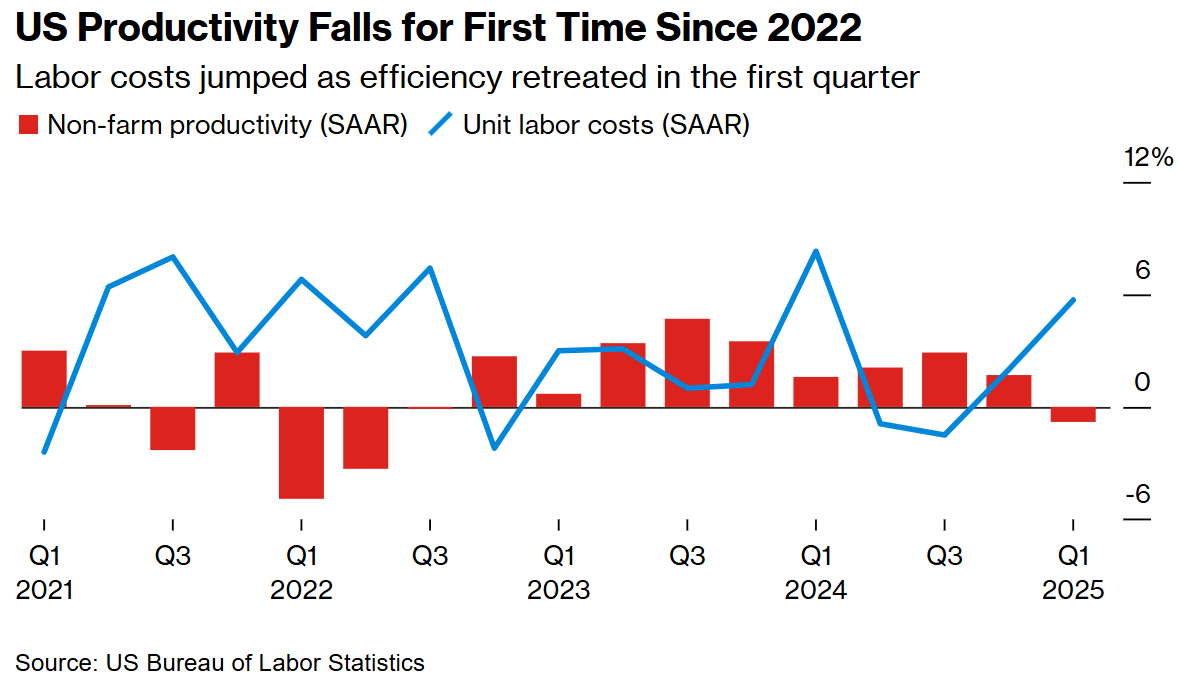
Group 1 - The U.S. labor productivity declined for the first time in nearly three years in Q1, primarily due to a decrease in economic output, interrupting the previous trend of efficiency improvements that helped alleviate employment cost inflation [1][4] - Non-farm employee output per hour annualized fell by 0.8%, with the previous value revised to a growth of 1.7% [1] - The decline in labor productivity led to a surge in unit labor costs, which increased by 5.7% in Q1, marking the largest rise in a year [1][4] Group 2 - The drop in productivity was mainly attributed to a 0.3% decrease in corporate output, as indicated by recent GDP data suggesting a contraction due to trade factors, despite an increase in hours worked [4] - Short-term productivity growth may remain under pressure as companies delay investment plans while awaiting clearer U.S. trade and tax policies [4] - The Trump administration is attempting to stimulate domestic manufacturing and investment through tariffs, while post-pandemic productivity gains and an influx of immigrants are seen as key drivers for economic growth and inflation control [4] Group 3 - Federal Reserve officials are closely monitoring productivity data, as improvements driven by technological upgrades, including artificial intelligence, could help curb wage inflation [4] - Labor costs represent the largest expense for most companies, prompting them to seek new technologies and equipment upgrades to enhance efficiency and mitigate inflationary pressures from wage increases [4] - Despite high borrowing costs, ongoing inflation, and economic uncertainty leading some companies to invest selectively, many are still focused on improving efficiency [4] Group 4 - Manufacturing productivity surged by an annualized 4.5%, the largest increase in nearly four years, with factory output rising by 5.1%, likely reflecting increased production of commercial aircraft [4] - Another report indicated that initial jobless claims in the U.S. fell to 228,000, suggesting limited layoffs [4]
企业产出下滑拖累,美国劳动生产率自2022年以来首次下降
Hua Er Jie Jian Wen· 2025-05-08 13:41
Group 1 - U.S. labor productivity has declined for the first time since 2022, with a 0.8% annualized decrease in Q1, surpassing economists' expectations of a 0.7% decline [1] - Unit labor costs surged by 5.7% in Q1, marking the largest increase in a year, exceeding the anticipated 5.1% rise [1] - The Federal Reserve is closely monitoring these productivity figures, as improvements in productivity are crucial for controlling wage inflation [1] Group 2 - The decline in productivity is primarily attributed to a 0.3% decrease in business output, which was also reflected in the Q1 GDP data showing an annualized initial value of -0.3% [2] - Labor costs have increased by 1.3% year-over-year, with hourly wages rising to 4.8%, a 2.7% increase compared to the previous year [3] - Despite overall negative data, the manufacturing sector showed strong performance, with productivity increasing by 4.5% in Q1, the highest in nearly four years [3]