
大健康

Search documents
信邦制药:确保公司长期稳健的发展和经营
Zheng Quan Ri Bao Wang· 2026-01-15 08:43
Core Viewpoint - The company, Xinbang Pharmaceutical, emphasizes its commitment to a business structure centered around medical services, supplemented by pharmaceutical distribution and traditional Chinese medicine manufacturing, aiming for sustainable and steady development through innovation and exploration of new business models [1] Business Strategy - The company plans to deepen and explore the potential of industry development while maintaining daily operations [1] - It aims to develop and sell health products and explore the construction and operation of new-style traditional Chinese health care centers [1] - The company is focused on actively expanding its business model and continuously innovating its operational strategies to enhance quality and efficiency [1]

汉王科技20260114
2026-01-15 01:06
Summary of Hanwang Technology Conference Call Company Overview - Hanwang Technology focuses on AI technology and its application in various industries, including judicial and financial sectors, with a strong emphasis on intelligent interaction and multimodal big data services [2][3] Key Business Segments - **Intelligent Interaction Business**: This is the cornerstone of Hanwang's operations, generating approximately 1 billion yuan in annual revenue [2][3] - **Multimodal Big Data Business**: Utilizes OCR and cognitive intelligence to serve B2B clients in sectors such as judicial and financial [3] - **AI Intelligent Terminals**: Products include smart writing pads and blood pressure monitors, continuing the strategy of integrating hardware and software [2][3] Product Innovations - **Personal Digital Office Products**: Hanwang has launched innovative products like smart writing pads, readers, and digital pens, all embedded with AI features for enhanced functionality [6] - **Blood Pressure Monitors**: The company has improved measurement accuracy using an AI auscultation model, achieving precision within ±1 mmHg [7] Market Expansion Plans - **Sales Channels for Blood Pressure Monitors**: Hanwang plans to gradually expand sales channels from online to OTC and hospital channels between 2026 and 2028, although specific sales targets are not yet defined [8] - **Revenue Goals**: For 2026, the internal revenue target is set between 60 million to 80 million yuan, with a maximum goal of reaching 100 million yuan, aiming for annual growth rates of 50% to 100% [9] International Market Strategy - **Overseas Market for Smart Writing Pads**: Currently focused on the domestic market, Hanwang plans to launch 3-5 new products in 2026 for the overseas brand Pencil, expecting sales growth exceeding 100% and revenue around 30 million yuan [11] AI Application Achievements - Hanwang has received national awards for its AI applications, particularly in video analysis for elder care and privacy protection technologies [4][5] Future Outlook - Hanwang aims to maintain growth momentum despite a challenging economic environment, focusing on key projects and improving capital efficiency to achieve annual growth targets and profitability [14] Unique Selling Propositions - **Differentiated Technology**: Hanwang's machine dog technology is noted for its high simulation and intelligent processing capabilities, primarily targeting the security sector [12] - **Niche AI Models**: The company focuses on niche verticals for its large model strategy, avoiding direct competition with major players like Deepseek [13] This summary encapsulates the key points discussed in the conference call, highlighting Hanwang Technology's strategic focus, product innovations, market expansion plans, and future outlook.

盛赞冰雪魅力 共促中泰交流
Xin Lang Cai Jing· 2026-01-14 22:46
Group 1 - The visit of the Thai delegation led by Pochin Ponglajun to Harbin highlights the city's appeal as a winter tourism destination, emphasizing the unique experience of its ice and snow scenery [1][2] - The delegation's activities included attending cultural events and engaging in discussions on education, culture, and tourism, showcasing the potential for deeper cooperation between Thailand and Harbin [1] - The "Princess Sirindhorn Scholarship" program at Harbin Engineering University concluded with eight Thai students completing their Chinese language and cultural experience, indicating a successful educational exchange [1] Group 2 - The delegation's visit included a tour of Harbin Institute of Technology's Aerospace Museum, where discussions on collaboration in fields such as health, aerospace, and artificial intelligence took place, indicating a focus on academic partnerships [2] - Data shows a significant increase in tourism exchanges, with 23 charter flights from Thailand planned for the 2024-2025 winter season, carrying over 8,000 passengers, and a new winter route from Harbin to Bangkok set to operate 17 flights during the peak season [2] - The delegation expressed enthusiasm for promoting mutual tourism between Thailand and Harbin, highlighting the importance of cultural and tourism exchanges in strengthening bilateral relations [2]
全国每10朵银耳有9朵来自这座福建小城
Xin Hua She· 2026-01-13 05:44
Core Viewpoint - Gutian County, known as the "Mushroom Capital of China," has become a leading producer of edible fungi, particularly silver ear mushrooms, with 90% of the national output coming from this region [1][4]. Industry Overview - By 2025, the total output value of the edible mushroom industry chain in Gutian County is projected to reach 31.5 billion yuan, with products exported to over 20 countries and regions including Southeast Asia and Europe [2]. - The fresh edible mushroom production in Gutian County is expected to exceed 1 million tons, with silver ear mushrooms accounting for over 450,000 tons [4]. Production Techniques and Innovations - Gutian has transitioned from traditional cultivation methods to modern techniques, including the use of photovoltaic greenhouses, which enhance control over temperature and humidity, reduce pest issues, and lower electricity costs [3]. - The introduction of intelligent cultivation systems has allowed for year-round production, doubling yields while significantly reducing labor costs [9]. Industry Ecosystem - The silver ear industry in Gutian has developed a complete ecosystem from research and development of strains to cultivation, processing, and sales, encompassing over 60 product series across various categories [5]. - The county has established stable supply relationships with major supermarkets and pharmaceutical companies, and over 400 e-commerce enterprises facilitate the export of Gutian silver ear products [5]. Economic Impact - More than 70% of the agricultural population in Gutian is engaged in the edible mushroom industry, which contributes to 70% of the county's agricultural output value and 70% of farmers' cash income [5][6]. - The development of the silver ear industry has transformed the local economy and dietary habits, significantly improving the livelihoods of the residents [7][8]. Future Directions - Gutian County is actively promoting diversification in the industry, including the integration of silver ear products with ecological tourism to attract visitors and enhance consumer engagement [13]. - The county is also focusing on high-quality transformation and upgrading of the edible mushroom industry, aiming to build a modern industrial highland [11]. Challenges and Strategies - Despite rapid growth, the industry faces challenges such as talent shortages, weak brand building, and intense market competition [12]. - To address these issues, Gutian is implementing a "Mushroom Talent Revitalization Plan" in collaboration with local universities to cultivate expertise in various fields related to the industry [14].
山西证券研究早观点-20260113
Shanxi Securities· 2026-01-13 00:47
Group 1: Market Overview - The domestic market indices showed positive performance, with the Shanghai Composite Index closing at 4,165.29, up by 1.09% [4] - The SW textile and apparel sector rose by 2.65%, while the SW light industry manufacturing sector increased by 2.98%, indicating a general upward trend in the market [8] Group 2: Company Insights - Fast Retailing Group reported a revenue of 1,027.745 billion JPY for FY2026 Q1, a year-on-year increase of 14.8%, and raised its FY2026 revenue guidance to 3,800 billion JPY, up from the previous estimate of 3,570 billion JPY [6] - Ximai Foods achieved a revenue of 1.896 billion CNY in 2024, reflecting a year-on-year growth of 20.16%, and is positioned as the leading player in the oat industry in China [15][16] - Blue Sky Technology is expected to see revenues of 2.286 billion CNY in 2025, with a growth rate of 20.6%, driven by advancements in small nucleic acid technology [17] Group 3: Industry Trends - The solar energy sector experienced a decline in new installations, with a year-on-year decrease of 11.9% in November 2025, while the cumulative installed capacity for the year reached 274.89 GW, a 33.2% increase [11] - The retail sector is witnessing a shift towards community stores, as evidenced by Walmart's expansion in Shenzhen, indicating a competitive landscape in community retail [7] - The oat industry in China is projected to exceed 10 billion CNY in market size by 2024, driven by increasing health consciousness among consumers [15]
西麦食品(002956):燕麦龙头引领行业发展 大健康二次增长空间广阔
Xin Lang Cai Jing· 2026-01-12 08:37
Core Viewpoint - The company, Ximai Food, has established a complete industry chain in the oat sector, achieving significant revenue growth and maintaining its leading position in the Chinese market [1][2]. Group 1: Company Performance - In 2024, Ximai Food achieved a revenue of 1.896 billion yuan, representing a year-on-year growth of 20.16%, and a net profit attributable to shareholders of 133 million yuan, up 15.36% [1]. - The company's revenue CAGR from 2020 to 2024 is 16.65%, indicating strong and consistent growth [1]. - The company plans to implement an employee stock ownership plan in 2025 to enhance performance incentives [1]. Group 2: Industry Dynamics - The Chinese oat industry is experiencing a robust growth phase, with the market size expected to exceed 10 billion yuan in 2024, driven by an increase in health-conscious eating habits [1]. - The industry is characterized by a rising penetration rate and a compound growth in oats, leading to a simultaneous increase in both volume and price [1]. - The current CR3 of the oat industry in China is approximately 51.9%, with Ximai Food holding over 20% market share, indicating its dominant position [1]. Group 3: Product and Channel Strategy - The company's product structure includes composite oat flakes, pure oat flakes, and cold oat flakes, with significant growth driven by composite oats, which saw increases of 34.44%, 33.76%, and 28.81% from 2022 to 2024 [2]. - Ximai Food employs a "mainly distribution + direct sales" model to build an extensive and efficient sales network, ensuring market penetration in both first and second-tier cities as well as lower-tier markets [2]. - The company plans to focus on the health sector starting in 2025, with positive initial responses to its health food products, indicating potential for revenue growth from new product launches [2]. Group 4: Financial Projections - Revenue projections for Ximai Food from 2025 to 2027 are estimated at 2.286 billion yuan, 2.878 billion yuan, and 3.461 billion yuan, with growth rates of 20.6%, 25.9%, and 20.3% respectively [2]. - The net profit attributable to shareholders is expected to be 184 million yuan, 255 million yuan, and 307 million yuan for the same period, with corresponding PE ratios of 33.2, 24.1, and 20 times [2].
西麦食品(002956):燕麦龙头引领行业发展,大健康二次增长空间广阔
Shanxi Securities· 2026-01-12 08:17
Investment Rating - The report maintains a "Buy-A" rating for Ximai Food [2][4][54] Core Viewpoints - Ximai Food is the leading player in the Chinese oatmeal market, achieving steady revenue growth with a projected revenue of 1.896 billion yuan in 2024, representing a year-on-year increase of 20.16% [2][19] - The company has established a complete industry chain covering breeding, planting, research and development, production, and sales, which positions it well to lead the market [2][11] - The oatmeal industry in China is experiencing a significant increase in market size, expected to exceed 10 billion yuan in 2024, driven by rising health consciousness among consumers [3][28] Summary by Relevant Sections Company Performance - Ximai Food's revenue for 2024 is projected at 1.896 billion yuan, with a net profit of 133 million yuan, reflecting a year-on-year growth of 20.16% and 15.36% respectively [2][19] - The company has a five-year compound annual growth rate (CAGR) of 16.65% from 2020 to 2024, indicating strong market demand for its products [2][19] Industry Analysis - The Chinese oatmeal market is still in its early stages, with a current market concentration (CR3) of approximately 51.9%, indicating room for growth compared to more concentrated markets in developed countries [3][31] - The market is expected to continue expanding due to increasing health awareness and the aging population, with a projected CAGR of around 11.52% from 2011 to 2019 [28][30] Product and Channel Strategy - Ximai Food's product lineup includes composite oatmeal, pure oatmeal, and cold oatmeal, with composite oatmeal becoming the largest category, contributing significantly to revenue growth [3][35] - The company employs a dual-channel strategy combining online and offline sales, with a growing number of distributors and a strong presence in e-commerce platforms like Douyin and Tmall [3][39] Financial Forecast and Valuation - Revenue forecasts for 2025-2027 are 2.286 billion, 2.878 billion, and 3.461 billion yuan, with respective growth rates of 20.6%, 25.9%, and 20.3% [4][54] - The projected net profit for the same period is expected to reach 184 million, 255 million, and 307 million yuan, with growth rates of 38.5%, 38.1%, and 20.4% [4][54]
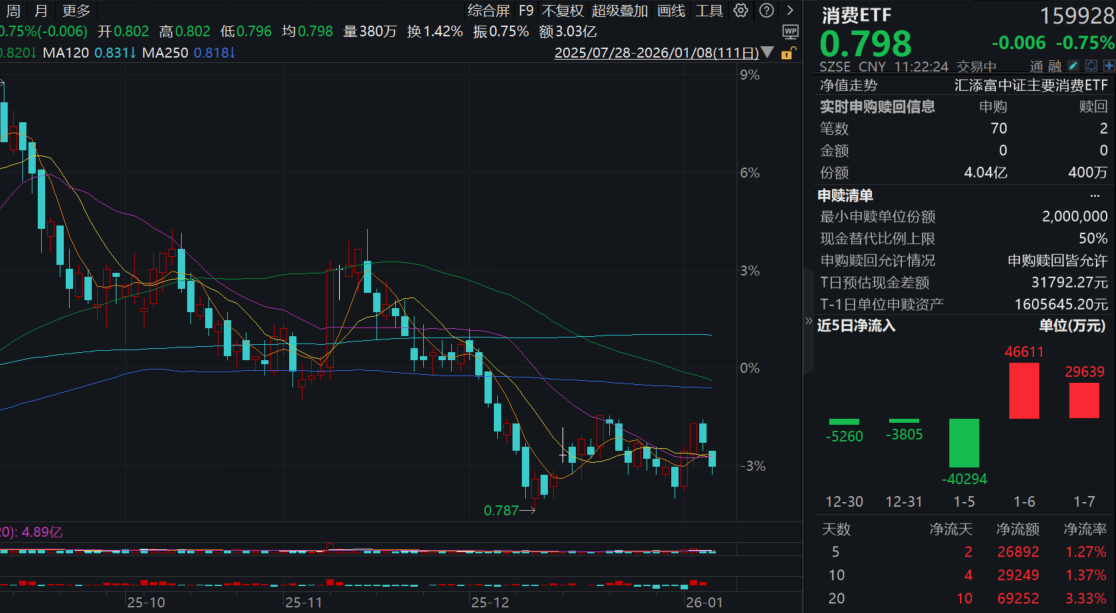
伊利董事长拟减持不超过0.98%股份!消费ETF(159928)弱势两连阴,近3日超10亿元资金布局!大消费当前估值性价比如何?
Sou Hu Cai Jing· 2026-01-08 03:52
Market Overview - The Shanghai Composite Index experienced a slight increase, while the consumer sector faced a second consecutive day of decline, with the Consumer ETF (159928) retreating by 0.75% after two days of gains [1] - The trading volume for the Consumer ETF exceeded 300 million yuan, with a net inflow of over 760 million yuan in the previous two days, and an additional net subscription of 460 million units [1] Company News - Yili Group announced that its Chairman and CEO, Pan Gang, plans to reduce his holdings by up to 62 million shares, accounting for 0.98% of the company's total shares. The proceeds will be used to repay expired stock pledge financing loans [3] - The Consumer ETF (159928) has a current scale exceeding 21.5 billion yuan, leading its peers in the same category [3] Industry Insights - Guolian Minsheng Securities highlighted that the food and beverage sector is showing signs of recovery, with expectations for CPI to turn positive by 2026, which may benefit the liquor and food segments [7] - The liquor industry is expected to see a phase of recovery in 2026, with a projected 20% decline in demand during the Spring Festival, but potential improvement by the Dragon Boat Festival [8] - The traditional consumption sector is experiencing a reversal of difficulties, with demand hitting bottom and supply chain adjustments underway [9] - The health and wellness sector is benefiting from the aging population and increased health awareness among younger consumers, with significant growth in the health supplement market [10] ETF Composition - The Consumer ETF (159928) includes major stocks with over 68.55% weight in the top ten holdings, including four leading liquor stocks accounting for 32% and major players like Yili Group (10%) and Haitian Flavoring (4%) [10]


聚焦新兴战略项目 常青股份拟2000万元投资私募基金
Zhong Guo Zheng Quan Bao· 2026-01-07 13:00
Group 1 - The company plans to invest 20 million yuan as a limited partner in the Jiaxing Zhongping Wanlong Equity Investment Partnership, which has a total fund size of 40.01 million yuan, representing approximately 49.9875% of the total committed capital [1] - The investment fund will focus on sectors such as new materials, controllable nuclear fusion, semiconductors, artificial intelligence, new energy, TMT, advanced manufacturing, health care, and consumer goods [1] - The company aims to leverage the expertise and management advantages of professional investment institutions to achieve indirect investments in emerging strategic projects, thereby enhancing its long-term development and overall competitiveness [1] Group 2 - The company seeks to strengthen business connections with other partners in the fund, project stakeholders, and potential customers, which will enhance its business development capabilities and core competitiveness [1]

常青股份:拟以2000万元投资私募基金 基金投资于新材料、可控核聚变等行业
Zheng Quan Shi Bao Wang· 2026-01-07 08:25
Group 1 - The core point of the article is that Changqing Co., Ltd. has announced an investment of 20 million yuan as a limited partner in the Jiaxing Zhongping Wanlong Equity Investment Partnership, accounting for 49.9875% of the fund's total committed capital [1] - The total scale of the investment fund is 40.01 million yuan, focusing on sectors such as new materials, controllable nuclear fusion, semiconductors, artificial intelligence, new energy, TMT (Technology, Media, and Telecommunications), advanced manufacturing, big health, and big consumption [1]