新三样

Search documents
院士名单背后的“新三样”崛起密码
Xin Lang Cai Jing· 2025-11-27 11:54
Group 1 - The recent election of three private enterprise experts as academicians by the Chinese Academy of Engineering signifies a historic shift in the recognition of private sector contributions to technology and innovation in China [1] - Private enterprises have become a crucial force in China's technological innovation, contributing 70% of the country's technological innovation results, 80% of specialized "little giant" enterprises, and 90% of high-tech companies [1] - The export of China's "new three samples" (electric vehicles, lithium batteries, and photovoltaic products) has surpassed half of the total contributions from private enterprises, highlighting the shift towards technology-intensive industries [3] Group 2 - CATL, a leading lithium battery manufacturer, has made significant contributions to the global lithium battery market, accounting for nearly 60% of the global export volume of lithium batteries [3][4] - CATL's R&D investment has exceeded 70 billion yuan over the past decade, with a record high of 18.6 billion yuan planned for 2024, showcasing its commitment to innovation [5] - As of mid-2025, Chinese companies hold six out of the top ten positions in global power battery installations, with a combined market share of 68.2%, indicating China's dominance in the lithium battery sector [6] Group 3 - The strong performance of the "new three samples" in exports reflects China's growing competitiveness in the global renewable energy market, driven by a complete industrial chain and substantial domestic demand [6] - The emergence of new competitive technologies, such as 3D printing, integrated circuits, and unmanned aerial vehicles, indicates a diversification of China's export capabilities beyond the "new three samples" [6] - The role of private enterprises and their scientists in addressing market challenges and driving innovation is crucial for China's transition from a follower to a leader in various technological fields [7]


发挥险资长期稳健优势!股权投资仍有巨大潜力|聚焦2025深圳国际金融大会
Zheng Quan Shi Bao· 2025-11-21 00:09
Group 1: Financial Innovation and Development - The 2025 Shenzhen International Financial Conference focused on "Global Financial Markets and Policy Innovation," gathering industry leaders to discuss new paths for financial development [1] - The conference highlighted the importance of technology in reshaping the financial industry, with increasing investments in technology sectors and a shift in financial institutions' focus from traditional networks to technological capabilities [1][2] - The Greater Bay Area has implemented over 30 financial innovation measures during the 14th Five-Year Plan, establishing a policy matrix to support high-quality regional financial development [2][3] Group 2: Insurance Sector Transformation - The insurance industry is urged to transition towards comprehensive risk management, focusing on four key areas: supporting the real economy, enhancing social security, maintaining financial safety, and establishing a disaster insurance system [3][4] - Insurance funds are seen as crucial for supporting national strategies and the real economy, with a shift from limited to precise regulation in investment practices [3][4] Group 3: Talent Development and Market Structure - There is a steady increase in the number and proportion of technology talents in China's financial institutions, but a gap remains compared to international financial centers [2] - Experts suggest enhancing the capital market ecosystem by improving inclusivity and adaptability, and restructuring the capital market to better support innovation and economic growth [10][11] Group 4: Long-term Capital and Financial Stability - The need to strengthen long-term capital sources, such as social security funds and insurance capital, is emphasized to provide stable funding for infrastructure and technology projects [6][8] - The conference underscored the role of financial systems in supporting high-quality economic development and the importance of open financial markets for fostering innovation [9][10]
深圳国际金融大会聚焦全球金融创新,业内人士认为—— 发挥险资长期稳健优势 股权投资仍有巨大潜力
Zheng Quan Shi Bao Wang· 2025-11-20 23:21
Core Insights - The Shenzhen International Financial Conference emphasizes the importance of financial innovation and the role of insurance capital in equity investment for economic development [1][2][3] Group 1: Financial Innovation and Technology - Technology innovation is highlighted as a national strategy and a core engine for reshaping the financial industry [1] - The share of venture capital investment in the technology sector, loans to high-tech enterprises, and the market capitalization of the A-share technology sector are all on the rise, indicating technology's critical role in driving the financial market [1] - Financial institutions are increasing their investments in fintech, shifting the industry's core competitiveness from traditional network expansion to technological advancement [1] Group 2: Talent Development - The total number and proportion of technology talents in China's financial institutions are steadily increasing, but there remains a gap compared to international financial centers like New York [2] - There is a need for collaboration between universities and the market to cultivate interdisciplinary and composite financial talents to support international competitiveness [2] Group 3: Insurance Sector Development - The insurance industry is urged to transition towards comprehensive risk management, focusing on four key areas: serving the real economy, enhancing social security, maintaining financial safety, and establishing a disaster insurance system [3] - The Greater Bay Area has implemented over 30 financial innovation measures during the 14th Five-Year Plan, creating a policy matrix to support high-quality regional financial development [2][3] Group 4: Equity Investment Potential - The core goal of insurance capital equity investment is to ensure capital safety while serving national strategies and the real economy [3] - Insurance capital investment has evolved from "limited opening" to "precise regulation," leading to a diversified investment landscape that extends from traditional infrastructure to new productive forces [3][4] - Recommendations for optimizing the policy environment for insurance capital include enhancing capital constraint mechanisms, clarifying rules, enriching asset management product systems, and opening innovative investment tools [4]
1.02万亿元、20%,有“量”有“质”!“新三样”出口表现亮眼
Yang Shi Wang· 2025-11-19 07:20
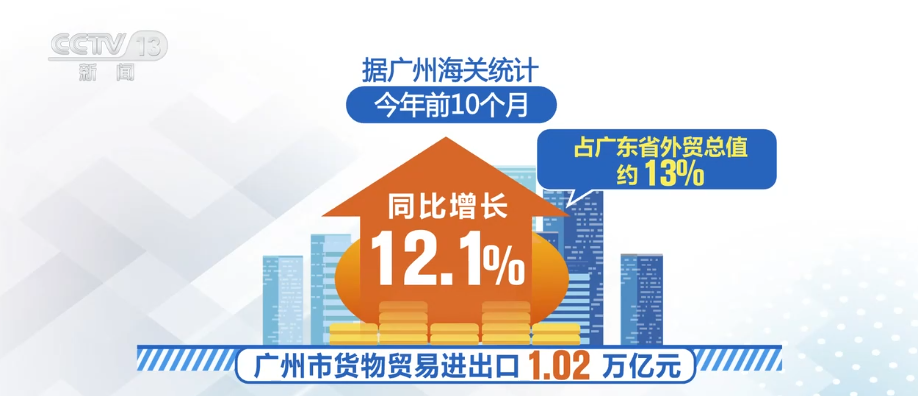
Group 1 - Guangzhou's goods trade import and export reached 1.02 trillion yuan in the first ten months of 2025, marking the first time it surpassed the 1 trillion yuan mark within this timeframe [1][3] - The export growth exceeded 20%, ranking first among major foreign trade cities in China [1] - The total import and export value increased by 12.1% year-on-year, accounting for approximately 13% of Guangdong province's total foreign trade [3] Group 2 - The "new three items" in exports showed remarkable performance, with exports of these products reaching 19.94 billion yuan, a year-on-year increase of 52.8% [13] - Solar photovoltaic products specifically saw exports of 1.62 billion yuan, representing a year-on-year growth of 2.3 times [13] - A solar energy company in Huadu District reported an export value of nearly 220 million yuan, a year-on-year increase of 5.5 times [7] Group 3 - The continuous growth of overseas orders has led to increased demands for customs clearance efficiency [10] - Guangzhou Customs is promoting logistics integration reforms in the Guangdong-Hong Kong-Macao Greater Bay Area to ensure efficient exports of "new three items" [10][11] - The "one port pass" initiative allows companies to declare once, facilitating quick customs clearance and direct shipment from inland ports to coastal ports [10][11]
前10月广州外贸进出口突破万亿元
Yang Shi Xin Wen· 2025-11-18 11:17
Group 1 - The core viewpoint of the articles highlights Guangzhou's significant growth in foreign trade, with a total import and export value of 1.02 trillion yuan in the first ten months of the year, marking the first time it has surpassed the trillion yuan mark in this period [1][2] - Exports from Guangzhou increased by over 20%, leading the growth rate among major foreign trade cities in China, with a year-on-year growth of 20.5% in exports, totaling 682.36 billion yuan [2] - The "New Three Samples" products, particularly solar photovoltaic components, showed remarkable performance, with exports reaching 19.94 billion yuan, a year-on-year increase of 52.8%, and solar products alone exported 1.62 billion yuan, a growth of 230% [1] Group 2 - The trade with countries involved in the Belt and Road Initiative saw a notable increase of 24.1%, contributing significantly to the overall foreign trade growth, with a total trade value of 479.61 billion yuan [2] - Private enterprises in Guangzhou demonstrated strong export performance, with a total export value of 444.87 billion yuan, reflecting a year-on-year growth of 27.3% [2] - The Guangzhou Customs has implemented policies to facilitate trade and reduce costs for enterprises, including promoting private companies to become AEO-certified, which enhances their international trade capabilities [2]
通威集团董事局主席刘汉元:相信在各方努力下,防止“新三样”过度内卷能够卓有成效
Zheng Quan Shi Bao Wang· 2025-11-17 10:18
Core Viewpoint - The solar and energy storage industry in China is urged to maintain a competitive yet sustainable ecosystem, emphasizing the collective responsibility of industry participants and associations to prevent excessive internal competition [1] Industry Insights - Liu Hanyuan, Chairman of Tongwei Group, highlighted the importance of sustaining competitive capabilities and necessary survival conditions for market players [1] - There is a consensus among industry peers regarding the need to maintain appropriate competitive intensity within the sector [1] - China's solar and energy storage industry possesses enduring scale and cost advantages globally, which is expected to contribute to effective high-quality collaborative development over the next 5 to 10 years and beyond [1]

硬派越野盯上了年轻人
Hua Er Jie Jian Wen· 2025-11-07 11:35
Core Insights - The Chinese hard-core off-road vehicle market is experiencing significant growth, with domestic brands like Tank, Beijing, BYD Fangchengbao, and Dongfeng Mengshi leading sales in September 2023 [1] - The market is becoming increasingly crowded with new entrants such as Dongfeng Mengshi M817 and Jietu Zongheng, indicating a shift in focus from traditional off-road vehicles to a younger demographic [1] - The penetration rate of hard-core off-road vehicles in the SUV market reached 2.91% in Q1 2025, with a projected market share of over 3% for the entire year and potentially exceeding 13% by 2030 [1] Market Dynamics - The launch of the new Tank 400 aims to attract younger users traditionally inclined towards urban smart SUVs, blurring the lines between hard-core off-road and urban SUV segments [2] - The vehicle's features, such as the Qualcomm 8295 chip and Coffee Pilot Ultra intelligent driving system, enhance its appeal for urban and highway driving scenarios [3] Technological Advancements - The success of domestic brands is attributed to the "new three elements" that address traditional off-road vehicle shortcomings, such as high fuel consumption and low comfort [4] - The new Tank 400 is priced at 249,800 yuan, making it more accessible compared to traditional off-road vehicles, while technological advancements have lowered the barriers to off-road driving [4] Consumer Behavior - A significant portion of hard-core off-road vehicle owners (64.8%) use their vehicles for off-roading no more than twice a month, yet all owners desire their vehicles to reflect an off-road lifestyle [5] - The competition is shifting from price wars to building ecosystems and communities around brands, with a focus on user identity and social sharing among younger consumers [5] Future Challenges - As the initial phase of competition targeting younger consumers nears its end, the real challenges for brands may just be beginning, indicating a need for ongoing innovation and community engagement [6]
厦门海事局打“组合拳”:护航首单省外新能源汽车“铁海联运”出海
Ren Min Wang· 2025-11-04 09:20
Core Viewpoint - The successful transportation of 26 Dongfeng brand electric vehicles from Hubei to Xiamen via rail and then by sea to Poland marks the first "New Three Samples" iron-sea intermodal export operation from Xiamen, establishing a new efficient pathway for China's inland new energy industry to access international markets [1][3]. Group 1: Regulatory and Operational Innovations - Xiamen Maritime Department has implemented "on-site teaching" and "cloud auditing" to enhance safety standards for lithium battery vehicles during maritime transport, ensuring compliance with international regulations [2]. - The "cloud auditing" process allows for remote supervision of the loading operations, significantly reducing the time required for the export process by 5-7 days through the establishment of a "green channel" for dangerous goods approval [2]. Group 2: Collaborative Efforts and Infrastructure Development - A collaborative framework has been established between Xiamen and Wuhan maritime authorities to facilitate seamless intermodal transport, enhancing the logistics efficiency of the "New Three Samples" industry [1][2]. - The Xiamen Maritime Department has created a comprehensive service support network by coordinating with shipping companies, railways, and freight forwarders to ensure real-time information sharing and operational efficiency [2][3]. Group 3: Strategic Implications - The successful execution of this operation demonstrates the proactive role of maritime services in supporting national strategies and ensuring the stability of supply chains, with plans to attract more inland cargo for export through Xiamen port [3].
朱拉隆功大学陈安:泰国对中企有三大新期待
21世纪经济报道· 2025-11-03 01:14
Core Viewpoint - The article emphasizes the importance of transitioning from "integration" to "co-creation" in Sino-Thai economic cooperation, highlighting the potential for mutual value creation and market expansion through collaborative efforts in various sectors [2][3]. Group 1: Sino-Thai Economic Relations - China has been Thailand's largest trading partner for 12 consecutive years, being the top source of agricultural exports, foreign investment, and tourism [3][4]. - The bilateral trade volume between China and Thailand is projected to reach USD 133.98 billion in 2024, reflecting a year-on-year growth of 6.1%, with Chinese exports increasing by 13.6% and imports decreasing by 5.2% [3][4]. Group 2: Investment Opportunities - From 2020 to 2024, China's cumulative greenfield investment in ASEAN is expected to reach USD 65.91 billion, with USD 42.26 billion (64.1%) allocated to "new three types" of investments, including photovoltaic, new energy vehicles, and lithium batteries [1][3]. - The report indicates that investments in new energy vehicles are primarily concentrated in Thailand, Malaysia, and Indonesia, while lithium battery investments are focused on Indonesia, and photovoltaic investments are mainly in Vietnam, Thailand, Malaysia, and Cambodia [1]. Group 3: Future Directions for Cooperation - The article identifies three key areas for future Sino-Thai cooperation: green and digital technology, agriculture and food industry, and financial services, where both countries can leverage their respective strengths [2][6]. - Thai enterprises are expected to actively engage in joint research and technology sharing with Chinese companies, establish local supply chains, and collaborate with large Chinese firms to explore larger ASEAN markets [3][9]. Group 4: Trade Agreements and Economic Frameworks - Utilizing key trade tools such as the Regional Comprehensive Economic Partnership (RCEP) and the upgraded China-ASEAN Free Trade Agreement is crucial for unlocking market potential and enhancing cooperation between China and Thailand [3][5]. - The evolving geopolitical landscape necessitates a strategic partnership between China and Southeast Asia, emphasizing the need for a comprehensive ecosystem that includes financial cooperation and research collaboration [10].

31省份三季报出炉:粤苏鲁三省仍稳居全国前三 高技术制造业提供关键支撑
2 1 Shi Ji Jing Ji Bao Dao· 2025-11-01 02:13
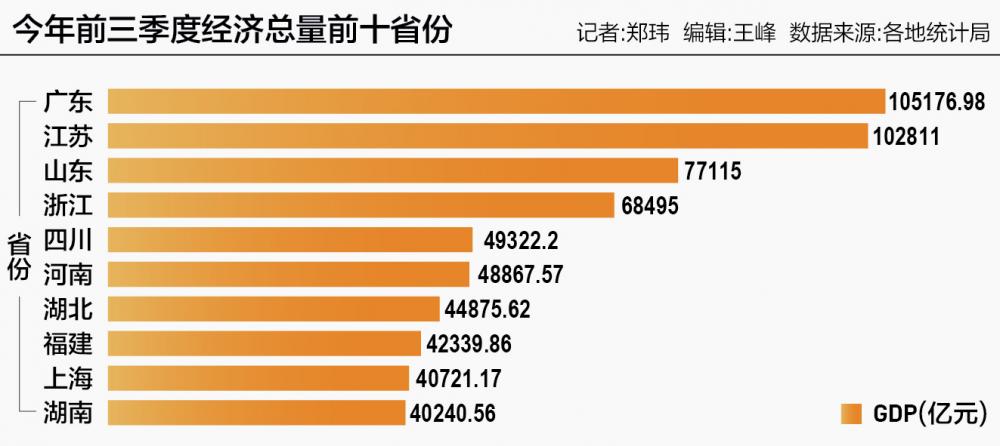
Economic Overview - As of October 31, all 31 provinces in China have released their Q3 reports for 2025, revealing significant economic changes as the year-end approaches [1][3] - Guangdong, Jiangsu, and Shandong remain the top three provinces by GDP, with Guangdong leading at 105,176.98 billion yuan, followed by Jiangsu at 102,811 billion yuan, and Shandong at 77,115 billion yuan [1][6] Economic Growth - Central and western provinces like Hubei and Tibet have shown impressive GDP growth rates, with Hubei achieving 6.0% and Tibet 7.1%, the highest in the country [1][8] - Hubei's GDP growth is supported by strong performance in consumption, investment, and exports, with a notable 30.8% increase in export value [9][10] High-tech Manufacturing - High-tech manufacturing has been a crucial driver of GDP growth across multiple provinces, significantly contributing to industrial investment and export performance [11][12] - In Guangdong, high-tech manufacturing's added value grew by 6.4%, while in Jiangsu, it accounted for 51.8% of industrial output [6][11] Policy Initiatives - Guangdong has introduced measures to expand effective industrial investment, focusing on sectors like solid-state batteries and electric vertical takeoff and landing vehicles [2][14] - Sichuan has also announced policies to incentivize industrial project completion, offering up to 1,500 million yuan in rewards [2][15] Export Performance - High-tech products have driven export growth, with Hubei's exports of electromechanical products reaching 2,191.7 billion yuan, a 19.8% increase [10][12] - Zhejiang's exports totaled 3.16 trillion yuan, with new high-tech products contributing significantly to this growth [12][13]