
温室气体减排

Search documents
美股三大指数小幅上涨 黄金股走高
Feng Huang Wang Cai Jing· 2025-10-08 15:10
Market Performance - The three major U.S. stock indices experienced slight increases, with the Dow Jones rising by 0.17%, the S&P 500 up by 0.39%, and the Nasdaq Composite gaining 0.66% [1] Gold Market - Spot gold prices surpassed $4040, leading to a rise in gold stocks, with companies such as Hecla Mining, Agnico Eagle Mines, Kinross Gold, and Harmony Gold all increasing by over 3% [1]
韩政府公布新减排方案
Ke Ji Ri Bao· 2025-09-27 23:34
Core Viewpoint - The South Korean government has announced ambitious greenhouse gas reduction targets for the transportation sector, aiming for significant cuts by 2035, with proposals ranging from 48% to 65% reductions from 2018 levels [1][2]. Group 1: Emission Reduction Plans - The South Korean government presented four reduction plans corresponding to 2018 emissions of 742.3 million tons, targeting reductions of 48%, 53%, 61%, and 65% [1]. - For the transportation sector, the 48% reduction plan aims to decrease emissions from 98.8 million tons in 2018 to 44.3 million tons, while the 65% plan targets a reduction to 32.6 million tons [1]. Group 2: Electric and Hydrogen Vehicle Adoption - The government plans to accelerate the adoption of zero-emission vehicles, proposing that 30% and 34% of all vehicles be replaced with electric or hydrogen vehicles under the 48% and 53% plans, respectively [1]. - For the more ambitious 61% and 65% plans, the proportion of zero-emission vehicles must exceed 35% [1]. Group 3: Policy Measures and Incentives - The South Korean government is considering measures similar to the EU, such as restricting the sale of gasoline vehicles by 2035 [1]. - Plans include introducing dedicated taxes for zero-emission vehicles and corporate tax incentives to promote their adoption [1]. Group 4: Current Challenges - The transportation sector is identified as one of the lagging areas in South Korea's greenhouse gas reduction efforts, with emissions only slightly decreasing from 98.8 million tons in 2018 to 97.5 million tons projected for 2024, a mere 1.3% reduction [2]. - The adoption of electric and hydrogen vehicles faces challenges, including stagnant demand and reduced subsidies, with a target of 4.5 million vehicles by 2030, but only 850,000 currently in use [2].
中国新一轮国家自主贡献目标:2035年覆盖全经济范围温室气体
Bei Ke Cai Jing· 2025-09-25 03:53
Core Points - The new national contribution target for China aims to reduce greenhouse gas emissions by 7%-10% from peak levels by 2035, with non-fossil energy consumption exceeding 30% of total energy consumption [1] - The total installed capacity of wind and solar power is targeted to reach 360 million kilowatts, which is over six times the capacity in 2020 [1] - The forest stock volume is expected to exceed 24 billion cubic meters, and new energy vehicles are to become the mainstream of new vehicle sales [1] Summary by Sections Previous Commitments - The previous commitment aimed for carbon dioxide emissions to peak before 2030 and achieve carbon neutrality before 2060 [1] - By 2030, carbon dioxide emissions per unit of GDP were to be reduced by over 65% compared to 2005 levels, with non-fossil energy accounting for about 25% of primary energy consumption [1] - The forest stock volume was to increase by 6 billion cubic meters compared to 2005, and the total installed capacity of wind and solar power was to exceed 120 million kilowatts [1] Current Achievements - As of the end of 2024, China's installed wind power capacity is approximately 510 million kilowatts, and solar power capacity is about 840 million kilowatts, achieving the 2030 target six years ahead of schedule [2] - The new national contribution targets represent a revolutionary upgrade, covering all greenhouse gases and indicating a shift from carbon emission management to broader sustainable development [2] - The national carbon market has expanded to include major emitting industries such as steel, cement, and aluminum, with plans to extend to petrochemical, chemical, and aviation sectors by 2027 [2] International Implications - The early achievement of the 2030 targets sends a strong signal to the international community about China's commitment to climate action [2] - The announcement of the 2035 targets further reinforces the systematic approach to climate action and showcases China's ambition and determination in addressing climate change [2]
习近平宣布中国新一轮国家自主贡献,到2035年风电和太阳能发电总装机容量力争达到36亿千瓦
Xin Hua Cai Jing· 2025-09-25 00:47
Core Points - President Xi Jinping announced China's new round of Nationally Determined Contributions (NDCs) at the UN Climate Change Summit, aiming for a 7% to 10% reduction in total greenhouse gas emissions by 2035 compared to peak levels [1] - The share of non-fossil energy consumption in total energy consumption is targeted to exceed 30% [1] - Installed capacity for wind and solar power is expected to reach over six times that of 2020, striving for 360 million kilowatts [1] - Forest stock volume is projected to exceed 24 billion cubic meters [1] - New energy vehicles are set to become the mainstream of new vehicle sales [1] - The national carbon emissions trading market will cover major high-emission industries [1] - A climate-resilient society is aimed to be fundamentally established [1] - These targets reflect China's commitment to the Paris Agreement and require significant domestic efforts as well as a favorable international environment [1]

习近平在联合国气候变化峰会发表视频致辞 宣布中国新一轮国家自主贡献
Hua Er Jie Jian Wen· 2025-09-24 18:42
Core Viewpoint - China announced new national contributions to reduce greenhouse gas emissions by 7% to 10% from peak levels by 2035, aiming for significant advancements in renewable energy and carbon trading markets [1] Group 1: Emission Reduction Goals - By 2035, China's total greenhouse gas emissions are targeted to decrease by 7% to 10% from peak levels [1] - The goal aligns with the requirements of the Paris Agreement, reflecting China's commitment to climate change mitigation [1] Group 2: Renewable Energy Targets - Non-fossil energy consumption is expected to account for over 30% of total energy consumption [1] - Installed capacity for wind and solar power is projected to exceed six times that of 2020, aiming for 360 million kilowatts [1] Group 3: Forest and Vehicle Initiatives - Forest stock volume is targeted to reach over 24 billion cubic meters [1] - New energy vehicles are expected to become the mainstream of new vehicle sales [1] Group 4: Carbon Trading and Climate Adaptation - The national carbon emissions trading market will cover major high-emission industries [1] - A climate-resilient society is aimed to be fundamentally established [1]
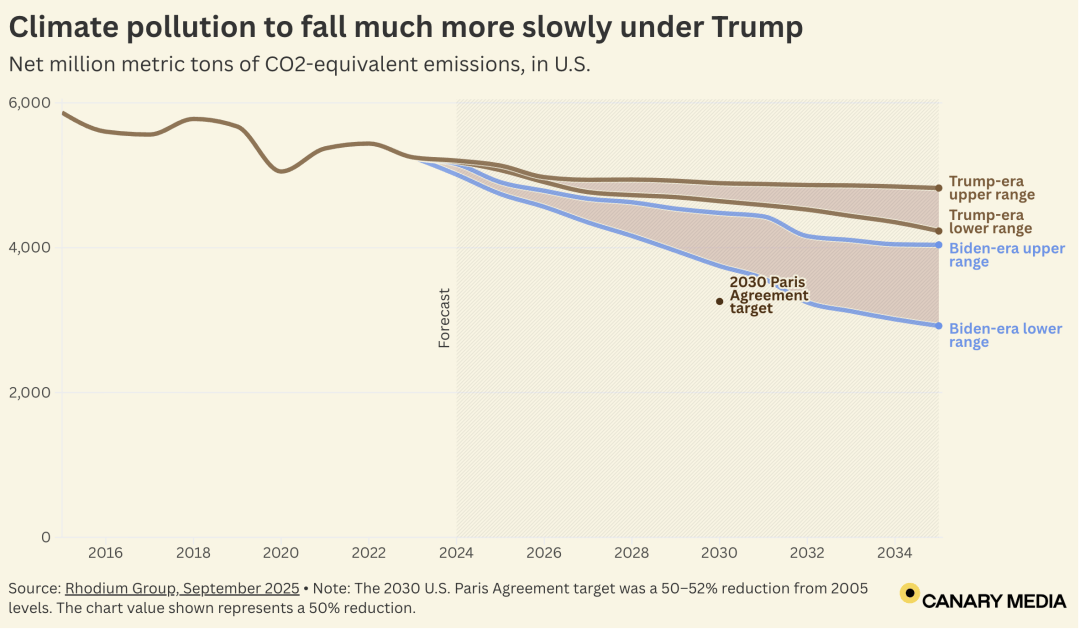
【分析】特朗普正在减缓美国气候进展,具体造成多大损害?
Sou Hu Cai Jing· 2025-09-17 00:05
Core Points - The article discusses the impact of Trump's return to the White House on U.S. greenhouse gas emissions reduction efforts, indicating a significant setback compared to the Biden administration's goals [1][4] - According to Rhodium Group, the U.S. is projected to reduce emissions to only 26-35% of 2005 levels over the next decade, which is substantially lower than previous forecasts during Biden's tenure [1][4] - The report highlights that the Trump administration and Republican lawmakers have effectively dismantled key environmental regulations and initiatives aimed at promoting renewable energy and reducing fossil fuel dependency [4] Summary by Sections - **Emission Reduction Projections** - The U.S. is expected to achieve a reduction of 26-35% in greenhouse gas emissions by 2035, a stark contrast to the Biden administration's earlier projection of 38-56% [1][4] - The current trajectory indicates that the U.S. will not meet its 2030 commitments under the Paris Agreement, a situation that Trump seems unconcerned about, having exited the agreement on his first day back in office [4] - **Legislative Changes and Environmental Impact** - The Trump administration has repealed significant legislation, including the Inflation Reduction Act, which provided tax incentives for renewable energy and electric vehicles, as well as funding to accelerate the transition away from fossil fuels [4] - The rollback of regulations aimed at limiting vehicle emissions has implications not only for greenhouse gas emissions but also for harmful air pollutants [4] - **Future Outlook** - Despite the current setbacks, the article suggests a glimmer of hope, indicating that changes in government can lead to rapid shifts in policy and trajectory, similar to the previous progress made under the Biden administration [4]

新预测:美国气候政策转向拖累全球气候治理
Xin Hua Wang· 2025-09-16 09:21
Core Viewpoint - In the first half of this year, U.S. greenhouse gas emissions surged, leading to a global increase in emissions compared to the same period last year, with a new forecast indicating that the U.S. government's shift towards fossil fuel support will hinder global climate governance [1] Group 1: U.S. Climate Policy Changes - The U.S. energy and climate policy has undergone the most drastic shift in recent years since President Trump returned to the White House, which will reduce the U.S. emission reduction rate to half of what was achieved in the past 20 years [1] - In the best-case scenario, where fossil fuels become more expensive and renewable energy is rapidly deployed, U.S. greenhouse gas emissions could only decrease by 43% by 2040, significantly lower than the previous administration's commitment to reduce emissions by 61% to 66% from 2005 levels by 2035 [1] Group 2: Global Climate Impact - The shift in U.S. climate policy is expected to have profound implications for the global climate crisis, potentially leading to an increase in U.S. greenhouse gas emissions by the end of the 2030s if the development of clean energy is severely constrained by economic and political factors [1]
生态环境部拟发文禁止生产以HFCs为制冷剂的家用电冰箱和冷柜产品
Shang Hai Zheng Quan Bao· 2025-08-15 18:23
Core Viewpoint - The Ministry of Ecology and Environment has proposed a draft to ban the production of household refrigerators and freezers using hydrofluorocarbons (HFCs) as refrigerants starting from January 1, 2026, marking a significant step towards environmental protection and compliance with international agreements [1][2]. Group 1: Regulatory Changes - The draft aims to phase out HFCs, which are potent greenhouse gases and significant contributors to ozone layer depletion, by promoting the use of more environmentally friendly refrigerants like R600a, which has a low global warming potential [1]. - The Kigali Amendment to the Montreal Protocol, accepted by China in 2021, sets a target to reduce global HFCs by at least 80% over the coming decades, with the formal implementation in China starting in September 2021 [2]. Group 2: Industry Impact - The 2025 plan outlines a 10% reduction in the production and usage of HFCs compared to baseline values, with a specific quota reduction of 51,241 tons for 2025 compared to 2024 [3]. - The Chinese home appliance industry has seen significant growth, with total revenue reaching 1.84 trillion yuan and total profits of 156.5 billion yuan in 2023, while also achieving over 50% of global production share in major home appliance products [3]. Group 3: Compliance and Enforcement - The draft mandates that relevant departments ensure companies comply with the regulations regarding the elimination of HFCs in household refrigeration, with penalties for violations enforced by local environmental authorities [4].
“生态转型计划”将促进巴西GDP增长,并创造更多就业岗位
Shang Wu Bu Wang Zhan· 2025-08-15 16:01
Core Insights - The "Ecological Transition Plan" is expected to increase Brazil's GDP growth rate by an average of 0.8 percentage points annually until 2035 [1] - The plan is viewed as an opportunity for Brazil, aiming to reduce environmental impact while promoting income growth [1] - Key initiatives of the plan include carbon market regulation, establishment of sustainable classification, Tropical Forest Permanent Fund (TFFF), future fuels, new industries in Brazil, climate fund, and low-carbon hydrogen plan [1] Economic Impact - The plan aims to promote sustainable economic growth in Brazil and achieve greenhouse gas reduction targets set at the United Nations Climate Change Conference [1] - The Brazilian Ministry of Finance emphasizes that the transition to this economic model is seen as beneficial rather than costly [1]
【环球财经】巴西上调汽柴油生物燃料掺混比例
Xin Hua Cai Jing· 2025-08-02 07:54
Group 1 - Brazil has implemented a new mandatory blending policy for gasoline and diesel biofuels, increasing the ethanol blend in gasoline from 27% to 30% and the biodiesel blend in diesel from 14% to 15% [1] - The Brazilian government anticipates that the new policy will lower fuel prices and volatility without compromising supply security, with gasoline prices potentially decreasing by up to 0.11 reais per liter [1] - The initiative aims to reduce dependence on imported fuels amid global oil price fluctuations due to geopolitical conflicts, leveraging Brazil's position as a major producer of ethanol and biodiesel [1] Group 2 - Concerns have been raised by the automotive parts industry regarding the higher ethanol blend potentially causing engine compatibility issues for traditional gasoline vehicles [2] - The increase in biodiesel blending has also raised technical concerns among logistics companies and transport operators, particularly regarding biodiesel's stability and potential maintenance costs [2] - To address market concerns, the National Agency of Petroleum, Natural Gas and Biofuels (ANP) has intensified regulatory oversight on biodiesel production, distribution, and storage to prevent quality issues [2]