
绿色化转型

Search documents
省政协委员柴兴臣:锚定战新产业,加快河南铜加工转型升级
Sou Hu Cai Jing· 2026-01-27 12:08
Core Viewpoint - The copper industry in Henan is poised for significant development opportunities as the provincial government emphasizes upgrading traditional industries, including steel, coal, and non-ferrous metals [1] Group 1: Industry Performance - In 2025, China's non-ferrous metal industry is expected to stabilize and recover, with profits from large-scale enterprises reaching 448.62 billion yuan, a year-on-year increase of 15.9% [2] - The copper industry, as the second-largest sector in Henan's non-ferrous metals, has surpassed a production value of 100 billion yuan, closely linked to the province's industrial technology development [2] Group 2: Supply and Demand Dynamics - The global copper market is experiencing unprecedented production challenges on the supply side, while demand is surging, particularly from emerging industries such as renewable energy, artificial intelligence, and 5G communications [3] - Copper is referred to as the "blood vessel of industry," essential for developing new productive forces, with Henan's manufacturing scale providing ample application scenarios for copper processing [3] Group 3: Future Development Strategies - Henan can focus on selecting 3-5 key industrial chains with strong foundations and potential within trillion-yuan industrial clusters, implementing "collaborative innovation" actions [4] - The province aims to establish a provincial-level collaborative innovation fund to support leading enterprises in forming innovation alliances with universities and research institutions [4] Group 4: Logistics and Supply Chain Optimization - Henan is transitioning from a "geographical center" to an "economic circular core," with improvements in multi-modal transport systems expected to reduce logistics costs and enhance the attractiveness of high-end manufacturing and bulk commodity trade [5] - There is potential for further reduction in logistics costs for manufacturing enterprises, particularly in the "last mile" connectivity, which can be improved through integrated transport networks [6] Group 5: Market Positioning and Global Integration - As a major copper processing country, China accounts for over 50% of global refined copper production, but has historically relied heavily on imported raw materials and lacks sufficient pricing power in the industry [6] - With the growth of Henan's port hub economy, copper processing enterprises are expected to access overseas copper resources more economically and facilitate the distribution of finished products to national and global markets [6]

“广货行天下”春季行动灯饰专场促销活动在中山古镇举行
Nan Fang Ri Bao Wang Luo Ban· 2026-01-27 09:03
当前,电商与内容营销正重塑消费生态,过去以线下经销为主的照明灯饰行业也正在进行新的探索。活 动现场组织了欧普照明、木林森等行业龙头骨干企业设置20个精品展台并开展线上直播,发动80家优质 企业同步开展店铺直播。 "我们这次一共带来17款产品进行线上销售。"沈玉辉介绍,雷士照明已经深耕电商10年,2025 年"6·18"直播带货销售额同比增长27%,成为照明灯饰行业最受年轻人偏爱的第一名。此外,活动现场 集中展示了护眼健康照明、全屋智能照明、商业照明、文旅景观亮化等多场景产品,覆盖家庭消费、城 市更新和夜间经济等新需求。 "叠加官方补贴、平台补贴及企业折扣,我们此次带来的产品优惠能够做到正价的四折左右。"1月26 日,"广货行天下"春季行动灯饰专场促销活动在"中国灯饰之都"中山古镇镇举行。当天古镇镇有超百家 企业同步开展直播,并在全国联动七大灯具直销基地同步促销,形成"南北呼应、全国联动"的消费热 潮。 雷士照明直播运营负责人沈玉辉表示,"广货行天下"联动电商平台带动的流量扶持,使企业的日均曝光 度提升了70%—80%,单场交易额提升约120%。 直播间里,萌动着产业集群的新变革、新机遇。作为全球最大的照明产品 ...
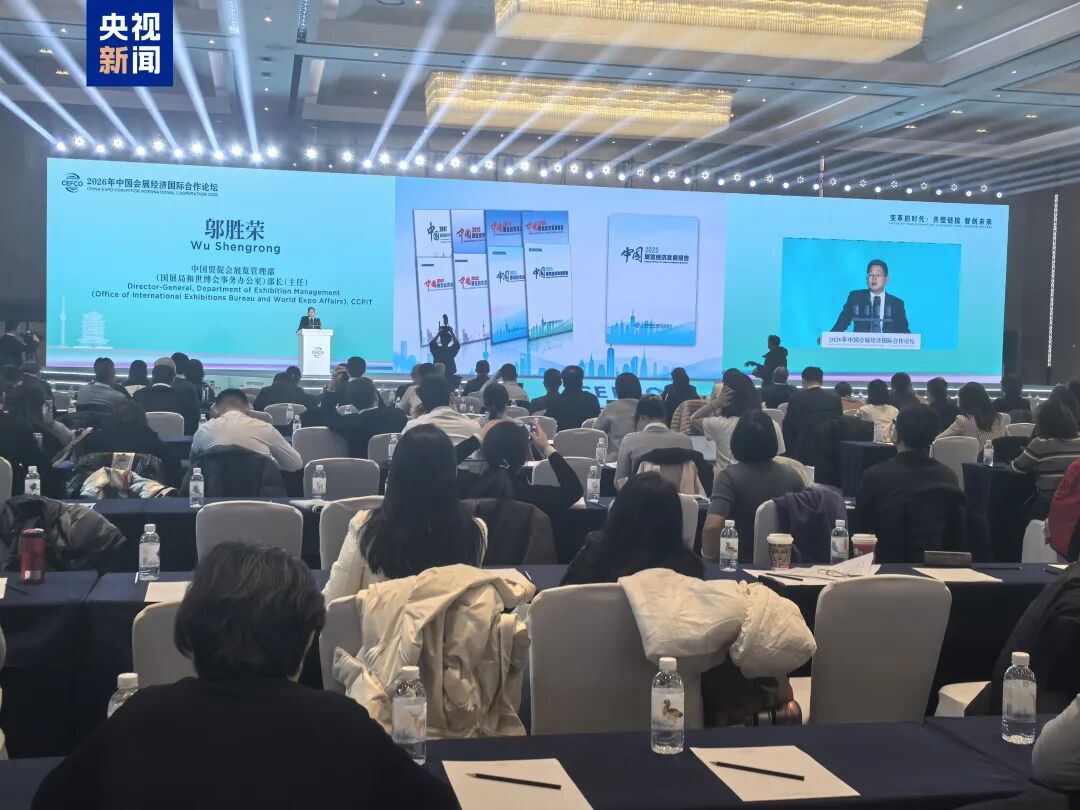
【总台央视】《中国展览经济发展报告2025》发布:国内展会数量与面积再创新高
Xin Lang Cai Jing· 2026-01-23 13:09
在今天(1月23日)召开的2026年中国会展经济国际合作论坛上,中国贸促会对外发布了《中国展览经济发展报告2025》。《报告》显示,中国国内展览 继续呈现稳中有进的良好态势,展会数量与面积再创新高。 2025年,出国展览呈现出"总体平稳、结构优化"的特征,项目数量延续增长态势。机械、交通运输物流是中国企业海外参展办展项目数量最多的行业。消 费品行业项目数量占比增长势头也比较突出。 来源:总台央视 编辑:游万龙 《报告》显示,2025年,中国国内共举办经贸类展会4095项,展览总面积1.59亿平方米,同比分别增长6.53%和2.5%。 与此同时,中部和西部地区展会数量增速较快,分别同比增长11.51%和14.94%。 中国贸促会展览管理部部长 邬胜荣:数字化、绿色化转型成效显著。人工智能、数字孪生等技术快速迭代,为展览业数字化水平提升注入强劲动能。 中国贸促会展览管理部部长 邬胜荣:区域集聚特征显著,东部地区举办的经贸类展会数量和展览面积占全国比重均超六成,京津冀、长三角、珠三角三 大区域贡献了全国53.85%的展会数量和62.48%的展出面积。 在今天(1月23日)召开的2026年中国会展经济国际合作论坛上, ...

智能化、绿色化、融合化步伐加快 制造业“压舱石”作用更加凸显
Zhong Guo Zheng Quan Bao· 2026-01-22 00:21
Core Insights - The analysis by the National Taxation Administration indicates that by 2025, the sales revenue of China's manufacturing industry will grow 1.7 percentage points faster than the overall national sales growth rate, with manufacturing accounting for 29.7% of total sales, an increase of 0.5 percentage points from the previous year [1][2] Group 1: Intelligent Upgrading - The implementation of the "Artificial Intelligence + Manufacturing" initiative is accelerating, with manufacturing enterprises expected to increase their purchases of automation and digital equipment by 11.3% and 10% year-on-year, respectively, by 2025 [1] - The intelligent transformation and digital upgrade of the manufacturing sector are driving the development of related industries, with sales revenue in the intelligent equipment manufacturing sector projected to grow by 28.1% year-on-year, including a 17.4% increase in industrial robots and a 42.1% increase in special operation robots [1] Group 2: Green Transformation - The sales revenue of high-energy-consuming manufacturing industries is expected to decrease by 1.1 percentage points as a proportion of total manufacturing revenue, indicating ongoing optimization of the industrial structure [2] - Manufacturing enterprises are increasing their investment in environmental governance services, with a year-on-year growth of 7.3%, and high-energy-consuming sectors seeing a 14.6% increase in such expenditures [2] - The renewable energy sector is rapidly developing, with sales revenue in the new energy vehicle manufacturing and lithium-ion battery manufacturing industries expected to grow by 14.3% and 25.1% year-on-year, respectively [2] Group 3: Digital Integration - The sales revenue of digital product manufacturing is projected to grow by 9.4% year-on-year, with manufacturing enterprises increasing their procurement of digital technologies by 10.4%, an acceleration of 3.5 percentage points compared to the previous year [2] - Specific sectors such as automotive manufacturing and computer communication equipment manufacturing are expected to see significant increases in digital technology procurement, with year-on-year growth rates of 24.5% and 11.8%, respectively [2]
制造业“压舱石”作用更加凸显
Zhong Guo Zheng Quan Bao· 2026-01-21 21:08
Group 1 - The core viewpoint of the articles indicates that China's manufacturing industry is expected to see a sales revenue growth rate that exceeds the national average by 1.7 percentage points by 2025, with manufacturing accounting for 29.7% of total sales, an increase of 0.5 percentage points from the previous year [1][2] Group 2 - The acceleration of intelligent upgrades in manufacturing is highlighted, with a projected year-on-year increase of 11.3% in the purchase of automation equipment and 10% in digital equipment by 2025, indicating a faster pace of intelligent transformation and digital renovation [1] - The sales revenue of the intelligent equipment manufacturing sector is expected to grow by 28.1% year-on-year, with industrial robots and special operation robots seeing increases of 17.4% and 42.1% respectively [1] Group 3 - The ongoing green transformation is noted, with high-energy-consuming manufacturing's sales revenue share decreasing by 1.1 percentage points, reflecting an optimization of the industrial structure [2] - The amount spent by manufacturing enterprises on environmental governance services is projected to increase by 7.3% year-on-year, with high-energy-consuming sectors seeing a 14.6% increase [2] - The sales revenue of the new energy vehicle manufacturing sector and lithium-ion battery manufacturing sector is expected to grow by 14.3% and 25.1% respectively [2] Group 4 - The deepening digital integration is emphasized, with a projected 9.4% year-on-year growth in sales revenue for digital product manufacturing and a 10.4% increase in the purchase of digital technologies by manufacturing enterprises, which is 3.5 percentage points faster than the previous year [2] - The automotive manufacturing and computer communication equipment manufacturing sectors are expected to see year-on-year increases of 24.5% and 11.8% in their purchases of digital technologies [2] Group 5 - The tax authorities are committed to implementing policies that support the transformation and upgrading of the manufacturing sector, ensuring that tax benefits reach enterprises effectively to contribute to high-quality development in manufacturing [2]
制造业经济“压舱石”作用更加凸显
Xin Lang Cai Jing· 2026-01-21 18:32
Core Insights - The manufacturing sector in China is projected to have a sales revenue growth rate that exceeds the national average by 1.7 percentage points by 2025, with its share of total sales reaching 29.7%, an increase of 0.5 percentage points from the previous year [1] Group 1: Intelligent Upgrading - The procurement of automation and digital equipment by manufacturing enterprises is expected to grow by 11.3% and 10% year-on-year, respectively, indicating a rapid advancement in intelligent transformation and digitalization [1] - The sales revenue of the intelligent equipment manufacturing sector is anticipated to increase by 28.1% year-on-year, with industrial robots and special operation robots seeing growth rates of 17.4% and 42.1%, respectively [1] Group 2: Green Transformation - The sales revenue of high-energy-consuming manufacturing industries is projected to decrease by 1.1 percentage points as a share of total manufacturing, reflecting ongoing structural optimization [1] - The amount spent by manufacturing enterprises on environmental governance services is expected to rise by 7.3% year-on-year, with high-energy-consuming sectors increasing their spending by 14.6% [1] Group 3: Digital Integration - The sales revenue of the digital product manufacturing sector is forecasted to grow by 9.4% year-on-year, with manufacturing enterprises' procurement of digital technologies increasing by 10.4%, a 3.5 percentage point acceleration compared to the previous year [2] - The automotive manufacturing and computer communication equipment sectors are expected to see procurement of digital technologies grow by 24.5% and 11.8%, respectively, indicating a deepening integration of the digital economy with the real economy [2]
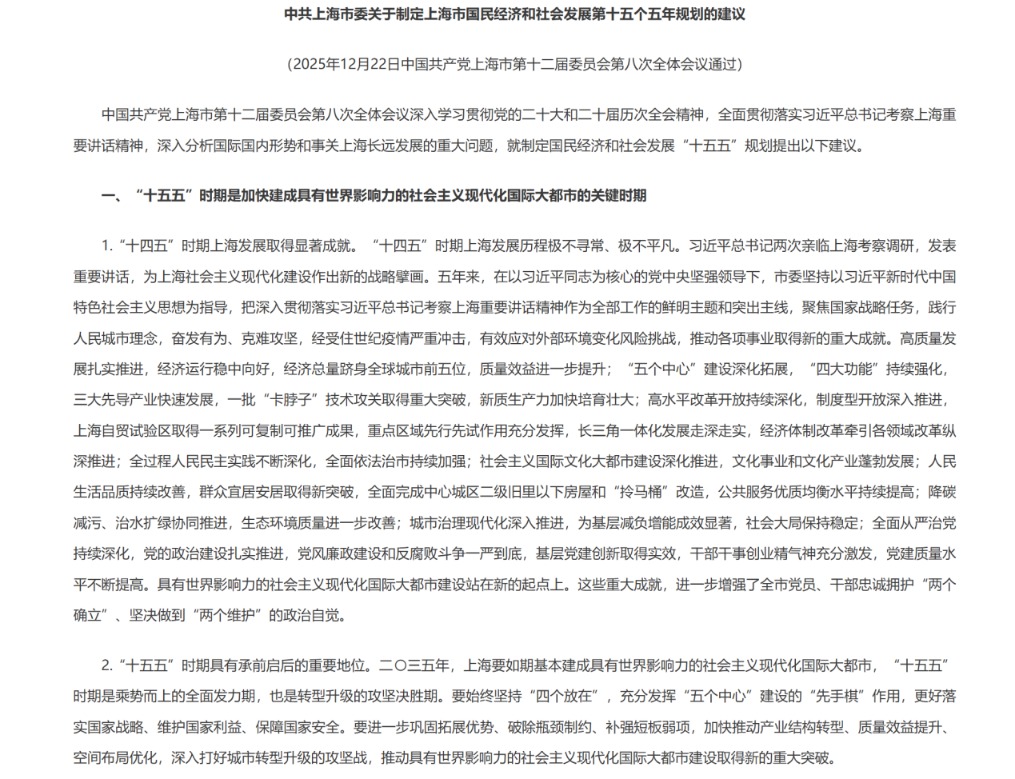
构建“2+3+6+6”体系 上海市“十五五”规划确立产业布局新航线
Zhong Guo Jing Ying Bao· 2026-01-19 08:51
Core Viewpoint - Shanghai aims to accelerate the construction of "five centers" to enhance its urban capability and core competitiveness, marking the "14th Five-Year Plan" period as crucial for becoming a globally influential socialist modern metropolis by 2035 [3][4]. Group 1: Five Centers - The "five centers" include international economic, financial, trade, shipping, and technological innovation centers, which are deemed essential for Shanghai's modernization efforts [4]. - The plan emphasizes innovation-driven development and the importance of a coordinated approach between central and local governments to enhance global resource allocation and technological innovation [4]. Group 2: Industrial Structure - Shanghai will implement a "2+3+6+6" industrial structure, focusing on the digital and green transformation of traditional industries and accelerating the development of integrated circuits, biomedicine, and artificial intelligence [4]. - The city aims to establish six emerging pillar industry clusters in electronic information, life health, automotive, high-end equipment, advanced materials, and fashion consumer goods [4]. Group 3: Regional Coordination - The plan calls for higher quality integration of the Yangtze River Delta region, emphasizing cross-regional collaboration in technological and industrial innovation [5]. - By 2035, the functions of the "five centers" are expected to be fully upgraded, with key development indicators reaching international leading levels, and per capita GDP projected to double compared to 2020 [5].
2026年全球及中国钼金属行业背景、发展现状、市场供需、竞争格局及未来发展趋势研判:供需紧平衡凸显价值,高端转型开拓新局[图]
Chan Ye Xin Xi Wang· 2026-01-19 01:09
Core Insights - Molybdenum is a critical transition metal with high melting point and strength, categorized into four main forms: pure molybdenum, molybdenum alloys, molybdenum compounds, and molybdenum products [1][2][3] - The global molybdenum market is characterized by a long-term tight balance, with a projected demand gap of 0.39 million tons in 2024, which may expand in the future [1][7] - China holds a significant advantage in molybdenum reserves, becoming the core support for global molybdenum industry development, with production and consumption both leading globally [1][9] Industry Overview - The molybdenum industry is divided into three main segments: upstream (exploration and mining), midstream (smelting and processing), and downstream (deep processing and end applications) [5][6] - Upstream is dominated by major enterprises that control core resources, while midstream is characterized by high industry concentration but relies on imported high-end technologies [5][6] - Downstream applications are primarily in the steel industry, with rapid growth in emerging fields such as renewable energy and aerospace [1][6] Policy and Strategic Importance - Recent policies from the Chinese government aim to regulate resource management and promote industry upgrades, including export controls and support for green mining technologies [6][7] - Molybdenum is classified as a strategic mineral due to its scarcity and concentrated global distribution, with China, the US, and Peru being the top three countries in terms of reserves [6][7] Supply and Demand Dynamics - Global molybdenum production is expected to remain between 262,100 tons and 290,200 tons from 2020 to 2024, with consumption fluctuating between 247,600 tons and 294,100 tons [7][8] - In 2024, China's molybdenum production is projected to reach 133,700 tons, with consumption also on the rise, reflecting a compound annual growth rate of 6.78% from 2020 to 2024 [10][11] Competitive Landscape - The Chinese molybdenum industry is characterized by an oligopolistic structure, with leading companies like Jinduicheng Molybdenum Co., Ltd. and Luoyang Molybdenum Co., Ltd. controlling approximately 70% of the market share [11][12] - The competition is intensifying as smaller firms focus on niche markets, while larger firms leverage their resources and technology to maintain a competitive edge [11][12] Future Development Trends - The industry is expected to shift towards green and intelligent resource development, with a focus on efficient utilization of low-grade and associated molybdenum ores [12][13] - There will be a transition from traditional raw material output to high-end manufacturing, with an emphasis on domestic production of high-purity molybdenum products and specialized alloys [12][13] - Demand for molybdenum is anticipated to grow in both traditional sectors and emerging fields, with strategic support from policies aimed at enhancing the high-potential areas of the industry [12][14]





我省三大产业优化升级实施方案落地
Xin Lang Cai Jing· 2026-01-18 17:25
Group 1: Core Insights - The Anhui provincial government has approved three implementation plans focusing on the optimization and upgrading of the non-ferrous metals, building materials, and textile industries, aiming for high-quality development in manufacturing [1][2] - The non-ferrous metals industry is a key pillar for Anhui, with a target to exceed 500 billion yuan in revenue by 2027, cultivating two trillion-level industries (copper and aluminum) and two hundred billion-level industries (magnesium and lead) [1] - The building materials industry is competitive, with cement and glass as trillion-level segments, aiming for 270 billion yuan in revenue by 2027 and the establishment of 20 advanced intelligent factories and 50 provincial-level green factories [2] - The textile industry is crucial for Anhui's economy, with a goal of achieving approximately 120 billion yuan in revenue by 2027, fostering 2-3 nationally recognized consumer brands, and improving energy efficiency and recycling of textile waste [2] Group 2: Industry-Specific Goals - The non-ferrous metals sector aims for significant breakthroughs in key technologies and enhanced resource security, with a focus on creating innovative enterprises and industrial clusters [1] - The building materials sector emphasizes innovation with products like flexible foldable glass and high-generation display glass substrates, maintaining a leading market share domestically [2] - The textile industry is positioned as a vital part of the manufacturing strategy, enhancing competitiveness and creating new economic growth points through optimization and upgrading [2]
安徽三大产业实施方案落地 推动传统产业优化升级
Zhong Guo Jin Rong Xin Xi Wang· 2026-01-17 04:06
Group 1: Core Insights - The Anhui provincial government has issued three implementation plans focusing on the optimization and upgrading of the non-ferrous metals, building materials, and textile industries, aiming for high-quality development through targeted policies [1][4]. - The non-ferrous metals industry aims to achieve a revenue target of 500 billion yuan by 2027, with plans to cultivate two trillion-level industries (copper and aluminum) and two hundred billion-level industries (magnesium and lead) [2]. - The building materials industry targets a revenue of 270 billion yuan by 2027, promoting the synergy between traditional and new materials, with a focus on ultra-low emissions and the elimination of inefficient production capacities [3]. - The textile industry aims for a revenue of 120 billion yuan by 2027, positioning itself as a significant hub for innovative textile manufacturing and fashion branding, with a focus on technology, sustainability, and health [4]. Group 2: Strategic Initiatives - The non-ferrous metals plan emphasizes five key tasks, including optimizing industrial structure, promoting green transformation, and enhancing investment effectiveness, while establishing a comprehensive recycling system for copper and aluminum [2]. - The building materials plan outlines 14 measures to drive innovation and set standards, including the development of high-performance fibers and special glasses, transitioning from scale expansion to quality enhancement [3]. - The textile plan includes seven special actions focusing on innovation, structural optimization, and green quality improvement, with significant achievements in establishing innovation centers and smart factories [4]. Group 3: Policy Support and Implementation - The three plans emphasize policy coordination and integration of resources, aiming to enhance the competitiveness of the entire industrial chain in the three sectors [4]. - The Anhui provincial government will strengthen inter-departmental collaboration and ensure the effective implementation of these initiatives, contributing to the province's industrial foundation and the cultivation of new productive forces [4].