
融合化

Search documents
税收数据显示:制造业经济“压舱石”作用更加凸显
Xin Hua She· 2026-01-21 04:20
新华社北京1月21日电(记者刘开雄)记者21日从国家税务总局获悉,国家税务总局日前利用税收大数 据对制造业开展分析显示,2025年,我国制造业销售收入较全国总体销售增速高1.7个百分点;制造业 占全国总体销售比重为29.7%,较上年提高0.5个百分点,制造业智能化、绿色化、融合化步伐加快,经 济"压舱石"作用更加凸显。 ...
习近平:党的二十届四中全会对“十五五”时期经济社会发展作出战略部署,要全面深刻准确领会和把握
Yang Shi Xin Wen Ke Hu Duan· 2026-01-21 01:04
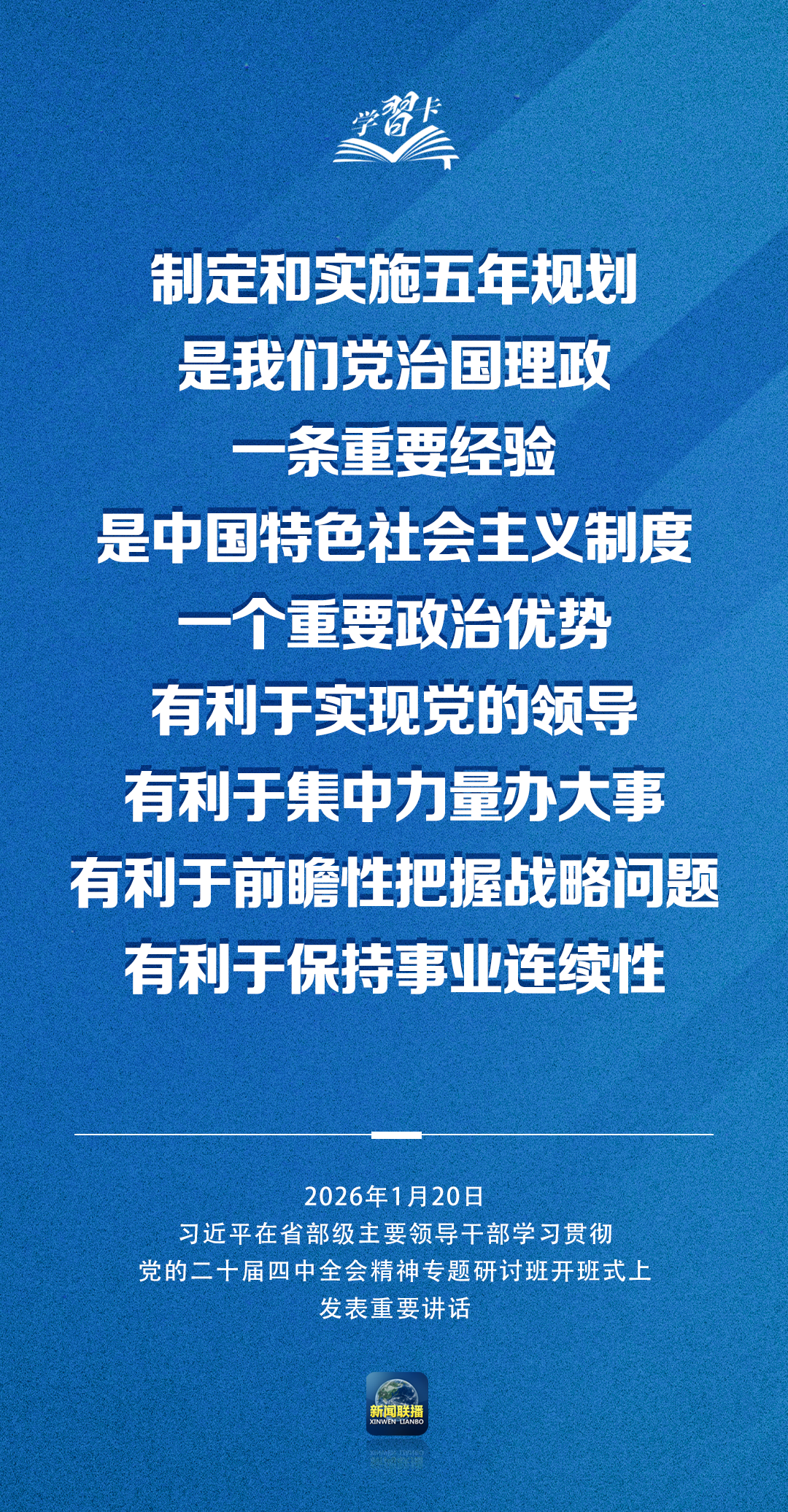
省部级主要领导干部学习贯彻党的二十届四中全会精神专题研讨班20日上午在中央党校(国家行政学院)开班。中共中央总书记、国家主席、中央军委主 席习近平在开班式上发表重要讲话强调,要把学习贯彻党的二十届四中全会精神不断引向深入,更好统一思想、凝心聚力,在党中央坚强领导下扎实做好 各项工作,努力实现"十五五"良好开局。 坚持发扬民主 集思广益 坚持规划法定原则等 我们要坚定制度自信 不断结合新的实际 把这一优势发扬光大 2026年1月20日 习近平在省部级主要领导干部学习贯彻 党的二十届四中全会精神专题研讨班开班式上 发表重要讲话 2026年1月20日 习近平在省部级主要领导干部学习贯彻 党的二十届四中全会精神专题研讨班开班式上 发表重要讲话 在制定实施五年规划的 长期实践中 我们党创造积累了丰富经验 包括坚持党中央集中统一领导 坚持从实际出发 坚持全国一盘棋 帶的一十层四面4 对"十五五"时期经济社会发展 作出战略部署 要全面深刻准确领会和把握 全面 就是要以全局视野领会全会精神 将各项部署作为一个整体来把握 不能顾此失彼 深刻 就是要知真然又知其所以然 既明自是什么 又明白为什么 怎么做 頁 准确 就是要精准把握 ...

国家发展改革委谈2026年经济工作
Xin Hua Cai Jing· 2026-01-21 00:00
全年经济总量迈上140万亿元新台阶、制造业增加值连续16年位居全球第一、年末常住人口城镇化率比 上年提高0.89个百分点……2025年,我国交出一份高质量的发展答卷。 新的一年,如何落实中央经济工作会议精神,推动"十五五"实现良好开局?国务院新闻办公室20日举行 新闻发布会,国家发展改革委相关负责人回答记者提问。 充分挖掘中国经济潜能 "经济社会发展主要目标顺利完成,经济运行稳中有进,发展韧性进一步彰显,民生政策更有温度,交 出了一份高质量答卷。"在总结过去一年经济发展成果时,国家发展改革委副主任王昌林这样概括。 "展望2026年,我们认为消费与投资、科技与产业、城乡与区域都将释放出巨大的发展潜能。"国家发展 改革委国民经济综合司司长周陈说。 从点上看,新技术新产品新场景蔚然成势。周陈表示,我国新能源、新材料、航空航天等新的经济增长 点正在蓄势待发。"目前我们正在谋划推进一批'十五五'时期的高技术产业标志性引领性重大工程。"周 陈说。 从线上看,创新链产业链人才链加速融合。周陈介绍,我国有完整的产业体系和超大规模市场,也有全 球规模最宏大、门类最齐全的人才资源,具备了将创新成果从"书架"推上"货架"的全链条全 ...
从“蔚小理”到“零鸿米”(小经说汽车)
Ren Min Ri Bao· 2026-01-15 22:04
Group 1 - The new rankings of car manufacturers in 2025 show significant changes, with Leap Motor leading in sales, followed by Hongmeng Zhixing, and Xiaomi entering fourth place, while XPeng, Li Auto, and NIO rank third, fifth, and sixth respectively [1] - The shift in rankings reflects changes in the comprehensive competitiveness of car manufacturers and indicates a transformation in the automotive market competition landscape [2] - The rise of "Zero, Hongmeng, and Xiaomi" signifies a new trend in the integration and development of the automotive industry, supported by leading ICT companies like Huawei and Dahua, which provide technological advantages and efficient supply chain capabilities [3] Group 2 - The automotive industry is transitioning from the "first half" of electrification to the "second half" of intelligence, with competition now focusing on technological differentiation, cost efficiency, and global capabilities [2] - Huawei's role in the automotive sector is emphasized, as it provides smart solutions and collaborates with various car manufacturers to enhance their product development and marketing processes [4] - The integration of ICT technologies into the automotive industry is expected to foster continuous innovation and potentially create world-class Chinese intelligent mobility brands [4]
山东宁津:电梯特色产业转型“智造”攀新高
Xin Hua Wang· 2026-01-12 00:27
Core Insights - The elevator industry in Ningjin County, Shandong, has become a significant sector, with a market share exceeding 60% in the domestic market and an annual output value surpassing 7 billion yuan [1][2] - The county is focusing on smart transformation and upgrading of traditional manufacturing, aiming for the elevator equipment manufacturing cluster to be recognized as a distinctive industrial cluster in Shandong Province by 2025 [1] - The local power supply company has enhanced the electricity infrastructure to support industrial growth, including the operation of two 110 kV substations and the installation of over 280 kilometers of high and low voltage lines [1] Industry Development - Ningjin County has established a 1,000-acre elevator industrial park and a shared processing center for steel, producing over 3,000 varieties of elevator components [1] - The transition from component production to an industrial cluster and from manufacturing to intelligent manufacturing has been a key focus for the elevator industry [1] - The local power supply company offers value-added services such as energy consulting and comprehensive energy efficiency analysis, resulting in an average reduction of over 30% in overall energy consumption [1] Urban Integration - The county is promoting a "renovation + elevator" model, integrating elevator industry development with urban renewal [2] - The local power supply company has streamlined the electricity application process, reducing the time from application to connection to within three working days [2] - A significant portion of the Oriental Garden community has installed elevators, improving residents' quality of life by providing direct access to their homes [2]
培优育厚产业“硬家底”
Xin Lang Cai Jing· 2026-01-08 20:05
Core Viewpoint - The development of the economy relies on the foundation of the real economy, with a focus on building a modern industrial system that reflects the unique advantages of Inner Mongolia as a priority for high-quality development and national modernization efforts [1] Group 1: Industrial Upgrade - Industrial upgrading is fundamentally a process of reshaping the industrial ecosystem and optimizing resource allocation through reform [1] - Emphasis on leveraging existing strengths and enhancing traditional industries such as energy, chemicals, metallurgy, equipment manufacturing, and strategic resources through smart, green, and integrated approaches [1] - The agricultural, pastoral, and cultural tourism resources in Inner Mongolia have the potential to develop into significant industries, requiring improvements in quality and brand creation [1] Group 2: Expanding New Industries - The key to expanding new industries lies in embracing reform to strengthen emerging industries and cultivate future industries [2] - There is a need to align with trends in green low-carbon technologies and the rapid iteration of artificial intelligence, focusing on growing sectors like new energy, new materials, and green computing [2] - Inner Mongolia's rich application scenarios in low-altitude economy, autonomous driving, and artificial intelligence are crucial for seizing future development opportunities [2] Group 3: Future Outlook - By taking advantage of strengths, addressing weaknesses, and enhancing efficiency, Inner Mongolia is poised to achieve significant industrial transformation and the emergence of new driving forces [3]
振芯科技三名董事抛出增持计划 传递“稳发展”信号
Zhong Guo Jin Rong Xin Xi Wang· 2026-01-08 12:24
Core Viewpoint - The management team of Zhenxin Technology demonstrates confidence in the company's future development through stock buybacks and strategic planning, particularly in the context of the "14th Five-Year Plan" focusing on "AI + hardware empowerment" [1][2][6]. Group 1: Stock Buyback and Management Confidence - Zhenxin Technology announced that its directors plan to increase their holdings in the company by investing between RMB 5.1 million and RMB 10.2 million within six months [1]. - The management's decision to buy shares reflects their confidence in the company's strategic direction and governance capabilities, especially following a court ruling regarding the company's control structure [5][6]. Group 2: Strategic Focus and Development Plans - The company aims to focus on "AI + hardware empowerment" during the "14th Five-Year Plan" period, targeting rapid growth in sectors such as integrated circuits, high-end chips, and intelligent applications [2]. - Zhenxin Technology has transitioned from a hardware supplier to a provider of comprehensive intelligent systems and services, launching several leading products in communication, satellite applications, and autonomous platforms [2]. Group 3: Technological Foundation and Market Position - Over its 22 years, Zhenxin Technology has built a robust product matrix in RF communication, Beidou navigation, and video image processing, ensuring high reliability in complex environments [3]. - The company reported a revenue of over RMB 240 million from its integrated circuit business in the first half of 2025, marking a 30% increase year-on-year [3]. - In the Beidou navigation sector, the company achieved over RMB 170 million in revenue, a 73% increase compared to the previous year [3]. Group 4: Research and Development Investment - Zhenxin Technology places a strong emphasis on innovation, with 63% of its workforce dedicated to R&D, and has seen a compound annual growth rate of 20% in R&D expenses since 2019 [4]. - In the first three quarters of 2025, the company reported revenues of RMB 736 million, a year-on-year increase of 30.56%, and a net profit of RMB 92.78 million, up 30.79% [4].

南化公司:全会精神与发展规划深度融合
Zhong Guo Hua Gong Bao· 2026-01-06 03:05
Group 1 - The company held a special learning expansion meeting to integrate the spirit of the conference with its "14th Five-Year Plan" and long-term development strategy, emphasizing a comprehensive implementation plan for learning and execution [1] - A multi-dimensional promotional matrix was established to create a strong atmosphere for learning among all employees, with interactive topics on the company's official WeChat account encouraging employees to share insights and strategies based on their roles [1] - A layered and categorized learning platform was set up to deepen understanding of the conference spirit, involving different levels of leadership and staff in various learning and discussion formats [1] Group 2 - Various units quickly took action to implement the conference spirit, focusing on key areas such as carbon capture, utilization, and storage (CCUS) process optimization, and the quality enhancement of electronic-grade sulfuric acid [2] - Activities like "Party Member Responsibility Zones" and "Strongest Operation Competitions" were initiated to promote stable operation of hydrogen production systems and increase aniline output [2] - The sales and material equipment centers concentrated on market expansion and cost control, optimizing marketing strategies and upgrading procurement processes to support cost reduction and efficiency improvement [2]
巩固提升海洋装备制造业优势
Jing Ji Ri Bao· 2026-01-01 22:13
Core Viewpoint - The development of China's marine equipment manufacturing industry is crucial for enhancing the country's maritime capabilities, with a focus on upgrading towards green and low-carbon technologies [1][2]. Group 1: Industry Development - The marine equipment manufacturing industry is a significant part of China's marine economy and a key growth point for foreign trade, with shipbuilding completion and order volumes increasing by 6.7% and 25.7% year-on-year, respectively, in the first three quarters of 2025 [1]. - China's global market shares for new orders, shipbuilding completions, and hand-held orders are 63.5%, 47.3%, and 58.6%, respectively, maintaining a leading position worldwide [1]. Group 2: International Context - The 21st century is recognized as the century of the ocean, with marine equipment being a focal point for national strategic development among marine nations [2]. - Countries like South Korea and France are advancing their marine equipment sectors, focusing on nuclear-powered ships and seawater desalination, respectively [2]. Group 3: Strategic Advantages - China possesses unique advantages for developing its marine equipment manufacturing industry, including a complete industrial system and vast maritime territory, which provides a stable market demand [2]. - The new type of national system allows for resource integration and concentrated efforts in tackling key core technologies, supporting the industry's upgrade [2]. Group 4: Future Directions - To enhance the marine equipment manufacturing industry's advantages, there is a need for systematic and forward-looking development, focusing on innovation and collaboration between academia and industry [3]. - Emphasis should be placed on addressing areas with significant gaps compared to global standards and high import dependency, particularly in chips, industrial software, and advanced materials [3]. Group 5: Integration and Globalization - Promoting land-sea integration and connecting marine equipment manufacturing with other manufacturing sectors is essential for industry upgrade [4]. - Utilizing artificial intelligence to improve collaboration efficiency across the supply chain and enabling real-time data sharing among upstream and downstream enterprises will enhance industry resilience [4]. - Encouraging advanced manufacturing enterprises to engage in global layouts and integrate into the global division of labor will create greater growth opportunities for the marine equipment manufacturing industry [4].
李军:场景相融促进消费扩容
Jing Ji Ri Bao· 2025-12-30 00:32
Core Viewpoint - The article emphasizes the growth of consumer momentum in China driven by policies such as trade-in programs, highlighting the importance of expanding service consumption and creating new consumption scenarios through innovation and technology [1] Group 1: Current Trends in Consumption - China's consumption landscape is characterized by digitalization, integration, and greening, with technologies like 5G, AI, and VR enhancing the consumer experience [1] - The integration of various sectors is breaking down industry boundaries, leading to the emergence of cross-sector consumption scenarios such as "consumption + culture and tourism" and "consumption + health" [1] - The transition towards green consumption is becoming a significant trend, with rapid adoption of new energy vehicle charging scenarios and smart home energy management systems [1] Group 2: Advantages of Building Consumption Scenarios - China benefits from a massive market that drives consumer demand, exemplified by the live e-commerce market growing from less than 500 billion yuan in 2019 to 5.8 trillion yuan by 2024, a tenfold increase [2] - The digital infrastructure supports this growth, with China accounting for over 60% of global 5G base stations and a mobile payment penetration rate of 86%, facilitating scenarios like contactless payments [2] - Targeted policy initiatives, such as the "smart business district" pilot by the Ministry of Commerce, are fostering an innovative environment for consumption scenario development [2] Group 3: Challenges in Consumption Scenario Development - There are shortcomings in China's consumption scenario development, including an incomplete ecological collaboration mechanism and low cross-departmental data sharing, leading to prolonged conversion cycles from technology research to practical application [2] - Regional disparities exist, with first-tier cities dominating innovation while third and fourth-tier cities still rely on traditional consumption models, and rural areas face challenges like insufficient cold chain logistics [2] - The standard system is lagging, with high complaint rates regarding false advertising in live streaming and data security breaches, indicating a need for improved evaluation standards and service norms [2] Group 4: Recommendations for Enhancing Consumption Scenarios - Strengthening top-level design and policy support systems is essential, including establishing a national-level consumption scenario innovation fund to support new consumption themes [3] - Enhancing technological empowerment through the use of VR, AR, and AI to create immersive consumption experiences and building "consumption scenario innovation laboratories" to shorten the technology-to-application cycle [3] - Promoting cross-industry integration by developing "consumption + metaverse," "consumption + health," and "consumption + education" scenarios, and supporting the revitalization of traditional brands through technology [4]