被动投资

Search documents
2025年公募基金发行“量效齐升”
Xin Lang Cai Jing· 2025-12-30 23:15
Core Insights - The public fund issuance market in 2025 shows a positive trend with both quantity and efficiency increasing, with 1,553 new public fund products issued, a 35.87% increase from 1,143 in 2024, marking a four-year high [1][3] - The average subscription days for new funds decreased from 22.63 days in 2024 to 16.41 days in 2025, indicating heightened market participation enthusiasm [1][3] Fund Issuance Trends - The main drivers for the increase in new fund issuance include a favorable equity market, positive market sentiment, and a deepening trend towards passive investment, with strong demand for index-based tools [4] - The number of equity funds issued reached 1,109, accounting for 71.41% of new fund products, with 835 being stock funds and 274 being mixed equity funds [4][5] - Passive index products performed particularly well, with 699 new products issued, representing 45.01% of the total, including 618 passive index stock funds [4][5] Bond and FOF Fund Trends - In contrast, the issuance of bond funds decreased to 284, down approximately 13.94% from 330 in 2024, reflecting a "strong equity, weak bond" market dynamic [5] - FOF (Fund of Funds) products saw explosive growth, with 88 new products issued, more than doubling from the previous year and surpassing the total issuance of the past three years [5] Market Concentration - The market remains concentrated, with 133 institutions participating in new fund issuance, and 24 institutions issuing 20 or more products [5] - E Fund led the market with 69 new products, followed by China Universal Fund with 64 and Huaxia Fund with 61, indicating a significant concentration of issuance among leading firms [5] Future Market Outlook - Several institutions maintain a positive outlook for the equity market in 2026, anticipating an overall upward turning point in A-share company earnings, driven by economic cycle patterns and structural optimization in various industries [6] - Signs of stabilization and improvement have emerged in multiple sectors since 2025, such as engineering machinery, steel, and aviation, with a trend of resources concentrating towards leading quality enterprises [6]
新基金发行创新高
Shen Zhen Shang Bao· 2025-12-30 17:37
Core Insights - The total number of newly established public funds reached 1553 in the year, marking a year-on-year increase of 35.87%, the highest issuance in the past four years [1] - The average subscription period for new funds was 16.41 days, which is over 6 days shorter than the previous year, indicating heightened market enthusiasm [1] Group 1: Market Dynamics - The increase in both the number and efficiency of new fund issuances is attributed to several factors: a favorable equity market, a surge in market enthusiasm, and a significant reduction in average subscription days [1] - The deepening trend of passive investment has led to a strong demand for index-based products, with accelerated approvals and expansion of ETFs, making passive index equity funds the mainstay of new issuances [1] Group 2: Product Structure - Equity funds dominate the new product landscape, with 1109 newly issued equity and mixed equity funds, accounting for 71.41% of the total new fund issuances [1]
新基金发行数量创近四年新高,权益类占主导地位
Xin Lang Cai Jing· 2025-12-30 06:44
Core Insights - The public fund issuance market has shown significant growth this year, with a total of 1,553 new public fund products established, representing a year-on-year increase of 35.87%, marking a four-year high in issuance volume [1][4] - The average subscription period for new funds has decreased to 16.41 days, down over 6 days from last year, indicating heightened market enthusiasm [1][4] Group 1: Market Dynamics - The increase in new fund issuance and efficiency is attributed to several factors: a favorable equity market, a deepening trend towards passive investment, and the leading role of major public fund institutions [1][4] - The demand for index-based investment tools has surged, with passive index funds becoming the mainstay of new fund issuance [2][5] Group 2: Fund Structure - Equity funds dominate the new issuance landscape, with 1,109 equity-related funds launched, accounting for 71.41% of total new funds. This includes 835 stock funds (53.77%) and 274 mixed equity funds (17.64%) [1][5] - Passive index funds have emerged as a significant segment, with 699 new passive index funds issued, making up 45.01% of the total. Among these, 618 are passive index stock funds [2][5] Group 3: Performance Trends - The issuance of equity funds has seen a substantial year-on-year increase of 56.64%, with stock funds alone rising by 75.79%. In contrast, bond fund issuance has decreased by 13.94%, highlighting a clear "strong equity, weak bond" market dynamic [2][5] Group 4: Institutional Landscape - A total of 133 public fund institutions launched new funds this year, with 88 institutions issuing fewer than 10 funds, while 24 institutions issued 20 or more funds, indicating a high concentration among leading firms [2][5] - Notable institutions include E Fund with 69 new funds, followed by China Universal with 64, and Huaxia Fund with 61, showcasing the dominance of major players in the market [3][6]
美股市值逼近70万亿美元,背后原因是什么
2 1 Shi Ji Jing Ji Bao Dao· 2025-12-30 02:30
Market Overview - The S&P 500 index is approaching the 7000-point mark, with a significant market capitalization increase driven by the AI revolution and the Federal Reserve's easing policies, bringing the total market value close to $70 trillion [1][6] - In 2025, the S&P 500 index is expected to have a year-to-date increase of 17.82%, while the Nasdaq is projected to rise by 22.18%, indicating a strong performance across major indices [1] Valuation Concerns - The Buffett Indicator (total market capitalization/GDP) has reached 223%, significantly exceeding the 70%-80% range considered reasonable, raising concerns about potential market corrections if liquidity tightens or AI profits fall short [4] - Current high valuations are underpinned by several factors, including low risk-free rates, substantial share buybacks, and the dominance of passive investment strategies, which may distort price discovery in the market [6][7] AI Sector Dynamics - The AI sector is anticipated to remain a key driver of market performance in 2026, shifting focus from mere technological advancements to profitability and capital returns [9][10] - Companies are expected to demonstrate tangible revenue growth from AI investments, particularly in data centers and traditional industries, to maintain investor confidence [9][11] Investment Trends in Asia - As the U.S. economy slows and valuations remain high, Asian markets are becoming increasingly attractive to investors, with expectations of continued capital flow towards Asia in 2026 [13][14] - Factors driving this trend include a structurally weaker dollar, significant valuation differences between U.S. and Asian markets, and higher economic growth rates in Asia compared to the U.S. [13][14] Structural Opportunities in China - Investment opportunities in China for 2026 are identified in three key areas: self-sufficiency in hard technology, benefits from mergers and acquisitions in competitive industries, and growth driven by demographic changes [15] - The focus on sectors such as semiconductors, AI applications, and industries benefiting from consolidation is expected to yield high valuation premiums [15]

美股市值逼近70万亿美元,背后原因是什么
21世纪经济报道· 2025-12-30 02:23
Core Viewpoint - The article discusses the significant rise of the U.S. stock market, particularly the S&P 500 index nearing the 7000-point mark, driven by factors such as AI advancements and Federal Reserve policies, while also highlighting the potential risks associated with high valuations and market dynamics [1][4]. Group 1: Market Performance and Drivers - The U.S. stock market has seen a substantial increase, with the Dow Jones up 14.49%, S&P 500 up 17.82%, and Nasdaq up 22.18% year-to-date, indicating a strong performance over the past three years [1][5]. - Three main drivers of this market surge are identified: 1. Discount rate logic, where the market bets on lower risk-free rates and compressed risk premiums [5]. 2. Cash flow return through dividends and buybacks, which has created a "floor" effect on valuations [6]. 3. The liquidity illusion from passive investments, where high trading volumes in ETFs and index funds lead to a self-reinforcing cycle of stock price increases [6]. Group 2: Valuation Concerns and Risks - The Buffett Indicator (total market cap/GDP) has reached 223%, significantly above the 70%-80% range considered reasonable, raising concerns about potential market corrections if liquidity tightens or AI profits fall short [4][7]. - Current high valuations are contingent on several factors: a soft landing for the U.S. economy, successful interest rate cuts, and sustained profit margins, particularly for AI leaders [7]. - Two deep-seated risks are highlighted: 1. The relatively high U.S. Treasury yields compared to the low earnings yield of the S&P 500, leading to a near-zero or inverted equity risk premium [7]. 2. The current high index levels are largely driven by passive funds, creating a "virtual inflation" that could lead to rapid sell-offs if liquidity conditions change [7]. Group 3: AI's Role and Future Outlook - AI is expected to remain a key driver for the U.S. stock market in 2026, shifting from a focus on hardware to profitability and capital returns [9][10]. - The potential for AI to impact various sectors is noted, with expectations for capital expenditures in data centers to support performance [9]. - Risks associated with AI include valuation disparities among companies, tightening regulatory policies, and the potential for underwhelming commercial applications of AI technologies [10][11]. Group 4: Investment Opportunities in Asia - As the U.S. economy slows and valuations remain high, Asian markets are becoming increasingly attractive to investors, with several factors driving this trend: 1. A structural weakness in the dollar, leading to capital outflows from dollar assets [12]. 2. Significant valuation differences, with the S&P 500's TTM P/E at 29.5 compared to 14.1 for the CSI 300 [12]. 3. Higher economic growth rates in Asia, particularly China, which is projected to grow at around 5% in 2026 [12][13]. - The article emphasizes three structural opportunities in the Chinese market for 2026: 1. Focus on hard technology and self-sufficiency, particularly in semiconductors and AI applications [13]. 2. Benefits from mergers and acquisitions leading to industry consolidation and improved profitability [13]. 3. Growth opportunities driven by demographic changes and consumer trends, particularly in healthcare and entertainment sectors [13][14].

美股70万亿美元市值的“狂欢与隐忧”
2 1 Shi Ji Jing Ji Bao Dao· 2025-12-29 13:07
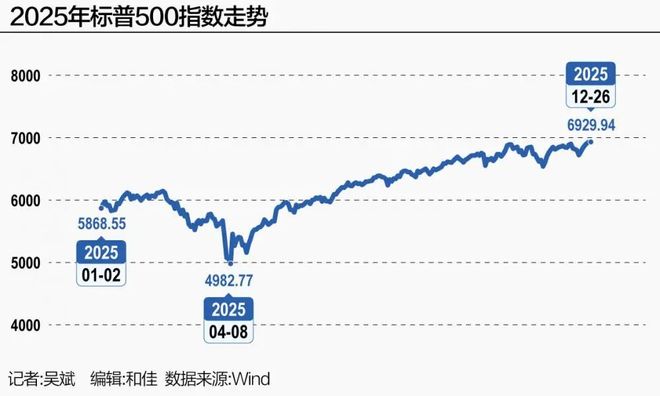
4月3日和4月4日,美股市值在短短两天内蒸发了创纪录的6.6万亿美元,标普500指数两日累计跌幅达 10.53%,罗素2000指数和纳斯达克综合指数分别在4月3日和4日跌入技术性熊市。而如今,美国所 谓"对等关税"引发的风暴已经成为过去式。 南方财经 21世纪经济报道记者吴斌 在2025年即将画上句号之际,数月前一度被暴跌恐惧支配的投资者意外地发现,标普500指数距离7000 点大关竟然只差"临门一脚"。 过去一年,AI革命与美联储宽松周期形成强劲共振,美股总市值持续攀升,已逼近70万亿美元大关。 截至12月26日收盘,道指年内已累计上涨14.49%,标普500指数大涨17.82%,逼近7000点,纳指暴涨 22.18%,三大指数均有望连续三年录得两位数百分比的涨幅。 与此同时,警报已然拉响。巴菲特指标(股市总市值/GDP)已经升至223%,远超巴菲特认为的 70%-80%的合理区间,并显著高于2000年互联网泡沫时期峰值。如果流动性退潮或AI盈利不及预期, 这场约70万亿美元的狂欢或将面临严峻考验…… 在美股连续三年大涨、标普500指数剑指7000点背后,核心原因究竟是什么? 法国里昂商学院管理实践教授李徽 ...

中国ETF总规模首破6万亿元!7只千亿级ETF,125只ETF规模突破百亿
Xin Lang Cai Jing· 2025-12-28 07:02
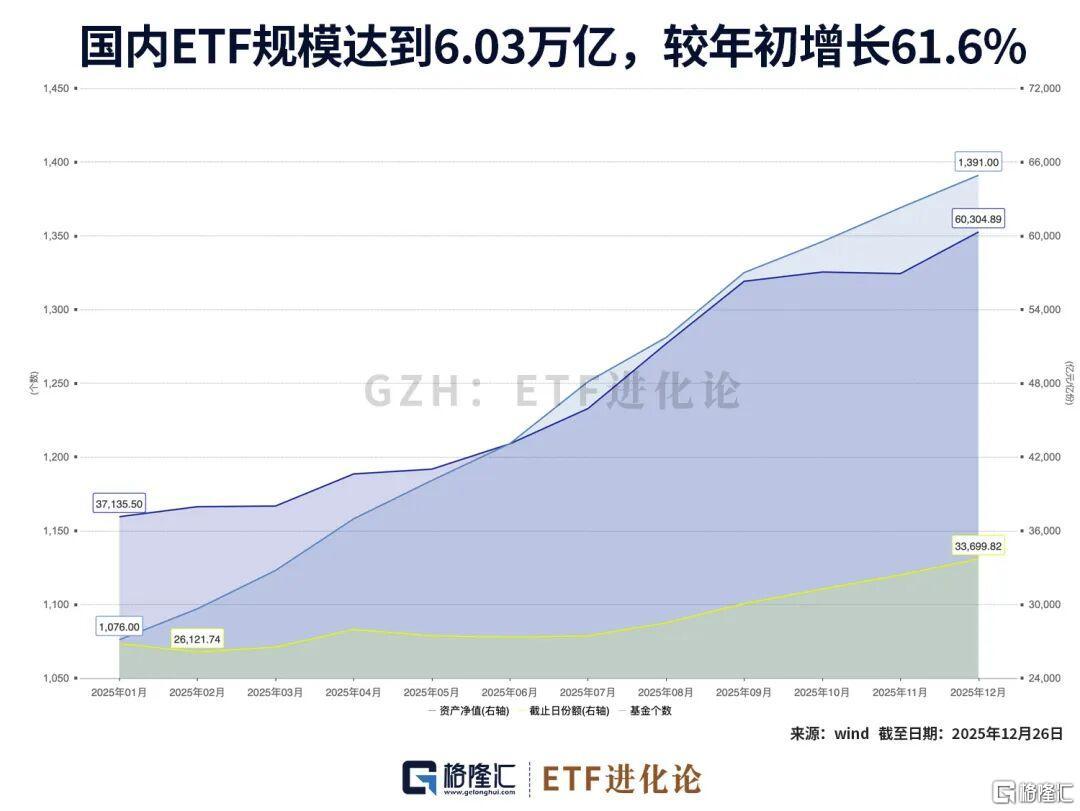
Core Insights - The Chinese capital market is entering an "ETF era" by 2025, with the total market size of ETFs reaching 6 trillion yuan, a remarkable increase of 61.6% in just one year [1][3][4] Market Growth - The ETF market has shown rapid growth, breaking through significant thresholds of 4 trillion, 5 trillion, and 6 trillion yuan within 2025, indicating a clear acceleration in market expansion [3][4] - Historical data shows that the ETF market grew from 1 trillion yuan in 2020 to 2 trillion in 2023, and then to 3 trillion in 2024, culminating in a "super explosion" in 2025, where the market crossed multiple trillion thresholds in a matter of months [4][5] Market Structure - The ETF landscape has transformed, with ETFs becoming a key component of the public fund system, featuring 1,381 ETFs, including 7 flagship ETFs exceeding 100 billion yuan and 125 ETFs surpassing 10 billion yuan [5][9] - The Huatai-PB CSI 300 ETF leads the market with a size of 427.07 billion yuan, making it the only ETF to exceed 400 billion yuan [5][7] Fund Inflows - In 2025, 50 ETFs experienced net inflows exceeding 10 billion yuan, with the Hong Kong Stock Connect Internet ETF attracting the highest inflow of 57.07 billion yuan, followed by the Gold ETF with 41.70 billion yuan [17][19] - Bond ETFs have also seen significant inflows, with the Short-term Bond ETF and 30-Year Treasury Bond ETF attracting 35.05 billion yuan and 22.35 billion yuan, respectively [17][19] Competitive Landscape - The top three fund companies dominate the ETF market, holding 41% of the market share, while the top ten companies account for 75% [21] - The "ETF Billion Club" expanded from 12 to 16 members in 2025, with new entrants including Huatai-PB, Hai Fu Tong, Penghua, and Tianhong [21] Global Context - The domestic ETF market is approximately one-fourth the size of the U.S. market, indicating that the long-term trend of index-based investing is just beginning in China [27]
中国ETF总规模首破6万亿元!谁是2025年的胜者?
Xin Lang Cai Jing· 2025-12-28 07:01
Core Insights - The Chinese capital market is entering an "ETF era" by 2025, with the total market size of ETFs reaching 6 trillion yuan, a 61.6% increase in just one year [1][3][4] Market Growth - The ETF market has shown rapid growth, breaking through 4 trillion, 5 trillion, and 6 trillion yuan in quick succession within 2025, indicating a clear acceleration in growth [3][4] - Historical data shows that the ETF market grew from 1 trillion yuan in 2020 to 2 trillion in 2023, and 3 trillion in 2024, culminating in a significant leap in 2025 [4] Market Structure Changes - The growth in ETF size has transformed the market landscape, making ETFs a key component of the public fund system, with 1,381 ETFs in total, including 7 flagship ETFs exceeding 100 billion yuan [5][9] - The Huatai-PB CSI 300 ETF leads the market with a size of 427.07 billion yuan, followed by other major ETFs from E Fund, Huaxia, and others [5][7] Fund Inflows - In 2025, 50 ETFs saw net inflows exceeding 10 billion yuan, with the Hong Kong Stock Connect Internet ETF attracting the most at 57.07 billion yuan, followed by the Gold ETF with 41.70 billion yuan [17][19] - Bond ETFs also saw significant inflows, with the Short-term Bond ETF and 30-Year Treasury Bond ETF attracting 35.05 billion yuan and 22.35 billion yuan, respectively [17] Competitive Landscape - The top three fund companies dominate the ETF market, holding 41% of the market share, while the top ten companies account for 75% [21] - The "ETF billion club" expanded from 12 to 16 members in 2025, with new entrants including Huitianfu, Haifutong, and Penghua [21] Global Context - The domestic ETF market is approximately one-fourth the size of the U.S. market, indicating that the long-term trend of indexation in China is just beginning [27]
ETF迈入6万亿!七只基金已成千亿“巨无霸”,今年这些ETF被爆买
Sou Hu Cai Jing· 2025-12-28 06:23
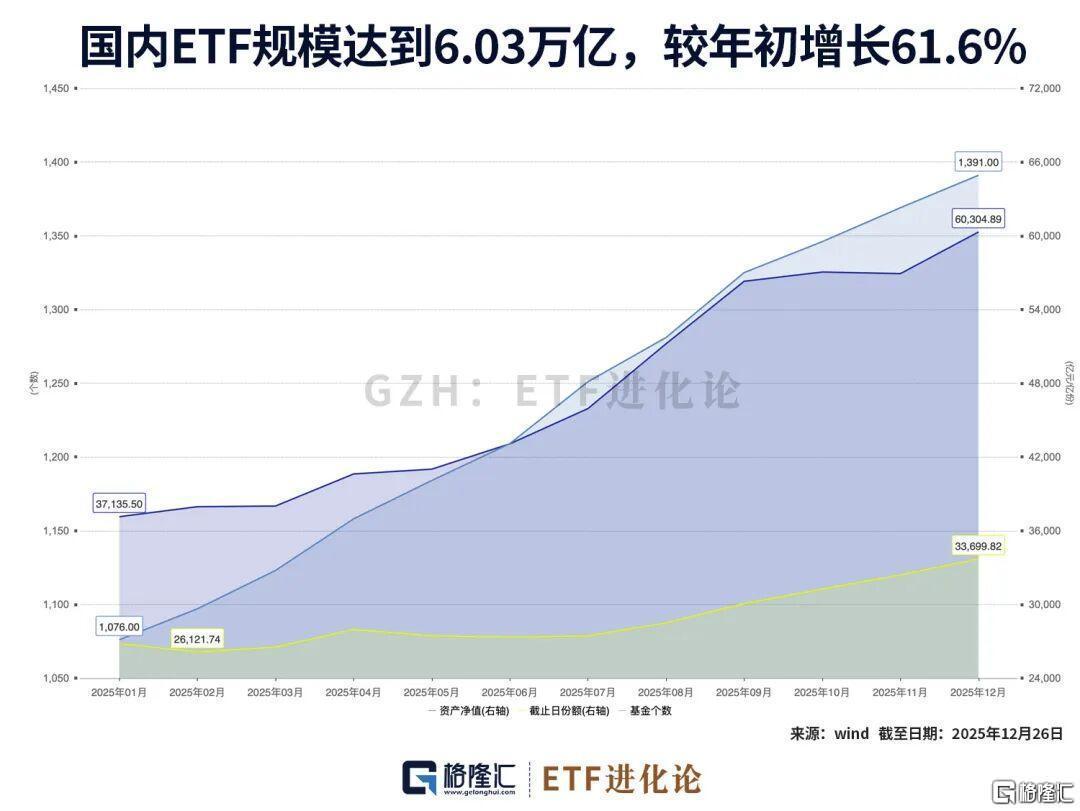
智通财经记者 | 杜萌 中国ETF正式迎来6万亿时刻。 Wind数据显示,截至12月26日,ETF规模合计为6.02万亿元,较去年底增长超2.2万亿元。 1 1000 0 the open 495 36 pp t 20 p 1997 t with the ar a status and the states t 198 1 and States of the - and all r Property the first State The the comment 1 180 the first 具体到单只ETF规模,共有7只"巨无霸"ETF规模超千亿元。华泰柏瑞沪深300ETF(510300.SH)一马当先,规模已经达到了4270.67亿元;易方达沪深 300ETF(510310.SH)紧随其后,达到3029.96亿元。华夏沪深300ETF(510330.SH)、嘉实沪深300ETF(159919.SZ)、华夏上证50ETF(510050.SH)、南 方中证500ETF(510500.SH)、易方达创业板ETF(159915.SZ)的最新规模也突破了1000亿元。 表:截至12月26日,千亿规模以上的ETF有 ...

历史新高!突破6万亿元!
Xin Lang Cai Jing· 2025-12-28 01:06
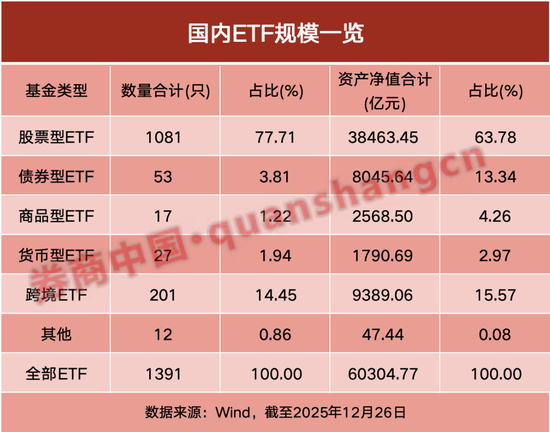
Core Insights - The total scale of China's ETF market has surpassed 6 trillion yuan, reaching 6.03 trillion yuan as of December 26, marking a significant increase of over 60% from the beginning of the year [1][12][13] - The rapid growth reflects a profound evolution in the investment structure and participation methods within China's capital market [1][12] - The market has seen a notable increase in the number of large-scale ETF products, with 125 ETFs exceeding 10 billion yuan, including 7 flagship products with over 100 billion yuan [1][17] Market Overview - As of December 26, the distribution of ETF assets shows that stock ETFs dominate with a scale of 3.85 trillion yuan, accounting for 64% of the total [2][13] - The number of stock ETFs tracking various indices has reached 366, with significant scales for those tracking the CSI 300 and other major indices [2][13] - Cross-border ETFs and bond ETFs have scales exceeding 930 billion yuan and 800 billion yuan, respectively, while commodity and currency ETFs also show substantial figures [2][13] Fund Management Landscape - The "head effect" in ETF fund management is pronounced, with the top three fund companies holding a combined market share of 41% [5][15] - The top ten fund companies account for 75% of the market, while the top sixteen hold over 90%, indicating a strong concentration of market power [5][15] - Major fund managers include Huaxia Fund, E Fund, and Huatai-PB Fund, with their respective ETF scales being 960.14 billion yuan, 888.33 billion yuan, and 628.30 billion yuan [5][16] Historical Growth - The ETF market has achieved significant milestones, crossing 4 trillion yuan, 5 trillion yuan, and 6 trillion yuan in rapid succession from April to December 2025 [3][14] - The growth trajectory indicates a shift from mere scale expansion to a focus on quality development in index investment [1][19] Future Outlook - The domestic index investment is transitioning from a phase of scale expansion to one emphasizing quality enhancement, supported by policy measures that streamline ETF approval processes [19][20] - The application of AI technology and the influx of long-term capital are expected to further optimize the ETF market structure [20][21] - Industry experts believe that index investment is evolving into a foundational infrastructure for high-quality development in the capital market, facilitating capital focus on emerging industries [19][20]