
错位竞争

Search documents
新车看点丨“半价Model 3”,零跑B01醉翁之意不在酒
Guan Cha Zhe Wang· 2025-07-28 11:53
Core Viewpoint - Leapmotor's B01 is positioned as a "half-price Model 3," offering young consumers advanced performance and intelligence at a price range of approximately 89,800 to 119,800 yuan [1][3]. Product Launch and Market Positioning - The B01, launched on July 24, is a compact electric sedan with a full price range of 89,800 to 119,800 yuan, targeting the compact electric vehicle market [3]. - Leapmotor's strategy emphasizes a unique competitive edge in the market, focusing on cost reduction and market positioning, which has led to record monthly sales [3][4]. - The A-class sedan market, where B01 is positioned, saw nearly 1.83 million new car sales in the first half of the year, holding a market share of 16.8% [3]. Competitive Landscape - The A-class sedan market is dominated by models from BYD and other competitors, with significant competition from new entrants like Xpeng's MONA M03 [4][6]. - Leapmotor will face challenges in the A-class sedan market, competing against brands known for their cost reduction capabilities [6]. Technical Specifications - The B01 features dimensions of 4770mm in length, 1880mm in width, and 1490mm in height, with a wheelbase of 2735mm [7]. - The vehicle offers enhanced interior space due to its CTC 2.0 Plus battery integration and rear motor design, with rear legroom of 932mm and a trunk capacity of 460L [9]. - The B01 is equipped with a rear-wheel drive layout, a seven-in-one high-performance oil-cooled electric drive, delivering a maximum power of 160kW and a peak torque of 240N·m, achieving 0-100 km/h in 6.4 seconds [9]. Intelligent Features - The B01 incorporates Qualcomm's 8650 driving assistance chip and 8295 smart cabin chip, enabling 26 advanced driving assistance functions [11]. - The vehicle features a 14.6-inch 2.5K central control screen and the Leapmotor OS 4.0 Plus interactive system [11]. Battery and Range - The B01 offers three battery capacity options: 43.9kWh, 56.2kWh, and 67.1kWh, with corresponding CLTC ranges of 430km, 550km, and 650km [13]. - The vehicle's 27-in-1 super integrated thermal management system reduces space by approximately 30% and weight by 15%, achieving a low energy consumption of 11.4kWh per 100km [13].


董明珠“仇敌”,要IPO了
Sou Hu Cai Jing· 2025-07-26 12:24
Core Viewpoint - The news highlights the upcoming IPO of AUX Electric Co., a major player in the air conditioning market, which is seeking to capitalize on the current hot IPO environment in Hong Kong after a previous unsuccessful attempt in January 2025 [1][11]. Company Overview - AUX Electric Co. is recognized as the "fifth largest air conditioning supplier globally" and has a history dating back to the 1990s when it entered the burgeoning Chinese air conditioning market [1][11]. - The company was founded by Zheng Jianjiang, who aimed to disrupt the market dominated by high-priced competitors by initiating aggressive price wars, earning the nickname "air conditioning butcher" [1][6]. Market Position and Strategy - AUX has achieved significant revenue growth, with projected revenues of 195.28 billion yuan, 248.32 billion yuan, and 297.59 billion yuan for the years 2022, 2023, and 2024 respectively, alongside adjusted net profits of 14.49 billion yuan, 25.11 billion yuan, and 29.35 billion yuan [11]. - The company has successfully expanded its market presence internationally, operating in over 150 countries and regions, while focusing on lower-tier domestic markets to avoid competition with major players like Gree and Midea [2][9]. Competitive Landscape - The air conditioning market has seen a shift from a single dominant player to a more fragmented competitive landscape, with AUX's aggressive pricing strategy significantly impacting competitors like Spring Lan [1][8]. - Despite its growth, AUX still lags behind major competitors, with Midea's revenue reaching 407.2 billion yuan and Gree's at 190 billion yuan, indicating a substantial gap in market share and financial performance [2][11]. IPO Context - The recent surge in IPO activity in Hong Kong presents a strategic opportunity for AUX to secure funding and enhance its market position, especially after a significant pre-IPO dividend payout of 3.794 billion yuan [11]. - The company aims to leverage its global market share of 7.1% to attract investors and establish a stronger foothold in the competitive air conditioning industry [11].
赢了沃尔玛“一毛钱”,却输掉一个时代,“广东超市三巨头”崩塌退市
3 6 Ke· 2025-07-21 04:03
Core Viewpoint - The delisting of Renrenle Supermarket marks the accelerated decline of the golden era of traditional large chain supermarkets in China, reflecting broader industry turbulence and differentiation [1][2][3]. Company Overview - Renrenle Supermarket, once a prominent player alongside Yonghui and RT-Mart, has seen its market value plummet from approximately 13.668 billion yuan at its peak in 2010 to about 1.58 million yuan at the time of delisting, representing a 99% decrease [2][3]. - Founded in 1996, Renrenle was initially successful, breaking the myth of "no competitors within 3 kilometers" against Carrefour and Walmart, and was recognized as one of the "three giants" of Guangdong supermarkets [2][16]. Industry Context - The rise and fall of Renrenle reflect the changing dynamics of the retail industry, where new entrants like Sam's Club and the emergence of e-commerce have disrupted traditional business models [3][26]. - The traditional supermarket model, which relied heavily on physical store expansion, has become increasingly untenable in the face of evolving consumer preferences and the rise of online shopping [18][26]. Strategic Missteps - Renrenle's aggressive expansion strategy, including a "ten thousand stores in five years" plan, led to significant financial strain, particularly in markets like Xi'an where profitability was not achieved [19][20]. - The company failed to adapt its successful business model from Shenzhen to other regions, leading to operational inefficiencies and financial losses [20][21]. Financial Decline - By 2023, Renrenle's audited net assets were reported at -387 million yuan, triggering delisting warnings, and the company faced severe liquidity issues with a 40% out-of-stock rate in stores [25][27]. - The company's financial struggles culminated in the closure of 45 stores in 2024, alongside significant asset sales to recover funds [25][27]. Broader Industry Trends - The entire supermarket sector is experiencing challenges, with competitors like RT-Mart and Yonghui also reporting significant revenue declines and store closures [25][29]. - The shift towards e-commerce and changing consumer behaviors have rendered traditional supermarket models less effective, leading to a wave of industry consolidation and exits [26][30]. Conclusion - The case of Renrenle serves as a cautionary tale for the retail industry, highlighting the risks of failing to innovate and adapt to changing market conditions, as well as the consequences of misaligned strategic decisions [26][31].
公募ETF强者恒强 中小公司错位谋变
Zheng Quan Shi Bao· 2025-06-08 18:48
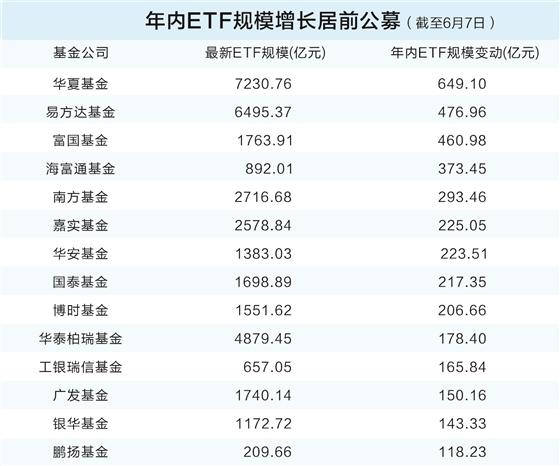
Core Insights - The ETF market in China is experiencing a "Matthew Effect," where larger fund companies dominate while smaller firms seek niche opportunities for growth [2][5][8] - As of June 7, 2023, the total market size of ETFs reached 4.16 trillion yuan, with the top three fund companies managing 1.86 trillion yuan [3][4] - 14 fund companies have seen their ETF sizes grow by over 10 billion yuan this year, indicating a significant inflow of capital into these products [3][6] Group 1: Market Dynamics - The top three fund companies, namely Huaxia Fund, E Fund, and Huatai-PB Fund, have a combined management scale of 1.86 trillion yuan, creating a formidable scale barrier [2][3] - Smaller fund companies like Haifutong Fund and Pengyang Fund have achieved significant growth by focusing on specialized products such as bond ETFs and gold ETFs [2][7] - The competition among ETF providers has intensified, with product innovation and cost control becoming critical for survival [2][8] Group 2: Challenges for Small Fund Companies - Many small fund companies are avoiding direct competition in the ETF market and are instead focusing on off-market index funds due to resource constraints [5][6] - Small firms face challenges in product differentiation, as many ETFs track the same indices, leading to high levels of product homogeneity [6][8] - The operational costs associated with launching and maintaining ETFs can be prohibitive for smaller firms, impacting their ability to compete effectively [7][9] Group 3: Strategies for Growth - Small fund companies are encouraged to focus on niche markets, such as thematic or cross-border ETFs, to carve out a competitive edge [8][9] - Developing innovative products, such as ESG index funds or index-enhanced products, can help smaller firms attract investor interest [9] - Collaborating with other firms or institutions to share research and development costs may provide a pathway for smaller companies to enhance their product offerings [9]
混战的印尼网约车市场:出海者的差异化生存法则
Tai Mei Ti A P P· 2025-06-06 00:27
Core Insights - The ride-hailing market in Indonesia is highly competitive, with major players like Grab and Gojek dominating over 90% of the market share, while traditional taxi companies like Blue Bird are also experiencing growth [1][3][11] - Blue Bird has successfully transformed its business model by focusing on high-end services and B2B partnerships, achieving a revenue of approximately $295 million in 2023, with a year-on-year growth of 23.2% [4][6] - New entrants like Maxim are targeting underserved markets, particularly in smaller cities, and have adopted a low-cost strategy, resulting in significant user growth and market penetration [10][11] Company Summaries Grab - Founded in 2012 and headquartered in Singapore, Grab is Southeast Asia's largest super app, with a core business in ride-hailing and extensions into food delivery, digital payments, and financial services [3] - Grab holds a significant market share in most Southeast Asian countries, except Indonesia, where it competes closely with Gojek [3] Gojek - Established in 2010, Gojek started as a motorcycle ride-hailing service and has expanded into a comprehensive ecosystem covering ride-hailing, food delivery, and payments [3] - Gojek commands a 55% market share in ride-hailing and 70% in food delivery within Indonesia [3] Blue Bird - Blue Bird, a traditional taxi company with over 50 years of history in Indonesia, has adapted to the ride-hailing competition through high-end service offerings and digital upgrades [4][6] - The company reported a revenue of approximately $295 million in 2023, with a target of $336 million for 2024, reflecting a growth strategy focused on corporate partnerships and digitalization [4][6] Maxim - Maxim, a Russian ride-hailing service, entered the Indonesian market in 2018 and focuses on lower-tier cities and underserved areas, offering competitive pricing and lower commission rates for drivers [10][11] - The company has seen a 30% year-on-year increase in user ride time, indicating strong growth in its user base [10][11] Market Trends - The Indonesian ride-hailing market is projected to reach $3.13 billion by 2025 and grow to $4.78 billion by 2030, with a compound annual growth rate (CAGR) of approximately 8.8% [11] - Over 70% of ride-hailing transactions occur in the Greater Jakarta area, but there remains significant growth potential in second and third-tier cities where market penetration is below 15% [11]

对谈轩妈创始人,蛋黄酥没有奥利奥的命,中国为什么不能有自己的“费列罗”?
FBIF食品饮料创新· 2025-04-22 01:19
以下文章来源于天下网商 ,作者天下网商 天下网商 . 记录互联网商业的人物和故事。 很少有创业者愿意将自己"虚弱"的一面示人,甚至将处于调整期的品牌,"冷静"撕开肌理,展开来看。 当我们走进轩妈创始人韦福献在杭州的办公室,他最先坦露的是发展困境、自身的迷惘和局限性。他身 上有焦虑,但也有兴奋。谈及过往及转折,他掏出手机找出一张Boss直聘截图页面展示给我们看。这不 是一个求职对话框,而是一个"差评"。 图片来源:微博@轩妈蛋黄酥 几年前,高速发展的轩妈融资之后,开始探索线下货架渠道,寻找新的生意增量。于是,上架了90天长 保的蛋黄酥,与此前短保的蛋黄酥口味有些差异。有位用户直接在Boss直聘上找到韦福献,称作为南宁 人,从小吃到大,一直很信任,但长保产品让"轩妈变味了",他觉得很"失望"。 这个差评,直接让韦福献决定,砍掉当时持续贡献利润的线下长保业务。这张图片被他保存下来,时时 警醒。 2007年,韦福献和夫人来到杭州旅行,看着这座城市一半是城市楼宇,一半是湖光山色,就在心里种 下一颗种子:有机会一定要到杭州生活。如今,他已经如愿以偿。2022年,他将公司搬来了杭州。前 几个月,他接来家人在杭州定居。轩妈办 ...
北京城南迎来商业体新项目集中入市,“错位竞争”激活区域消费
Xin Jing Bao· 2025-04-14 10:29
海淀大悦城(000031)启幕,超极合生汇东西区"合体",ART PARK大融城西区即将亮相……随着商业 项目不断"上新",北京北部区域消费能级不断被激活。近日,新京报记者了解到,北京南城也将迎来商 业体新项目集中入市,上德银泰城、元创大都会等有望今年年内开业。随着南城新项目启幕,北京南部 区域商业或将改变北京大兴荟聚"一家独大"现状,多个项目错位发展、相互补充,北京南城区域消费将 有望迎来升级。 大兴区多个新项目有望年内亮相 北京上德银泰城总建筑面积达到15.5万平方米,其中包括5.6万平方米的商业空间以及2.3万平方米的沉 浸式花园。项目涵盖1大超级IP地标、2大艺术装置、3大景观地标,计划引入超120个新兴生活方式品 牌,引领当下新兴的萌宠经济+户外运动+日咖夜酒等消费趋势,以社群营销+事件营销的形式实现社交 新场景,助力区域生活品质提升。根据上德中心公众号发布的信息,上德银泰城目前招商进度已达到 65%。 南城新项目主打"错位竞争" 位于大兴的北京荟聚购物中心一直是北京南城区域消费的"领头羊"。根据公开数据,在刚刚过去的清明 假期,北京荟聚以45.65万人次的客流量和8151万元的收入领跑全区。 北京 ...
小红书的电商选择题:调性和规模,只能留一个
晚点LatePost· 2024-12-16 14:02
肯花钱的用户、四处求货的博主、难聚起的流量。 文丨孙海宁 制图丨黄帧昕 编辑丨高洪浩 设置独立电商部门一年多,小红书最大的成就,可能是让用户感觉不到平台正挖空心思引导他们下一单。 打开小红书推荐页,信息流中的商品笔记不外显价格;应用里看不见官方制作的热销商品榜单;直播间 内,也少有 "三、二、一,上链接!" 的叫卖声。今年双十一,小红书核心玩法不是刺激交易的抢券、满 减、拼单,而是 "集章"——用户在特定直播间呆够 60 秒并关注主播,可以获得一枚电子图章。 种种含蓄显得小红书对电商业务并不急迫,但这只是表象。去年 8 月, 这家公司整合电商和直播业务 , 组建一级部门 "交易部",与 "社区部" 和负责广告的 "商业部" 平行,由公司 COO 柯南直接管理。几个月 前,他们又在杭州新设办公地,要和业内前辈阿里、字节做邻居、抢人才。 据我们了解,小红书电商今年实现了千亿元量级的销售额。电商部门当前的工作重心是培养站内用户的购 物习惯、提高商家的成长速度。 小红书的电商业务始于 2014 年上线的"福利社"——平台从海外买来好产品,附上易懂的介绍,任消费者 选购。可没几年,进口税收新政的大浪拍来,小红书电商逐渐 ...