
风险收益比

Search documents
为什么身边有钱人,家里有多套房,却捂住不抛售?真实原因太扎心
Sou Hu Cai Jing· 2025-07-18 02:43
Core Insights - The article discusses the complex motivations behind wealthy individuals holding multiple properties, emphasizing that real estate serves as a crucial component of their asset allocation strategy [1][5][12] - It highlights the stability and reliability of rental income from real estate investments, which provides a consistent cash flow despite market fluctuations [1][6][12] Group 1: Investment Logic - Real estate is perceived as a "hard currency" due to its high preservation rate, with core urban residential properties maintaining a value retention rate of 98.7% in 2024 [2] - The rental yield in first-tier cities remains stable between 2.5% and 3.2%, which, while modest, is valued for its reliability [1][2] - Investors view real estate as a "ballast" in their diversified portfolios, providing stability during market volatility [2][10] Group 2: Economic and Policy Context - The ongoing urbanization process supports housing demand, with the urbanization rate reaching 67.5% by the end of 2024, indicating a steady influx of population into cities [5] - The government's "housing is for living, not speculation" policy framework suggests that property prices will not experience extreme fluctuations, benefiting long-term holders [5][12] Group 3: Tax and Wealth Preservation - Holding real estate offers tax advantages compared to frequent buying and selling, as selling may incur significant personal income tax liabilities [6] - Real estate serves as a means of wealth preservation, especially in uncertain economic times, as it provides a tangible asset that can safeguard capital [6][10] Group 4: Long-term Value and Legacy - Wealthy individuals often purchase properties not just for personal use but also for future generations, as real estate is easier to pass down and less likely to cause disputes [7] - The investment philosophy of these individuals focuses on long-term strategic value rather than short-term gains, reflecting a more patient and calculated approach to wealth accumulation [7][12] Group 5: Market Trends and Future Outlook - Despite a cooling market, structural opportunities remain in core urban areas and high-quality districts in strong second-tier cities, which are still considered scarce resources [8][12] - The article suggests that real estate will continue to be a significant pillar of the Chinese economy, with a clear intention from policymakers to stabilize the market [12][13]


巴菲特说不懂不投,达里奥做分散配置,两者有矛盾吗?
雪球· 2025-07-10 08:15
Core Viewpoint - The article discusses two prominent investment philosophies: Warren Buffett's focus on understanding one's own capability circle and Ray Dalio's all-weather diversified allocation strategy, questioning which approach is more beneficial for investors [1][2][3]. Group 1: Investment Philosophy - Buffett's principle of "do not invest in what you do not understand" is widely recognized, yet many investors confuse familiarity with true understanding [3][5]. - Dalio's strategy emphasizes diversification, but investors often fall into the trap of diversifying without understanding the underlying correlations, leading to ineffective risk management [5][11]. Group 2: Understanding Risk - True understanding in investing does not equate to predicting price movements; it involves comprehending potential losses and their probabilities [6][9]. - The article highlights that overconfidence stemming from cognitive biases can be more detrimental than a lack of knowledge [8][17]. Group 3: Data Insights - Historical data from 2005 to 2025 indicates that a stock-bond allocation reduces maximum drawdown by 15% compared to a pure A-share investment [16]. - Further diversification into global assets, including U.S. stocks and gold, minimizes drawdown while maintaining returns, validating both Buffett's and Dalio's investment principles [16][17]. Group 4: Bridging Understanding and Diversification - The article suggests that a balanced approach can be achieved by integrating Buffett's focus on understanding with Dalio's diversification, allowing for a more robust risk-return profile [17].

警惕熊市反弹陷阱!高盛:当前股市如同“带刺的玫瑰”
Zhi Tong Cai Jing· 2025-05-06 11:24
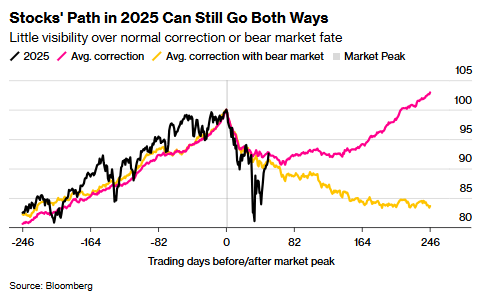
Core Viewpoint - The recent rapid rebound in global stock markets is characterized as a typical bear market rally, indicating that investors will face pain regardless of market direction [1][3] Group 1: Market Dynamics - High volatility in stock prices is primarily driven by short-term news headlines and speculation regarding the evolving U.S. tariff policies and their impact on corporate earnings and valuations [1] - The current risk-reward ratio for stock investments is deemed unfavorable, with significant uncertainty prevailing among investors regarding long-term bullish or bearish consensus [1][6] - Historical data shows that bear market rallies typically last an average of 44 days with an average gain of 14%, while the recent rebound since April 7 has seen an 18% increase [3][4] Group 2: Investor Behavior - Market participants are caught in a dilemma of either chasing a fading rally or missing out on potential gains, leading to increased difficulty in decision-making [3] - Many investors have been forced to reduce risk exposure due to unclear tariff prospects, only to be compelled to buy at higher prices later [3][6] - Retail investors have significantly increased their risk exposure, with record buying intensity observed in individual stocks and ETFs [9] Group 3: Systematic and Macro Investors - Systematic macro investors have increased their buying scale, reaching $51 billion last week, with expectations to hit $57 billion this week, although the rapid fluctuations may slow down the inflow of funds [8] - Macro investors are reducing their stock exposure despite recent market gains, indicating a divergence between stock market performance and investor sentiment [6][8]

【广发宏观陈礼清】3月以来的宏观交易主线:大类资产配置月度展望
郭磊宏观茶座· 2025-04-02 13:48
Core Viewpoints - The performance of major asset classes as of March 31, 2025, shows gold leading with a year-to-date (YTD) increase of 19.3%, followed by LME copper and crude oil, while the Chinese stock market remains relatively strong despite a high-low switch in structure [1][12][13]. Group 1: Asset Performance - As of March 31, 2025, the ranking of major asset classes is gold > LME copper > crude oil > Hang Seng Index > 0 > CSI 300 > China bond > Euro index > Hang Seng Tech > US dollar > Nikkei > Dow Jones > NASDAQ [1][12]. - Gold reached a new high in March, with a YTD increase of 19.3% and a maximum drawdown of only 3%, indicating the best risk-reward ratio among major assets [1][12]. - The global stock indices continued a "risk-off" sentiment, with the US stock market experiencing a significant increase in the fear index, while the Chinese stock market showed a relatively strong performance [1][12][18]. Group 2: Macro Trading Themes - The macro trading themes in March 2025 revolve around four core clues: the gradual confirmation of economic recovery, uncertainty in external tariffs, a continued "risk-off" sentiment in global risk assets, and heightened risk aversion leading to strong performance in gold and silver [2][62]. - The economic foundation is slowly confirming an upward trend, with cyclical assets and interest rate levels generally rising [2][62]. Group 3: Economic Indicators - The domestic manufacturing PMI, service PMI, and construction PMI for March 2025 rose to 50.5%, 50.3%, and 53.4%, respectively, indicating a stable start to the first quarter [3][72]. - The model predicts a March CPI increase of -0.04% month-on-month and +0.27% year-on-year, while PPI is expected to be -0.09% month-on-month and -2.19% year-on-year, indicating a slight recovery in CPI and continued weakness in PPI [3][76][79]. Group 4: Future Drivers for Equity Assets - Upcoming economic data for the first quarter and more corporate earnings reports are expected to provide a verification period for macro and micro fundamentals, with a significant impact anticipated from the technology sector [4][96]. - The implementation of "reciprocal tariffs" in April is expected to clarify economic impacts, while policy measures are likely to continue to heat up, providing a favorable window for potential interest rate cuts [4][96][97]. Group 5: Timing Signals - The "M1-BCI-PPI timing system" indicates an improvement in timing signals for the CSI 300 index from +0.169 to +0.353 for the period from mid-April to mid-May 2025, suggesting a positive outlook for equity assets [5][100]. - The stock-bond ratio has returned to a more normalized range, indicating that the previous extreme safety margins in the stock market have been consumed, and future performance will be more critical [6][9]. Group 6: Sector Performance - Approximately 55% of the 31 industries recorded positive returns in March, with cyclical and consumer sectors leading the gains, while previously high-performing technology sectors experienced corrections [40][47]. - The real estate market shows overall stability but with increasing structural differentiation, particularly in first-tier cities where transaction volumes are relatively high [47].


基金经理请回答 | 对话王路遥:估值提升,是机会还是挑战?
中泰证券资管· 2025-03-28 08:00
Core Viewpoint - The fund's equity investment ratio decreased to below 80% at the end of Q4, indicating a cautious approach due to rising valuations and reduced potential returns from certain stocks [2][3][4] Group 1: Fund Positioning and Strategy - The fund manager emphasizes a bottom-up approach to stock selection, leading to a reduction in positions for certain high-flying stocks as their potential returns diminished [2][4] - The fund's investment strategy is not to fully allocate capital when there are insufficient attractive investment opportunities, reflecting a cautious market outlook for Q4 2024 [2][3] - The fund maintains a minimum stock allocation of 60%-70%, but may lower return expectations if market valuations rise significantly [5][6] Group 2: Market Valuation and Return Expectations - As market valuations increase, the potential return rates for selected stocks decrease, prompting the fund to adjust its positions accordingly [4][5] - The fund manager notes that the required return rates are influenced by the prevailing market conditions and risk-free rates, rather than arbitrary targets [6][8] - The manager acknowledges that achieving higher returns (10%-15%) may be challenging due to elevated valuations and market dynamics [7][8] Group 3: Risk Assessment and Cash Flow Analysis - The risk-reward ratio is assessed based on the probability of achieving expected cash flows, with a focus on potential downside risks [9][10] - The fund manager highlights the importance of understanding market space and competitive dynamics, which can significantly impact stock valuations and future cash flows [10][14] - Continuous monitoring of company performance and market conditions is essential to reassess investment decisions and manage risks effectively [13][15] Group 4: Industry Insights and Research Approach - The fund manager's research spans various sectors, including renewable energy, consumer goods, and chemicals, leveraging insights from a collaborative research team [19][20] - The manager emphasizes the importance of understanding the business model and cash flow generation rather than getting bogged down in technical details [20][21] - The approach to investment is based on identifying companies with strong fundamentals and potential for growth, while also considering market limitations [16][18]

2025年3月可转债组合推荐与策略展望-大类资产
2025-03-04 07:00
Summary of Conference Call on Convertible Bond Strategy and Recommendations Industry Overview - The focus is on the convertible bond market, particularly strategies and recommendations for 2025 [3][4][6]. Key Points and Arguments 1. **Market Strategy Shift**: The convertible bond market strategy has reversed since September 2024, driven primarily by stock performance rather than credit recovery [3][4][6]. 2. **Investment Approach**: The current strategy emphasizes stock selection over increasing positions, advocating for a focus on efficiency and individual stock selection rather than merely adjusting portfolio weight [3][8]. 3. **Monthly Portfolio Construction**: A combination of top-down and bottom-up approaches is used to construct monthly portfolios, with a focus on identifying market drivers and avoiding purely defensive strategies [9][12]. 4. **Targeted Sectors**: The strategy favors technology sectors with high barriers to entry, including computing power, solid-state batteries, robotics, and photovoltaics, with a particular emphasis on companies with strong fundamentals [3][13]. 5. **Selected Convertible Bonds**: The top ten recommended convertible bonds include companies like Zhenhua Pump, Zhongbei Communication, and Huamao Co., chosen for their potential to outperform the index and their strong fundamentals [14][15]. 6. **Focus on High-Quality Bonds**: Recommendations include bonds rated 2A or higher, ensuring a balance between capturing high-potential opportunities and maintaining stable returns [12][14]. 7. **Market Efficiency**: Emphasis is placed on market efficiency and the importance of selecting the right stocks over merely increasing portfolio exposure [8][12]. 8. **Quantitative Strategies**: Recommended strategies include a dual low strategy focusing on bonds priced around 130 with a 20% premium, and a momentum strategy targeting high volatility stocks rated 2A or above [24]. Additional Important Insights - **Convertible Bond Characteristics**: The strategy highlights the importance of selecting convertible bonds with favorable characteristics, such as those with a price above 130 and a premium rate around 20% [10][12]. - **Sector-Specific Opportunities**: The call identifies specific opportunities within the photovoltaic sector due to recent market dynamics, suggesting potential for short-term trading [21]. - **Broader Market Context**: The discussion reflects a broader market context where the convertible bond market is seen as a dynamic environment influenced by stock performance and macroeconomic factors [4][6][19]. This summary encapsulates the key insights and strategies discussed in the conference call regarding the convertible bond market and its investment opportunities.