
人民币汇率

Search documents
汇率双向波动是常态
Jing Ji Ri Bao· 2025-12-29 02:13
接下来,人民币汇率是否会呈现单边升值态势?专家认为,对此还需客观、理性看待。"美联储面 临通胀和就业的艰难平衡,进一步降息面临的约束不少,并不像部分媒体所说的明年会超预期大幅降 息,目前市场预期明年会降息2次。近期美元指数跌幅较大,未来存在回调走升的可能。"中国民生银行 首席经济学家温彬说。 作为货币之间的比价,汇率双向波动是常态。温彬提醒,未来人民币汇率走势仍存在较大不确定 性,企业和金融机构切忌盲目跟风、赌汇率走势,要坚持风险中性理念,做好汇率风险管理。 近日召开的中国人民银行货币政策委员会2025年第四季度例会强调,增强外汇市场韧性,稳定市场 预期,防范汇率超调风险,保持人民币汇率在合理均衡水平上的基本稳定。专家认为,近年来,在应对 多轮外部冲击的过程中,我国外汇市场的监管部门积累了丰富的经验,也有充足的政策工具储备,有经 验、有能力、有信心应对各种冲击和挑战,维护我国外汇市场的稳定运行。 经济日报记者 姚进 今年以来,全球汇市波动加剧,而人民币对美元走势稳中偏强。从人民币对美元汇率中间价来看, 年内涨幅超过1500个基点,并于近日升至2024年9月以来最高。这引发市场广泛讨论,其间不乏"人民币 会继续 ...
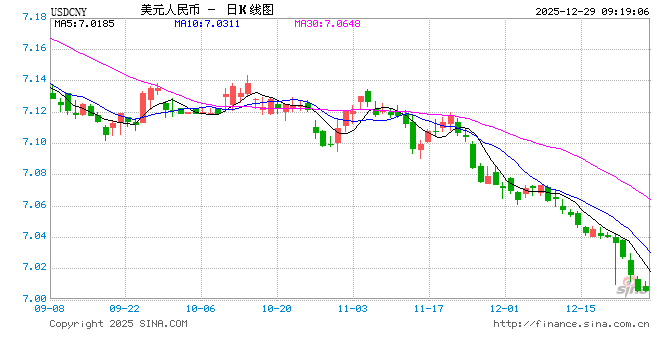
人民币中间价报7.0331,创2024年9月30日以来最高
Bei Jing Shang Bao· 2025-12-29 02:04
Wind数据显示,截至当日9时40分,人民币对美元汇率报7.0093,贬值0.04%,离岸人民币对美元汇率 报7.0069,贬值0.04%。 北京商报讯(记者 刘四红)12月29日,人民币对美元中间价调升27个基点,报7.0331,创2024年9月30 日以来最高。前一交易日中间价报7.0358。 ...
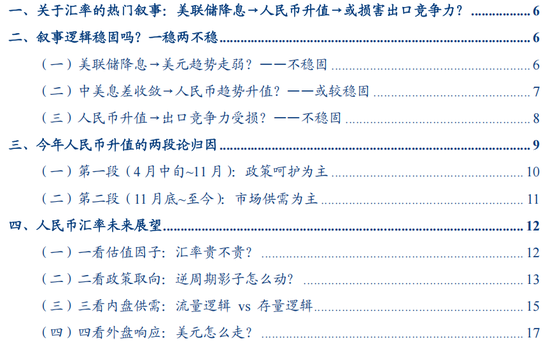
张瑜:美联储降息≠人民币升值≠出口承压
Xin Lang Cai Jing· 2025-12-29 01:52
Group 1 - The core narrative is that the Federal Reserve's interest rate cuts lead to a weaker dollar, which in turn causes the renminbi to appreciate, potentially harming export competitiveness [1][3][69] - The logic of this narrative is questioned, as a Fed rate cut does not necessarily equate to a weaker dollar, and an appreciation of the renminbi does not automatically imply a loss of export competitiveness [1][3][69] - The outlook for the renminbi exchange rate suggests that it is currently fairly valued, with no significant overvaluation or undervaluation issues. The internal stability of the renminbi is supported by export resilience and policy support, but substantial upward momentum may require further accumulation [1][3][64] Group 2 - The relationship between the Fed's rate cuts and the dollar's trend is unstable, with a historical correlation coefficient of only 0.04 between Fed rate adjustments and dollar index movements since October 1982 [4][15][70] - The convergence of interest rate differentials between China and the U.S. has shown a strong correlation with the renminbi's appreciation, with a correlation coefficient of 0.88 since January 2022 [5][18][71] - The assertion that renminbi appreciation harms export competitiveness is not strongly supported, as only the real exchange rate shows a potential impact on exports, while nominal rates do not correlate with export performance [6][21][72] Group 3 - The renminbi's appreciation this year can be divided into two phases: the first phase from mid-April to November, driven primarily by policy support, and the second phase from late November to the present, driven by market supply and demand [7][25][73] - In the first phase, the renminbi's central parity appreciated from approximately 7.21 to around 7.08, with a monthly average appreciation of about 186 basis points [29][31] - In the second phase, the renminbi's central parity further appreciated to just above 7.04, with a significant increase in market-driven factors influencing this change [31][32] Group 4 - Future exchange rate trends will be influenced by four key factors: valuation factors, policy orientation, internal supply and demand, and external responses [39][74] - The valuation of the renminbi is currently within a reasonable range, with deviations from the "value center" being only 0% to 2% [39][74] - The policy orientation has shifted from supporting a stable appreciation of the renminbi to preventing excessive appreciation volatility, indicating a focus on maintaining stability rather than encouraging a one-sided market trend [42][75]

人民币对美元中间价年内涨幅超1500基点 专家:汇率双向波动是常态
Jing Ji Ri Bao· 2025-12-29 01:40
Group 1 - The core viewpoint of the articles highlights the recent strengthening of the Chinese yuan against the US dollar, with an increase of over 1500 basis points this year, reaching its highest level since September 2024 [1] - Experts suggest that the long-term trend of the yuan's exchange rate is fundamentally driven by economic conditions, while short-term fluctuations are influenced by various factors including economic growth, monetary policy, and geopolitical events [1] - The recent appreciation of the yuan is attributed to a shift in the US dollar environment, particularly following the Federal Reserve's decision to lower interest rates, which is expected to suppress the dollar's long-term outlook and provide external support for the yuan [1] Group 2 - There is a cautionary note regarding the future trajectory of the yuan, emphasizing the need for a rational perspective as the Federal Reserve faces challenges in balancing inflation and employment, which may limit further rate cuts [2] - The People's Bank of China has emphasized the importance of enhancing the resilience of the foreign exchange market and maintaining stability in the yuan's exchange rate, aiming to prevent excessive fluctuations [2] - Experts believe that China's regulatory authorities have gained valuable experience in managing external shocks and possess sufficient policy tools to ensure the stability of the foreign exchange market [2]
A股指数涨跌不一,创业板指跌0.19%,风电、贵金属等板块涨幅居前
Feng Huang Wang Cai Jing· 2025-12-29 01:36
凤凰网财经讯 12月29日,三大指数开盘涨跌不一,沪指高开0.02%,深成指几乎平开,创业板指低开 0.19%,有色金属、风电、贵金属等板块指数涨幅居前,造纸、医药商业、酒店餐饮等板块指数跌幅居 前。 机构观点: 华泰证券:A股短期或仍偏震荡 华泰证券研报表示,上周A股市场"八连阳"收涨,接近11月中旬高点,红包行情能否持续是投资者关注 的重点之一。我们认为目前虽然海外环境相比11月中旬已有一定改善,但考虑到市场仍处于政策和业绩 的真空期、各类资金尚未形成合力,短期A股或仍偏震荡,但逆势资金流入下,A股在12月中旬点位或 具备一定支撑。向后看,险资等配置意愿存在回升动力,春季行情仍具备一定基础,关注1月中旬年报 预告披露及1月可能的降准催化。配置侧,建议继续布局春季行情,在关注电池、部分化工品、军工、 大众消费等景气改善方向的基础上,在主题内部做高切低,挖掘具备涨价及政策逻辑中的低位方向。 中信证券研报表示,近期头部酒企陆续召开重要会议,传递调整、改革、渠道再平衡决心,有利于行业 长期健康发展。今年四季度以来,白酒头部企业均采取持续控制发货、为经销商减负、促进开瓶动销等 措施,以降低渠道库存。综合考虑到动销已 ...






人民币对美元中间价报7.0331 调升27个基点
Zhong Guo Jing Ji Wang· 2025-12-29 01:32
(责任编辑:关婧) 中国经济网北京12月29日讯 来自中国外汇交易中心的数据显示,今日人民币对美元汇率中间价报 7.0331,较前一交易日调升27个基点。 中国人民银行授权中国外汇交易中心公布,2025年12月29日银行间外汇市场人民币汇率中间价为: 1美元对人民币7.0331元,1欧元对人民币8.2630元,100日元对人民币4.4833元,1港元对人民币0.90494 元,1英镑对人民币9.4661元,1澳大利亚元对人民币4.7061元,1新西兰元对人民币4.0819元,1新加坡 元对人民币5.4633元,1瑞士法郎对人民币8.8904元,1加拿大元对人民币5.1305元,人民币1元对1.1387 澳门元,人民币1元对0.57609马来西亚林吉特,人民币1元对11.0260俄罗斯卢布,人民币1元对2.3747南 非兰特,人民币1元对205.28韩元,人民币1元对0.52388阿联酋迪拉姆,人民币1元对0.53490沙特里亚 尔,人民币1元对46.8764匈牙利福林,人民币1元对0.51013波兰兹罗提,人民币1元对0.9045丹麦克朗, 人民币1元对1.3055瑞典克朗,人民币1元对1.4272挪威克朗, ...
人民币兑美元中间价报7.0331,上调27点 升值至2024年9月30日以来最高!
Xin Lang Cai Jing· 2025-12-29 01:20
热点栏目 自选股 数据中心 行情中心 资金流向 模拟交易 客户端 12月29日,人民币兑美元中间价报7.0331,上调27点。升值至2024年9月30日以来最高。 多因素支撑人民币汇率走强 专家表示,美元指数走弱、年底企业结汇需求提升等因素支撑人民币汇率走强。展望未来,美元指数存 在走升可能,在外部环境反复多变、本外币利差明显倒挂的背景下,人民币汇率单边走势不可持续,双 向波动仍将是常态。(中国证券报) 据CME"美联储观察",美联储明年1月降息25个基点的概率为18.8%,维持利率不变的概率为81.2%。到 明年3月累计降息25个基点的概率为46.9%,维持利率不变的概率为44.7%,累计降息50个基点的概率为 8.5%。 责任编辑:郭建 12月29日,人民币兑美元中间价报7.0331,上调27点。升值至2024年9月30日以来最高。 热点栏目 自选股 数据中心 行情中心 资金流向 模拟交易 客户端 多因素支撑人民币汇率走强 专家表示,美元指数走弱、年底企业结汇需求提升等因素支撑人民币汇率走强。展望未来,美元指数存 在走升可能,在外部环境反复多变、本外币利差明显倒挂的背景下,人民币汇率单边走势不可持续,双 ...
再谈人民币汇率何时破
2025-12-29 01:04
再谈人民币汇率何时破 720251228 摘要 2025 年人民币升值受多重因素驱动,包括美联储降息、中美关税缓和 及年底结售汇顺差,推动人民币中间价逼近 7.0。若这些因素持续,叠 加中国经济基本面稳定和全要素生产率提升,未来数月突破 7.0 的可能 性增加。 人民币长期升值潜力取决于美元贬值趋势和中国自身发展。美国可能在 2027-2030 年因人工智能风险释放导致美元贬值,为人民币提供升值 空间。中国跨越中等收入陷阱并证明科技实力,将吸引外资流入,推动 人民币升值。 预计 2026 年中国制造业和基建投资增速将回升,基建投资由负转正, 制造业投资增速回升至 5%-6%区间。中央经济工作会议强调推动投资 止跌企稳,重大工程将靠前发力,为投资增长提供支撑。 2026 年全口径居民消费增速预计超过 5%,高于 2025 年的 4.6%。服 务消费增速将进一步提高至约 6%,带动商品消费和民生类基建投资。 服务消费与房地产销售相关性较低,且无强烈透支效应。 Q&A 为什么人民币汇率在近期突然加速升值? 近期人民币汇率的加速升值主要由以下几个因素共同作用导致。首先,年底结 汇行为显著增加。通常在年底,出口企业会集 ...
周周芝道-2026-铜金共振-还是铜金接力
2025-12-29 01:04
Summary of Key Points from Conference Call Industry and Company Overview - The discussion primarily revolves around the Chinese currency (RMB) exchange rate, the copper and gold markets, and the impact of macroeconomic factors on these commodities. Core Insights and Arguments 1. **RMB Exchange Rate Dynamics** - The RMB is unlikely to break the 7 mark in the short term due to the current Chinese economic fundamentals not supporting a stronger currency. The central bank may intervene at critical levels to prevent excessive volatility, particularly around 7.2 and 7.3 [1][3][7] 2. **Seasonal Settlement Impact** - Seasonal currency settlements significantly influence the RMB exchange rate, particularly at year-end and year-beginning, which can lead to short-term appreciation but do not alter the long-term trend [1][4][5] 3. **Carry Trade Effects** - The "Chinese version of carry trade" affects the performance of Chinese sectors, as companies assess the opportunity cost of holding foreign currency assets. This has led to a return of funds to China, impacting foreign capital holdings and increasing M1 growth [1][6] 4. **Long-term RMB Internationalization** - Long-term RMB internationalization could lead to a significant decline in gold prices, as a strong international currency diminishes gold's appeal as a safe-haven asset. However, no immediate changes are expected [1][10] 5. **Investment Recommendations for 2026** - The recommendation is to short U.S. Treasuries and go long on copper, as U.S. Treasury rates are expected to rise in the long term while copper prices have room for growth due to economic recovery and increased demand [2][11] 6. **Copper-Gold Ratio Importance** - The copper-gold ratio is a critical indicator of relative value, historically showing that during economic recoveries, this ratio tends to rise. Current low levels of this ratio are expected to correct as economic conditions improve [12][13] 7. **Market Expectations for 2026** - The market outlook for 2026 includes factors such as the global tech race and increased manufacturing capital expenditure in emerging markets, which are expected to drive demand for copper. The Fed's monetary policy may also converge, affecting gold demand [17][23] 8. **Central Bank Gold Purchases** - Central bank gold purchases have been a significant driver of gold prices in 2025, but this momentum may weaken in 2026 unless new geopolitical events challenge U.S. credit [18][22] 9. **Geopolitical Influences on Gold Demand** - The Russia-Ukraine conflict has led to increased gold purchases by countries like Russia and Ukraine, highlighting the dual role of the dollar as both an economic and political tool [19][20][21] 10. **Private Sector vs. Central Bank Influence on Gold Prices** - Gold prices are influenced by both private sector investments and central bank purchases. A reduction in private sector investment could lead to price adjustments, but central bank support is expected to maintain a higher price level [25] Other Important Insights - The historical context of copper and gold price movements during economic shifts provides valuable insights into current market dynamics, particularly the unique conditions observed from 2001 to 2003 and 2013 [14][15][16] - The potential for AI industry growth is expected to support copper prices in the near term, despite concerns about possible bubbles in the sector [23][24]
警惕汇率超调!离岸人民币“破7”后,2026年这些变量仍要关注
Di Yi Cai Jing· 2025-12-29 00:54
Core Viewpoint - The recent appreciation of the Renminbi (RMB) against the US dollar has sparked discussions about a potential new cycle of RMB appreciation, but significant uncertainties remain regarding future exchange rate movements [1][2]. Group 1: Current RMB Exchange Rate Trends - The offshore RMB reached a critical level of approximately 6.99 against the US dollar on December 25, marking a significant milestone as it broke the 7 mark [1]. - The recent appreciation of the RMB is attributed to multiple factors, including adjustments in Federal Reserve policies, fluctuations in the US dollar index, and improvements in domestic policy expectations [1][2]. - Market experts emphasize the need for companies and financial institutions to manage exchange rate risks carefully and avoid speculative behaviors [1]. Group 2: Future Outlook for RMB Exchange Rate - The outlook for the RMB exchange rate in 2026 remains uncertain, influenced by various internal and external factors [2]. - Short-term factors driving the recent RMB appreciation include a weakening US dollar and robust performance of the Chinese economy, with a projected growth rate of around 5% for the year [2]. - Experts suggest that while the US dollar may not weaken as much as anticipated, the RMB's future movements will still be affected by a combination of domestic and international influences [2][3]. Group 3: Policy Considerations - The People's Bank of China (PBOC) aims to maintain the RMB exchange rate's stability at a reasonable and balanced level, focusing on preventing excessive fluctuations in either direction [4][5]. - The central bank's policy direction emphasizes the need to manage both appreciation and depreciation risks, indicating a preference for a dual-directional fluctuation within a defined range for the RMB [4][5]. - Analysts believe that the PBOC will likely maintain a stable RMB exchange rate policy, particularly in the face of significant depreciation pressures [5].