生成式AI

Search documents
113个团队苏州“决战”人工智能应用场景创新
Xin Hua Ri Bao· 2026-01-26 00:11
Core Insights - The third National Artificial Intelligence Application Scenario Innovation Challenge Finals and the National AI + Application Scenario Innovation Conference were held in Suzhou, featuring 113 top innovative teams from both domestic and international backgrounds [1] - The event released several key reports, including the "2025 National AI Application Scenario Innovation TOP10 Best Practice Cities Report," the "National AI Application Scenario Innovation 100 Directory," and the "National AI High-Value Application Scenario Demonstration Enterprises TOP50 List" [1] Group 1 - The event was co-hosted by the Chinese Association for Artificial Intelligence (CAAI), the Suzhou Municipal Government, and Soochow University, with support from the Gusu District Government [1] - The competition focused on key areas such as large models, generative AI, low-altitude economy, and embodied intelligence, emphasizing a "scenario-driven, digital intelligence strong nation" theme [1] - The competition utilized a three-tier system consisting of online selection, specialized advancement, and a national final, with 49 scenario-specific competitions covering 15 provinces and cities, attracting over 3,250 teams from around the world [1]
谷歌、Anthropic双重围剿下的OpenAI,正面临「生死抉择」
3 6 Ke· 2026-01-25 23:40
Core Insights - OpenAI is shifting its strategic focus from consumer products to the enterprise market, aiming to provide comprehensive support for business clients [1][2][3] Group 1: Strategic Shift - OpenAI's notable actions in 2025 were primarily centered around consumer products, but it is now emphasizing enterprise solutions [2] - CEO Sam Altman indicated a desire for OpenAI to become a one-stop shop for all AI needs of businesses, including tools like ChatGPT and Codex [2] - A new initiative is being developed to assist large companies in integrating AI into various business operations, such as customer service and data organization [2][4] Group 2: Competitive Landscape - OpenAI aims to attract enterprise clients from competitors like Anthropic, which has gained attention with its tools Claude Code and Cowork [3][5] - OpenAI's products have not met expectations in certain areas, prompting a need for upgrades to compete effectively [3] - The competitive landscape is intensifying, with Google Gemini emerging as a significant challenger, capturing approximately 20% of the market share [6][8] Group 3: Market Dynamics - OpenAI's market share has decreased from nearly 90% to around 65% over the past year, indicating a loss of dominance [6][8] - Monthly unique visitors for ChatGPT increased by 30.6 million, with a penetration rate rising from 71% to 77.3% [8][9] - Other competitors like Google Gemini and Grok are also experiencing significant growth in user engagement and market penetration [8][9] Group 4: Revenue and Business Model - Currently, about 40% of OpenAI's revenue comes from enterprise clients, with expectations to increase to 50% by the end of the year [4] - OpenAI has restructured its sales approach to streamline the process for enterprise clients, focusing on a unified sales strategy [4]

腾讯研究院AI速递 20260126
腾讯研究院· 2026-01-25 16:01
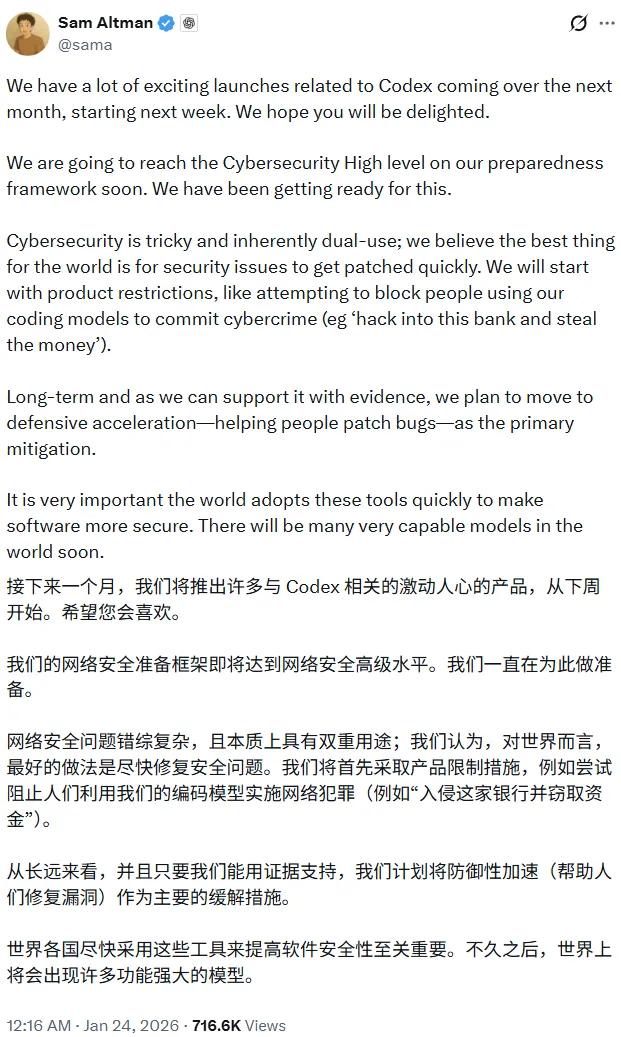
Group 1 - OpenAI CEO Altman announced the release of significant Codex-related content starting next week, with a technical blog revealing the core architecture of Codex CLI, specifically the intelligent agent loop [1] - The intelligent agent loop coordinates user instructions, model inference, and local tool execution through the Responses API, employing a "consistent prompt prefix" strategy to trigger cache optimization [1] - Codex supports zero data retention configurations to ensure privacy and utilizes automatic compression technology to manage context windows, with further details on tool invocation and sandbox models to be introduced later [1] Group 2 - Google DeepMind released D4RT, which unifies 3D reconstruction, camera tracking, and dynamic object capture into a single "query" action, achieving speeds 18 to 300 times faster than existing state-of-the-art methods [2] - The core innovation is a unified spatiotemporal query interface, where AI first globally "reads" videos to generate scene representations and then searches for 3D trajectories, depth, and poses of any pixel on demand [2] - This technology is significant for embodied intelligence, autonomous driving, and AR, although training still requires a 1 billion parameter model and 64 TPUs [2] Group 3 - Claude Code upgraded its internal "Todos" to "Tasks," enabling multi-session or sub-agent collaboration on long-term complex projects across multiple context windows [3] - Tasks are stored in a file system for easy collaboration among multiple sessions, with updates in one session broadcasting to all sessions handling the same task list [3] - The new feature is compatible with Opus 4.5, enhancing autonomous operation capabilities, allowing users to enable multiple sessions to collaborate on the same task list through environment variables [3] Group 4 - Baidu's Wenxin 5.0 officially launched with a parameter count of 2.4 trillion, utilizing native multimodal unified modeling technology to support understanding and generation of text, images, audio, and video [4] - It has topped the LMArena text and visual understanding leaderboard five times, entering the global first tier, with language and multimodal understanding capabilities leading internationally [4] - Practical tests show the model excels in complex emotional understanding, subtext analysis, and creative writing tasks, earning the title of "strongest liberal arts student" [4] Group 5 - The open-source project Clawdbot has gained popularity in Silicon Valley, capable of running on Mac mini, serving as both a local AI agent and chat gateway, allowing conversations via WhatsApp, iMessage, etc. [5] - Clawdbot addresses the memory limitations of large models, capable of recalling conversations from two weeks ago, proactively sending emails, reminders, and executing tasks on the computer [5] - The project has received 9.2k stars on GitHub, with a minimum monthly cost of approximately $25, though it requires some technical knowledge for deployment, and users report it can automate business management and code writing, replacing paid services like Zapier [5] Group 6 - Turing Award winner LeCun announced that AMI Labs' core direction is "world models," aiming to build intelligent systems that understand the real world, possess persistent memory, and have reasoning and planning capabilities [6] - This approach argues that merely predicting the next token does not lead to true understanding of reality, necessitating predictions and reasoning at a higher representational level to filter out unpredictable noise [6] - AMI Labs is reportedly seeking financing at a valuation of $3.5 billion, targeting applications in industrial control, robotics, and healthcare, where reliability is crucial [6] Group 7 - Anthropic launched the Claude in Excel plugin, available for Pro, Max, Team, and Enterprise users, based on the Opus 4.5 model, which can be installed and activated via Microsoft Marketplace [7] - The plugin can search the internet and automatically fill in spreadsheets, supporting formula reading, debugging errors, zero-based modeling, and pivot table creation, compatible with .xlsx and .xlsm formats [7] - Currently, it does not support conditional formatting, macros, or VBA, and the company warns of prompt injection risks, advising users to only use files from trusted sources, with high-risk functions triggering confirmation prompts [7] Group 8 - Claude Code's creator Boris Cherny provided a detailed tutorial on using Cowork, emphasizing its role as an "executor" rather than a chat tool, capable of directly manipulating documents, browsers, and various tools [8] - He reiterated that the core workflow involves running multiple tasks in parallel while overseeing Claude instances, starting with "planning mode" for communication until satisfaction is achieved, then switching to "auto-accept edits" mode for execution [8] - Cherny highlighted the importance of Claude.md as a team compounding knowledge base, where any mistakes made by Claude should be documented, and methods for validating Claude's outputs can significantly enhance quality [8] Group 9 - Google Cloud AI Director Addy Osmani warned that programmers who only write prompts will be eliminated by 2026, stating that AI can handle 70% of preliminary work, but the remaining 30% requires experienced engineers [9] - A Stack Overflow survey indicated that developer trust in AI accuracy dropped from 40% to 29%, with 73% of respondents encountering issues with code comprehension due to "ambient coding" [9] - By 2026, the true core competency will be transforming vague problems into clear execution intentions, designing appropriate contextual structures, and distinguishing what is truly important [9] Group 10 - At the Davos Forum, tech giants shared notable insights, with Musk predicting that AI will surpass human intelligence by the end of 2026 and be smarter than the collective intelligence of humanity by 2030, with Tesla set to launch the humanoid robot Optimus next year [10] - Microsoft CEO Nadella warned that if AI only consumes resources without improving outcomes, society will lose tolerance, while Huang Renxun stated that embodied intelligence represents a "once-in-a-generation opportunity" [10] - DeepMind CEO Hassabis believes AGI will still require 5-10 years, while Anthropic CEO Dario claimed that models are just 6-12 months away from being able to complete software development end-to-end [10]

第三届全国人工智能应用场景创新挑战赛总决赛收官
Xin Lang Cai Jing· 2026-01-25 13:03
Group 1 - The third National Artificial Intelligence Application Scenario Innovation Challenge (CICAS) concluded in Suzhou, with 93 teams winning awards, including 12 special prizes, 36 first prizes, and 45 second prizes [1] - Notable projects awarded in the special prize categories include an intelligent amphibious transport system and a multi-source panoramic visual perception system [1] - The event recognized 20 typical cases of national AI application scenarios, 10 excellent organizational awards, and 14 outstanding instructor awards [1] Group 2 - Three authoritative reports were released, including the "2025 National AI Application Scenario Innovation TOP10 Best Practice Cities Report," which highlights differentiated development paths of leading cities like Beijing, Shenzhen, and Shanghai [2] - The "National AI Application Scenario Innovation 100 Directory List" systematically outlines 100 high-value scenarios across five major fields, including smart manufacturing and healthcare [2] - The "National AI High-Value Application Scenario Demonstration Enterprises TOP50 List" identifies 50 benchmark enterprises through a multi-dimensional evaluation system [2] Group 3 - CICAS serves as a benchmark event for AI application scenario innovation and technology commercialization, focusing on key areas such as large models, generative AI, and embodied intelligence [2] - The competition aims to explore a development path driven by demand for research and development, application driven by scenarios, and ecosystem empowerment for industries [2] - The event facilitates deep integration of AI enterprises with the real economy across innovation, funding, talent, and industry chains, contributing to the development of the digital economy and new productive forces [2]
计算机行业周报:SpaceX有望引领太空革命
KAIYUAN SECURITIES· 2026-01-25 12:24
Investment Rating - The investment rating for the computer industry is "Positive" (maintained) [1] Core Insights - The report highlights a significant focus on the commercial aerospace sector, particularly with SpaceX's upcoming IPO, which is expected to raise over $30 billion and achieve a valuation of approximately $1.5 trillion, potentially setting a record for the largest IPO in history [5][12] - The third-generation Starship is set to make its maiden flight in 2026, marking a transition from flight testing to engineering applications, with a payload capacity exceeding 100 tons to low Earth orbit (LEO) [6][13] - SpaceX plans to launch its second-generation Starlink system in 2027, aiming to provide a mobile service experience comparable to 5G, with a capacity increase of over 100 times compared to the first generation [7][14] Summary by Sections Market Review - During the week of January 19-23, 2026, the CSI 300 index fell by 0.62%, while the computer index decreased by 0.30% [4][16] Company Dynamics - Notable earnings forecasts include: - Electric Security Network expects a net profit of 50 million to 65 million yuan for 2025, a decline of 58.90% to 68.38% year-on-year [17] - Hikvision anticipates total revenue of approximately 92.52 billion yuan for 2025, with a net profit increase of 18.46% year-on-year [18] Industry Dynamics - OpenAI is planning to initiate a financing round exceeding $50 billion, with a potential valuation increase to between $750 billion and $830 billion [32] - The domestic news includes TikTok's establishment of a data security joint venture in the U.S. to comply with regulatory requirements [26]
全国人工智能应用场景创新挑战赛总决赛 12支队伍获特等奖
Xin Lang Cai Jing· 2026-01-25 10:00
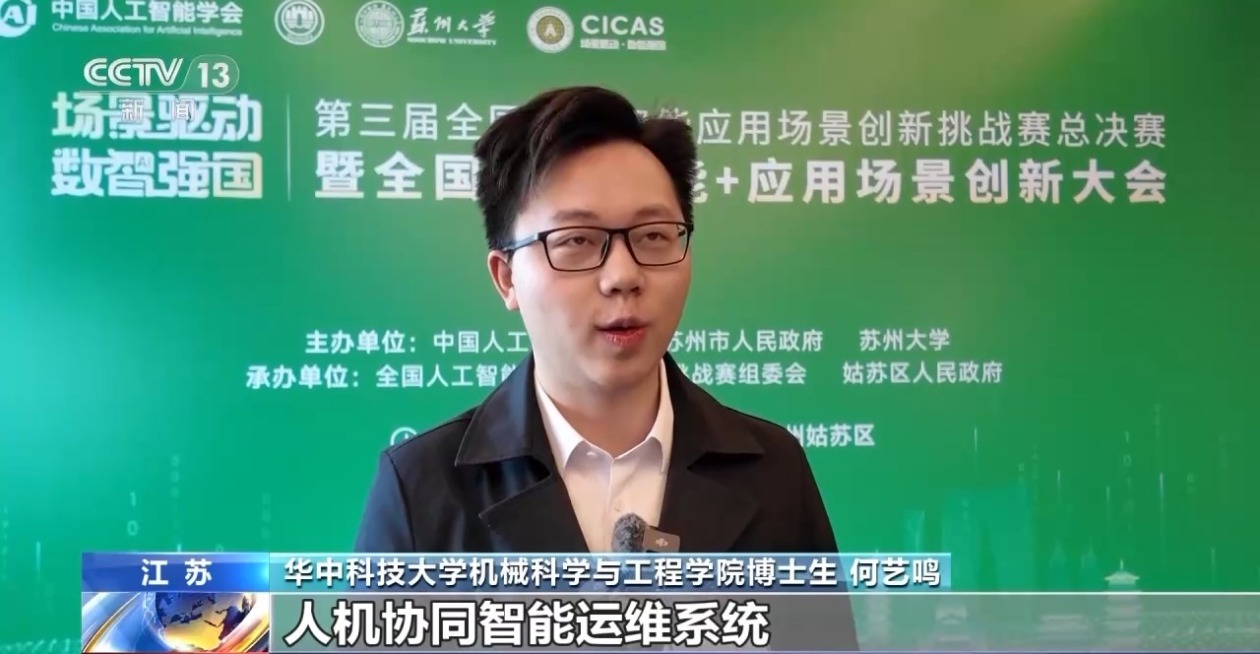
Group 1 - The third National Artificial Intelligence Application Scenario Innovation Challenge finals revealed 113 teams showcasing innovative results in the "AI+" field [1] - The competition attracted over 3,250 teams from both domestic and international participants, with 113 innovative teams advancing to the finals [1] - A total of 12 teams were awarded special prizes through various evaluation methods including data set assessments and functional tests [1] Group 2 - The National "AI+" Application Scenario Innovation Conference released the "National Artificial Intelligence Application Scenario Innovation 100 Directory List," outlining 100 high-value scenarios across five major fields including intelligent manufacturing and smart healthcare [5] - This directory serves as a significant support for exploring application driven by scenarios [5] Group 3 - A project presented by a doctoral student from Huazhong University of Science and Technology focuses on an edge AI intelligent human-machine collaborative operation and maintenance system, likened to a "robot doctor" for industrial equipment [3]
谷歌、Anthropic双重围剿下的OpenAI,正面临「生死抉择」
机器之心· 2026-01-25 08:08
Core Insights - OpenAI is shifting its strategic focus from consumer products to enterprise markets, aiming to provide comprehensive support for business clients [1][3][10] - The company plans to implement a new business model that includes taking a percentage of profits generated by clients using its AI technologies [1][3] - OpenAI's CEO, Sam Altman, has indicated a desire to become a one-stop shop for AI needs, offering a range of products from chatbots to programming tools [5][10] Group 1: Strategic Shift - In 2026, OpenAI is prioritizing enterprise-level solutions alongside its consumer offerings [1][3] - The company is expected to release new AI hardware designed by former Apple design chief Jony Ive, potentially a wearable device [4] - A recent gathering led by Altman included executives from major companies like Disney, signaling OpenAI's intent to enhance its enterprise services [5] Group 2: Competitive Landscape - OpenAI is facing increasing competition from Anthropic, which has gained attention with its programming and office automation tools [6][7] - The market share of OpenAI has decreased from nearly 90% to around 65% over the past year, with Google Gemini emerging as a significant competitor [12][13] - Other competitors, including DeepSeek, Meta, Claude, Perplexity, and Grok, are also gradually capturing market share [14] Group 3: Product Development and Revenue - OpenAI's revenue from enterprise clients is currently about 40%, with expectations to rise to 50% by the end of the year [10] - The company is enhancing its products, including ChatGPT, by adding collaborative features and industry-specific applications [9] - OpenAI has restructured its sales approach to streamline the process for enterprise clients, focusing on a single sales representative for multiple products [9]

五粮液:白酒行业将逐渐步入修复期|首席资讯日报
首席商业评论· 2026-01-25 04:48
Group 1 - Wuliangye believes that the liquor industry will gradually enter a recovery period due to the continuous improvement of the macro economy, the rebound in consumer demand, and the ongoing support from various industrial policies [2] - Tesla plans to start training its Optimus robot at the Austin factory next month, indicating a potential acceleration in the mass production of humanoid robots, which may revolutionize manufacturing and logistics [2] - In Guangzhou, the consumption by foreign visitors through overseas bank cards and mobile payments exceeded 35 million transactions, amounting to over 11.3 billion yuan, with year-on-year growth of 57% and 58% respectively [3] Group 2 - Hainan Free Trade Port is expected to see a significant increase in passenger flow during the upcoming Spring Festival, with an estimated 22.368 million travelers [4] - In Hunan, the financial system has shown reasonable growth, with total deposits reaching 8.91 trillion yuan, a year-on-year increase of 8.2%, and loans totaling 7.89 trillion yuan, up 6.1% [5] - The first unprofitable company, Shenzhen Dapu Microelectronics, has received approval for its IPO registration on the ChiNext board, marking a significant milestone for the board [6] Group 3 - By 2025, the wholesale and retail industry in China is projected to achieve an added value of 14.6 trillion yuan, with a year-on-year growth of 5.0%, accounting for 10.4% of GDP, a historical high [7] - The scale of China's bank wealth management market has surpassed 33 trillion yuan, with a year-to-date growth of 11.15%, and the number of investors holding wealth management products has increased by 14.37% [8] - Zhongke Aerospace has completed its IPO counseling, transitioning from "counseling acceptance" to "counseling work completed" [9] Group 4 - BYD plans to increase its vehicle deliveries outside of China to 1.3 million units by 2026, representing a nearly 25% increase from last year's overseas deliveries of 1.05 million units [10] - The price of iPhone Air has dropped significantly, with discounts leading to a price reduction of nearly 3000 yuan in three months, making it more competitive in the market [11][12] - Over 10% of Japanese manga artists and illustrators have reported a decline in income due to generative AI, with some experiencing income drops of over 50% [12]

调查显示:超一成日本创作者因生成式AI收入下滑
Huan Qiu Wang Zi Xun· 2026-01-25 03:38
Core Insights - Over 10% of Japanese manga artists and illustrators experienced income decline due to the rise of generative AI, with 88.6% of respondents perceiving it as a threat to their livelihoods [1][5] - The survey, conducted by the Freelancers Union of Japan, collected 24,991 valid responses, highlighting significant concerns within the creative industry regarding generative AI [1][5] Group 1: Income Impact - 12% of respondents directly linked their income decline to generative AI, with 9.3% reporting a decrease of 10%-50% and 2.7% experiencing a drop of over 50% [1][5] Group 2: Industry Changes - The widespread use of generative AI has altered the industry landscape, with clients often assuming creators will use AI, leading to shorter delivery times and lower service fees [5] - Some clients are directly using AI-generated content, resulting in traditional creators losing significant orders [5] Group 3: Attitudes Towards AI - 62.9% of respondents stated they would not use generative AI now or in the future, while 21.4% would use it for brainstorming and creative concepts [5] - 9.3% utilize AI for repetitive tasks, 4.1% for sketching and drafts, and only 2.8% would use AI for completing parts or all of their work [5] Group 4: Copyright and Reputation Risks - 77.8% of respondents have witnessed peers facing plagiarism accusations or being suspected of using AI, leading to defamation or online attacks [5] - 14.5% of respondents have personally experienced such situations [5] Group 5: Regulatory Demands - There is a strong consensus among creators for legislative action, with 92.8% advocating for mandatory disclosure of copyrighted works used in AI training to protect creators' rights [5]

2026年全球医疗健康行业私募股权报告(英文版)
Sou Hu Cai Jing· 2026-01-25 02:40
Core Insights - The global healthcare private equity market is experiencing a significant recovery and record growth, with total deal value expected to exceed $191 billion in 2025, marking a historical high [11][12][16] - The market shows clear regional differentiation, with Europe leading in biopharma and healthcare services, North America maintaining stability despite policy impacts, and Asia-Pacific demonstrating broad growth resilience [11][25][27] Market Performance - In 2025, healthcare private equity saw a record performance with disclosed deal value surpassing $191 billion and 445 buyouts, making it the second-highest annual total on record [11][12] - The exit value surged from $54 billion in 2024 to an expected $156 billion in 2025, driven by an increase in large deals [15][16] Regional Analysis - Europe experienced a doubling of deal value to approximately $59 billion, primarily driven by biopharma and healthcare provider deals [25] - North America faced a temporary pullback in the second quarter but still achieved a healthy year with an expected exit activity of $90 billion, significantly higher than 2024 [26] - Asia-Pacific set a record for deal value, exceeding 2021's high by over 30%, with notable growth in biopharma, medtech, and healthcare IT [27][28] Sector Trends - Biopharma remains a cornerstone of investment, with deal value rising from $55 billion in 2024 to an estimated $80 billion in 2025, accounting for about 30% of overall deal volume [33] - Provider and related services deal value increased by 57% to an estimated $62 billion, driven by technology-enabled assets and healthcare IT [38] - Medtech is emerging as a new growth engine, with investors focusing on revenue growth and margin expansion [39] Investment Strategies - The investment logic in healthcare IT is shifting towards revenue and profit expansion through refined pricing and generative AI applications, with the "60 rule" becoming a new performance benchmark [3] - Investors are adopting a "barbell strategy" in pharma services, focusing on high-quality assets with scale advantages and potential operational improvements [3]