内卷式竞争

Search documents
中金:“反内卷”的宏观含义
中金点睛· 2025-07-16 23:43
Core Viewpoint - The article discusses the issue of "involutionary competition" in various industries, emphasizing the need for regulatory measures to promote product quality and orderly market competition, as highlighted in the recent Central Financial Committee meeting [1][5][6]. Understanding "Involutionary Competition" - "Involutionary competition" refers to a form of homogenized and disorderly competition, resulting in excessive investment without improving output efficiency, leading to resource misallocation [10][11]. - It manifests in two dimensions: horizontal competition among peers, characterized by over-investment and price wars, and vertical competition, where dominant firms transfer competitive pressure to suppliers and retailers, disrupting market order [11][12]. Causes of "Involutionary Competition" - The root causes include macroeconomic oversupply and microeconomic market failures. Oversupply leads to a negative cycle, while market failures can stem from blind investments and structural power imbalances [22][23]. - The article identifies the need to combat "involution" to achieve reasonable price recovery and promote sustainable innovation, shifting competition from price to value [31][35]. Effective Measures to Address "Involutionary Competition" - The current approach to combating "involution" is more market-oriented and legalistic compared to previous capacity reduction efforts, focusing on innovation and consumer demand [3][44]. - Industries likely to benefit from these measures include coal, steel, construction materials, chemicals, and emerging sectors like photovoltaic and electric vehicles, which are currently experiencing "involutionary competition" [6][66]. Regulatory Framework and Industry Response - Recent regulatory actions include collective production cuts in the photovoltaic glass sector and commitments from major automotive companies to limit payment terms to suppliers [6][9]. - The government has implemented various laws to ensure fair competition, such as the "Fair Competition Review Regulations" and the "Payment Guarantee for Small and Medium Enterprises" [9][17]. Industry Impact and Future Outlook - The article suggests that industries with significant "involutionary competition" characteristics, such as declining capacity utilization and increased sales expenses, should be closely monitored for the effectiveness of "anti-involution" policies [64][66]. - The transition from price competition to value competition is expected to enhance product quality and long-term profitability, aiding in the overall industrial upgrade and high-quality development [43][44].


上半年经济数据出炉,哪些趋势值得关注?
Zhong Guo Fa Zhan Wang· 2025-07-16 08:50
Economic Performance - China's GDP for the first half of 2025 reached 66,053.6 billion yuan, showing a year-on-year growth of 5.3% at constant prices [1] Consumer Trends - There is a growing demand for higher quality green and low-carbon products, as well as active consumption in entertainment, sports, and tourism [2] - Retail sales of consumer goods increased by 5.0% year-on-year, while service retail sales grew by 5.3% [2] - Service consumption expenditure accounted for approximately 45% of residents' disposable income, indicating an ongoing optimization of consumption structure [2] Trade and Supply Chain - China's economic momentum is strengthening, driven by industrial structure upgrades and the development of the digital economy, creating new opportunities [3] - China's export growth is supported by supply stability and resilience, indicating potential for continued stable growth in foreign trade [3] Financial Support - The cost of funds has been decreasing, with the weighted average interest rate for interbank RMB market lending dropping from 1.86% in January to 1.46% in June [4] - The weighted average interest rate for pledged repos fell from 2.16% in January to 1.5% in June, supporting the stability of the real economy [4] Real Estate Market - The decline in nominal mortgage rates has led to a recovery in real estate sales and prices, with a positive outlook for major cities [5] - Policies aimed at stabilizing expectations and activating demand in the real estate sector are being effectively implemented [5] Competition and Market Dynamics - It is crucial to distinguish between fair competition and "involutionary competition," as the latter distorts market price signals and leads to unfavorable outcomes [6] - The role of industry associations is emphasized in regulating unfair competition and enhancing effective demand [6] Economic Outlook - The long-term positive fundamentals of the economy remain unchanged, with confidence in achieving annual economic growth targets [7] - The second half of the year is expected to show stronger trade performance due to consumer promotions and significant holidays [7] - If GDP growth maintains around 5% in the second half, the annual growth rate could exceed 5%, slightly above the government's initial target [7]
专家析中国经济下一步:发力政策工具创新 加大市场秩序规范治理
Zhong Guo Xin Wen Wang· 2025-07-16 08:02
Economic Growth - China's GDP grew by 5.3% year-on-year in the first half of 2025, an increase of 0.3 percentage points compared to the same period last year and the entire previous year [1] - Economic experts believe that despite increasing uncertainties in the international economic and trade order, China's economy is showing resilience and achieving a "dual optimization" in both total economic volume and structure [1] - The chief economist of CITIC Securities, Mingming, noted that the 5.3% growth rate exceeds market expectations and anticipates that the government may implement innovative policy tools to support growth in the second half of the year [1] Foreign Trade - China's import and export scale reached 20 trillion yuan in the first half of the year, marking a historical high for the same period, demonstrating the resilience of China's foreign trade [1] - The researcher from the Ministry of Commerce, Zhou Mi, believes that China has the potential and capability to maintain stable growth in foreign trade in the second half of the year, particularly with countries involved in the Belt and Road Initiative [1] Real Estate Market - The dean of Tsinghua University's School of Civil and Hydraulic Engineering, Wu Jing, stated that "good houses" have become a new growth point for China's real estate industry, especially in hot cities and regions [2] - The real estate policies are expected to continue stabilizing expectations, activating demand, optimizing supply, and mitigating risks, creating more opportunities in the industry [2] Market Competition - The Chinese government is formulating measures to regulate "involution" competition in certain industries and enterprises, aiming to enhance market order [2] - Wei Qijia, director of the Industrial Economics Research Office at the National Information Center, proposed using standards and legal means to curb unfair competition and expand effective demand to boost consumer spending [2]
专家解读2025年中国经济“半年报”
Zhong Guo Jing Ji Wang· 2025-07-16 06:41
Economic Performance - China's economy shows strong resilience and vitality in 2025, with a focus on improving living standards and meeting consumer demands for higher quality products and services [1] - The economy achieved a growth rate of 5.3% in the first half of the year, supported by continuous fiscal and financial policy efforts [2] Foreign Trade - China's foreign trade demonstrates resilience, positioning the country as a stabilizing force in the global trade system, with potential for continued stable growth [1][2] - There is an expectation for a more diversified domestic import structure, supported by ongoing mechanisms to reduce market uncertainties [1] Financial Market - The financial market has performed well despite significant pressures, with positive effects from recent financial policies implemented in September 2022 and May 2023 [2] - Credit support is increasingly directed towards inclusive finance, green finance, and technology innovation finance, with loan growth rates surpassing overall loan growth [2] Real Estate Market - The real estate market is stabilizing, driven by demand for "good houses" in hot cities and regions, indicating a potential recovery [2] - Future real estate policies are expected to stabilize expectations, activate demand, optimize supply, and mitigate risks [2] Competition Issues - Addressing "involution" competition requires distinguishing it from fair competition, with a focus on regulatory standards, legal measures, and policies to boost effective demand and consumer confidence [3]
专访国家信息中心魏琪嘉:加快全国统一大市场建设,确保公平竞争
2 1 Shi Ji Jing Ji Bao Dao· 2025-07-15 13:58
Economic Overview - The GDP for the first half of the year reached 66,053.6 billion yuan, with a year-on-year growth of 5.3% at constant prices [1][2] - The current economic situation shows a continuous improvement, with significant enhancements in economic strength, technological capability, and comprehensive national power [2][3] Key Economic Development Goals - The main expected target for GDP growth this year is around 5%, with four key areas of focus for achieving this goal: enhancing macro policy counter-cyclical adjustments, expanding domestic demand comprehensively, implementing further reforms, and increasing high-level opening-up [3][5] Industrial Performance - The industrial added value for large-scale enterprises increased by 6.4% year-on-year, with equipment manufacturing and high-tech manufacturing growing by 10.2% and 9.5% respectively, outpacing the overall industrial growth [6][7] - The industrial structure is continuously optimizing, with a steady push towards green transformation and high-quality development [6][7] Challenges and Solutions in Industrial Development - The industrial economy faces challenges such as external uncertainties and the need for better balance between supply and demand [7][8] - Solutions include enhancing effective investment, improving investment efficiency, and fostering orderly development of traditional, emerging, and future industries [7][8] New Industrialization Strategy - The focus of new industrialization remains on strengthening the real economy, with an emphasis on systematic approaches to build a modern industrial system [8][9] - The interaction between industry and technology is crucial, with opportunities arising from the new technological revolution and industrial transformation [8][9] Addressing "Involution" in Competition - The phenomenon of "involution" in competition reflects a dynamic process of supply and demand in emerging industries, necessitating specific analysis rather than a one-size-fits-all approach [9][10] - A comprehensive approach to address "involution" should include optimizing industrial structure, promoting fair competition, and ensuring effective market resource allocation [10][11]
半年盘点|上半年航司业绩分化,“旺丁不旺财”持续
Di Yi Cai Jing· 2025-07-15 11:32
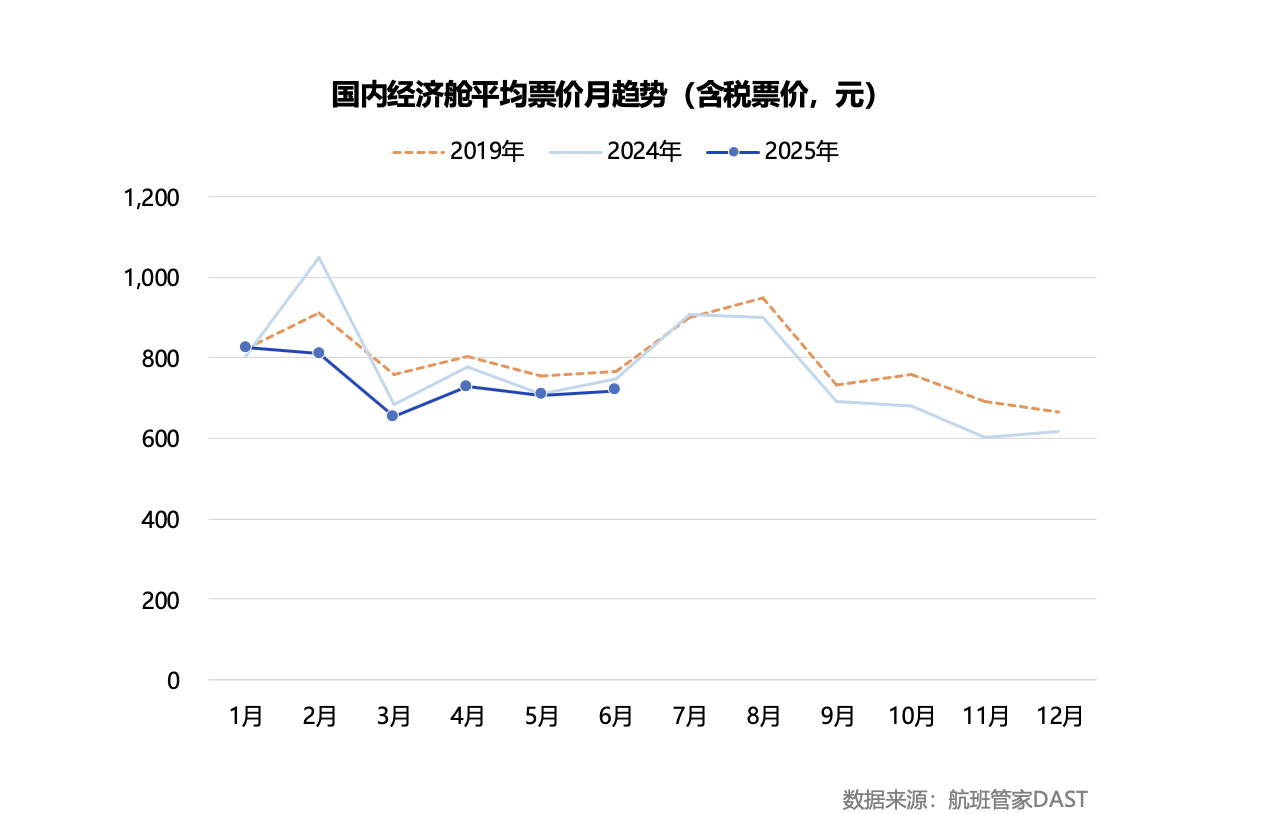
国有三大航没能扭亏,但继续大幅减亏,货运物流和机场上市公司的业绩表现更好。 截至今天,A股多家上市航司和机场披露了2025年上半年的业绩预告,国有三大航依然没能扭亏,但继续大幅减亏。 相比之下,货运物流和机场上市公司的业绩表现更好些,不过也开始面临来自国际贸易不确定性的挑战。 业绩分化 记者梳理各家航司的半年业绩预告发现,国有三大航中国国航(601111.SH),中国东航(600115.SH),南方航空(600029.SH)依然未能扭亏,上半年分 别预计亏损17亿到22亿,12亿到16亿以及13.38亿到17.56亿。 其中,中国东航和中国国航相比去年同期大幅减亏,东航的减亏幅度最大,并且是三大航中亏得最少的;南航比去年同期亏得更多,但公告中透露归属于上 市公司股东的扣除非经常性损益的净利润有较大提升。 民营航司中,华夏航空(002928.SZ)披露了业绩预告,上半年预计归属于上市公司股东的净利润2.2亿-2.9亿元,同比增长741.26%–1,008.93%;海航控股 (600221.SH)则预告扭亏为盈,上半年归属于母公司所有者的净利润4,500万元到6,500万元。 而根据航班管家的统计,上半年我国民航 ...
国家发改委专家:“内卷式”竞争削弱价格信号灯功能,没有受益方
和讯· 2025-07-15 10:16
Core Viewpoint - The article emphasizes the resilience of China's economy in the first half of 2023, highlighting a GDP growth of 5.3% year-on-year, and the importance of balancing growth and transformation in future policies [1][2]. Economic Trends - The article identifies three key trends: 1. Long-term resilience in exports 2. Strong performance in the cultural and tourism consumption market 3. Accelerated growth in high-tech manufacturing, with its value-added growth outpacing that of all industrial sectors [2]. - The economic situation is summarized with four words: stable, real, new, and optimized, indicating a solid foundation for achieving annual economic and social development goals [2]. Policy Recommendations - There is a call to strengthen macroeconomic policies with a focus on people's livelihoods, emphasizing the need for effective interaction between investment and consumption [3][4]. - The article stresses the importance of expanding domestic demand and stabilizing growth, with a focus on improving consumption and addressing structural changes in the market [4]. Competition Issues - The article discusses the phenomenon of "involution" in competition, indicating that there are no beneficiaries in such a competitive environment, leading to a win-lose or lose-lose situation [5][6]. - It highlights the need for regulatory measures to address low-price and disorderly competition, promoting product quality and the orderly exit of outdated capacities [5][6]. Fair Competition - The distinction between fair competition and "involution" is crucial, as fair competition allows for dynamic equilibrium through price signals, while "involution" distorts these signals [6][7]. - The article advocates for the implementation of fair competition review regulations to ensure that industrial policies and competition policies work in tandem, allowing market forces to dictate production and operational behaviors [7][8]. Investment Strategies - The article suggests that attracting investment should focus on a chain-oriented approach, avoiding excessive competition for existing resources, and tailoring strategies to local advantages [8].

外卖大战升级:0元奶茶能喝多久?如何避免中小商家成牺牲品
Nan Fang Du Shi Bao· 2025-07-15 09:36
Group 1 - The core viewpoint of the articles highlights the intensifying competition in the food delivery market, particularly following JD's entry, which disrupts the long-standing duopoly of Meituan and Ele.me [1][2][3] - JD's entry into the market has led to significant growth, with daily order volume exceeding 25 million within 90 days and coverage expanding to 350 cities with over 1.5 million quality restaurants [2][4] - The competition has escalated into a "subsidy war," with platforms offering substantial discounts and promotions to attract customers, leading to a surge in order volumes [3][5] Group 2 - The articles discuss the unsustainability of high subsidies, with experts warning that once these subsidies decline, the market may face challenges, particularly for small and medium-sized businesses [6][7] - Concerns are raised about the long-term impact of price wars on the profitability of restaurants, with some businesses reporting minimal profits per order and fears of a "low-price, low-quality" cycle [8][9] - The articles emphasize the need for regulatory oversight to ensure fair competition and protect smaller businesses from being adversely affected by the aggressive strategies of larger platforms [10][11] Group 3 - The growth of the instant retail market is highlighted, with projections indicating a rise from 650 billion yuan in 2023 to 2 trillion yuan by 2030, attracting significant interest from major e-commerce players [10][12] - The articles suggest that the entry of new players into the market could reshape the competitive landscape, potentially leading to increased market concentration and challenges for smaller operators [9][12] - The importance of maintaining market openness and accessibility is stressed, with recommendations for regulatory measures to prevent monopolistic behaviors and ensure a level playing field for all market participants [11][12]



【热点评述】中汽协、工信部发声反对“内卷式”竞争
乘联分会· 2025-07-15 09:00
Core Viewpoint - The article discusses the ongoing "involution" competition in the Chinese automotive industry, highlighting the negative impacts of price wars initiated by companies like BYD, and the government's response to promote healthy industry development [3][10][14]. Group 1: Background and Current Situation - The automotive market has entered a new round of price wars, with BYD launching a promotional campaign that significantly reduced prices across multiple models, prompting other brands to follow suit [5]. - Over a dozen automotive brands have announced price cuts, indicating a widespread trend in the industry [5]. Group 2: Factors Contributing to "Involution" Competition - The decline in manufacturing costs due to supply chain efficiencies and technological advancements has enabled companies to engage in price wars, with BYD sacrificing component profits to maintain sales [7]. - The emergence of "involution" competition is driven by various factors, including policy changes, market dynamics, and ambitious sales targets that lead companies to resort to price reductions to boost sales [8]. Group 3: Impacts of "Involution" Competition - The ongoing price wars are causing profit growth in the automotive industry to decline, leading to increased accounts payable and extended payment cycles for companies [10]. - The pressure on upstream suppliers is resulting in deteriorating product quality, which in turn is causing an increase in consumer complaints [10]. Group 4: Government Response and Future Outlook - Multiple government departments are taking action to address "involution" competition, aiming to shift the focus of competition towards safety and technological innovation [11]. - A coordinated policy approach involving various government bodies is essential to promote healthy development in the automotive industry, with future market dynamics expected to prioritize product quality, technology, and service over price competition [12][14].


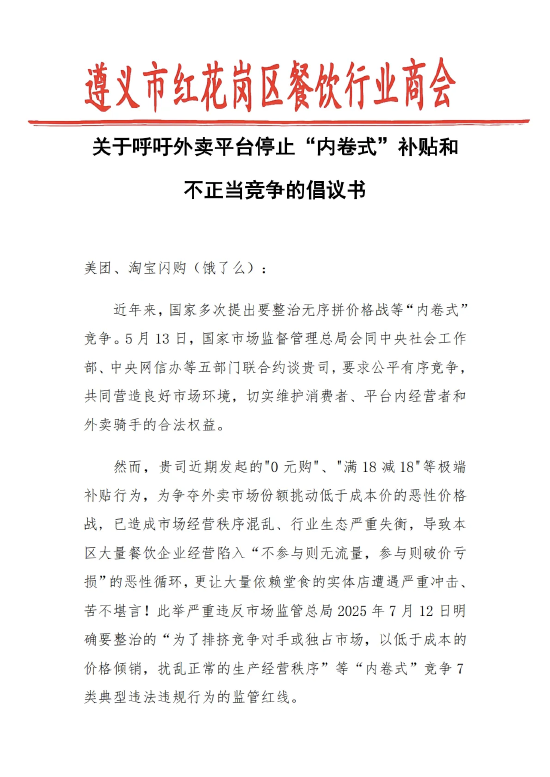
遵义餐饮商会喊话美团淘宝:外卖补贴已造成市场混乱,呼吁停止“反内卷”补贴!
Xin Lang Ke Ji· 2025-07-15 04:04
Core Viewpoint - The recent competition in the food delivery market has intensified, with Meituan and Taobao Flash Purchase (Ele.me) engaging in aggressive subsidy strategies that have led to a chaotic market environment and significant challenges for local restaurants [1][2][3] Group 1: Market Dynamics - As of July 12, Meituan's daily order volume exceeded 1.5 billion, while Taobao Flash Purchase and Ele.me surpassed 80 million orders, indicating a fierce competition for market share [1] - The aggressive subsidy strategies, such as "0 yuan purchase" and "18 yuan off 18 yuan," have triggered a price war below cost, disrupting market order and harming the industry ecosystem [2][3] Group 2: Industry Concerns - The restaurant industry is facing a "lose-lose-lose" situation where merchants sacrifice long-term viability, consumers receive lower quality products, and delivery personnel suffer from overexertion [3][5] - The local restaurant association has called for an end to irrational subsidies and a return to value-based competition, emphasizing the need for sustainable practices in the industry [4][5] Group 3: Recommendations from the Industry - The association has proposed three main initiatives: 1. Stop irrational subsidies and return to value competition, including ceasing loss-leading promotions and establishing a reasonable pricing mechanism [3][4] 2. Protect merchants' legal rights by ensuring voluntary participation in promotions and providing support for non-participating small businesses [4][5] 3. Build a sustainable development ecosystem focused on food safety and fair competition [4][5]