液冷技术

Search documents
川润股份(002272) - 2025年9月12日投资者关系活动记录表
2025-09-12 13:29
Group 1: Business Outlook and Strategy - The company expects a significant recovery in its operating performance in the second half of 2025, following a notable reduction in losses in the first half [1] - The operational strategy focuses on "optimizing the fundamentals, innovating for growth, and strengthening competitiveness" [1] - The company aims to enhance its market share in the wind power sector as demand recovers, alongside growth in offshore wind [1] Group 2: Liquid Cooling Business - The company has over 30 years of experience in liquid cooling technology, providing comprehensive solutions that are efficient and reliable [3] - As of June 2025, the liquid cooling production line has been operational, enabling better fulfillment of overseas orders [3] - The majority of current orders are from international clients, indicating a strong overseas market presence [3] Group 3: Research and Development Investment - In 2024, the company plans to invest over 62 million yuan in R&D, with an additional 23 million yuan allocated for the first half of 2025 [5] - The company is focused on standardizing and scaling liquid cooling technology, aiming to become a cornerstone for efficient heat dissipation in digital infrastructure [5] Group 4: Financial Management and Risk Control - The company maintains a manageable level of accounts receivable, with over 80% of receivables expected to be collected within one year [8] - A comprehensive risk management system is in place to assess credit risks and monitor contract compliance [9] - Legal measures will be taken against clients who delay payments, including litigation and asset preservation [9]

调研速递|川环科技接受线上投资者调研,液冷业务布局引关注
Xin Lang Zheng Quan· 2025-09-12 13:12
Group 1 - The company held an online investor meeting on September 12, 2025, to discuss its semi-annual report and performance, with active participation from investors [1] - Key personnel present included Chairman Wen Qichao, Secretary Zhou Xianhua, and CFO Luo Ying, indicating a high level of engagement from the company's leadership [1] - The meeting was conducted on the "Investor Relations Interactive Platform" and focused on the company's performance and future strategies [1] Group 2 - During the meeting, the company addressed inquiries regarding its collaboration with clients, specifically mentioning that its pipeline products have entered the CoolerMaster supplier system and are undergoing product development [2] - The company is actively promoting its advantageous products to potential clients, although it refrained from disclosing information about other suppliers for CoolerMaster and AVC due to confidentiality [2] - The company is optimizing personnel configuration in response to the growing market demand for its pipeline products, indicating a strategic approach to production based on customer orders [2] Group 3 - The company has over 30 years of experience in rubber pipeline material formulation and manufacturing, achieving V0 level standards and UL certification for its liquid cooling server pipeline products [3] - The company is focusing on promoting and developing liquid cooling products in key areas such as data server cooling, energy storage cooling, and automotive fluid pipelines [3] - Safety measures are being implemented across departments to enhance production safety, including education, preventive checks, and cross-checking [3]

腾龙股份:拟投资5000万元设立子公司,从事液冷相关业务
Bei Ke Cai Jing· 2025-09-12 09:52
Group 1 - The company, Tenglong Co., plans to invest 50 million yuan to establish a wholly-owned subsidiary in Changzhou, focusing on the research, production, and sales of liquid cooling components and products for energy storage and server applications [1] - The company has agreed to waive its preferential right to acquire a 22.5% stake in its subsidiary, Zhejiang Lichi Leao Environmental Technology Co., Ltd., which is a transfer of shares among direct relatives, with no significant change in actual equity [1]

中邮证券:维持比亚迪电子“买入”评级 25H1业绩超预期
Zhi Tong Cai Jing· 2025-09-12 09:33
Core Viewpoint - Company maintains a "buy" rating for BYD, projecting revenues of 187.49 billion, 206.12 billion, and 234.81 billion RMB for 2025, 2026, and 2027 respectively, with net profits of 4.95 billion, 6.24 billion, and 7.84 billion RMB for the same years [1] Group 1: Business Performance - In the first half of 2025, the company achieved operating revenue of 80.606 billion RMB, a year-on-year increase of 2.58%, and a net profit of 1.730 billion RMB, up 13.97% year-on-year [1] - The company has consolidated its leadership in the high-end product supply chain while expanding cooperation with overseas major clients, driving steady growth in the consumer electronics segment [1] - The new energy vehicle segment continues to show strong growth momentum, contributing to a record high in overall business scale [1] Group 2: AI and New Product Development - The company is experiencing rapid growth in AI server shipments, with the AI data center business achieving significant growth due to the global demand for computing power and AI [2] - Liquid cooling technology is becoming the mainstream cooling solution for green data centers, with the company actively investing in new product development and customer expansion [2] - The company’s new intelligent product business generated revenue of 7.209 billion RMB in the first half of 2025 [2] Group 3: Automotive Sector Growth - The year 2025 is seen as a pivotal year for intelligent driving, bringing technological innovations and reshaping the automotive industry competition landscape [3] - The company has a clear technological advantage in smart cockpit systems, smart driving assistance systems, and other key areas, with significant increases in shipment volumes [3] - The new energy vehicle segment generated revenue of 12.450 billion RMB in the first half of 2025, reflecting a year-on-year increase of approximately 60.50% [3] Group 4: Consumer Electronics Performance - The company focuses on high-value-added products, maintaining a major supplier position in flagship models, including titanium and foldable phones [4] - The assembly business for overseas major clients continues to grow, driving year-on-year increases in shipment volumes and revenue [4] - The consumer electronics segment achieved revenue of 60.947 billion RMB in the first half of 2025, with component business contributing 13.752 billion RMB and assembly business 47.195 billion RMB [4]

中科曙光(603019):盈利能力提升 持续完善国产算力全栈生态
Xin Lang Cai Jing· 2025-09-12 08:28
Core Viewpoint - The company reported strong performance in its 2025 semi-annual report, with steady revenue growth and rapid profit increase driven by product structure optimization and strong performance from joint ventures [1][5] - The company plans to merge with Haiguang Information to create a leading domestic computing power industry chain, aiming for deep integration and synergy from chips to services, significantly enhancing core competitiveness [1][5] - Continuous high-intensity investment in R&D is focused on key areas such as liquid cooling and AI software, providing a solid computing power foundation for new productive forces [1][5] Financial Performance - In the first half of 2025, the company achieved revenue of 5.85 billion yuan (+2.41%) and a net profit attributable to shareholders of 729 million yuan (+29.39%) [2][3] - The second quarter of 2025 saw revenue of 3.26 billion yuan (+0.94%) and a net profit attributable to shareholders of 542 million yuan (+28.91%) [2] - Investment income for 2024 was 322 million yuan (+44.24%), mainly due to increased net profits from joint ventures such as Haiguang Information and Zhongke Xingtu [2] Business Strategy - The company is integrating high-performance computing with AI technology services to enhance profitability, achieving a significant profit growth rate that outpaces revenue growth [3] - The integration of data, algorithms, and business facilities into a comprehensive solution is aimed at providing flexible service models for various AI applications [3] - The company has maintained high R&D spending of 629 million yuan in the first half of 2025, focusing on intelligent computing, advanced storage, and green computing [4] Mergers and Acquisitions - The planned merger with Haiguang Information aims to leverage the strengths of both companies in chips and data center infrastructure, enhancing the overall competitive landscape [4] - The merger is expected to build a full-stack capability from chip to cloud, accelerating the development of the domestic computing power ecosystem [4] - Haiguang Information reported over 40% year-on-year growth in both revenue and net profit in the first half of 2025, contributing significantly to the company's profit growth [4] Investment Outlook - The company is optimistic about its long-term value driven by AI and domestic production, with revised revenue forecasts for 2025-2027 at 14.55 billion, 16.13 billion, and 17.89 billion yuan, reflecting year-on-year growth of 10.67%, 10.87%, and 10.87% respectively [1][5] - Expected net profit attributable to shareholders for the same period is projected at 2.48 billion, 2.98 billion, and 3.56 billion yuan, with growth rates of 29.55%, 20.49%, and 19.26% [1][5] - The company maintains a price-to-earnings ratio of 49, 41, and 34 for the respective years, sustaining a "buy" rating [1][5]

北美巨额订单提振算力市场信心,国产算力产业链迎高增长周期
Sou Hu Cai Jing· 2025-09-12 07:13
Core Insights - The announcement of a $455 billion unfulfilled revenue obligation (RPO) by a North American tech giant has significantly boosted the global computing power sector, highlighting strong demand for AI infrastructure and a supply-demand imbalance in computing power [1] - The North American contract signifies a strategic turning point for the global computing industry, elevating computing power to a strategic asset level comparable to oil and chips [6] Industry Overview - IDC predicts that the global AI market will exceed $800 billion by 2028, with a compound annual growth rate (CAGR) of over 32% [2] - Morgan Stanley forecasts global data center spending to approach $3 trillion by 2029 [2] - The China Academy of Telecommunications Research estimates that AI could contribute over 11 trillion yuan to China's GDP by 2035, potentially driving a tenfold to hundredfold increase in computing power demand [2] Policy Developments - Recent policies aim to implement "AI+" actions across various sectors, promoting deep integration of AI with economic and social fields [4] - The Ministry of Industry and Information Technology (MIIT) plans to guide the construction of computing power facilities to enhance resource supply quality [4] Demand Dynamics - The computing power arms race is intensifying, with new technologies like DeepSeek enabling low-cost industrialization of large models, stimulating new application scenarios and reducing inference barriers [5] - IDC forecasts an 18% growth in the global infrastructure market by 2025, with AI servers expected to reach a market size of $147.2 billion [5] Company Positioning - Lenovo is strategically positioned to capitalize on the AI wave, leveraging its "computing gene" to secure a competitive edge in the market [6] - Lenovo's hybrid AI framework integrates various models to address traditional AI deployment challenges, enhancing efficiency and sustainability [7] Product Innovations - Lenovo has launched the next-generation ThinkSystem V4 servers and ThinkEdge SE100 AI inference servers, enhancing its competitiveness in the AI server market [8] - The company's liquid cooling solutions demonstrate superior thermal management and energy efficiency, aligning with industry trends towards energy conservation [8] Financial Performance - Lenovo's AI infrastructure business has seen explosive growth, with a 155% year-on-year revenue increase and strong order reserves [10] - The company's liquid cooling technology has achieved nearly 30% revenue growth, contributing to its overall financial success [10] - Analysts maintain a positive outlook on Lenovo, with firms like Huatai Securities and Guotai Junan issuing "buy" and "overweight" ratings, respectively, due to the rapid growth in global AI infrastructure demand [10][11]



280亿!金发科技供应商,化工新材料龙头跨界液冷最大并购
DT新材料· 2025-09-11 16:04
Core Viewpoint - The article discusses the strategic transformation of Dongyangguang from a traditional manufacturing giant to a player in the digital economy and artificial intelligence, highlighted by its acquisition of Qinhuai Data for 28 billion yuan, marking a record in China's data center industry mergers and acquisitions [2][4]. Group 1: Strategic Transformation - Dongyangguang's main business includes electronic components, high-end aluminum foil, chemical new materials, energy materials, liquid cooling technology, and embodied intelligence, making it a leader in fluorochemical and refrigerant sectors in China [5]. - The company has established partnerships with major players like Blue Moon, Xinzhoubang, and Gree, focusing on chemical new materials and environmentally friendly refrigerants [6]. - In 2024, Dongyangguang reported revenue of 12.199 billion yuan, a year-on-year increase of 12.40%, with a net profit growth of 170.57% in the first half of 2025, indicating sustained business growth [7]. Group 2: Liquid Cooling Technology - The acquisition of Qinhuai Data is driven by the need for liquid cooling technology, which is essential for managing the increasing power consumption and heat density of AI chips, such as NVIDIA's GB200 super chip [9][10]. - Dongyangguang's expertise in fluorinated cooling liquids and cold plate components positions it to provide a comprehensive solution from materials to systems in the liquid cooling ecosystem [9][13]. - The application of liquid cooling technology can significantly reduce the Power Usage Effectiveness (PUE) of data centers, making it a necessity under current environmental regulations [13]. Group 3: Market Background - The Chinese liquid cooling server market reached 1.26 billion USD in the first half of 2024, with a year-on-year growth of 98.3%, and is expected to exceed 16 billion USD by 2029, with a compound annual growth rate of 46.8% [14]. - The merger not only positions Dongyangguang as a focal point in the data center industry but also sets a new paradigm in the liquid cooling sector, showcasing a potential pathway for material companies to transition into the digital economy [14].


润泽科技(300442):2022半年报点评:IDC交付规模创新高,aIDC收入结构优化
Changjiang Securities· 2025-09-11 14:45
Investment Rating - The investment rating for the company is "Buy" and is maintained [9]. Core Insights - In Q2 2025, the company's performance showed gradual improvement, aligning with the current delivery pace. The IDC delivery scale reached a record high, and the AIDC revenue structure was optimized, significantly enhancing business profitability and stability, showcasing industry-leading technology [2][13]. - For H1 2025, the company achieved a revenue of 2.496 billion yuan, representing a year-on-year increase of 15.3%. However, the net profit attributable to the parent company was 882 million yuan, down 8.7% year-on-year [6][13]. Summary by Sections Event Description - On August 28, the company released its H1 2025 report, achieving a revenue of 2.496 billion yuan, up 15.3% year-on-year, and a net profit of 882 million yuan, down 8.7% year-on-year [6]. Event Commentary - The company's performance in H1 2025 was in line with the current delivery pace, with IDC revenue reaching 1.61 billion yuan, a year-on-year increase of 6.15%. The gross margin was 46.9%, down 4.4 percentage points due to new delivery buildings still ramping up. The AIDC revenue was 880 million yuan, up 36.95%, with a gross margin of 53.9%, down 16.7 percentage points [13]. - The company has established a leading position in liquid cooling delivery, having collaborated with clients since early 2021 and successfully delivered the industry's first large-scale liquid-cooled computing center in 2023 [13]. Financial Projections - The company is projected to achieve net profits of 2.59 billion, 3.05 billion, and 3.54 billion yuan for 2025, 2026, and 2027, respectively, with year-on-year growth rates of 45%, 18%, and 16%. The corresponding price-to-earnings ratios are expected to be 32x, 28x, and 24x [13].

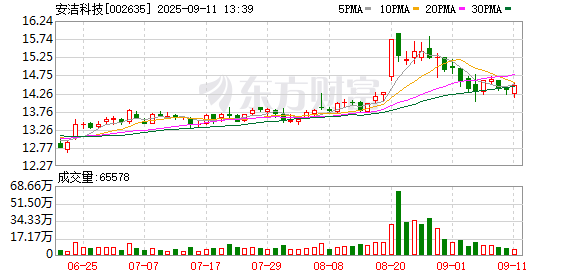
安洁科技:精密结构件可以运用在液冷设备上
Zheng Quan Ri Bao Wang· 2025-09-11 10:48
Group 1 - The core viewpoint of the article is that Anjie Technology (002635) is actively developing liquid cooling technology and business, indicating a strategic focus on precision structural components for liquid cooling equipment [1] Group 2 - The company has confirmed that its precision structural components can be utilized in liquid cooling devices, showcasing its capability in this emerging technology sector [1] - The ongoing development of liquid cooling plate technology suggests potential future growth opportunities for the company in the tech industry [1]

安洁科技:公司的精密结构件可以运用在液冷设备上,公司目前正在进行液冷板技术开发和业务开发
Mei Ri Jing Ji Xin Wen· 2025-09-11 05:39
Group 1 - The company, Anjie Technology, confirmed that its precision structural components can be used in liquid cooling equipment [2] - The company is currently engaged in the development of liquid cooling plate technology and business [2]