
人民币升值

Search documents
人民币持续升值,哪些资产会受到影响?
格隆汇APP· 2025-12-24 10:16
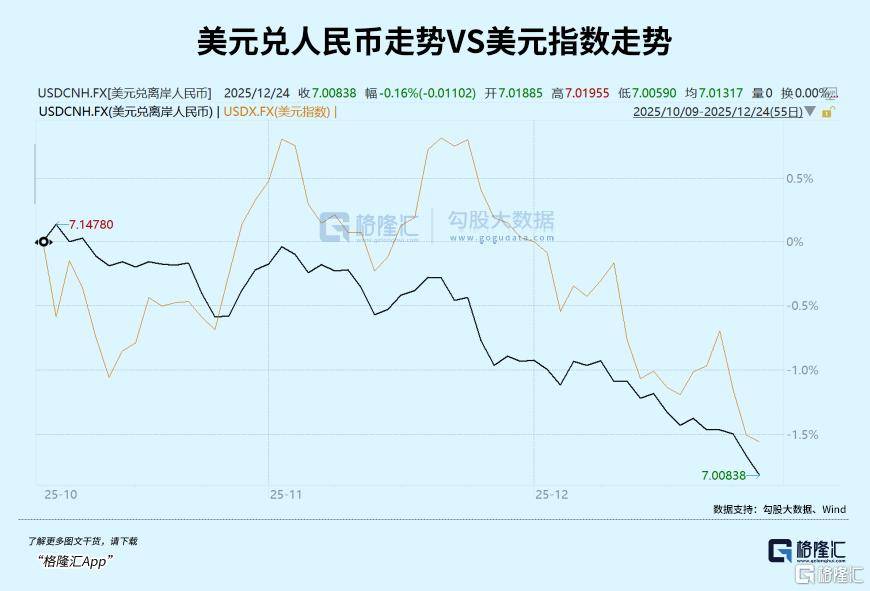
Group 1 - The article discusses the recent appreciation of the Chinese yuan, which rose from 7.15 to around 7, marking a 2% increase, influenced by both market beta factors (like the US dollar index) and domestic alpha factors (such as China's economic fundamentals and monetary policy) [4][7] - The depreciation of the US dollar index by 1.8% during the same period indicates that the yuan's appreciation is largely driven by external market conditions, although some domestic factors, such as year-end settlement and trade surpluses, also play a role [7][8] - The article suggests that the yuan's appreciation is likely to benefit overall Chinese assets, as it typically coincides with a declining US dollar index, which improves liquidity for most countries' assets [10][11] Group 2 - The appreciation of the yuan negatively impacts export-oriented companies, as it reduces the amount of yuan received for dollar-denominated sales, although the extent of this impact varies by company and market conditions [14][15] - Conversely, companies engaged in imports or those with costs denominated in dollars, such as airlines, benefit from yuan appreciation, as it lowers their dollar-denominated costs, potentially leading to significant profit improvements [15][16] - The article highlights that sectors like duty-free companies and resource industries may also see cost reductions due to yuan appreciation, which can enhance their profit margins [16][17]

人民币破“7”在望,影响几何?
证券时报· 2025-12-24 09:08
Group 1 - The core viewpoint of the article is that the Chinese yuan has recently reached a 14-month high, with expectations of breaking the "7" mark against the US dollar due to strong economic fundamentals and a weakening dollar [1][2]. - The strong performance of exports, with a current account surplus of $600 billion, supports the positive outlook for the yuan's appreciation [2]. - The People's Bank of China is managing market expectations through the yuan's midpoint rate and adjusting the foreign exchange market to control the pace of capital inflows [2][3]. Group 2 - The article discusses the potential for the yuan to appreciate further, with predictions of reaching 6.7 by the end of 2026 and possibly 6.0 in the next decade [2]. - It highlights the impact of yuan appreciation on the capital market, suggesting that a 0.1% increase in the exchange rate could lead to a 3%-5% rise in stock valuations [3]. - The article also notes that yuan appreciation may increase the cost of currency exchange for cross-border investments, potentially affecting returns on investments in Hong Kong stocks and other cross-border financial products [3].

人民币持续升值,哪些资产会受到影响?
Sou Hu Cai Jing· 2025-12-24 08:21
Group 1 - The recent appreciation of the RMB is attributed to both market beta factors, such as the decline of the US dollar index, and some domestic alpha factors, including China's economic fundamentals and monetary policy decisions [1][3] - The RMB has appreciated approximately 2% from 7.15 to around 7, while the US dollar index has depreciated by 1.8% during the same period, indicating that the RMB's appreciation is primarily driven by market conditions [1][3] - Looking ahead, the US dollar index is expected to remain weak, which may continue to favor RMB appreciation in the coming years [4] Group 2 - RMB appreciation is beneficial for overall Chinese assets, as it often coincides with a declining US dollar index, which improves liquidity for many countries' assets [5] - Historical data shows that RMB appreciation typically leads to increases in both Hong Kong and A-share indices, although there have been instances of divergence [5][6] - The current market conditions suggest that the A-share market may experience upward movement following the recent RMB appreciation, despite some short-term fluctuations [6] Group 3 - RMB appreciation negatively impacts export-oriented companies, as it reduces the value of their dollar-denominated earnings when converted to RMB [7] - However, the impact varies by region; companies exporting to emerging markets may benefit from increased business volume due to improved dollar liquidity [7] - Conversely, companies engaged in import businesses, particularly those with significant dollar-denominated costs, stand to gain from RMB appreciation, such as airlines and duty-free companies [8] Group 4 - For H-shares, RMB appreciation increases the converted profits and dividends for companies listed in Hong Kong, enhancing the actual dividend yield for foreign investors [9] - The current divergence in the market is not expected to last long, as historical patterns suggest a correction will occur [9] - The focus should be on identifying sectors with strong fundamentals that can sustain growth despite the RMB's appreciation [10]
中顺洁柔:纸浆采购主要使用外币结算,人民币升值一定程度上会降低采购成本
Sou Hu Cai Jing· 2025-12-24 07:35
声明:市场有风险,投资需谨慎。本文为AI基于第三方数据生成,仅供参考,不构成个人投资建议。 来源:市场资讯 针对上述提问,中顺洁柔回应称:"尊敬的投资者,您好!非常感谢您对公司的关注和支持!公司纸浆 采购目前主要使用外币结算,人民币升值一定程度上会降低公司采购成本。" 有投资者在互动平台向中顺洁柔提问:"最近人民币升值了这么多,对贵公司是否有产生积极影响,影 响大概有多大?" ...

人民币创14个月新高,对A股市场影响几何?谁喜谁忧?这些板块迎“汇率红包”
Jin Rong Jie· 2025-12-24 01:33
Core Viewpoint - The offshore and onshore RMB have both strengthened against the USD, reaching their highest levels in 14 months, which is expected to attract foreign investment into Chinese assets [1][3]. Group 1: Impact of RMB Appreciation - The appreciation of the RMB enhances the attractiveness of RMB-denominated assets, particularly for foreign investors focused on exchange rate gains [3]. - Historical data indicates that during periods of RMB appreciation, foreign capital, represented by "northbound funds," tends to show accelerated net inflows, favoring liquid, well-valued assets that align with China's economic growth [3]. - The current A-share market is at a historically low valuation, and the strengthening RMB may catalyze long-term foreign capital to reassess and increase allocations to Chinese assets, potentially stabilizing or boosting market indices [3]. Group 2: Beneficiaries and Losers - Export-oriented industries, such as home appliances, electronics, textiles, and machinery, are likely to suffer as RMB appreciation reduces their price competitiveness in international markets, potentially eroding exchange gains and profit margins [3][4]. - Beneficiaries of RMB appreciation include industries with significant dollar-denominated liabilities, such as airlines, which will see improved financials due to reduced exchange losses [4]. - Cost-importing sectors, like paper and basic chemicals, will benefit from lower raw material costs due to RMB appreciation, enhancing their profit margins [4]. Group 3: Market Sentiment and Trends - The psychological impact of RMB appreciation is significant, as it signals economic stability, effective policy, and international capital recognition, which can fundamentally boost market risk appetite [4]. - In an appreciating currency environment, "core assets" are likely to perform better, with large-cap value stocks benefiting from their close ties to the macroeconomy and foreign capital preferences [4]. - The importance of sustained RMB appreciation is emphasized, as lasting trends rather than short-term fluctuations will have a more profound impact on the A-share market [4][5].
12.24盘前速览 | 卫星巨震,伦敦铜价再创史高,结构性机会延续
Jin Rong Jie· 2025-12-24 01:32
Macroeconomic Dynamics - The RMB to USD exchange rate is expected to gradually appreciate from 7.0 to around 6.0 over the next decade [1] - The US economy grew by 4.3% in Q3, with former officials suggesting that the Federal Reserve is lagging behind in addressing interest rate cuts [1] Satellite Internet - The Long March 12A rocket's maiden flight was successful for the first stage, but the recovery of the sub-stage failed [1] - Related ETF: Satellite Industry ETF (on-market: 159218) [1] Non-ferrous Metals - London copper prices have surpassed $12,000 per ton, setting a new historical high [1] - Sellers are optimistic about the prices of gold, silver, platinum, and lithium [1] - Related ETF: Mining ETF (on-market: 159690) [1] Semiconductor - Sellers emphasize that clean rooms are a necessary engineering phase for the continued expansion of global AI capital expenditure [1] - The US has announced zero tariffs on Chinese semiconductor products until June 2027 [1] - Related ETF: Semiconductor Equipment ETF (on-market: 561980, off-market link: 020464) [1] Artificial Intelligence - Reports indicate that ByteDance plans to invest $23 billion in purchasing top-tier chips and building AI infrastructure [1] - Volcano Engine will become the AI cloud partner for the Spring Festival Gala in 2026 [1] - Market rumors suggest that ByteDance may significantly increase its procurement framework for Huawei's AI chips [1] - Related ETF: Cloud Computing ETF (on-market: 159890, off-market link: 021716), Semiconductor Equipment ETF (on-market: 561980, off-market link: 020464) [1] New Energy - The market is focused on the progress of long-term negotiations for lithium hexafluorophosphate, with price expectations shifting upward [1] - Leading manufacturers are expected to start bidding for solid-state battery pilot lines in January next year [1] - Policies aim for a total installed capacity of solar thermal power generation to reach around 15 GW by 2030 [1] - Related ETF: Battery ETF (on-market: 561910, off-market link: 016020) [1] Autonomous Driving - Beijing has issued the first batch of special license plates for L3 level autonomous driving vehicles, all of which are from BAIC's Arcfox brand [1] - Related ETF: Consumer Electronics 50 ETF (on-market: 159779, off-market link: 016007) [1] Market Observation - On December 23, the market transaction volume reached 1,899.8 billion, an increase of 37.9 billion [2] - The market is experiencing strong fluctuations at high levels, with sectors like electric equipment, building materials, and electronics leading the gains [2] - The satellite launch recovery failure may lead to a shift in expectations towards high-level fluctuations; AI core leaders are consolidating while upstream sectors like liquid cooling and PCB are showing determined performance [2] - The upstream energy storage sector rebounded due to news catalysts [2] - The market is expected to experience short-term fluctuations near previous highs, but the clear industrial trends in technology and commodities remain focal points [2]
人民币强势拉升 距离7.0关口仅“一步之遥”
Sou Hu Cai Jing· 2025-12-24 01:31
Core Viewpoint - The recent appreciation of the Renminbi (RMB) against the US dollar is driven by both internal and external factors, with a strong demand for currency settlement at year-end playing a significant role [3][4]. Group 1: External Factors - The US Federal Reserve's recent interest rate cut of 25 basis points has weakened the US dollar, contributing to the RMB's strength [4]. - Market expectations suggest that continued rate cuts by the Federal Reserve will further suppress the long-term outlook for the dollar, providing a favorable environment for RMB appreciation [4]. Group 2: Internal Factors - The seasonal demand for currency settlement at year-end has increased, leading to a stronger RMB as companies convert foreign earnings [4]. - Historical data indicates that foreign trade revenue peaks in December, with significant increases in currency settlement amounts during the fourth quarter [4]. Group 3: Future Outlook - Analysts predict that the RMB will continue to appreciate moderately, with the peak of currency settlement demand potentially extending into January [5]. - The RMB's exchange rate is expected to rise approximately 0.8% against the dollar in January due to the ongoing settlement demand [5]. Group 4: Market Implications - Industries reliant on imports, companies with significant dollar-denominated debt, and certain service sectors are likely to benefit from RMB appreciation [7]. - Sectors such as energy, agriculture, and materials may see reduced import costs, while industries like aviation and tourism could experience increased revenues [7]. Group 5: Risk Management for Companies - Companies, especially those engaged in foreign trade, are advised to develop systematic currency risk management capabilities to navigate the RMB's appreciation [7]. - It is recommended that businesses adopt a "currency risk-neutral" approach, focusing on core operations and employing strategies such as RMB-denominated transactions and hedging tools to mitigate risks [7].
港股配置性价比较高 国产AI龙头等方向获机构看好
Zhong Guo Zheng Quan Bao· 2025-12-23 22:40
Group 1 - The Hong Kong stock market has experienced increased volatility since the fourth quarter, with investors speculating on the potential for a "Christmas rally" similar to the A-share "spring rally" [1][2] - Analysts suggest that while the "Christmas rally" narrative may drive a rebound from oversold conditions, its investment guidance may be limited due to changing market dynamics and the predominance of passive over active funds [2][3] - The Hang Seng Index and other major indices have shown fluctuations, with a recent net inflow of over 6 billion HKD from southbound funds, totaling more than 240 billion HKD since the fourth quarter [2] Group 2 - The current market sentiment indicates that the Hong Kong stock market is still in a left-side layout phase, with strong expectations for an early spring rally, but supply and demand pressures remain at year-end [3] - Analysts believe that the market's basic fundamentals are expected to improve, driven by favorable macroeconomic conditions and a potential shift in liquidity as the Federal Reserve's policies evolve [3][4] - The "14th Five-Year Plan" is expected to catalyze growth in emerging industries such as solid-state batteries, brain-computer interfaces, and quantum technology, which could lead to a sustainable upward trend in revenue and profits for Hong Kong stocks [4][5] Group 3 - Investment recommendations include focusing on upstream resources in the power chain, travel chain leaders, and domestic AI leaders, with an emphasis on sectors that may benefit from policy developments and economic recovery [4][5] - Long-term investment strategies should consider technology sectors, particularly AI and consumer electronics, as well as healthcare, resources benefiting from inflation expectations, and undervalued consumer staples [5]
人民币 强势拉升
Shang Hai Zheng Quan Bao· 2025-12-23 14:10
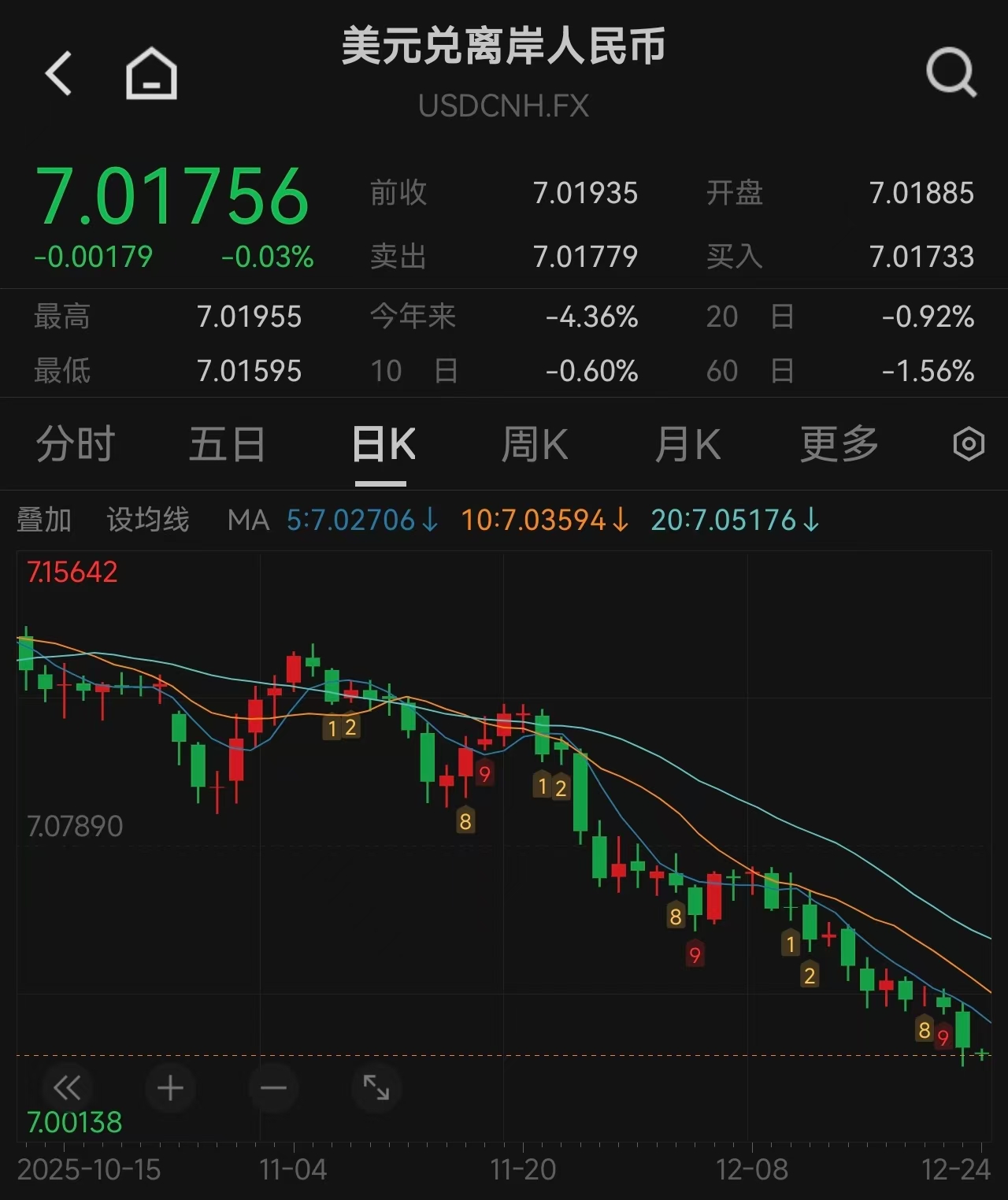
临近岁末,人民币走出一波强势升值行情。 12月23日,离岸人民币对美元率先升破7.02关口,为2024年10月以来首次,距离收复7.0整数关口仅"一 步之遥"。与此同时,在岸人民币对美元日内升破7.03关口,上涨近百点。 分析人士认为,美元指数走势趋弱与岁末结汇需求不断释放,构成了本轮人民币上涨的主要动力。后续 看,丰厚的结汇盘仍将支撑人民币偏强运行,但出现单边快速升值的概率较低。 内外因素驱动人民币汇率维持强势 本轮人民币的强势行情可追溯至10月中旬。截至12月23日,在岸、离岸人民币对美元期间累计升值幅度 分别约1000点与1200点,涨幅分别达1.58%、1.68%。 业内人士认为,近期人民币升值主要受内外两方面因素驱动。 从外部看,12月以来,随着美联储如期降息25个基点,美元指数再度走弱,一度失守98关口。"市场预 期,美联储继续开展降息将进一步压制美元长期走势,为人民币提供长期外部升值空间。"国家金融与 发展实验室特聘高级研究员庞溟对记者表示。 内部动因则在于年末的季节性"结汇潮"。东方金诚首席宏观分析师王青对记者表示,临近年底,企业结 汇需求增加,带动人民币季节性走强。在人民币持续走强后,前期累 ...
人民币,强势拉升
Xin Lang Cai Jing· 2025-12-23 12:03
Group 1 - The core viewpoint of the news is that the Chinese yuan has experienced a strong appreciation trend as it approaches the end of the year, with the offshore yuan breaking the 7.02 mark against the US dollar for the first time since October 2024, and the onshore yuan surpassing 7.03 [1][2] - Analysts attribute the recent appreciation of the yuan to both internal and external factors, including a weakening US dollar index and seasonal demand for currency settlement as the year-end approaches [3][8] - The yuan's appreciation trend is expected to continue, supported by substantial settlement demand, although the likelihood of a rapid one-sided appreciation is low [1][4] Group 2 - The recent strong performance of the yuan can be traced back to mid-October, with the onshore and offshore yuan appreciating approximately 1000 and 1200 points respectively, translating to increases of 1.58% and 1.68% [2][7] - External factors include a 25 basis point interest rate cut by the Federal Reserve in December, which has led to a weaker dollar, while internal factors are driven by increased corporate settlement demand as the year-end approaches [8][9] - Historical data indicates that foreign trade income peaks in December, with average settlement amounts in October, November, and December being 141.4 billion, 148.9 billion, and 170.4 billion USD respectively, highlighting a trend of increased settlement in the fourth quarter [8][9] Group 3 - The outlook for the yuan suggests a gradual and moderate appreciation, with expectations that the peak of settlement demand may extend into January, potentially leading to a 0.8% increase in the yuan's value against the dollar [4][9] - Market sentiment regarding the resilience of China's economic transformation and the prospects of the new economy is improving, which may further support the yuan's appreciation [4][9] - The central economic work conference emphasized maintaining the yuan's exchange rate stability at a reasonable level, indicating a focus on enhancing the currency's elasticity and resilience while preventing excessive fluctuations [10] Group 4 - The appreciation of the yuan is expected to benefit import-dependent industries, companies with significant dollar liabilities, and certain service trade sectors, potentially lowering import costs and increasing revenues in related industries [5][10] - However, the report also notes that the yuan's appreciation may negatively impact exports and exacerbate current price deflation pressures [6][10] - Companies are advised to adopt a risk-neutral approach to currency fluctuations, integrating exchange rate volatility into their operational decision-making and employing various strategies to mitigate risks [11]