数据中心

Search documents
山西证券研究早观点-20251231
Shanxi Securities· 2025-12-31 01:02
Market Trends - The domestic market indices showed mixed performance, with the Shanghai Composite Index closing at 3,965.12, unchanged, while the Shenzhen Component Index rose by 0.49% to 13,604.07 [2] Industry Commentary - The solar power sector saw a significant increase in new installations, with a month-on-month growth of 75% in November, totaling 22.02 GW of new capacity [5][8] - The coal import data indicates a continued upward trend in import prices, with November's average price reaching $73 per ton, despite a year-on-year decrease in import volume [11][13] Company Insights - The report highlights the company "Hengdong Light" as a national-level "specialized and innovative" small giant in the optical communication field, focusing on passive optical devices [15][17] - Hengdong Light's revenue is projected to grow rapidly from 475 million yuan in 2022 to 1.315 billion yuan in 2024, with net profit expected to increase significantly during the same period [17][18] Investment Recommendations - The report suggests focusing on companies in the photovoltaic sector, including Aiko Solar and Longi Green Energy, as well as those involved in energy storage and market-oriented electricity [12] - The investment outlook for Hengdong Light is positive due to its competitive advantages and strong growth potential in the optical communication market [17][18]
国际铜价:2024年涨势或延续,AI成新动力
Sou Hu Cai Jing· 2025-12-30 15:15
本文由 AI 算法生成,仅作参考,不涉投资建议,使用风险自担 【12月30日,国际铜价迈向2009年以来最强劲一年】受人工智能(AI)投资热潮、全球供应担忧及美元走 弱等因素影响,国际铜价正迈向自2009年以来表现最强劲的一年。分析人士称,在供需格局收紧、数据 中心建设加速下,铜价上涨动能有望延续至明年。Astris Advisory商品策略师指出,AI成推动铜价上涨 核心因素之一。全球供应偏紧,铜市场"高度紧张",价格有进一步上行空间。该策略师还表示,过去数 年铜价主要受绿色能源和电动车投资支撑。随着数据中心成投资重点,铜需求结构向高附加值领域倾 斜。 ...

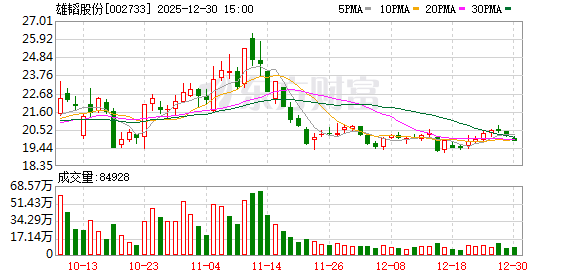
雄韬股份:公司专注于算力中心与数据中心UPS电源领域
Zheng Quan Ri Bao· 2025-12-30 14:16
Core Viewpoint - The company emphasizes that its core development strategy focuses on computing centers and UPS power supplies for data centers, aiming to provide various product solutions in these areas [2] Group 1: Company Strategy - The company is dedicated to the computing center and data center UPS power supply sectors [2] - It aims to offer different product solutions, including high-rate, high-energy-density lithium batteries, maintenance-free high-power lead-acid batteries, and hydrogen energy batteries as alternatives to diesel generation and clean energy power generation [2]


公用事业公司CEO谈数据中心危机:美国电网亮起“警示灯”
财富FORTUNE· 2025-12-30 13:08
Core Viewpoint - The rapid development of artificial intelligence (AI) and data centers is pushing the U.S. power grid into uncharted territory, with warnings from utility executives about the urgent need for repairs to avoid power shortages [2][4]. Group 1: Current State of the Power Grid - The CEO of Exelon, Calvin Butler, likened the current state of the U.S. energy grid to a car on the verge of breaking down, emphasizing that the warning lights are on and must not be ignored [2]. - Butler highlighted that the U.S. is experiencing unprecedented load growth, driven by AI's demand for computing power, manufacturing reshoring, and overall electrification of the economy [3][4]. Group 2: Demand and Supply Discrepancy - There is a disconnect between the growth in demand for electricity and the incentives for building new power generation facilities, as independent power producers are currently maximizing existing assets rather than expanding capacity [4]. - This situation is leading to increased risks of shortages and inevitable price hikes, as producers focus on extracting maximum value from current infrastructure [4]. Group 3: Future Electricity Prices - Butler stated that electricity prices are expected to rise, influenced by market dynamics within the PJM interconnection, which serves 13 states and Washington D.C. [6]. - The expiration or adjustment of previously implemented price caps could lead to a resurgence of suppressed costs, potentially costing consumers billions [6]. Group 4: Technology and Cybersecurity - Despite the pressures from the AI revolution, Butler expressed that utility companies should not be at the forefront of technology application, as failures could have severe consequences [6]. - Exelon is cautious about adopting new technologies, particularly regarding cybersecurity, rating their confidence in third-party supply chain security at only 6 to 7 out of 10 [6]. Group 5: Investment in Infrastructure - The industry plans to invest $1.1 trillion over the next five years in large infrastructure projects to address impending capacity issues, including a new 220-mile transmission line across Pennsylvania and West Virginia [7]. - Butler stressed that merely relying on physical infrastructure without addressing underlying policy issues will not resolve the problems facing the power grid [7].


金盘科技:公司与海外客户签订数据中心项目合同,金额达9899.22万美元
Xin Lang Cai Jing· 2025-12-30 11:56
金盘科技公告,公司与海外客户F签订数据中心项目合同,提供电力产品,合同金额为9899.22万美元, 折合人民币约6.96亿元。该合同为日常经营销售合同,对公司2025年度经营业绩无重大影响,若顺利履 行,预计将对未来经营业绩产生积极影响。 ...

数据中心供配电设备行业跟踪:海外云厂商资本开支高增长,电力设备需求高企
Shanghai Aijian Securities· 2025-12-30 06:43
Investment Rating - The report assigns an "Outperform" rating for the power equipment industry, indicating a positive outlook for investment opportunities in this sector [3]. Core Insights - The data center industry has become a core incremental application scenario for the power equipment sector, directly driving demand growth and technological iteration in power equipment [6]. - The report emphasizes the need to incorporate multi-dimensional indicators from the AI industry to accurately assess the demand for power distribution equipment, given the capital expenditure characteristics of the data center industry [3][6]. - Key indicators are constructed from three aspects: demand side (capital expenditure trends of leading cloud vendors), supply chain (GPU supply capabilities), and AI application development [3][6]. Summary by Sections Demand Side - Capital expenditure from overseas cloud vendors reached $99.617 billion in Q3 2025, a year-on-year increase of 80.39% and a quarter-on-quarter increase of 9.54% [8]. - Alibaba's capital expenditure was 31.5 billion yuan in Q3 2025, up 80.10% year-on-year but down 18.55% quarter-on-quarter [13]. - Tencent's capital expenditure was 13 billion yuan, down 24.05% year-on-year and 32.05% quarter-on-quarter [13]. Supply Chain - Nvidia's revenue in Q3 2025 reached 362.571 billion yuan, a historical peak with a quarter-on-quarter growth of 24.63% and a year-on-year growth of 62.49% [18]. - TSMC's revenue in November 2025 was 343.614 billion New Taiwan dollars, a year-on-year increase of 24.5% [24]. - The CPU price index in October 2025 was 98.20, showing a slight recovery from 96.15 in September [27]. Application Side - The number of AI models is steadily increasing, with a notable growth in application deployments [29]. - The token usage on OpenRouter from December 16 to December 22 was 5.70T, reflecting a 2.56% decrease [35]. - The price of tokens for models scoring over 40 on the Artificial Analysis Intelligence Index dropped by over 50% in Q3 2025 [46].
燃气轮机需求复苏 A股产业链公司有望迎来订单与业绩双重爆发
Xin Lang Cai Jing· 2025-12-29 23:27
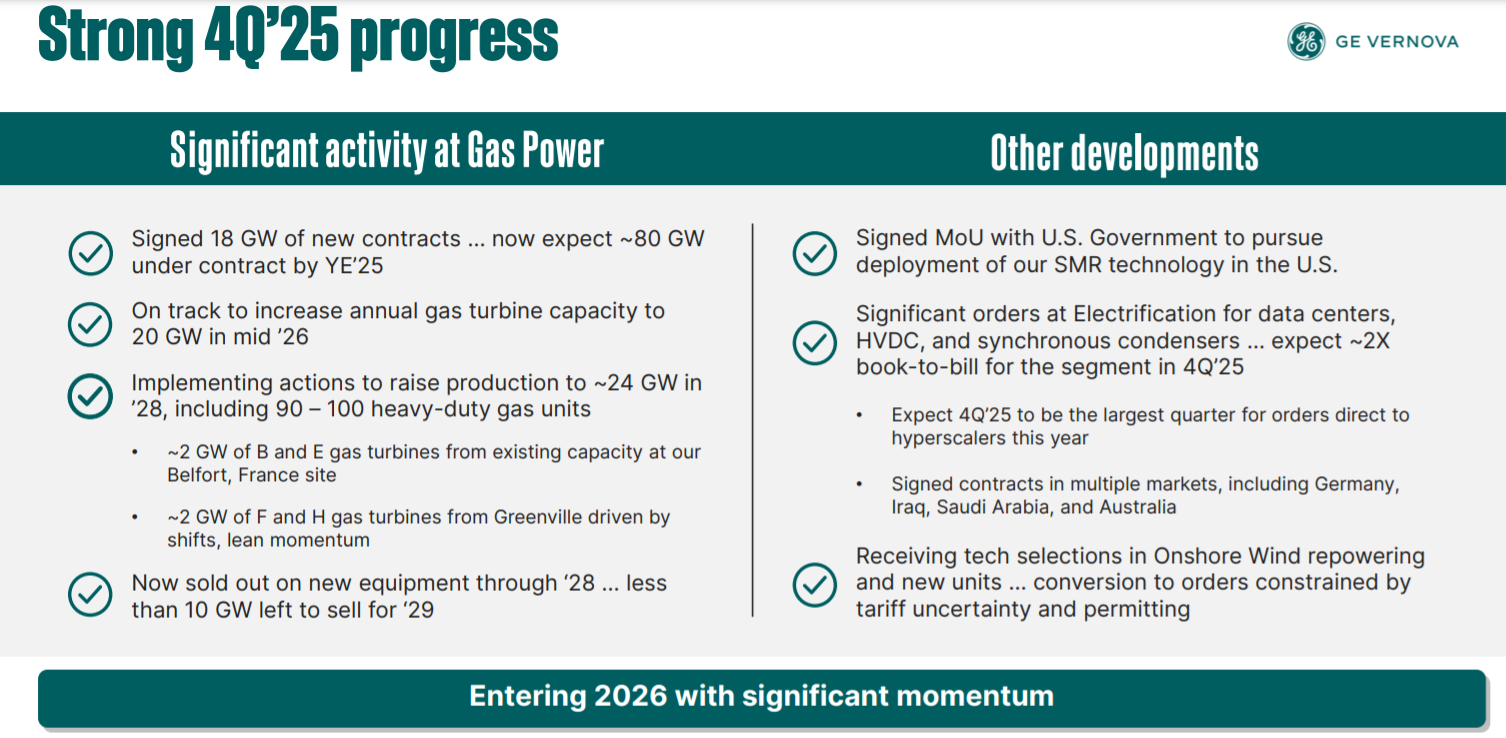
Core Insights - The increasing contradiction between "U.S. power shortages" and explosive growth in computing power demand is driving a rigid demand for electricity from high-energy-consuming facilities like data centers, creating a historic opportunity for gas turbines as a rapid response and efficient power supply solution [1][19] - Major international gas turbine companies like General Electric (GE Vernova) and Siemens Energy are experiencing strong stock performance, reflecting market expectations for future growth, with GE Vernova's stock up over 115% this year and over 430% since its spin-off [20][1] - The strong demand wave from overseas is transmitting through the supply chain, providing unprecedented development opportunities for related A-share listed companies deeply integrated into the overseas power generation equipment supply chain, with expectations for a dual explosion in orders and performance by 2026 [20][1] Electricity Demand and Supply Gap - The electricity gap in the U.S. is continuously expanding, with the U.S. Energy Information Administration (EIA) predicting that electricity consumption will reach 4,267 billion kilowatt-hours by 2026, driven primarily by AI data centers and cryptocurrency mining [2][20] - Morgan Stanley estimates that the cumulative electricity gap for U.S. data centers from 2025 to 2028 will reach 47 gigawatts, equivalent to the total electricity consumption of nine Miami areas, with a shortfall of 6-16 gigawatts expected even after accounting for rapid power supply solutions [2][20] Gas Turbines as a Core Solution - In the context of electricity shortages, gas turbines are becoming the core choice for addressing the U.S. power gap due to their quick startup speed, strong peak-shaving capabilities, and low carbon emissions [21][20] - Compared to traditional coal power, gas turbines can start within hours and respond quickly to the intermittent power demands of data centers, while also providing stable power supply as a baseload source, unaffected by weather conditions [21][20] Global Energy Transition and Gas Turbines - The global energy transition is accelerating under the "dual carbon" goals, with gas turbines serving as a core equipment for transitional energy due to their lower carbon emissions compared to coal power [3][21] - Policies like the U.S. Inflation Reduction Act (IRA) support clean energy projects, including gas power generation, particularly for low-carbon modifications like hydrogen combustion in gas turbines [3][21] Performance and Capacity Expansion of Major Players - GE Vernova and Siemens Energy have provided strong performance guidance and capacity expansion plans, indicating high industry prosperity, with GE Vernova expecting revenues of $41-42 billion in 2026 and a significant increase in gas turbine orders [4][22] - GE Vernova's new gas turbine orders reached 18 gigawatts in Q4 2025, tripling year-on-year, with total orders expected to exceed 80 gigawatts, reflecting a doubling from the beginning of the year [22][25] - Siemens Energy's gas turbine orders reached 26 gigawatts, with a 94% year-on-year increase, and an order value of €23 billion, indicating strong demand from data centers [25][29] Supply Chain Opportunities for A-Share Companies - A-share gas turbine supply companies have achieved technological breakthroughs in various segments, with some becoming core suppliers to overseas giants [34][36] - Companies like Yingliu Technology and Zhenjiang Co. are positioned to benefit from the expansion of GE Vernova and Siemens Energy in North America, with substantial orders and production capacity [35][36] - The demand for key materials and components, such as high-temperature alloy materials and precision parts, is expected to grow significantly, with domestic companies like Sry New Materials leading in the production of high-purity chromium powder [36][34]


祥鑫科技:公司与开展机器人业务的下游客户保持密切沟通
Zheng Quan Ri Bao Zhi Sheng· 2025-12-29 12:12
Group 1 - The core viewpoint of the article is that Xiangxin Technology is actively engaging in business opportunities related to the supply of CNC sheet metal parts and precision metal structures for applications in 5G base stations, IDC cabinets, and data centers [1] - The company is experiencing increased business opportunities as downstream customers expand their data center and computing power center layouts across the country [1] - Xiangxin Technology is maintaining close communication with downstream customers involved in robotics business, although specific customer information and business details are not disclosed due to confidentiality agreements [1]

美国最大电网“容量拍卖”内幕:若无价格管制,AI热潮本将令电价再涨60%
Hua Er Jie Jian Wen· 2025-12-29 10:10
Core Insights - The latest capacity auction results from PJM Interconnection reveal that the surge in demand from artificial intelligence and data centers is pushing the U.S. power system to its limits [1][2] - The auction for the 2027/2028 base residual capacity saw prices soar to $333.40 per MW-day, breaking previous records and hitting the price cap approved by FERC [1] - If the price cap were removed, the simulated market clearing price could reach $529.80 per MW-day, indicating a potential 60% increase in electricity costs due to data center demand [1][4] Demand and Supply Dynamics - The demand for electricity from U.S. data centers has significantly increased, with a monthly addition of 1.6 GW in November, a 4% month-over-month growth, bringing total capacity to 44.6 GW [3] - PJM market, covering key areas including Virginia's "Data Center Alley," saw the largest capacity addition of 0.45 GW, with Virginia contributing 0.27 GW [3] - Despite high demand, supply response has been slow, with only about 350.7 MW of new generation and 423.6 MW of upgraded capacity procured in the auction [3] Hidden Costs and Reliability Concerns - The auction results highlight the risk of "shadow prices," with potential costs rising by 40% year-over-year if unregulated [4] - The reserve margin dropped from 18.9% to 14.8%, indicating a tightening supply situation and falling below the target of 20% [5] - The effective load-carrying capability (ELCC) increased from 69% to 92%, but this did not alleviate the supply shortage [6] Future Outlook - The next auction scheduled for June 2026 faces significant uncertainty, as no price caps have been set, potentially leading to prices reaching $600 per MW-day [6] - Without structural changes before the next auction, the U.S. may face a dilemma between AI development and air conditioning electricity needs in 2026 [6]
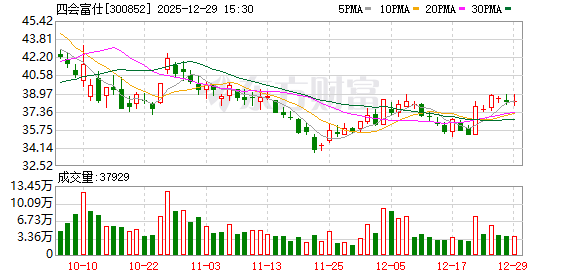
四会富仕:公司PCB产品应用于机器人、航空航天及数据中心等领域
Zheng Quan Ri Bao· 2025-12-29 09:40
证券日报网讯 12月29日,四会富仕在互动平台回答投资者提问时表示,公司PCB产品下游应用广泛, 有部分应用于机器人、航空航天及数据中心等领域。 (文章来源:证券日报) ...