
价值投资

Search documents
警惕偷走你长期财富的“伪资产”
雪球· 2025-12-29 13:00
Core Viewpoint - The article emphasizes the importance of understanding the difference between assets and liabilities, highlighting that many high-income individuals fail to accumulate wealth due to poor investment choices and excessive consumerism [4][5][6]. Group 1: Investment Understanding - The article advocates for a clear definition of assets and liabilities, stating that assets are things that put money into one's pocket, while liabilities take money out [5]. - It stresses that many people mistakenly consider liabilities as assets, leading to financial instability [6][7]. - The article references the views of successful investors like Buffett and Munger, who criticize the investment in gold due to its lack of cash flow generation [9]. Group 2: Consumer Behavior - The concept of "face tax" is introduced, where unnecessary spending to maintain appearances is criticized as a significant financial drain [3][10]. - The article discusses the "luxury car paradox," where high-cost items depreciate quickly and become liabilities rather than assets [10]. - It encourages individuals to redirect funds from superficial consumption into investments that generate real value, such as index funds or rental properties [10]. Group 3: Wealth Accumulation Strategies - The article outlines three key strategies for high-income earners to avoid pitfalls and build wealth: focusing on cash flow direction, avoiding face consumption, and establishing a passive income system [8][11]. - It suggests starting with a small percentage of income to invest in true assets and gradually building a passive income stream [12]. - The ultimate goal is to achieve financial freedom, defined as having the ability to choose how to spend time without financial constraints [12].


霍华德·马克斯最新访谈:改变世界≠投资者赚到了钱
Xin Lang Cai Jing· 2025-12-29 11:47
Group 1 - The current investment climate is compared to the internet bubble of 1998-2000, highlighting that both are driven by revolutionary technologies that spark market imagination, but "changing the world" does not equate to "making money for investors" [1][71][24] - There is a lack of clarity regarding the commercialization and profitability of AI compared to the internet bubble, where many ideas have since materialized [2][73][82] - Investors are warned to avoid a "lottery mentality" and "binary bets" when investing in AI [3][30][100] Group 2 - Two types of investment choices are identified: betting on pure AI concept companies, which are high-risk but potentially high-reward, and investing in established tech companies where AI serves as a growth driver [4][75] - Investors must be aware of their risk tolerance and investment plans [5][76] - For gold and Bitcoin, these assets do not generate cash flow, making it impossible to assess their intrinsic value; their prices are entirely dependent on market supply and demand [6][77][120] Group 3 - Historical data shows that gold has underperformed compared to the S&P 500, with annualized returns of approximately 7.7% for gold since 2010, compared to 12.7% for the S&P 500 [7][52][123] - The long-term return of gold is lower than that of the stock market, and investors should not be misled by short-term price increases [7][54][124] - High-yield bonds are considered relatively attractive assets in the current environment, offering around 7% returns [67][138]

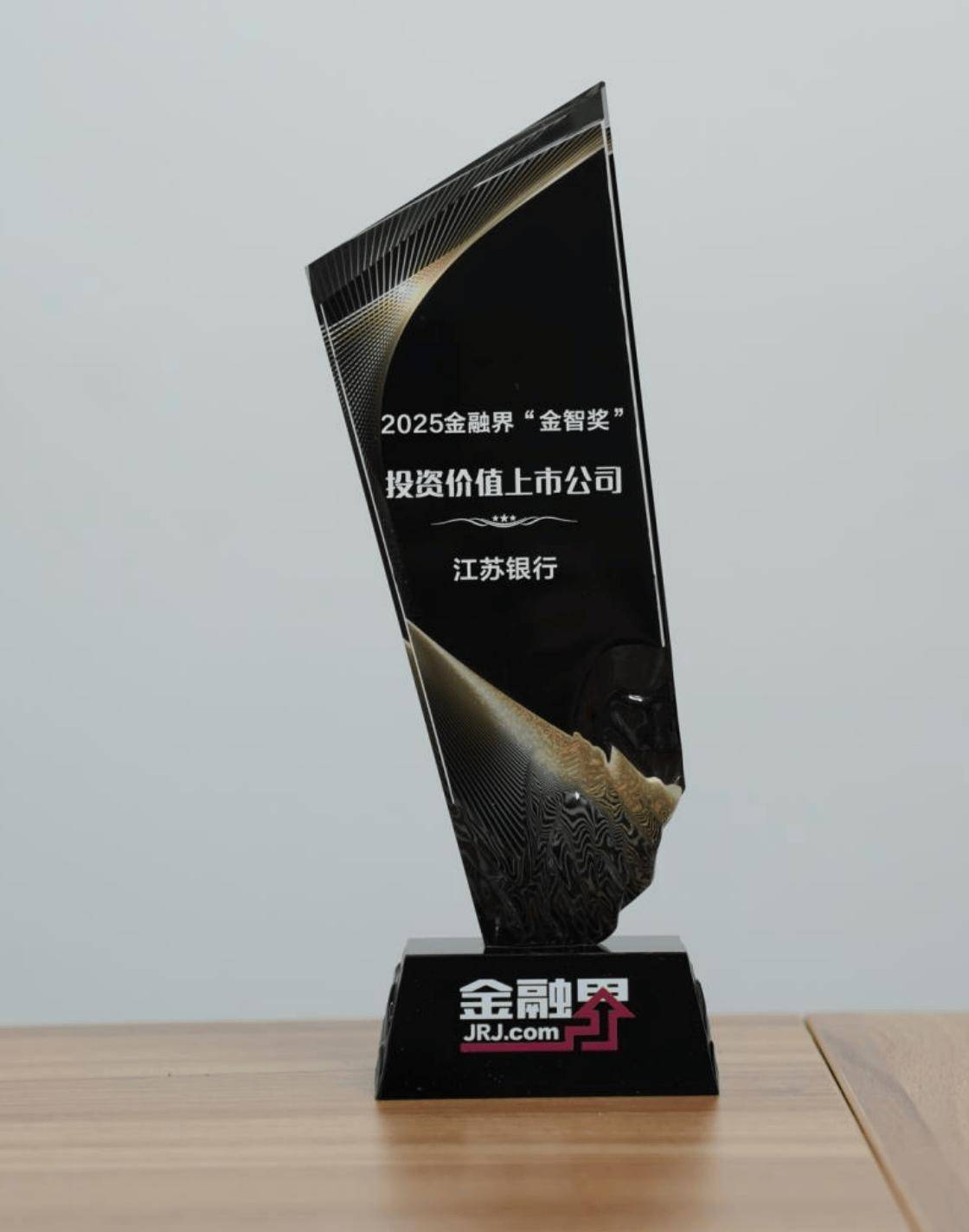
江苏银行斩获金融界“金智奖”投资价值上市公司 以高质量发展韧性铸就投资价值典范
Sou Hu Cai Jing· 2025-12-29 10:04
12月26日,以"新开局、新动能、新征程"为主题的"启航·2025金融峰会"在北京圆满举办,大会由金融界主办,汇聚监管部门、行业协会、金融机构、上市 公司、媒体等数百位相关领导和重磅嘉宾。会上,第十四届金融界"金智奖"年度评选结果重磅揭晓,江苏银行荣获"投资价值上市公司"。 "金智奖"旨在树立高质量发展标杆,引导上市公司聚焦主业、持续创新、践行社会责任,推动资本向优质企业集聚。本届评选中,金融界上市公司研究院紧 密契合"十五五"规划建议中"提升上市公司质量"的要求,将高质量发展内核分解为社会责任、实业贡献、投资回报、成长前景、创新效率、杰出品牌六大维 度,以企业财务数据和公开信息为基础建立量化分析模型,最终覆盖A股、港股及中概股超8000家企业,评选出近200家获奖企业。 "投资价值上市公司"以资本价值与发展潜力为核心评判标准,聚焦财务健康度、行业赛道前景、核心竞争力、公司治理规范性及可持续发展能力。旨在树立 价值投资标杆,推动行业结构优化,引导市场回归理性投资,构建良性资本市场生态。 风险防控是银行稳健经营的核心,江苏银行深入推进风险管理体制改革,智慧化防控体系日益成熟。2025年三季报显示,报告期末不良贷 ...

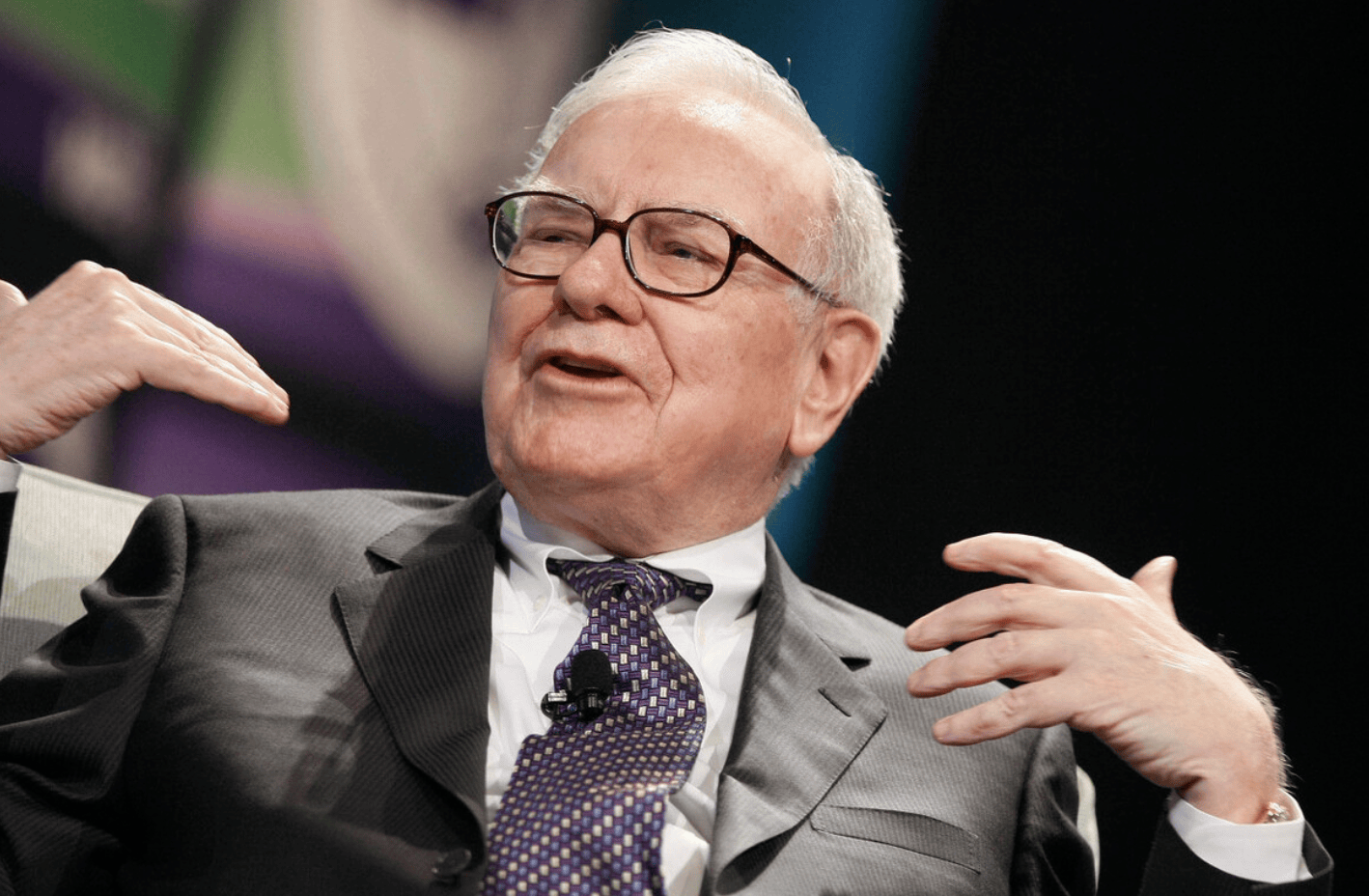
股神巴菲特交棒倒计时
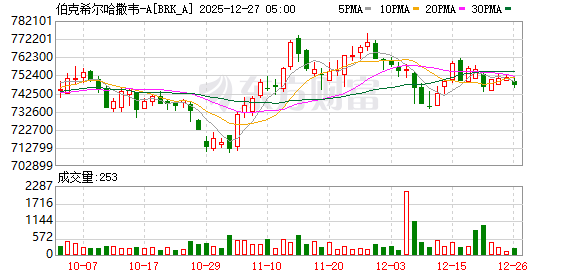
Guo Ji Jin Rong Bao· 2025-12-29 08:33
Core Viewpoint - The transition of leadership at Berkshire Hathaway marks the end of an era defined by Warren Buffett's investment philosophy, which has significantly influenced global investors for decades [3][12]. Group 1: Leadership Transition - Warren Buffett will officially step down as CEO of Berkshire Hathaway on December 31, 2025, passing the role to long-time partner Greg Abel [3]. - This leadership change is characterized by its long preparation and high transparency, symbolizing a new chapter for Berkshire Hathaway [3][12]. - Buffett will continue to serve as chairman, indicating his ongoing involvement with the company despite stepping down as CEO [8]. Group 2: Investment Philosophy - Buffett's investment legacy is not solely about financial gains but also about a distinct investment philosophy that emphasizes intrinsic value over market sentiment [5]. - His principles include a focus on companies with a "moat," long-term holding, and prioritizing risk management over immediate returns [6]. - Buffett's annual letters to shareholders have become a reference for value investing, shaping the thought processes of both institutional and individual investors [6]. Group 3: Current Financial Position - As of now, Berkshire Hathaway holds over 25% of its total assets in cash equivalents, amounting to more than $380 billion, reflecting a defensive strategy amid high market valuations [8][12]. - The S&P 500's forward P/E ratio stands at 21.5, indicating that the overall market is relatively expensive, which influences Berkshire's cautious approach to investments [8]. Group 4: Portfolio Composition - Berkshire's portfolio continues to reflect Buffett's investment style, with Apple being the largest holding, accounting for slightly over 20% of the portfolio [9]. - The investment strategy remains focused on long-term profitability rather than short-term trends, with a stable base including companies like American Express and Coca-Cola [10]. Group 5: Market Perception and Challenges - Since the announcement of Buffett's retirement, Berkshire's B shares have seen a nearly 12% decline, contrasting with a 21% rise in the S&P 500, indicating investor caution during the leadership transition [12]. - The stock price is currently facing resistance levels between $507 and $517, with significant support around $490, suggesting limited short-term upside potential [12]. - The market is reassessing Berkshire's positioning as Buffett steps back, highlighting the challenges ahead for the company in maintaining its legacy without the "Oracle of Omaha" [11][12].
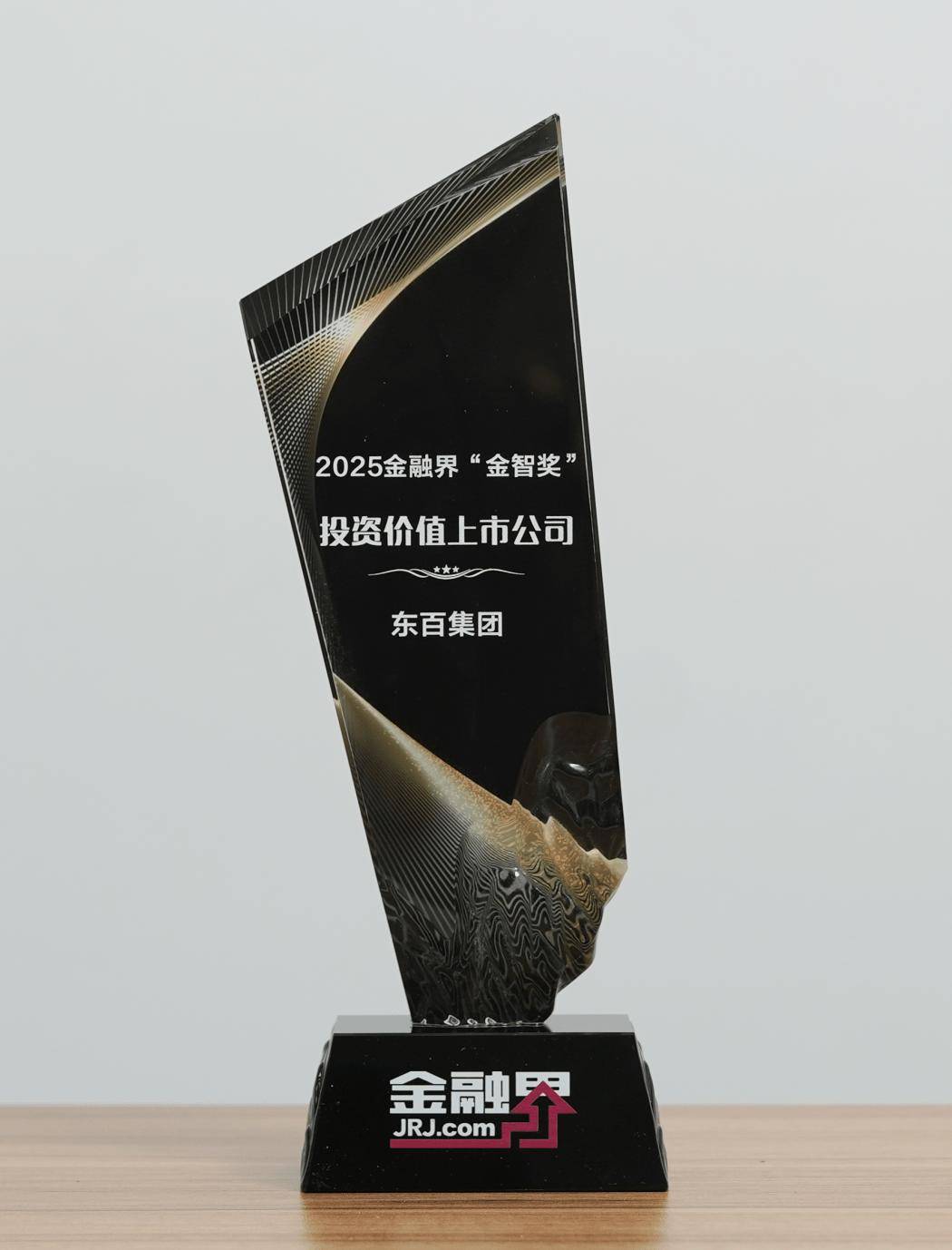
东百集团荣获第十四届金融界“金智奖”投资价值上市公司
Sou Hu Cai Jing· 2025-12-29 08:27
Core Viewpoint - The "Qihang·2025 Financial Summit" held in Beijing highlighted the importance of high-quality development in the financial sector, with Dongbai Group awarded the "Investment Value Listed Company" title, reflecting its strong financial health and growth potential [1][3][4]. Group 1: Award and Evaluation Criteria - The "Jinzhi Award" aims to set benchmarks for high-quality development, guiding listed companies to focus on core businesses, innovate continuously, and fulfill social responsibilities [3]. - The evaluation covered over 8,000 companies across A-shares, Hong Kong stocks, and Chinese concept stocks, with nearly 200 companies recognized for their performance [3]. Group 2: Dongbai Group's Performance - Dongbai Group's revenue reached 1.359 billion yuan, a year-on-year increase of 2.34%, while net profit attributable to shareholders was 88.05 million yuan, up 3.04%, demonstrating strong operational resilience [4]. - The company's operating cash flow net amount was 415 million yuan, reflecting a significant year-on-year growth of 165.89% due to stable logistics rental income and recovering retail sales [4]. Group 3: Business Strategy and Market Position - Dongbai Group has established a diversified business system covering commercial retail, warehousing logistics, hotel catering, and commercial real estate, maintaining a leading position in the regional retail market [4][6]. - The company has signed 58 new client agreements in the logistics sector, attracting high-quality enterprises such as BYD, Xiaomi, and Meituan, enhancing its client structure and operational efficiency [5]. Group 4: Shareholder Returns - Since its listing, Dongbai Group has distributed dividends 18 times, with a dividend payout ratio of 60.75%, ranking among the top in the industry [5].

投资的底层逻辑
雪球· 2025-12-29 08:01
Core Viewpoint - Many investors learn from successful investment experiences but still incur losses in practice, indicating a need to modify underlying investment logic [3] Group 1: Learning and Mindset - Investors should dedicate significant time to learning about investment, aiming to read over 100 books on value investing and prioritize financial freedom [3] - Understanding oneself and recognizing personal weaknesses is crucial, as these weaknesses can be magnified in the stock market [3] - Investors must break free from herd mentality and think independently, as the majority is often wrong in the stock market [4] Group 2: Analytical Thinking - Investors should focus on correlation rather than causation, as establishing cause-and-effect relationships in the stock market is challenging [5] - Utilizing statistical principles is essential, as relying on intuition can lead to poor decision-making; long-term investments are often more profitable than short-term ones [6] Group 3: Strategic and Emotional Considerations - Strategic thinking is vital for long-term investment success, considering broader economic and historical contexts [7] - A stable mindset is more important than high skill levels; emotional fluctuations can negatively impact investment outcomes [8] Group 4: Continuous Improvement and Support - Investors should remain humble and open to learning, acknowledging their imperfections and seeking to improve [9] - Gaining family support for investment activities is important, as societal biases against investors can create additional challenges [10] Group 5: Time Management and Focus - Investors should prioritize important tasks and relationships, avoiding distractions from unimportant matters [10] - Recognizing cyclical patterns in the market is crucial, as all investments are subject to cycles [11][12] Group 6: Passion and Curiosity - Maintaining passion for investment and curiosity for knowledge is essential for continuous growth and success in the field [13]

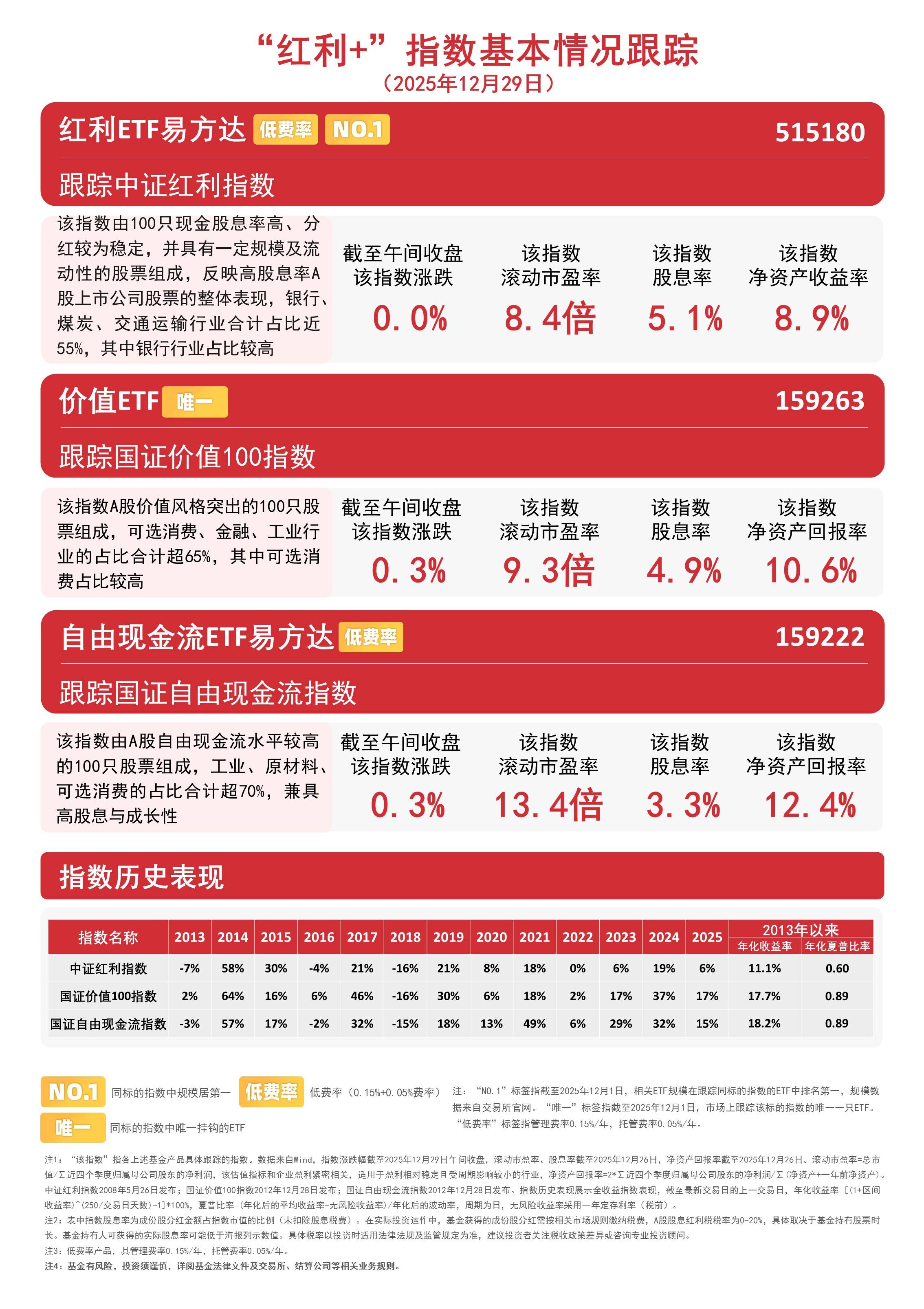
“红利+”指数小幅上行,关注价值ETF(159263)、自由现金流ETF易方达(159222)等产品投资机会
Sou Hu Cai Jing· 2025-12-29 04:57
Group 1 - The "Dividend +" index showed a slight increase in the morning session, with the Guozheng Value 100 Index and Guozheng Free Cash Flow Index both rising by 0.3%, while the CSI Dividend Index increased by 0.02% [1] - The Guozheng Value 100 Index employs a three-dimensional screening system based on "high dividend + high free cash flow + low price-to-earnings ratio" to select value stocks, demonstrating stable historical performance [1] - The Guozheng Free Cash Flow Index selects stocks based on free cash flow rates, combining high dividends with growth potential, and consists of 100 stocks with high free cash flow levels [4] Group 2 - The Value ETF (159263) and the Free Cash Flow ETF (E Fund, 159222) track the aforementioned indices, providing investors with opportunities to capitalize on related investment styles [1] - The historical performance of the indices shows varied returns, with the Guozheng Value 100 Index achieving a 64% increase in 2014 and a 46% increase in 2017, while the Guozheng Free Cash Flow Index had a 57% increase in 2014 [4] - The Free Cash Flow ETF has a low fee rate of 0.15% + 0.05%, making it the only ETF linked to the specified indices among similar products [4]
获股东增持与市场追捧 孚日股份斩获金融界“金智奖”投资价值上市公司
Jin Rong Jie· 2025-12-29 02:40
资本市场同样给予积极反馈,其股东也展现出对发展前景的信心,12月12日晚间公司发布公告称,安信投资通过深圳证券交易所交易系统以集中竞价方式累 计增持公司股份300万股,占公司总股本的0.32%,增持金额约为2910万元,相关增持计划已实施完毕;截至2025年12月25日,公司股价年内上涨143%,充 分反映了市场与股东对其发展前景的双重认可。 作为全球棉纺龙头之一,面对贸易摩擦等外部挑战,孚日股份主动优化客户结构、升级产品品质,牢牢筑牢家纺核心业务根基。受益于今年5月税率调整下 降的利好,美国市场部分订单回流,海外家纺业务保持稳定发展态势。在国内市场,公司精准把握消费升级趋势,聚焦需求与品牌升级,于9月推出"洁玉大 师系列"并签约成毅代言,借助明星影响力吸引年轻消费群体,进一步激活国内业务增长潜力,推动品牌价值持续提升。 12月26日,以"新开局、新动能、新征程"为主题的"启航·2025金融峰会"在北京圆满举办,大会由金融界主办,汇聚监管部门、行业协会、金融机构、上市 公司、媒体等领域数百位相关领导和重磅嘉宾。会上,第十四届金融界"金智奖"年度评选结果重磅揭晓,孚日股份荣获"投资价值上市公司"。 "金智奖"旨 ...


巴菲特谢幕!手握万亿资金的继任者,是否会加速拥抱AI?
Sou Hu Cai Jing· 2025-12-29 00:54
在最高光的时刻谢幕,是巴菲特给资本市场的最终答案。 面对资本市场的复杂,巴菲特用一生实践了"价值投资"的理念,并验证了它存在的价值。 自1965年接手伯克希尔·哈撒韦以来,六十多年的时光,巴菲特将这家濒临破产的纺织企业带到了前所未有的高度,让世界见证了市场的力量,如今这家企 业已成为一家市值超万亿美元的综合性金融集团。 根据相关媒体报道,退休之际,巴菲特本人的净资产已达1510亿美元,位居彭博亿万富豪榜单第十位。 据巴菲特的"谢幕信",从今年开始他就不再撰写伯克希尔·哈撒韦的年度报告,也就是说,往后再要想从年度报告"窥探"他本人对市场短期或者长期的看 法,已无机会。 从巴菲特的投资生涯来看,拥抱现金流比较好的企业,深耕消费、能源以及综合性金融贯穿了他的整个投资生涯,在"价值投资"的加持下,巴菲特享受到了 这些行业发展的红利,也在时代的发展中完成了蜕变。 近十年以来,巴菲特重要的一笔投资,就是2018年选择了苹果。这笔投资延续了伯克希尔的投资神话,成了巴菲特继续笑傲资本市场的砝码。最近两年,巴 菲特开始大幅减持苹果,为继任者格雷格·阿贝尔留下足够腾挪的空间。 当用后视镜视角去审视巴菲特的交易,可以清晰地认识到, ...
证监会严肃查处*ST长药财务造假案件 评论:“有进有退”优化资本市场资源配置
Xin Lang Cai Jing· 2025-12-28 23:31
登录新浪财经APP 搜索【信披】查看更多考评等级 近日,证监会严肃查处长江医药控股股份有限公司严重财务造假案件。*ST长药(维权)涉嫌触及重大 违法强制退市情形,深交所将依法启动退市程序。今年以来,已有多家上市公司被强制退市,涵盖财务 类退市、交易类退市、重大违法强制退市等类型。这体现出监管部门加大退市执法力度,畅通多元化退 市渠道,加快出清劣质资产,净化市场生态。 但与此同时,我国资本市场却对一批批来自新一代信息技术、新能源、新材料等战略性新兴产业的科技 型企业敞开了大门。 综合来看,随着我国资本市场全面深化改革纵深推进,劣质公司加速退场,优质公司不断"上新",市场 优胜劣汰的良性循环机制正加速形成。"一进一退"的背后,不仅是上市公司质量的整体提升,更是市场 资源配置的优化。 在笔者看来,这一良好态势的形成,主要得益于三大核心因素。 一是市场体系不断完善,上市制度、退市机制持续优化,推动形成"有进有退、进退有序"的市场格局。 今年以来,资本市场加力服务新质生产力发展,进一步畅通优质创新企业的上市通道:科创板"1+6"改 革举措加快落地,重启未盈利企业第五套上市标准,适用范围扩大至人工智能、商业航天、低空经济 ...