国内大循环

Search documents
7月30日晚间央视新闻联播要闻集锦
Yang Shi Xin Wen Ke Hu Duan· 2025-07-30 13:59
今日摘要 中共中央政治局召开会议,决定召开二十届四中全会,分析研究当前经济形势和经济工作。中共中央总 书记习近平主持会议。 就当前经济形势和下半年经济工作,中共中央召开党外人士座谈会。习近平主持并发表重要讲话。李强 通报有关情况,王沪宁、蔡奇、丁薛祥出席。 《习近平谈治国理政》第五卷中英文版出版发行。 "十四五"时期,我国成为世界上口岸通关效率最高效的国家之一。 各地各部门扎实做好救灾抢险和恢复重建工作。 俄罗斯堪察加半岛附近海域发生8.7级强震,多国发布海啸预警。 内容速览 中共中央政治局召开会议 决定召开二十届四中全会 分析研究当前经济形势和经济工作 中共中央总书记 习近平主持会议 中共中央政治局7月30日召开会议,决定今年10月在北京召开中国共产党第二十届中央委员会第四次全 体会议,主要议程是,中共中央政治局向中央委员会报告工作,研究关于制定国民经济和社会发展第十 五个五年规划的建议。会议分析研究当前经济形势,部署下半年经济工作。中共中央总书记习近平主持 会议。 就当前经济形势和下半年经济工作 中共中央召开党外人士座谈会 习近平主持并发表重要讲话 当地时间7月28日至29日,中美经贸中方牵头人、国务院副 ...
就当前经济形势和下半年经济工作 中共中央召开党外人士座谈会 习近平主持并发表重要讲话
Xin Hua She· 2025-07-30 07:03
7月23日,中共中央在中南海召开党外人士座谈会,就当前经济形势和下半年经济工作听取各民主党派 中央、全国工商联负责人和无党派人士代表的意见建议。中共中央总书记习近平主持座谈会并发表重要 讲话强调,做好下半年经济工作,要坚持稳中求进工作总基调,完整准确全面贯彻新发展理念,加快构 建新发展格局,保持政策连续性稳定性,增强灵活性预见性,着力稳就业、稳企业、稳市场、稳预期, 有力提振消费、破除"内卷",畅通国内大循环,促进国内国际双循环,努力完成全年经济社会发展目标 任务,实现"十四五"圆满收官。 中共中央政治局常委李强、王沪宁、蔡奇、丁薛祥出席座谈会。李强受中共中央委托通报了上半年经济 工作有关情况,介绍了关于下半年经济工作有关考虑。 座谈会上,民革中央主席郑建邦、民盟中央主席丁仲礼、民建中央主席郝明金、民进中央主席蔡达峰、 农工党中央主席何维、致公党中央主席蒋作君、九三学社中央主席武维华、台盟中央主席苏辉、全国工 商联主席高云龙、无党派人士代表孙其信先后发言。他们完全赞同中共中央对当前经济形势的分析判断 和下半年经济工作的考虑,并就推动科技创新和产业创新跨区域协同、促进文体旅商融合发展、促进服 务业消费、超前布局 ...
共同讲好进博故事上海精彩中国机遇 进博会城市服务保障领导小组扩大会议举行
Jie Fang Ri Bao· 2025-07-30 02:03
市委副书记、市长、中国国际进口博览会城市服务保障领导小组组长龚正主持会议。 记者 张骏 中国国际进口博览会城市服务保障领导小组昨天上午举行扩大会议。市委书记、中国国际进口博览 会城市服务保障领导小组组长陈吉宁出席会议并强调,要深入学习贯彻习近平总书记关于办好进博会的 重要指示精神,切实增强使命感和责任感,进一步优化服务保障、提升工作质效,强化统筹联动、放大 溢出效应,全力确保进博会常办常新、越办越好。 陈吉宁指出,举办进博会,是习近平总书记亲自谋划、亲自部署、亲自推动的重大开放举措。办好 进博会,对于坚定不移办好自己的事、坚定不移扩大高水平对外开放,提高开放型经济能级和水平意义 重大,有利于更好发挥我国超大规模市场优势,进一步做强国内大循环、畅通国内国际双循环,巩固经 济持续回升向好势头,对于上海做好稳就业、稳企业、稳市场、稳预期各项工作,推动贸易转型、提升 消费能级、加快培育发展新质生产力具有特殊重要性。要进一步深化思想认识、提高政治站位,按 照"越办越好"总要求,提高办展办会质量和城市服务保障水平,确保第八届进博会圆满成功举行。 陈吉宁指出,要更好服务办展办会。重大活动要全力支持配合、高质量做好组织保障。 ...
宏观周报:高质量开展城市更新-20250727
KAIYUAN SECURITIES· 2025-07-27 12:41
Economic Growth - President Xi Jinping emphasized seven key tasks for urban development, including optimizing modern urban systems and promoting high-quality urban renewal[9] - Premier Li Qiang highlighted the importance of strengthening domestic circulation and enhancing consumer demand through diversified supply[9] Infrastructure and Industry - The Yarlung Tsangpo River downstream hydropower project has commenced with a total investment of approximately CNY 1.2 trillion[10] - 16 central enterprises signed investment agreements for 75 industrial projects in Tibet, amounting to CNY 317.5 billion[10] Consumer Policy - The National Development and Reform Commission revised the Price Law for the first time in 27 years, addressing issues related to irrational price wars and unfair pricing practices[14] - Regulatory bodies have urged major platforms like Ele.me, Meituan, and JD.com to standardize promotional activities and engage in rational competition[14] Financial Regulation - The China Securities Regulatory Commission is pushing for listed companies to enhance investment value and implement major asset restructuring management[16] - The People's Bank of China and the State Administration of Foreign Exchange proposed a unified currency pool policy framework[16] Trade Relations - New high-level economic talks between China and the U.S. are set to begin, focusing on mutual economic concerns[18] - The Hainan Free Trade Port will implement zero-tariff policies for certain goods starting December 18, 2025[19] Risk Warning - There is a persistent divergence in domestic and foreign monetary policies, with domestic policy execution falling short of expectations[25]
日子好好过,该省的省、该花的花
Ren Min Ri Bao· 2025-07-27 05:46
Group 1 - The core idea emphasizes that advocating frugality and encouraging consumption are not contradictory but mutually reinforcing, aimed at better meeting the people's aspirations for a better life [1][2] - Frugality is a traditional virtue in Chinese culture, and the government promotes it to ensure resources are used efficiently, allowing savings to be redirected to social welfare [1][2] - Consumption is a crucial driver of China's economic growth, contributing 68.8% to GDP growth in the first half of the year, with final consumption expenditure accounting for 52% [2] Group 2 - The government is actively implementing measures to boost consumption, such as issuing consumption vouchers and promoting trade-in programs, to address barriers to consumer spending [2] - Encouraging consumption is essential for expanding domestic demand and enhancing the domestic economic cycle, which in turn supports production, industry upgrades, and job creation [2][3] - The relationship between frugality and consumption is framed as a means to allow citizens to obtain higher quality goods and services at lower costs while contributing to sustainable development [3]
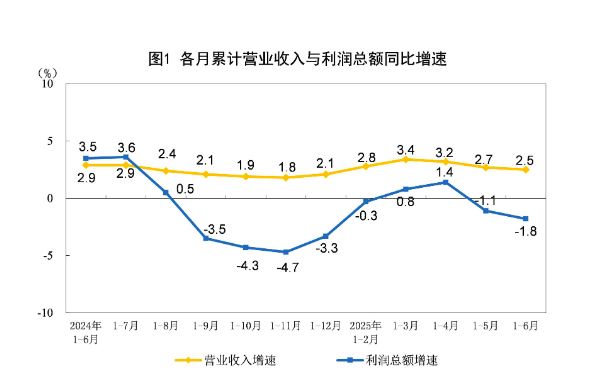
工业利润降幅收窄,装备制造业支撑作用突出
Di Yi Cai Jing· 2025-07-27 04:00
Group 1 - In June, the manufacturing sector showed significant improvement, with profits shifting from a decline of 4.1% in May to a growth of 1.4% [1] - For the first half of the year, the total profit of industrial enterprises above designated size reached 34,365.0 billion yuan, a year-on-year decrease of 1.8% [1] - In June, the total profit of industrial enterprises was 7,155.8 billion yuan, a year-on-year decline of 4.3%, but the decline narrowed by 4.8 percentage points compared to May [1] Group 2 - State-owned enterprises reported a total profit of 11,091.2 billion yuan, down 7.6%, while private enterprises saw a profit of 9,389.7 billion yuan, up 1.7% [3] - The mining industry experienced a profit drop of 30.3%, while the manufacturing sector's profit increased by 4.5% to 25,900.6 billion yuan [3] - The equipment manufacturing sector's revenue grew by 7.0% in June, with profits rebounding from a decline of 2.9% in May to a growth of 9.6% [3] Group 3 - High-end, intelligent, and green industries within manufacturing saw rapid profit growth, with electronic special materials manufacturing profits increasing by 68.1% [4] - The production of smart and automated products contributed to profit increases in related sectors, with smart consumer device manufacturing profits rising by 40.9% [4] - Green production initiatives led to significant profit growth in sectors like lithium-ion battery manufacturing, which saw a profit increase of 72.8% [5] Group 4 - The Ministry of Industry and Information Technology indicated that while external uncertainties have increased, supportive policies are being implemented to ensure stable industrial growth [6] - The upcoming plans for key industries such as steel and non-ferrous metals aim to stabilize growth in the second half of the year [6] - Analysts expect that the "Two New" policies will continue to support profit growth in the equipment manufacturing and high-tech sectors, leading to a broader recovery in industrial profits [6]

充分发挥自身优势 做强国内大循环
Zheng Quan Ri Bao· 2025-07-26 22:24
Group 1 - The core strategy of strengthening the domestic circulation is essential for stable and sustainable economic growth, with banks playing a crucial role as a financial hub [1] - Banks have significant opportunities to innovate consumer finance products, such as "education enhancement loans" for vocational training and "travel loans" for tourism enthusiasts, to meet diverse consumer needs [1] - Collaboration with e-commerce platforms, offline retail businesses, and cultural tourism organizations is vital for creating diverse consumption scenarios and stimulating both online and offline consumption [1] Group 2 - New quality productivity serves as both an "accelerator" for strengthening domestic circulation and a "core engine" for activating endogenous growth, necessitating innovative financial service models from banks [2] - Banks should provide long-term, low-interest loans to emerging industries to support technological research and development, and offer intellectual property pledge loans to technology-driven companies facing financing challenges [2] - Active participation in optimizing and upgrading industrial and supply chains is essential, with banks providing comprehensive financial services to core enterprises and supporting small and medium-sized enterprises in the supply chain [2] Group 3 - Banks must leverage their advantages by driving innovation and focusing on service to contribute to economic stability through promoting consumption, supporting investment, and optimizing supply chains [3]
银行业“穿针引线” 共“绣”国内大循环缤纷图景
Zheng Quan Ri Bao Zhi Sheng· 2025-07-26 17:38
Group 1 - The core strategy of strengthening domestic circulation is essential for stable economic growth, with the banking industry playing a crucial role in supporting this initiative through targeted financial services [1] - Banks are actively enhancing consumer spending by implementing specialized actions to boost consumption, optimizing policies, and embedding financial services throughout the consumption chain [2] - The banking sector is focusing on innovative financial products and enhancing payment experiences to stimulate immediate consumer activity [2] Group 2 - The banking industry is leveraging green credit and technology finance to support the cultivation of new productive forces and emerging service industries, thereby enhancing domestic circulation's internal momentum [3] - Specific examples include significant green credit support from banks for renewable energy projects, such as 17 billion yuan for a wind power project and 50 billion yuan for integrated wind-solar projects [3][4] - Banks are also innovating in financing for technology-driven enterprises, creating new evaluation systems to convert technological capabilities into financial assets [4] Group 3 - The banking sector is increasingly penetrating the emerging service industry, providing tailored financial solutions to support local cultural and tourism projects, such as the "Nanning Night" initiative [4][5] - Financial support has led to the rapid development of local economies, exemplified by the transformation of "Nanning Night" into a popular destination, thereby boosting the night economy in Guangxi [5] - Banks are encouraged to develop specialized service systems and risk control capabilities to effectively identify and serve target customer groups in the evolving economic landscape [5]
"以旧换新"政策进阶,浙江等地如何破题内需增量?
2 1 Shi Ji Jing Ji Bao Dao· 2025-07-25 12:38
Group 1 - The core viewpoint of the articles highlights the positive impact of the "old-for-new" consumption policy on driving retail sales and stimulating economic growth in China, particularly in Zhejiang province [1][9] - In the first half of the year, retail sales of consumer goods reached 1.6 trillion yuan, with significant year-on-year growth in various categories such as home appliances and communication equipment, contributing to a 5% increase in total retail sales [1][9] - The expansion of the "old-for-new" program in Zhejiang includes a wider range of products, now covering 85 categories, including smart home devices and electric bicycles, with increased subsidy limits [6][7] Group 2 - The Ministry of Finance plans to accelerate the implementation of policies to boost consumption, focusing on enhancing the consumer environment and supporting key cities in promoting new consumption models [2] - The "old-for-new" initiative has been extended to various community and enterprise settings, with over 500 events planned across 11 cities in Zhejiang to promote the program [8] - The growth in retail sales in Zhejiang was particularly strong in the second quarter, with a 6% increase, marking the highest growth rate since last year [9][10] Group 3 - The introduction of subsidies for 3C digital products, including smartphones and smartwatches, is expected to further stimulate consumer spending in these categories [6] - The government has increased the subsidy rate for electric bicycles from 20% to 40%, with a cap raised from 500 yuan to 1200 yuan, indicating a strong focus on promoting green transportation [7] - The integration of cultural and sports events into consumption strategies has shown potential for driving additional consumer spending, with significant attendance at events in Zhejiang [10][11]

专访华泰资产王军:像重视招商引资一样重视消费
21世纪经济报道· 2025-07-24 14:05
Core Viewpoint - China's GDP in the first half of the year reached 66.05 trillion yuan, growing by 5.3% year-on-year, laying a solid foundation for achieving the annual growth target of around 5% [1][5]. Economic Performance - The economic performance in the first half of the year exceeded external expectations, primarily due to the significant support from the manufacturing sector and a rebound in exports [1]. - Industrial added value grew by 6.4% year-on-year, with equipment manufacturing and high-tech manufacturing increasing by 10.2% and 9.5%, respectively [6]. - Export growth was robust, with a year-on-year increase of 5.9% in the first half, resulting in a trade surplus of 586 billion USD, a 34.7% increase compared to the previous year [6]. External Trade Dynamics - China has successfully expanded its foreign trade "circle of friends," with trade growth with over 190 countries and regions, and the number of trading partners exceeding 500 billion yuan increased by 5 [7]. - However, potential risks to exports in the second half of the year include demand exhaustion from the first half, new tariff impacts, and a downturn in external demand [8][9]. Consumer Spending and Income - The disposable income of residents increased by 5.3% in the first half, but consumer potential remains underutilized due to low risk appetite and cautious spending behavior [11]. - To stimulate consumption, it is suggested to strengthen domestic circulation, optimize consumption policies, and increase fiscal support for low-income groups and public services [12][13]. Policy Recommendations - A focus on increasing residents' income through reforms and the implementation of a "residents' income doubling" plan is recommended [14]. - The government should prioritize policies that support consumption, similar to how it emphasizes investment and project attraction [12][13]. Economic Outlook - Economic growth is expected to gradually slow in the third and fourth quarters, but the government aims to implement targeted policies to maintain a growth rate around 5% for the year [17]. - Investment dynamics are expected to be weak outside of infrastructure, with real estate investment continuing to decline [18].