AI泡沫

Search documents
Anthropic CEO最新专访:暗讽奥特曼花钱太猛,孤注一掷式豪赌或导致OpenAI破产
3 6 Ke· 2025-12-04 09:28
Core Insights - Anthropic's CEO, Dario Amodei, expresses a dual perspective on the AI industry, being both optimistic about technological advancements and cautious about the industry's current challenges [2][5][6] - Anthropic has achieved a remarkable revenue growth of 10 times annually for three consecutive years, with projections for 2024 to reach between $8 billion and $10 billion [6][10] - The AI industry is facing a significant dilemma due to the mismatch between the uncertain economic value growth and the long-term investment required for data center construction [6][10] Group 1: Industry Outlook - Amodei identifies himself as the "number one optimist" in the AI sector, believing that scaling laws will continue to drive technological breakthroughs [2][5] - The CEO warns that companies like OpenAI, which adopt aggressive "YOLO" strategies, may face severe consequences, including potential bankruptcy [6][7] - Anthropic differentiates itself by focusing on the enterprise market, avoiding the intense competition seen in the consumer space between companies like OpenAI and Google [2][14] Group 2: Financial Considerations - Anthropic's revenue trajectory shows a consistent 10-fold increase, with expectations for 2023 to reach between $8 billion and $10 billion, and a cautious estimate for 2024 of $20 billion to $30 billion [6][10] - The company aims to achieve break-even by 2028, while managing risks through efficient training and a healthy profit margin [11] - Amodei discusses the potential pitfalls of "circular financing" in the industry, where companies may overextend based on inflated revenue expectations [12][13] Group 3: Competitive Strategy - Anthropic's strategy focuses on optimizing models for enterprise needs, allowing it to avoid the "red alert" competition seen in consumer markets [14] - The company emphasizes the importance of building a deep understanding of industry-specific applications to create a sustainable competitive advantage [15] - Amodei believes that achieving AGI does not require revolutionary breakthroughs but can be approached through incremental improvements and scaling existing technologies [15][16]


大佬Gave警告:美联储财政部合流大局已定,明年美债或先崩,亚洲货币升值将终结黄金牛市
Hua Er Jie Jian Wen· 2025-12-04 08:27
Core Viewpoint - Louis-Vincent Gave predicts a convergence of the Federal Reserve and the U.S. Treasury, leading to a potential collapse of the U.S. bond market, drawing parallels with Japan's bond market deterioration and a "Turkey scenario" where bond and currency values are sacrificed for nominal GDP growth [1][3][4]. Group 1: U.S. Bond Market and Economic Implications - The bond market is seen as the most vulnerable segment, with Gave suggesting that the U.S. bond market may follow Japan's trajectory of decline [3][4]. - Concerns over the Federal Reserve's tightening policies have led to market sell-offs, indicating a shift in investor sentiment towards risk assets [3][4]. - Gave emphasizes that the long-term effects of the Federal Reserve and Treasury's convergence will manifest in the bond market, potentially leading to significant repercussions for the dollar and stock markets [3][4]. Group 2: Asset Allocation and Investment Strategies - In a zero-interest-rate environment, investors are increasingly seeking tangible assets that generate cash flow, such as stocks and precious metals, as a hedge against capital erosion [1][5][6]. - Gave notes that gold and silver have performed well recently, with silver rising by 100% and gold by 55%, primarily driven by demand from regions with zero interest rates like Japan and Korea [6][7]. - The future of gold is tied to the performance of Asian currencies, particularly the undervalued yen, which could influence capital flows and demand for gold [1][8]. Group 3: AI Market and IPO Concerns - Gave expresses skepticism regarding the upcoming IPOs of AI companies like Anthropic, suggesting that the market may be transitioning from rewarding capital expenditure to rewarding asset divestiture [1][9][10]. - Historical patterns indicate that capital-intensive sectors, such as AI, may face challenges as market sentiment shifts, potentially making it difficult for these companies to achieve favorable IPO valuations [9][10][12]. - The financial metrics surrounding AI investments are daunting, with projections suggesting that AI would need to generate revenues significantly exceeding those of the global advertising industry to justify current valuations [12].
2000亿英镑大调仓!AI泡沫风险逼退英国养老金
Sou Hu Cai Jing· 2025-12-04 08:25
Group 1 - UK pension funds are reducing their exposure to US stocks due to concerns over market concentration in a few tech giants and potential AI bubble risks [2][3] - The Nasdaq Composite Index, driven by stocks like Nvidia, Alphabet, and Meta, has surged over 20% this year, raising alarms about the dominance of a few stocks in the market [3][4] - The concentration of US tech stocks and their high valuations are prompting pension funds to reassess risks for their members, particularly those with long-term investment horizons [4][6] Group 2 - Aon Master Trust sold approximately 10% of its global equity portfolio, primarily US stocks, to capitalize on opportunities in the UK bond market while mitigating risks associated with the AI bubble [5] - Nest, a government-backed pension plan, is diversifying investments away from large tech stocks without selling existing US holdings, emphasizing risk management through diversification [6] - Some pension fund managers are hesitant to reduce exposure to strong-performing US tech stocks due to fears of missing out on further gains, despite acknowledging the risks of high valuations [7][8]





AI是否正在形成泡沫?
雪球· 2025-12-04 08:06
Core Viewpoint - The article discusses the current state of AI investments, arguing that while there are concerns about a potential bubble, the long-term demand for AI technology is expected to outpace supply, indicating that the current investment cycle is not a bubble but rather a necessary phase of development [2][5]. Group 1: AI Investment Dynamics - Recent market volatility has been significantly influenced by the tech sector's pullback related to AI, with major companies ramping up investments in AI infrastructure [2]. - The motivation for tech companies to invest in AI servers has shifted from a defensive stance to a proactive one, driven by clear business needs such as model training and system upgrades [3]. - AI infrastructure capital expenditures are often ahead of actual application deployment, leading to potential over-investment; however, sustained demand growth is crucial to balance this [3][7]. Group 2: Future AI Applications - The potential applications of AI are expected to far exceed current understanding, with AI's foundational infrastructure being developed while practical applications are just beginning [4]. - Various industries are already seeing deep integration of AI, enhancing efficiency and reducing costs in areas like content creation, medical diagnostics, and e-commerce [4]. Group 3: Investment Cycle and Market Behavior - The current AI investment cycle is in an "early construction phase," characterized by unprecedented capital expenditures from major tech firms, which may lead to inflated market expectations [5][6]. - Historical parallels, such as the U.S. shale oil revolution, illustrate that high investment can lead to rapid capacity expansion followed by market corrections, which is likely in the AI sector as well [6][8]. - The article emphasizes that while over-investment may occur, it is a natural part of technological development and can ultimately lead to efficiency improvements and accelerated application deployment [7][8].

三次科技泡沫破裂启示录:如何从“AI泡沫”中逃生?
3 6 Ke· 2025-12-04 07:35
Group 1 - The core argument is that significant disruptive innovations are often accompanied by bubbles and crashes, indicating a split between financial capital and production capital [1][21][25] - Concerns about the "AI bubble" have increased recently, with predictions that it may burst as early as March next year, with 15% of respondents believing so [3][4] - The valuation of major AI companies has surged dramatically since the rise of ChatGPT, with some companies seeing increases of up to 283%, significantly outpacing the S&P 500 index [6][7] Group 2 - AI-related spending is projected to reach $375 billion this year and exceed $500 billion next year, while current revenues in the AI sector do not match this level of investment [8] - The capital expenditure to revenue ratio in the AI industry is currently 6:1, much higher than previous tech bubbles, indicating potential overinvestment [9] - AI companies are engaging in a "left hand to right hand" game, where investments create internal revenue cycles, blurring the lines between customers, suppliers, and investors [10] Group 3 - Historical tech bubbles, such as the railway and internet bubbles, demonstrate that excessive optimism and detachment from actual cash flows can lead to significant market corrections [12][18] - The relationship between financial capital and production capital is crucial in understanding the severity of tech bubble impacts, with a greater separation leading to more severe consequences [21][25] - The current AI development phase shows less reliance on financial capital compared to previous bubbles, suggesting that the industry may not be in a full-blown speculative phase yet [26] Group 4 - The emergence of bubbles is often driven by a combination of high uncertainty, strong narratives, and tradable carriers, which together can ignite speculative fervor [27][32] - Uncertainty in technology routes, market competition, and business models increases the likelihood of volatility, while clearer conditions can reduce bubble risks [28] - The strength of the "technology narrative" influences investment interest, with compelling stories attracting more investors, as seen in past bubbles [29][30]


Anthropic CEO警告AI“烧钱大战”失速,有公司把风险推到极限
Jin Shi Shu Ju· 2025-12-04 04:13
Core Insights - The CEO of Anthropic, Dario Amodei, expressed concerns about AI companies taking on excessive risks by committing vast sums of money for AI system development, highlighting a dilemma in the industry regarding investment versus uncertain economic returns [2][3] Group 1: Investment and Risk Management - Companies are facing a dilemma of needing to invest heavily in data centers, which take years to develop, while the speed of AI's economic value growth remains uncertain [3] - Amodei noted that some companies are operating recklessly, referring to them as having "turned the risk knob too high" [3] - OpenAI has committed $1.4 trillion to AI infrastructure projects, raising concerns about a potential AI bubble [3] Group 2: Competitive Landscape - Anthropic, founded by former OpenAI employees, aims to position itself as a responsible AI manager, focusing on enterprise rather than consumer applications [4] - Anthropic raised $13 billion in a recent funding round, achieving a valuation of $183 billion, and is planning a large-scale IPO potentially exceeding $300 billion [4] - The company is in discussions for new private funding, with Microsoft and Nvidia planning to jointly invest $15 billion [4] Group 3: Product Focus and Market Position - Anthropic has not experienced urgent situations like "red alerts" that competitors such as OpenAI and Google have faced, as it focuses on enterprise-level AI [5] - The company's models are designed for enterprise needs, emphasizing coding, intellectual activities, and scientific capabilities rather than user interaction [5] - Anthropic's latest model, Claude Opus 4.5, excels in generating computer code and office documents, differentiating it from competitors [5][6]
“阴阳”OpenAI?Anthropic CEO:一些AI公司承担过大风险
美股IPO· 2025-12-04 01:43
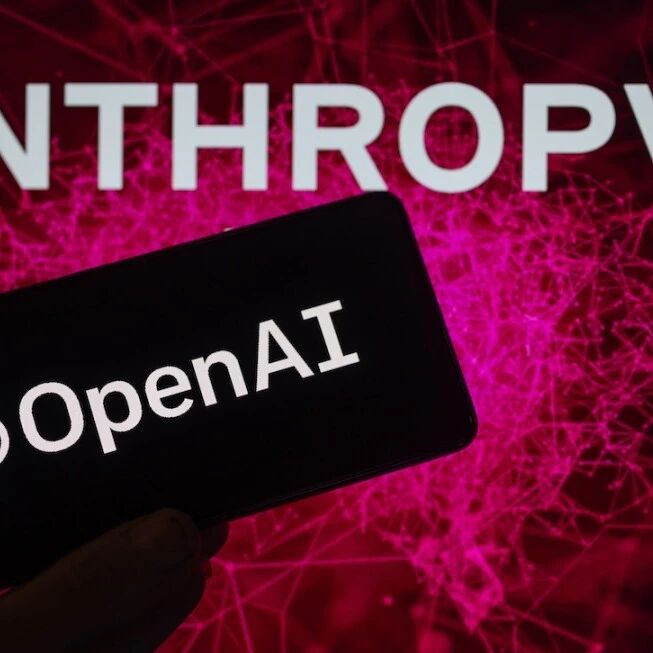
Core Viewpoint - The CEO of Anthropic, Dario Amodei, warns that some AI companies, like OpenAI, are taking excessive risks due to massive investments in infrastructure, reflecting a growing concern within the industry about the uncertainty between high costs and potential returns [1][3][4] Investment Dilemma: Cost vs. Value Uncertainty - Amodei emphasizes that building advanced AI systems requires significant and time-consuming infrastructure investments, with the timeline and feasibility of returns from AI applications remaining uncertain [4][5] - This uncertainty creates a "real dilemma" for the industry, positioning Anthropic as a more cautious participant compared to the aggressive strategies of other companies [4][6] Intensifying Competition: AI Spending Race - Amodei's cautious stance comes amid a fierce spending competition in the AI sector, with major players like Meta, OpenAI, and Alphabet's Google significantly increasing investments in computational infrastructure [5][6] - OpenAI's reported plan to invest $1.4 trillion is particularly noteworthy and has sparked discussions about a potential "AI bubble" [6][7] Alternative Path: Anthropic's Cautious Expansion - In contrast to competitors' trillion-dollar bets, Anthropic is also expanding but at a more restrained scale, announcing a $50 billion investment in building its first customized data centers across the U.S. [7] - This approach reflects a different risk appetite, as Anthropic aims to be a "more responsible AI steward" and focuses primarily on enterprise clients rather than the consumer market [7][8]
券商首席分析师热议“AI泡沫”:产业全面泡沫化言之过早 下游应用环节投资机会最多
证券时报· 2025-12-04 01:06
Core Viewpoint - The AI sector is experiencing a shift in market sentiment, with concerns about potential "AI bubble" emerging as prominent investors express skepticism about the profitability of AI investments [1][3][4]. Market Sentiment and Concerns - Influential investors like Michael Burry have raised alarms about inflated profits in major tech companies due to accounting practices, leading to increased market anxiety [1][3]. - Bridgewater Associates has significantly reduced its holdings in AI stocks, including Nvidia, indicating a cautious stance among institutional investors [1][3]. - The AI industry's capital expenditures are projected to reach $1.4 trillion from 2025 to 2027, with over $400 billion expected in 2025, yet nearly 80% of companies deploying AI have not seen profit increases, raising questions about ROI [4][6]. Current State of the AI Industry - Analysts generally agree that the AI industry has not yet reached a bubble stage, citing strong fundamentals and the self-sustaining nature of major players' capital expenditures [7][8]. - Major cloud service providers (CSPs) are primarily funding their capital expenditures through their profits, with no significant deterioration in cash flow or debt ratios observed [7][8]. - The commercial model for AI is evolving, with rapid growth in revenue for model providers like OpenAI, which is expected to reach $13 billion this year [7][8]. Investment Opportunities - The downstream application segment is viewed as the most undervalued yet potentially high-return area, with significant growth expected in sectors like finance, manufacturing, and healthcare [10][11]. - As hardware capacity increases and costs decrease, the investment attractiveness of downstream applications is expected to rise, creating new demand scenarios across various industries [12]. - The AI industry is anticipated to maintain a sustainable economic model, with each segment of the value chain supported by long-term logic, despite some segments reflecting future growth expectations [12].

“阴阳”OpenAI?Anthropic CEO:一些AI公司承担过大风险
Hua Er Jie Jian Wen· 2025-12-04 00:25
Core Insights - Dario Amodei, CEO of AI startup Anthropic, warns that some tech companies are taking excessive risks in AI investments, implicitly criticizing competitors like OpenAI for their massive spending [1][2] - The AI industry is facing a "real dilemma" regarding the high costs of infrastructure investments versus the uncertainty of how quickly AI technology can generate economic value [2][3] Investment Dilemma: Cost vs. Value Uncertainty - Amodei emphasizes that building advanced AI systems requires significant and time-consuming infrastructure investments, with the timeline for returns on these investments remaining uncertain [2] - This uncertainty creates a "real dilemma" for the industry, positioning Anthropic as a more cautious player compared to its aggressive competitors [2] Intensifying Competition: AI Spending Race - Amodei's cautious stance comes amid a fierce spending race in the AI sector, with major players like Meta, OpenAI, and Google significantly increasing their investments in computational infrastructure [3] - OpenAI's reported plan to invest $1.4 trillion is particularly noteworthy, raising concerns about a potential "AI bubble" and whether such massive capital expenditures can lead to sustainable business models and profits [3] Alternative Approach: Anthropic's Cautious Expansion - In contrast to competitors' trillion-dollar bets, Anthropic is expanding more conservatively, recently announcing a $50 billion investment to build customized data centers across the U.S. [4] - This figure, while substantial, reflects a different risk appetite compared to OpenAI's plans, and Anthropic aims to be a "more responsible AI steward" focusing on enterprise clients rather than direct consumer markets [4] - The company raised $13 billion in a funding round in September, achieving a valuation of $183 billion, indicating that its prudent expansion strategy is recognized by the capital markets [4]
AI工具盈利能力遭质疑 Snowflake(SNOW.US)弱指引引发股价跳水
Zhi Tong Cai Jing· 2025-12-03 23:33
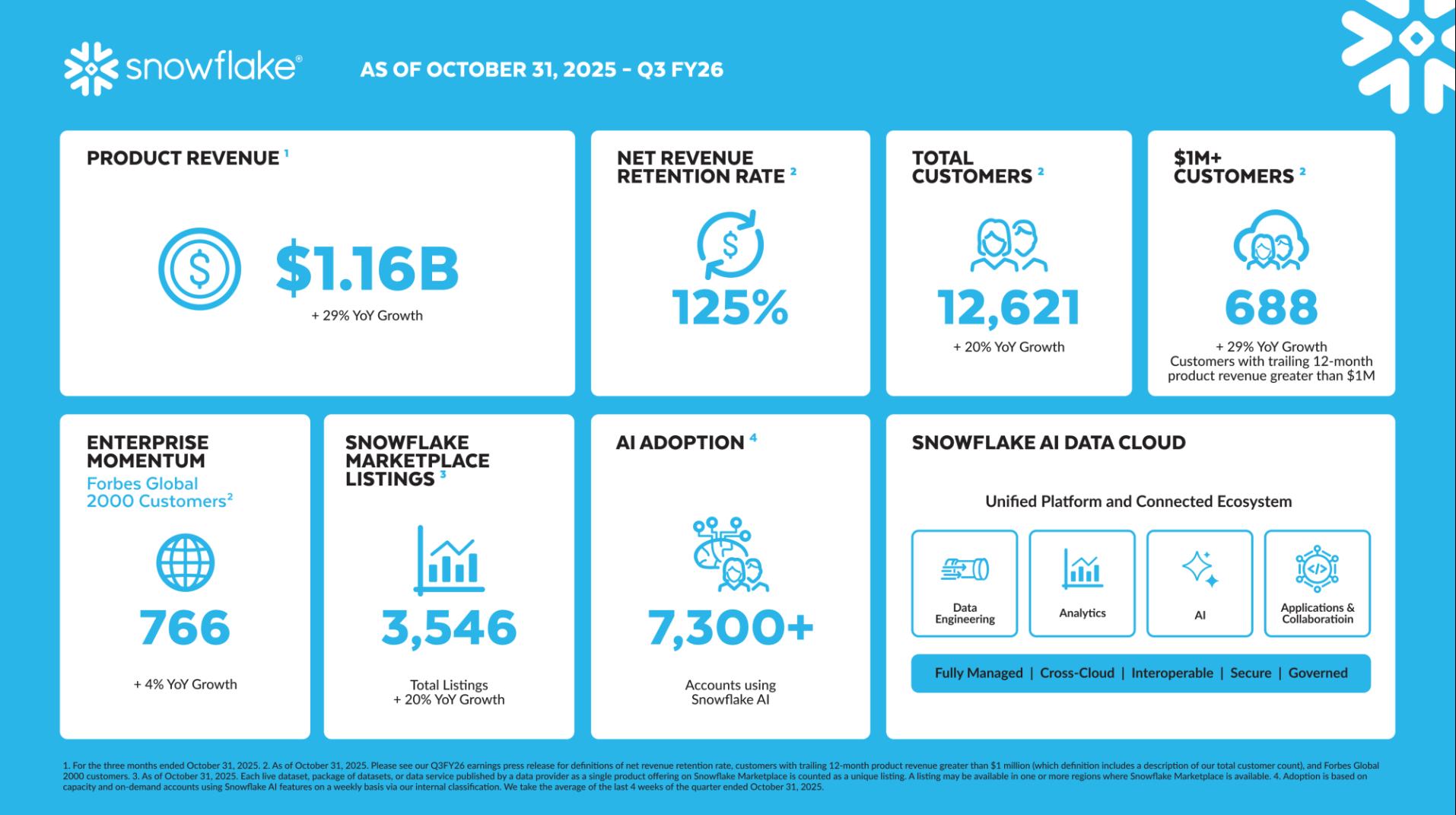
Core Viewpoint - Snowflake reported better-than-expected Q3 earnings, but provided a lower-than-expected operating margin outlook, raising concerns about the profitability of its new AI tools, leading to a post-earnings stock decline [1][3]. Financial Performance - For Q3 ending October 31, Snowflake's revenue was $1.21 billion, exceeding analyst expectations of $1.18 billion. Product revenue grew 29% year-over-year to $1.16 billion, accounting for 95% of total revenue, surpassing the expected $1.14 billion [1]. - Remaining performance obligations increased by 37% to $7.88 billion, higher than the forecasted $7.23 billion. Adjusted earnings per share were $0.35, above the expected $0.31 [1]. Future Outlook - For Q4, the company expects an adjusted operating margin of approximately 7%, below the analyst average estimate of 8.5%. Product revenue is projected to be between $1.195 billion and $1.2 billion, reflecting a 27% year-over-year growth, only slightly above the average expectation of $1.19 billion [3]. - Analysts had anticipated a growth rate exceeding 30%, which may be realized in the next quarter, potentially driving stock prices higher [3]. Market Reaction - Following the earnings report, Snowflake's stock fell over 9% in after-hours trading but recovered some losses after announcing a $200 million partnership with Anthropic to integrate its Claude AI model into Snowflake's platform [3]. - Year-to-date, the stock has risen by 72% [3]. Competitive Landscape - Snowflake faces increasing competition, particularly from Databricks, which is reportedly negotiating a new funding round that could value it over $130 billion, significantly higher than Snowflake's market cap of $89.7 billion at the time of the report [4][5]. - Despite concerns about competition, some analysts believe Snowflake is well-positioned in the current software industry environment, with limited threats from Databricks [5].