生成式人工智能

Search documents
山东:一根纱线“织出”17亿元海外市场
Yang Shi Wang· 2025-11-05 07:02
Core Viewpoint - The article highlights the transformation of the traditional textile industry in Shandong, China, through technological upgrades and innovations, leading to significant market expansion and environmental benefits. Group 1: Market Expansion - A textile company in Shandong secured a contract worth 130 million yuan for wax cloth exports to Africa, achieving a market share of over 70% in the high-end wax cloth segment after entering the Nigerian market in 2008 [1][2] - The company invested 50 million yuan to improve wax dyeing technology, resulting in the development of a preferred wax pattern for African customers, leading to annual sales of 1.7 billion yuan for wax cloth products across 23 African countries [2][3] Group 2: Environmental Sustainability - The company utilizes waste textile materials to produce logistics pallets, contributing to a circular economy and reducing waste [3][4] - By recycling 1 ton of waste textiles, the company saves 0.5 tons of standard coal and reduces carbon dioxide emissions by 1.6 tons, aligning with global trends in emission control [4] Group 3: Technological Innovation - The introduction of smart digital color spinning technology allows for the production of colorful fabrics without traditional dyeing processes, achieving a 67% reduction in water usage [5] - The company has established a generative AI technology platform for design, producing nearly 100,000 original design patterns within a year [5][6] - Over 90% of textile companies in Shandong have undergone digital transformation, creating several national-level design demonstration parks and industrial clusters [6]
贲圣林:中国以外还有近70亿人口 金融科技出海市场足够大
Zhong Guo Jing Ying Bao· 2025-11-04 14:16
中经记者 许璐 李晖 北京报道 全球金融科技领域竞争不断加剧,金融科技产业作为城市经济发展的重要增长极,其产业集聚区的发展 态势备受关注。 以人口结构为例,日本受老龄化影响,在新技术接受度上相对滞后。而在科研投入方面,中国整体水平 已较高,其中浙江科研经费占GDP比重已经超过3%,北京更是凭借中国科学院、重点高校及中关村等 科创园区的集聚优势,长期保持领先地位。这些科研力量为科技创新和成果转化提供了重要支撑。 "如果当年没有淘宝,支付宝不可能成长得如此迅速。以消费端为例,中国在To C数字经济领域的创新 能力被认为无与伦比。相比之下,To B端的数智化仍存在进一步提升空间,未来仍有较大潜力可释 放。"他表示。 此外,贲圣林认为,中国公司学习能力很强,在学习后又能够反向输出优秀实践。目前,包含支付宝在 内的多项中国金融科技模式已成功走向东南亚等海外市场。 全球城市金融科技发展区域,正出现两极分化特征。对于缩小这类差距,激发城市金融科技活力,贲圣 林认为,一个健康的创新生态必须具备多样性与包容性。现有指标体系中既包含宏观经济与人口结构, 也衡量科研强度等因素。 差异化是破题的关键 记者注意到,《报告》中发布的全国 ...
UberQ3总预订额大增21%,营业利润不及预期,盘前跌超4%|财报见闻
Hua Er Jie Jian Wen· 2025-11-04 13:45
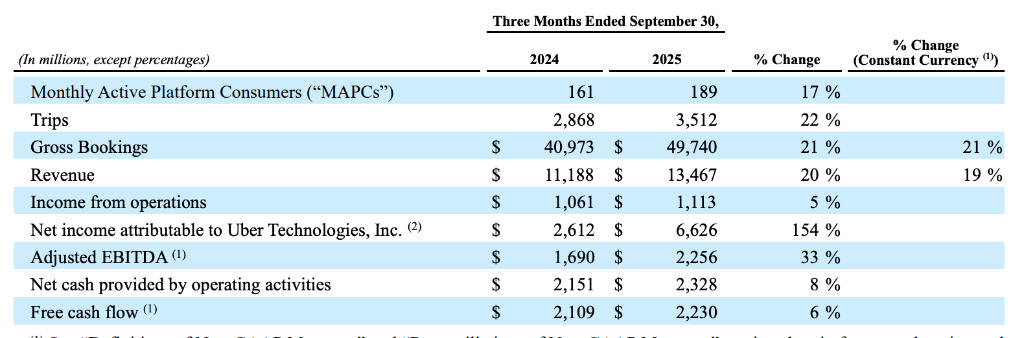
Core Viewpoint - Uber's Q3 financial results showed strong operational metrics despite lower-than-expected profitability, with total bookings reaching $49.7 billion, a year-over-year increase of over 20%, marking the largest growth in 2023 [1][4] Financial Performance - For the three months ended September 30, 2023, Uber reported: - Revenue of $13.467 billion, a 20% increase year-over-year [2] - Net income attributable to Uber Technologies, Inc. of $6.626 billion, a 154% increase [2] - Adjusted EBITDA of $2.256 billion, up 33% [2] - Monthly Active Platform Consumers (MAPCs) increased by 17% to 189 million [2][8] - Total trips increased by 22% to 3.512 billion [2] Business Growth and Challenges - Total bookings for Q3 reached $49.7 billion, driven by strong demand in both ride-hailing and delivery services, reflecting a significant rebound in overall travel activity [4] - The company provided a broad Q4 guidance, projecting total bookings between $52.25 billion and $53.75 billion, which is lower than the 22% growth seen in Q3 [3] - The delivery business saw adjusted EBITDA surge by 47% to $921 million, outpacing the mobility business's 21% growth [5] - Freight business remained stagnant with total bookings flat at $1.3 billion and an adjusted EBITDA loss of $20 million [5][8] Strategic Focus - CEO Dara Khosrowshahi outlined six strategic growth areas, including expanding ride-hailing and delivery services, developing a mixed platform of human and autonomous vehicles, and leveraging generative AI [6] - The company has divested approximately $1.4 billion from its $10.3 billion investments in other companies to prioritize these strategic initiatives [6] Market Reaction - Following the earnings report, Uber's stock price fell over 4% to $99.72 per share, despite a year-to-date increase of over 57% [6]

恒指公司与数码港合作推动于指数计算中应用生成式人工智能
Zhi Tong Cai Jing· 2025-11-04 10:44
Core Insights - The Hang Seng Index Company and Cyberport have successfully launched the first generative AI application based on the "Index Innovation Lab" to enhance index calculation efficiency [1] - The generative AI solution is currently applied to the calculation of the Hang Seng Index series, including the Hang Seng Index, Hang Seng China Enterprises Index, and Hang Seng Tech Index [1] Group 1 - The collaboration between Hang Seng Bank and Cyberport established the "Index Innovation Lab" in 2024, focusing on improving data processing efficiency through generative AI technology [1] - The Hang Seng Index Company collaborates with over 200 innovative institutions within the Cyberport community to develop practical solutions for enhancing index calculation efficiency [1] - The generative AI solution assists in calculating the circulation adjustment factor, improving the efficiency of determining the publicly tradable shares of listed companies [1] Group 2 - The Executive Chairman of the Hang Seng Index Company expressed satisfaction in introducing generative AI into index operations, reinforcing the company's commitment to innovation and enhancing market transparency and liquidity [2] - The Chairman of Cyberport highlighted the transformative power of AI in improving efficiency and driving innovation, emphasizing the collaboration's role in fostering growth for local startups and enhancing Hong Kong's status as an international financial and innovation center [2]
上海新增8款已完成备案的生成式人工智能服务,中经社行业洞察AI助手在列
Xin Hua Cai Jing· 2025-11-03 13:54
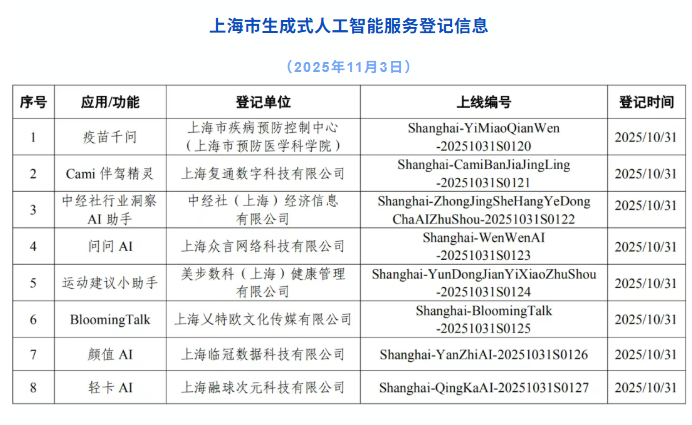
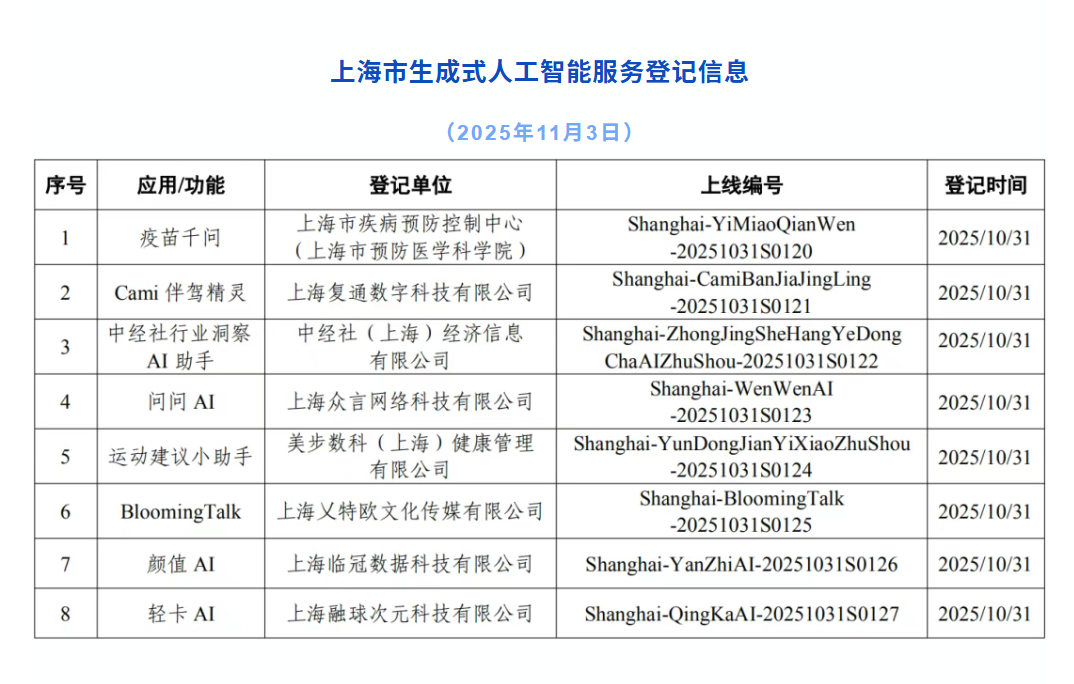
Core Viewpoint - As of October 31, Shanghai has registered 8 new generative artificial intelligence services, bringing the total to 127 registered services in the city [1][6]. Group 1: New Registrations - Eight new generative AI services have been registered, including the "Industry Insight AI Assistant" from Zhongjing Society [2][4]. - The newly registered services include applications such as "Vaccine Q&A," "Cami Driving Assistant," "Ask AI," "Sports Suggestion Assistant," "BloomingTalk," "Beauty AI," and "Light Truck AI" [4]. Group 2: Registration Details - The registration details for the new services include: 1. Vaccine Q&A - Shanghai Disease Prevention and Control Center, registered on October 31, 2025 2. Cami Driving Assistant - Shanghai Futong Digital Technology Co., Ltd., registered on October 31, 2025 3. Industry Insight AI Assistant - Zhongjing Society (Shanghai) Economic Information Co., Ltd., registered on October 31, 2025 4. Ask AI - Shanghai Zhongyan Network Technology Co., Ltd., registered on October 31, 2025 5. Sports Suggestion Assistant - Meibu Technology (Shanghai) Health Management Co., Ltd., registered on October 31, 2025 6. BloomingTalk - Shanghai Yiteou Cultural Media Co., Ltd., registered on October 31, 2025 7. Beauty AI - Shanghai Linguan Data Technology Co., Ltd., registered on October 31, 2025 8. Light Truck AI - Shanghai Rongqiu Dimension Technology Co., Ltd., registered on October 31, 2025 [4].
上海新增8款已完成登记的生成式人工智能服务
Di Yi Cai Jing· 2025-11-03 09:05
(文章来源:第一财经) 据"网信上海"公众号消息,截至10月31日,上海市新增8款已完成登记的生成式人工智能服务,累计已完成127款生成式人工智能服务登记。 | 序号 | 应用/功能 | 登记单位 | 上线编号 | 登记时间 | | --- | --- | --- | --- | --- | | 1 | 疫苗千问 | 上海市疾病预防控制中心 | Shanghai-YiMiaoOianWen | 2025/10/31 | | | | (上海市预防医学科学院) | -20251031S0120 | | | 2 | Cami 伴驾精灵 | 上海复通数字科技有限公司 | Shanghai-CamiBanJiaJingLing -20251031S0121 | 2025/10/31 | | 3 | 中经社行业洞察 | 中经社(上海)经济信息 | Shanghai-ZhongJingSheHangYeDong | 2025/10/31 | | | AI 助手 | 有限公司 | ChaAIZhuShou-20251031S0122 | | | 4 | 问问 AI | 上海众言网络科技有限公司 | Shanghai-WenW ...
谷歌 CEO 皮查伊:下一代 AI 模型Gemini 3 计划于今年发布
Huan Qiu Wang Zi Xun· 2025-11-03 05:06
Core Insights - Google is preparing to launch its next-generation AI model, Gemini 3, expected to be released in 2025, which aims to surpass Gemini 2.5 Pro and narrow the gap with OpenAI's GPT-5 [1] - CEO Sundar Pichai emphasized that while improvements in AI models are accelerating, significant breakthroughs will take time, indicating a gradual evolution rather than immediate results [1] - Gemini has become central to Google's AI strategy, with Alphabet's quarterly revenue projected to exceed $100 billion for the first time in Q3 2025, marking the official entry into the generative AI era [1] User Engagement - Gemini currently boasts over 650 million monthly active users, with query volume doubling compared to the previous quarter [2] - Despite this growth, Gemini still trails behind ChatGPT, which has reported 800 million weekly active users [2]

国企业指数跌1.91%。医药股逆势走
Xin Yong An Guo Ji Zheng Quan· 2025-11-03 02:31
Market Performance - A-shares collectively retreated, with the Shanghai Composite Index closing down 0.81% at 3954.79 points, the Shenzhen Component down 1.14%, and the ChiNext Index down 2.31%[1] - The Hong Kong Hang Seng Index fell 1.43% to 25906.65 points, with the Hang Seng Tech Index down 2.37% and the Hang Seng China Enterprises Index down 1.91%[1] - The total market turnover in Hong Kong decreased to 257.613 billion HKD[1] Economic Indicators - In October, the sales revenue of China's top 100 real estate companies dropped by over 41.9% year-on-year, amounting to 253 billion RMB (approximately 35.6 billion USD)[12] - The U.S. stock indices showed slight gains, with the Dow Jones up 0.09%, S&P 500 up 0.26%, and Nasdaq up 0.61%[1] Trade Relations - U.S. President Trump indicated willingness to eliminate all tariffs related to fentanyl if China takes strict measures against its export[12] - The EU is reportedly considering a new trade measure called "physical tariffs" to ensure the supply of critical raw materials from China[12] Sector Performance - Energy and metals sectors showed gains, while pharmaceutical stocks performed strongly against the market trend[1] - The overall decline in the real estate sector reflects ongoing challenges in the Chinese housing market, which has been struggling for over four years[12]




马斯克最新预言:未来5-6年传统手机与App将消失
Mei Ri Jing Ji Xin Wen· 2025-11-02 06:57
Core Viewpoint - Elon Musk predicts a radical future where traditional smartphones and apps will disappear within the next 5-6 years, with most content consumed by humans being AI-generated [1][3]. Group 1: Future of Technology - Musk envisions a future without operating systems or apps, where devices will merely display pixels and produce sound, predicting user preferences and generating content in real-time [3]. - He describes the future device as an AI inference edge node, equipped with radio modules for connectivity, communicating with server-side AI to generate desired content [3]. - Musk anticipates that AI will surpass individual human intelligence by 2026 and exceed the collective intelligence of humanity by 2030, driven by projects like Neuralink and xAI [4]. Group 2: Impact on Employment - Musk states that jobs involving email processing and customer service are rapidly disappearing, while programming and content creation will be largely replaced within 1-2 years [3]. - He notes that physical labor jobs, such as welding and cooking, will persist longer but will eventually be replaced by robots [3]. Group 3: Innovations in AI and Devices - OpenAI has entered the hardware space by recruiting legendary designer Jony Ive to create a series of smart devices centered around generative AI [5]. - The prototypes developed by Ive's team are pocket-sized devices capable of running custom AI models locally while utilizing cloud computing for complex tasks, aiming to become the "third core device" after laptops and smartphones [6]. - Alibaba's CEO also emphasizes that natural language will become the source code of the AI era, allowing users to create their own agents simply by expressing their needs in their native language [6].


马斯克,最新预测!
证券时报· 2025-11-02 05:07
Group 1 - Elon Musk predicts that within the next five to six years, all digital content consumed by humans will be generated by AI [1] - Musk envisions future smartphones as edge nodes for AI reasoning, eliminating the need for operating systems or applications, with devices serving merely as display and audio terminals [1] - The AI on personal devices will be capable of generating any required tool or application in one to two seconds, enhancing user experience significantly [1] Group 2 - OpenAI is developing a new smart device framework, with a team led by legendary Apple designer Jony Ive, aiming to make generative AI applications more accessible [2] - The new device, pocket-sized and AI-centric, will run custom AI models locally while utilizing cloud computing for complex tasks, positioning itself as a "third core device" after laptops and smartphones [2] - Alibaba's CEO also supports the idea that natural language will become the source code of the AI era, allowing users to create their own agents simply by inputting their needs in their native language [2] Group 3 - The emergence of large models is expected to revolutionize software development, allowing anyone to create an unlimited number of applications using natural language [3] - The potential developer base is projected to expand from millions to billions, as large models will enable end-users to meet their needs without the traditional costs associated with software development [3]