
绿色转型

Search documents
中石化中航油重组的战略考量
Jing Ji Ri Bao· 2026-01-14 21:59
Core Viewpoint - The restructuring of China Petroleum & Chemical Corporation (Sinopec) and China National Aviation Fuel Group (CNAF) marks a significant event in the context of state-owned enterprise (SOE) reforms, aimed at enhancing energy security and seizing opportunities in green transformation amidst complex international circumstances [1] Group 1: Impact on Aviation Fuel Industry - The restructuring is expected to enhance the competitiveness of the aviation fuel industry, as the global energy landscape is undergoing unprecedented changes, with a shift towards clean energy and ongoing geopolitical conflicts affecting energy supply chains [1] - The integration of Sinopec's upstream refining capabilities with CNAF's logistics and supply network creates a complete industrial chain from crude oil refining to airport fueling, addressing the historical separation of production and sales in China's aviation fuel sector [2] Group 2: Green Transition in Aviation - The restructuring supports the green transition in the aviation sector, which is under significant pressure to reduce carbon emissions, with Sustainable Aviation Fuel (SAF) recognized as a key pathway for low-carbon development [2][3] - Sinopec's leadership in SAF technology and production, combined with CNAF's control over airport storage and fueling systems, facilitates the market entry of SAF, potentially lowering development costs and accelerating its large-scale application [3] Group 3: Economic and Stable Fuel Supply - The restructuring aims to create a more stable and economical aviation fuel supply by reducing the fragmented supply chain, which has historically made prices vulnerable to international market fluctuations [3] - By internalizing transactions and optimizing resource allocation, the restructuring is expected to stabilize fuel prices, making travel costs more manageable for consumers and alleviating financial pressures on airlines [3] Group 4: Strategic Importance and Challenges - The restructuring enhances domestic aviation fuel security, ensuring stable supply even in extreme international situations, which is crucial for national emergency response and defense transportation [3] - However, the success of the restructuring depends on achieving deep integration between the two large SOEs, addressing differences in values and management styles, and ensuring that the benefits of scale do not lead to monopolistic practices [4]

深化改革驱动转型 多元布局擘画蓝图
Xin Lang Cai Jing· 2026-01-14 20:45
Core Viewpoint - Inner Mongolia Transportation Group has undergone significant reforms and strategic initiatives since its restructuring in June 2023, aiming to become a leading comprehensive and international modern transportation enterprise in China. Group 1: Reform and Governance - The company emphasizes deepening state-owned enterprise reforms to enhance core competitiveness and market vitality, focusing on modern enterprise systems and market-oriented operational mechanisms [5][6] - A scientific and standardized governance system has been established, integrating party leadership into all governance aspects, which has improved decision-making processes [5] - The implementation of a performance-based management system has motivated employees and led to significant operational improvements, including the acquisition of top-level qualifications in highway engineering [6] Group 2: Infrastructure Development - During the 14th Five-Year Plan, the company has invested 57 billion yuan in 23 highway projects, constructing 2,356 kilometers of roads to support the region's transportation network [7] - Major projects like the G65 Baomao Expressway and G5511 Jiala Expressway have been completed, showcasing the company's commitment to high-quality infrastructure [7] Group 3: Technological Innovation - The company has invested 1.57 billion yuan in R&D during the 14th Five-Year Plan, resulting in the establishment of national and regional innovation platforms and numerous patents [8] - Continuous improvement in service quality has been achieved through increased maintenance funding and the implementation of speed adjustment projects [9] Group 4: Green Transition - The company is focusing on developing renewable energy as part of its strategy to meet carbon neutrality goals, establishing a comprehensive green industry matrix [10] - The "Mengma Charging" brand has rapidly developed, with 7,260 charging facilities built, enhancing the infrastructure for electric vehicles in the region [10][11] Group 5: Market Expansion - The company has actively pursued market expansion, participating in the Belt and Road Initiative and increasing its project contracts significantly, with a 236.79% increase in signed contracts compared to the previous year [13][14] - It has established a digital logistics platform, "Mengma Smart Transport," which has seen substantial growth in user engagement and transaction volume [15] Group 6: Future Outlook - Looking ahead to the 15th Five-Year Plan, the company aims to solidify its role as a key player in transportation infrastructure investment and comprehensive service provision, aligning with national development goals [16]


2025年我国外贸规模再创新高
Shang Hai Zheng Quan Bao· 2026-01-14 17:51
Core Viewpoint - China's foreign trade is showing resilience and growth, with significant increases in exports and imports across various sectors, driven by green technology and diversified trade partnerships [1][2][3]. Group 1: Export Growth - By 2025, China's exports of lithium batteries and wind turbines are expected to grow by 26.2% and 48.7% respectively [1]. - In the green transportation sector, exports of electric motorcycles and bicycles are projected to increase by 18.1%, while electric locomotives are expected to rise by 27.1% [1]. - Exports of industrial gas purification devices are anticipated to grow by 17.3%, and electric forklifts by 5.2% [1]. Group 2: Import Trends - China's imports are projected to reach 18.48 trillion yuan by 2025, marking a historical high and maintaining its position as the world's second-largest import market for 17 consecutive years [1]. - Import growth has been steady, with a 4.4% increase in December, following seven months of year-on-year growth [1]. Group 3: Trade Diversification - China's foreign trade is becoming more diversified, with over 60% of countries and regions across all continents experiencing growth in trade with China [2]. - The share of China's top ten trading partners in total foreign trade has decreased to 47.7%, indicating a more balanced trade landscape [2]. Group 4: Belt and Road Initiative - In 2025, trade with Belt and Road Initiative countries is expected to reach 23.6 trillion yuan, a 6.3% increase, surpassing the overall foreign trade growth rate by 2.5 percentage points [2]. - The proportion of trade with Belt and Road partners in China's overall foreign trade is projected to rise to 51.9% [2]. Group 5: Business Vitality - In 2025, private enterprises are expected to continue driving foreign trade, with imports and exports reaching 26.04 trillion yuan, a 7.1% increase [4]. - Over 90% of surveyed multinational companies plan to continue investing in China, reflecting strong foreign confidence in the market [4]. Group 6: Future Outlook - For 2026, foreign trade is anticipated to exhibit a "stable quantity, improved quality" trend, with a focus on high-end equipment and green energy exports [5]. - The global trade environment is expected to improve, with increased demand driven by global monetary and fiscal easing [6].
绿电赋能项目兴 滨州产业向新行
Xin Lang Cai Jing· 2026-01-14 15:33
Core Viewpoint - Binzhou City is committed to achieving carbon peak and carbon neutrality goals, focusing on green and low-carbon high-quality development, with significant advancements in renewable energy and industrial transformation by 2025 [1][10]. Group 1: Renewable Energy Development - By the end of 2025, the total installed capacity of renewable energy in Binzhou is expected to reach 10.05 million kilowatts, tripling from the end of 2020, thus exceeding the "10 million kilowatt" target ahead of schedule [2]. - The city is developing a 21.18 million kilowatt integrated wind-solar-storage project in the northern coastal saline-alkali land, which will convert 1.29 million acres of previously barren land into a green energy hub, supplying 13.5 billion kilowatt-hours of green electricity annually [2][3]. - The city has implemented a total of over 5 million kilowatts of shared energy storage projects to stabilize green electricity supply and enhance local consumption [3]. Group 2: Energy Structure Optimization - The proportion of renewable energy in Binzhou's total power generation capacity has exceeded one-third, an increase of 21 percentage points since 2020, marking a significant shift towards cleaner energy sources [5]. - The city has completed the construction of six clean and efficient coal power units totaling 2.51 million kilowatts while shutting down 32 outdated coal power units totaling 1.235 million kilowatts [5]. Group 3: Innovative Development Models - Binzhou is addressing challenges in renewable energy integration by advancing integrated projects that combine generation, storage, and consumption, aiming for high-level energy consumption and deep industrial coupling [7]. - The city has launched the Huaneng Binzhou New Energy 850,000 kilowatt photovoltaic project, which is a benchmark for future renewable energy projects [7][8]. Group 4: Industrial Integration and Growth - The city is fostering deep integration between renewable energy and traditional industries, enabling sectors like aluminum production to transition to green energy, exemplified by the 2GW fish-solar complementary project [9]. - By 2025, the new energy and new materials industry cluster in Binzhou is projected to exceed 100 billion yuan in revenue, with a complete supply chain for battery materials and significant production capacities in various sectors [9][10]. Group 5: Future Goals and Vision - Binzhou aims to establish itself as a significant hub for new energy economic development, targeting an additional 100 billion yuan in output value by 2030, with plans to expand the new energy and new materials industry scale to over 200 billion yuan [10].
【2025回顾·新科技新产品记】滨化集团科技创新引领环氧丙烷绿色转型 年节水超500万吨
Xin Lang Cai Jing· 2026-01-14 15:33
Core Viewpoint - The transformation driven by technological innovation at Binhu Chemical Group is shifting traditional chemical production from a "resource-consuming" model to a "green circular" paradigm, significantly reducing water consumption and waste generation in the production of propylene oxide [1][2]. Group 1: Technological Innovations - Binhu Chemical Group has developed a new process for producing propylene oxide that reduces fresh water consumption from approximately 40 tons to below 11 tons per ton of product, and decreases waste generation from 600 kilograms to under 90 kilograms [1]. - The company has created a new calcium-based saponification process that replaces traditional methods, leading to improved efficiency and reduced waste by utilizing high-activity calcium hydroxide powder and concentrating saponification residuals for reuse [2]. - The new process has been recognized as a significant technological breakthrough, achieving compliance with national policy requirements six months ahead of schedule and providing a replicable model for the industry [2]. Group 2: Economic Benefits - The implementation of the new process is projected to save over 5 million tons of fresh water annually, resulting in savings of approximately 8 million yuan in water fees and over 10 million yuan in waste disposal costs, alongside additional revenue from waste reuse [3]. - The reduction in production costs enhances the competitiveness of Binhu Chemical Group's products in high-end markets, contributing to overall economic benefits [3]. Group 3: Strategic Development - Binhu Chemical Group is committed to a "technology-driven" development strategy, focusing on innovation as a core competitive advantage, with 21 technological achievements recorded in the past year [3]. - The company has established a partnership with a research institute to focus on the development and industrialization of pharmaceutical intermediates and fine chemicals, further promoting the green and high-end transformation of the chemical industry in Shandong Province [3].

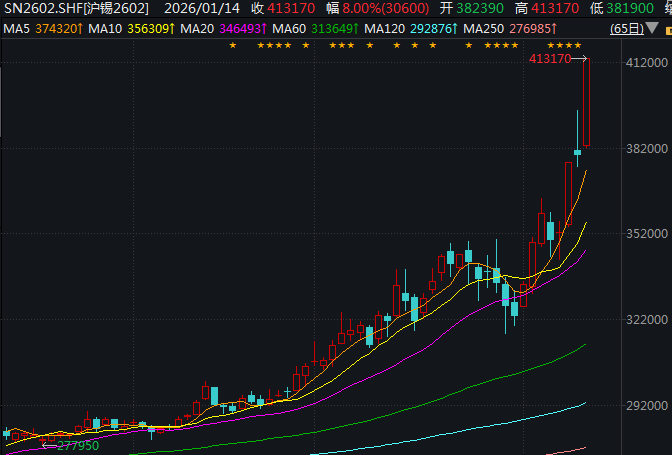
三天涨超20%!锡价大涨 影响几何?
Zheng Quan Shi Bao Wang· 2026-01-14 15:14
Core Viewpoint - The surge in tin prices is attributed to a combination of supply constraints, demand expectations, and macroeconomic factors, with the market reacting to lower-than-expected production resumption in Myanmar and strong demand forecasts from sectors like AI and renewable energy [1] Group 1: Tin Market Analysis - Tin prices have reached a historical high, with Mysteel reporting a daily increase of 7.6% to 412,000 yuan/ton [1] - The current market sentiment is characterized by a strong speculative interest, leading to a significant rise in futures prices, which in turn influences spot prices [2] - Despite the long-term positive outlook for demand in sectors like new energy and electronics, short-term purchasing demand is being suppressed by high prices, leading to cautious market behavior [2] Group 2: Copper and Aluminum Market Trends - The price of A00 aluminum reached a historical high of 24,330 yuan/ton, with a 4.38% increase from the beginning of January [3] - Domestic copper prices also saw significant increases, with 1 electrolytic copper reaching 103,185 yuan/ton, reflecting a year-on-year increase of 36.8% [3] - The aluminum market is facing supply constraints due to limited new capacity and production challenges, which are expected to support higher prices in the future [5] - The copper market is experiencing tight supply conditions, with expectations of a structural shortage and increasing demand from emerging industries such as electric vehicles and AI data centers [6]
水乡苏州城市污水集中收集处理率达87.7%
Xin Lang Cai Jing· 2026-01-14 13:25
Group 1 - During the "14th Five-Year Plan" period, Suzhou's air quality has improved, with PM2.5 annual average concentration and heavy pollution days maintained at good levels, and the proportion of water quality at national and provincial monitoring points reaching Grade III [1][3] - Suzhou has enhanced urban sewage treatment capacity by over 500,000 tons per day, achieving a centralized sewage collection rate of 87.7%, and completed the remediation of 116 enterprises to improve industrial wastewater treatment capacity by over 200,000 tons per day [3][4] - The city has implemented 176 lake governance projects and established a monitoring and early warning system for blue-green algae, restoring 13,000 acres of aquatic vegetation [3][4] Group 2 - Suzhou has initiated over 12,000 air pollution prevention projects, eliminated more than 46,000 diesel trucks that do not meet national standards, and completed ultra-low emission transformations in the steel industry [4][6] - The city has established a soil and groundwater monitoring information platform, promoting full lifecycle soil environmental management, and was recently selected as one of the "20 Cities Moving Towards 'Zero Waste'" by the UN Secretary-General's Advisory Committee [4][6] - In the "15th Five-Year Plan" period, Suzhou aims to synergize carbon reduction, pollution reduction, and green expansion, while modernizing its ecological environment governance system to achieve high-quality development and high-level protection [6]

每经热评|中欧电动汽车案破局 中企迎来价格承诺新考题
Xin Lang Cai Jing· 2026-01-14 12:26
Core Viewpoint - The negotiations between China and the EU regarding the electric vehicle anti-subsidy case have yielded positive results, allowing Chinese electric vehicle companies to submit price commitment applications to avoid high anti-subsidy taxes [1][2] Group 1: Impact on Companies - The EU's commitment to objectively and fairly review applications based on a non-discriminatory principle will enable eligible companies to replace anti-subsidy taxes, which range from 7.8% to 35.3%, thereby reducing export costs and mitigating risks of profit compression or market exit [1][2] - Companies are encouraged to actively adapt to the new rules, understanding the details to avoid potential risks, such as ensuring pricing does not exceed competitive levels or fall below review standards [3] - Firms should optimize operational processes by establishing detailed cost accounting systems for various export models and simplifying sales channels to enhance pricing transparency and reduce regulatory verification difficulties [3] Group 2: Industry Implications - The guidance document clarifies application processes and pricing standards, eliminating policy uncertainties and allowing companies to plan export strategies and long-term development clearly [1][4] - The resolution of the dispute is expected to foster deeper cooperation in market expansion and technological innovation within the electric vehicle industry, aligning with both parties' decarbonization goals [1][4] - The EU's review of Volkswagen's Chinese subsidiary's import quotas and price commitments in December 2025 will serve as a practical case for other companies, providing important references for compliance and operational standards [4]
中欧电动汽车案破局 中企迎来价格承诺新考题
Mei Ri Jing Ji Xin Wen· 2026-01-14 12:17
Group 1 - The negotiations between China and the EU regarding the anti-subsidy case for electric vehicles have yielded positive results, allowing Chinese electric vehicle companies to submit price commitment applications based on the newly released guidelines [1][2] - The European Commission has committed to an objective and fair review of the applications submitted by Chinese companies, which can replace high anti-subsidy tariffs (ranging from 7.8% to 35.3%) with price commitments, thus reducing export costs and mitigating risks of profit compression or market exit [1][2] - The guidelines clarify the application process and pricing standards, eliminating policy uncertainties and enabling companies to plan export strategies and long-term development more clearly, while also fostering collaboration across the electric vehicle industry chain [1][2] Group 2 - The achievement of this "soft landing" is significant, as the EU initiated an anti-subsidy investigation into Chinese electric vehicles in October 2023, leading to a five-year anti-subsidy tariff starting October 30, 2024, which cast a shadow over Chinese electric vehicle exports [2] - Chinese electric vehicle companies are encouraged to adapt proactively within the new regulatory framework, ensuring they understand the detailed rules to avoid potential risks, such as pricing too high or too low, and managing complex sales channels to prevent cross-subsidy issues [3] - Companies should optimize operational processes by establishing detailed cost accounting systems for various export models and simplifying sales channel structures to enhance pricing transparency and reduce regulatory verification difficulties [3] Group 3 - Companies heavily reliant on low-priced models need to reassess their local production strategies, as price commitments limit low-price competition, and local production in Europe can fundamentally avoid trade barriers while aligning with EU industrial policy [3] - The EU will review the import quotas and price commitments of Volkswagen's Chinese subsidiary by December 2025, serving as a practical case that will provide important references for subsequent companies [4] - The introduction of the guidelines creates valuable opportunities for the electric vehicle industry, marking a new starting point for companies to adapt to regulatory constraints and market competition, solidifying their development advantages in the European market [4]
2025年我国出口实现稳定增长 海关总署盘点三大突出表现
Zhong Guo Xin Wen Wang· 2026-01-14 09:23
Core Insights - China's exports reached 26.99 trillion yuan in 2025, marking a year-on-year growth of 6.1%, driven by quality improvements and innovation [1][2] Group 1: Innovation and Market Adaptation - High-tech product exports grew by 13.2% year-on-year, contributing 2.4 percentage points to overall export growth [1] - Exports of specialized equipment, high-end machine tools, and industrial robots increased by 20.6%, 21.5%, and 48.7% respectively, with industrial robots becoming a net export product for China [1] Group 2: Green Development - Exports in the green energy sector saw significant growth, with lithium batteries and wind turbine exports increasing by 26.2% and 48.7% respectively [2] - Electric motorcycles and bicycles experienced an 18.1% increase in exports, while electric locomotives grew by 27.1% [2] - Industrial gas purification equipment exports rose by 17.3%, and electric forklift exports increased by 5.2% [2] Group 3: Collaborative Growth - Trade in intermediate goods showed rapid growth, becoming a major driver of exports and supporting global industrial cooperation [2] - Exports to countries involved in the Belt and Road Initiative grew by 11.2%, contributing 5.4 percentage points to overall export growth [2] - ASEAN has remained China's largest export market for three consecutive years, with emerging markets in Latin America, the Middle East, Central Asia, and Africa showing faster export growth than the overall average [2]