
社会融资规模

Search documents
前7个月新增社融23.99万亿元 7月末M2余额同比增长8.8%
Zheng Quan Ri Bao· 2025-08-13 16:29
Group 1 - The core viewpoint of the articles indicates that the financial data for July shows a stable and supportive monetary environment for the real economy, with significant growth in social financing and money supply [1][2] - As of the end of July, the total social financing scale was 431.26 trillion yuan, reflecting a year-on-year growth of 9%, while the broad money (M2) balance reached 329.94 trillion yuan, growing by 8.8% [1][3] - The increase in loans, particularly in corporate and household sectors, demonstrates a solid support for the real economy, with a total loan balance of 268.51 trillion yuan, marking a 6.9% year-on-year increase [1][2] Group 2 - The acceleration in the issuance of government bonds has significantly contributed to the increase in social financing scale, aligning with a more proactive fiscal policy to support the economy [2] - The narrowing gap between M1 and M2 indicates improved liquidity and efficiency in the financial system, reflecting effective market stabilization policies and a recovery in economic activities [3] - The increase in M0, M1, and M2 balances suggests a positive trend in monetary circulation, with M0 growing by 11.8% year-on-year, M1 by 5.6%, and M2 by 8.8% [3]
前七月社融破23万亿元 信贷“小月”数据波动原因何在
Sou Hu Cai Jing· 2025-08-13 16:27
Core Viewpoint - The financial data for July shows a notable increase in broad money (M2) and social financing scale, indicating a robust credit environment despite seasonal fluctuations and structural adjustments in the economy [1][2][4]. Monetary Data Summary - As of the end of July, M2 balance reached 329.94 trillion yuan, with a year-on-year growth of 8.8%, up 0.5 percentage points from the previous month and 2.5 percentage points from the same period last year [1]. - The narrow money (M1) balance was 111.06 trillion yuan, growing by 5.6% year-on-year, an increase of 1 percentage point from the previous month [1]. - The total social financing scale stood at 431.26 trillion yuan, with a year-on-year growth of 9.0%, slightly up by 0.1 percentage points from the previous month [1]. Credit Growth Analysis - The increase in social financing scale for the first seven months of 2025 reached 23.99 trillion yuan, which is 5.12 trillion yuan more than the previous year [2]. - The fluctuation in credit data during June and July is attributed to seasonal factors, policy adjustments, and structural optimization [3][4]. - The impact of local government bond replacements has significantly influenced loan data, with an estimated 2.6 trillion yuan in refinancing special bonds affecting loan growth by approximately 1 percentage point [4]. Credit Structure Optimization - By the end of July, the balance of RMB loans was 268.51 trillion yuan, reflecting a year-on-year growth of 6.9%, which is notably higher than the nominal economic growth rate [5]. - The growth in loans for small and micro enterprises reached 35.05 trillion yuan, with an 11.8% year-on-year increase, while medium to long-term loans for the manufacturing sector grew by 8.5% [6]. Policy Coordination - The macroeconomic policy has been more proactive, with a significant increase in government bond issuance, which totaled 13.3 trillion yuan in the first half of the year, including 7.89 trillion yuan in national bonds [7]. - The government department's leverage ratio increased by 9 percentage points to 65.3%, while the leverage ratios for non-financial enterprises and households remained relatively stable [8]. - The ongoing fiscal policy aims to stimulate total demand and support economic recovery, which is expected to enhance credit demand and promote a positive cycle between finance and the real economy [8].
7月末中国社会融资规模存量同比增长9%
Zhong Guo Xin Wen Wang· 2025-08-13 16:23
Core Insights - The People's Bank of China reported that as of the end of July, the total social financing stock was 431.26 trillion yuan, reflecting a year-on-year growth of 9% [1] - The balance of RMB loans issued to the real economy reached 264.79 trillion yuan, with a year-on-year increase of 6.8% [1] - In the first seven months of this year, the cumulative increment of social financing was 23.99 trillion yuan, which is 5.12 trillion yuan more than the same period last year [1] Financing and Economic Impact - The increase in social financing in July was primarily supported by government bond financing, with a significant rise in the issuance of special bonds [1] - The issuance of government bonds in the first half of the year totaled 13.3 trillion yuan, with national bonds accounting for 7.89 trillion yuan, marking a 36% year-on-year increase [1] - The issuance of local special bonds aimed at replacing hidden debt reached approximately 1.8 trillion yuan [1] Future Outlook - Experts suggest that while government bond issuance may have a short-term substitutive effect on loans, sustained fiscal policy efforts will enhance total demand and stimulate incremental credit demand [2] - The expectation is that social financing will remain at a high level in August, continuing the trend observed in previous months [1]
7月信贷季节性波动,金融机构破除内卷式竞争“挤水分”
Sou Hu Cai Jing· 2025-08-13 15:43
Group 1 - The core viewpoint of the article highlights the acceleration of M2 growth and the sustained high level of social financing, indicating strong financial support for the real economy and effective coordination of monetary and fiscal policies [1][5][10] - As of the end of July 2025, the broad money (M2) balance reached 329.94 trillion yuan, with a year-on-year growth of 8.8%, reflecting a 0.5 percentage point increase from the previous month and a 2.5 percentage point increase from the same period last year [5] - The total social financing stock was 431.26 trillion yuan, with a year-on-year growth of 9%, indicating a robust financing environment for the real economy [5][10] Group 2 - The increase in social financing is primarily attributed to a favorable issuance pace of government bonds, with over 17 trillion yuan issued from January to July 2025, averaging a net increase of 1.27 trillion yuan per month [5][12] - Direct financing's share in the total social financing stock is gradually rising, reflecting an ongoing optimization of the financing structure in China [7][11] - The M1-M2 gap has narrowed to 3.2%, indicating an improvement in the liquidity and efficiency of fund circulation, which aligns with the trend of economic activity recovery [7][10] Group 3 - The RMB loan balance reached 268.51 trillion yuan by the end of July, with a year-on-year growth of 6.9%, although this growth rate has slowed down due to seasonal factors [8][10] - The balance of inclusive small and micro loans was 35.05 trillion yuan, growing by 11.8% year-on-year, while medium to long-term loans in the manufacturing sector reached 14.79 trillion yuan, with an 8.5% year-on-year growth [10][12] - The overall downward trend in bond issuance rates in July has stimulated corporate bond financing demand, with an increase of 755 billion yuan year-on-year [6][12] Group 4 - The article emphasizes the importance of observing broader indicators such as social financing scale and M2, rather than solely focusing on loan balances, to better understand the financial support for the real economy [9][11] - The shift towards direct financing and the diversification of corporate financing channels are seen as beneficial for meeting the varied financing needs of enterprises [7][11] - The ongoing efforts to improve local debt management and promote financing platform reforms are expected to enhance the efficiency of fund utilization and support economic activity [12][13]

7月金融数据出炉,融资成本持续下降
2 1 Shi Ji Jing Ji Bao Dao· 2025-08-13 14:28
Core Viewpoint - The financial statistics for July 2025 indicate a continued strong support from the financial sector to the real economy, with significant year-on-year growth in social financing scale, broad money (M2), and RMB loans, all exceeding economic growth rates [1][4]. Group 1: Financial Statistics - As of the end of July 2025, the social financing scale reached 431.26 trillion yuan, growing by 9% year-on-year, which is 0.1 percentage points higher than the previous month and 0.8 percentage points higher than the same period last year [4]. - The broad money (M2) balance was 329.94 trillion yuan, with a year-on-year increase of 8.8%, while the narrow money (M1) balance was 111.06 trillion yuan, growing by 5.6% [3]. - RMB loan balance stood at 268.51 trillion yuan, reflecting a year-on-year growth of 6.9% [7]. Group 2: Economic Context - The GDP growth rate for the first half of the year was 5.3%, which is an increase of 0.3 percentage points compared to the same period last year, supporting the reasonable growth of financial totals [1]. - The government has adopted a more proactive fiscal policy, with a significant increase in the issuance of government bonds, which has positively influenced the social financing scale and monetary credit [4]. Group 3: Market Dynamics - The M1-M2 growth rate difference has narrowed to 3.2 percentage points, indicating improved fund circulation efficiency and market confidence due to effective policies [3]. - The financing cost for loans has decreased, with new corporate loan rates around 3.2% and new personal housing loan rates around 3.1%, reflecting a more favorable lending environment [9]. Group 4: Sectoral Insights - The balance of inclusive small and micro loans reached 35.05 trillion yuan, growing by 11.8%, while medium to long-term loans for the manufacturing sector increased by 8.5% to 14.79 trillion yuan, both outpacing overall loan growth [9]. - Financial institutions are shifting focus from scale and growth to service quality and precision, enhancing the effectiveness of financial support to the real economy [8].

央行重磅数据 最新解读!
Zhong Guo Ji Jin Bao· 2025-08-13 14:26
Group 1 - The central bank's latest financial data indicates a moderately loose monetary policy, with social financing and broad money (M2) growing by 9% and 8.8% year-on-year, respectively, as of the end of July [1] - New personal housing loan rates are approximately 3.1%, while new corporate loan rates are around 3.2%, reflecting a decline of about 45 and 30 basis points compared to the same period last year [2] - The overall credit resource supply is abundant, and the financing needs of the real economy are being met, supported by various policy measures that enhance the interest rate mechanism [3] Group 2 - As of the end of July, the balance of RMB loans reached 268.51 trillion yuan, with a year-on-year growth of 6.9%, and a total increase of 12.87 trillion yuan in RMB loans over the first seven months [4] - The increase in loans to households and enterprises indicates a robust support for the real economy, with household loans increasing by 680.7 billion yuan and enterprise loans rising by 11.63 trillion yuan [4] - The social financing scale indicator, introduced by the central bank, provides a comprehensive view of financial growth, encompassing various financing channels beyond just loans [5] Group 3 - The new loan issuance metric is crucial as it reflects the actual lending and repayment activities of banks during the current period [6] - High loan issuance and repayment volumes can lead to stable loan balance growth, indicating that the effective financing needs of the economy are being adequately met [7]
7月金融数据出炉,融资成本持续下降
21世纪经济报道· 2025-08-13 14:16
Core Viewpoint - The financial statistics for July 2025 indicate a robust support from the financial sector to the real economy, with significant year-on-year growth in social financing, broad money (M2), and RMB loans, reflecting a stable economic development trend in China [1][4][5]. Group 1: Financial Indicators - As of the end of July 2025, the social financing scale reached 431.26 trillion yuan, growing by 9% year-on-year, which is 0.1 percentage points higher than the previous month and 0.8 percentage points higher than the same period last year [4][5]. - The broad money (M2) balance was 329.94 trillion yuan, with a year-on-year increase of 8.8%, while the narrow money (M1) balance was 111.06 trillion yuan, growing by 5.6% [4][5]. - The M1-M2 growth rate difference narrowed to 3.2 percentage points, indicating improved liquidity and efficiency in fund circulation [4][6]. Group 2: Loan Growth and Characteristics - The RMB loan balance stood at 268.51 trillion yuan, with a year-on-year growth of 6.9%, reflecting a stable support for the real economy despite seasonal fluctuations in loan demand [7][9]. - The growth in loans is influenced by structural economic transformations, increased direct financing, and the efficiency of special bonds, with estimates suggesting that debt replacement and risk management measures have significantly impacted loan growth [7][8]. - The balance of inclusive small and micro loans reached 35.05 trillion yuan, growing by 11.8%, while medium to long-term loans for the manufacturing sector increased by 8.5% [8]. Group 3: Financial Environment and Policy - The current monetary policy remains moderately accommodative, providing a suitable financial environment for the real economy, with a focus on social financing scale and M2 growth aligning with economic growth targets [5][6]. - The comprehensive financing cost has decreased, with new corporate loan rates around 3.2% and personal housing loan rates at approximately 3.1%, reflecting a more favorable lending environment [9].

新华财经晚报:我国对欧盟两家金融机构采取反制措施
Xin Hua Cai Jing· 2025-08-13 14:02
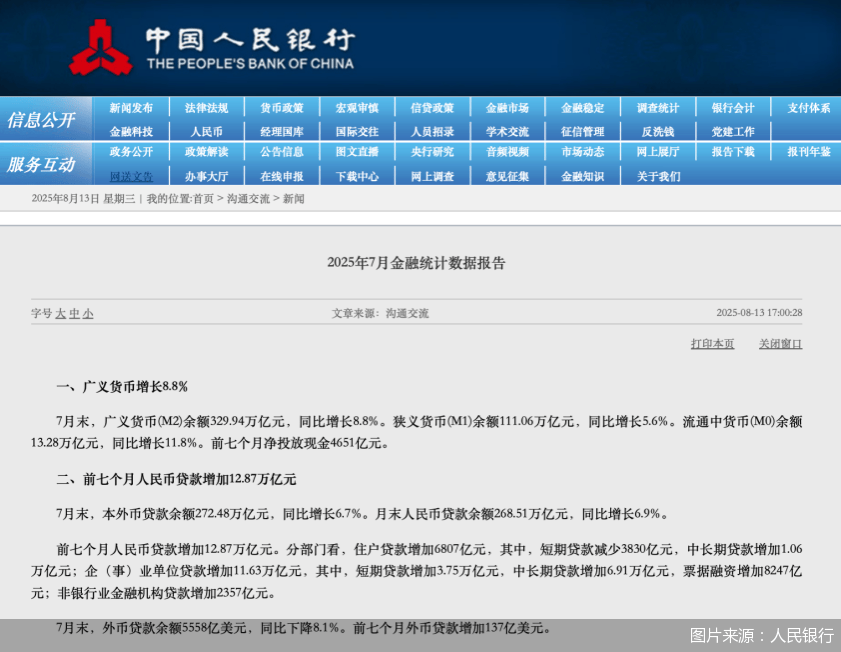
Domestic News - The People's Bank of China reported that as of the end of July, the broad money supply (M2) reached 329.94 trillion yuan, an increase of 8.8% year-on-year [1] - The narrow money supply (M1) was 111.06 trillion yuan, growing by 5.6% year-on-year, while the currency in circulation (M0) amounted to 13.28 trillion yuan, up 11.8% year-on-year [1] - The net cash injection in the first seven months was 465.1 billion yuan [1] - The total social financing stock was 431.26 trillion yuan as of July 2025, reflecting a year-on-year growth of 9% [1] - The increment in social financing for the first seven months was 2.399 trillion yuan, which is 512 billion yuan more than the same period last year [1] - The Ministry of Commerce announced countermeasures against two EU financial institutions, effective from August 13, 2025, prohibiting domestic organizations and individuals from engaging in transactions or cooperation with UAB Urbo Bankas and AB Mano Bankas [1] Investment and Economic Policies - The National Development and Reform Commission stated that 188 billion yuan in special bonds for equipment upgrades has been allocated, supporting approximately 8,400 projects across various sectors, leading to total investments exceeding 1 trillion yuan [2] - The Ministry of Finance highlighted new interest subsidy policies aimed at stimulating consumer spending and enhancing market vitality, suggesting that 1 yuan in interest subsidies could potentially mobilize 100 yuan in loan funds for consumer sectors [2] Market Regulation - The State Administration for Market Regulation reported that as of the end of July, 111,900 batches of beverage products were inspected, with a non-compliance rate of 0.57%, primarily due to microbial and quality standard issues [3]

新增社融连续8个月同比多增,金融支持实体经济力度较大
Xin Lang Cai Jing· 2025-08-13 13:06
Core Insights - The People's Bank of China reported that in the first seven months of this year, RMB loans increased by 12.87 trillion yuan, which is a decrease of 660 billion yuan compared to the same period last year [1] - The total social financing scale increased to 23.99 trillion yuan, which is an increase of 5.12 trillion yuan year-on-year [1] - In July, RMB loans decreased by 50 billion yuan, marking the first negative growth since August 2005 [1] - New social financing in July was 1.16 trillion yuan, an increase of 389.3 billion yuan year-on-year, continuing a trend of year-on-year growth for eight consecutive months [1] Group 1: Loan and Financing Trends - Analysts attribute the weak credit performance in July to factors such as overdraft effects, local government hidden debt replacement, and adjustments in the real estate market [1] - The loan balance at the end of July showed a year-on-year growth of 6.9%, significantly higher than the nominal economic growth rate, indicating stable support from credit to the real economy [1] - The average new loan amount for June and July combined was approximately 1.1 trillion yuan, which is consistent with the previous year's average of 1.2 trillion yuan, suggesting stable credit performance when smoothing out short-term effects [1][2] Group 2: Monetary Policy and Economic Support - The increase in social financing in July was primarily supported by government bond financing, indicating a significant scale of hidden debt replacement [2] - Analysts emphasize the importance of monitoring broader financial indicators such as social financing scale and M2, which provide a more comprehensive view of financial support for the real economy [2] - As of the end of July, M1 grew by 5.6% year-on-year, and M2 grew by 8.8%, both showing an acceleration in growth rates compared to the previous month [2] Group 3: Future Outlook and Policy Measures - Analysts expect that after the short-term disturbances from overdraft effects diminish, new credit in August will return to positive values, with social financing remaining at a high level [2][3] - The introduction of new personal consumption loan subsidies is anticipated to lower borrowing costs for residents, potentially stimulating credit demand [3] - The central bank's recent actions to lower interest rates on new corporate loans to approximately 3.2% and personal housing loans to about 3.1% reflect a commitment to maintaining a supportive monetary policy stance [3][4]
7月金融数据出炉:资金活化程度提升,融资成本持续下降
2 1 Shi Ji Jing Ji Bao Dao· 2025-08-13 12:48
Core Insights - The central viewpoint of the articles indicates that China's financial support for the real economy remains robust, with significant growth in social financing, broad money supply (M2), and RMB loans, all outpacing economic growth [1][3]. Financial Statistics - As of the end of July 2025, the social financing scale reached 431.26 trillion yuan, reflecting a year-on-year growth of 9%, which is 0.1 percentage points higher than the previous month and 0.8 percentage points higher than the same period last year [2]. - The broad money supply (M2) stood at 329.94 trillion yuan, with a year-on-year increase of 8.8%, while the narrow money supply (M1) was 111.06 trillion yuan, growing by 5.6% [2]. - RMB loans amounted to 268.51 trillion yuan, showing a year-on-year growth of 6.9% [4]. Economic Context - China's GDP grew by 5.3% year-on-year in the first half of the year, which supports the reasonable growth of financial totals [1]. - The narrowing gap between M1 and M2 growth rates indicates improved liquidity and efficiency in fund circulation, reflecting the effectiveness of policies aimed at stabilizing market expectations [2][3]. Loan Dynamics - The growth in loans is influenced by seasonal characteristics, with July typically being a month of lower credit activity due to various factors, including the end of the first half of the year [4][5]. - The shift towards bond financing for infrastructure projects is noted, with many governments and enterprises preferring this method over traditional bank loans [5][6]. Financial Quality and Cost - The quality of financial support is emphasized, with a focus on providing precise and efficient services rather than merely increasing loan volumes [6]. - The average interest rates for new corporate loans and personal housing loans have decreased to approximately 3.2% and 3.1%, respectively, reflecting a more favorable borrowing environment [7].