经济增长

Search documents
欧洲央行行长拉加德:核心通胀指标与2%的目标一致,通胀前景比以往更加不确定
Hua Er Jie Jian Wen· 2025-10-30 14:22
Group 1 - The core inflation indicator aligns with the 2% target, but the inflation outlook is more uncertain than before, with a stronger euro potentially further reducing inflation [1] - Wage growth is expected to slow down in the first half of 2026 according to wage tracking indicators [1] - Some downside risks to economic growth have eased, with the US trade agreement and ceasefire helping to mitigate these risks; however, the global trade policy environment remains unstable [1]
欧洲央行继续按兵不动,但内部的“分裂”已无法掩盖!
Jin Shi Shu Ju· 2025-10-30 14:15
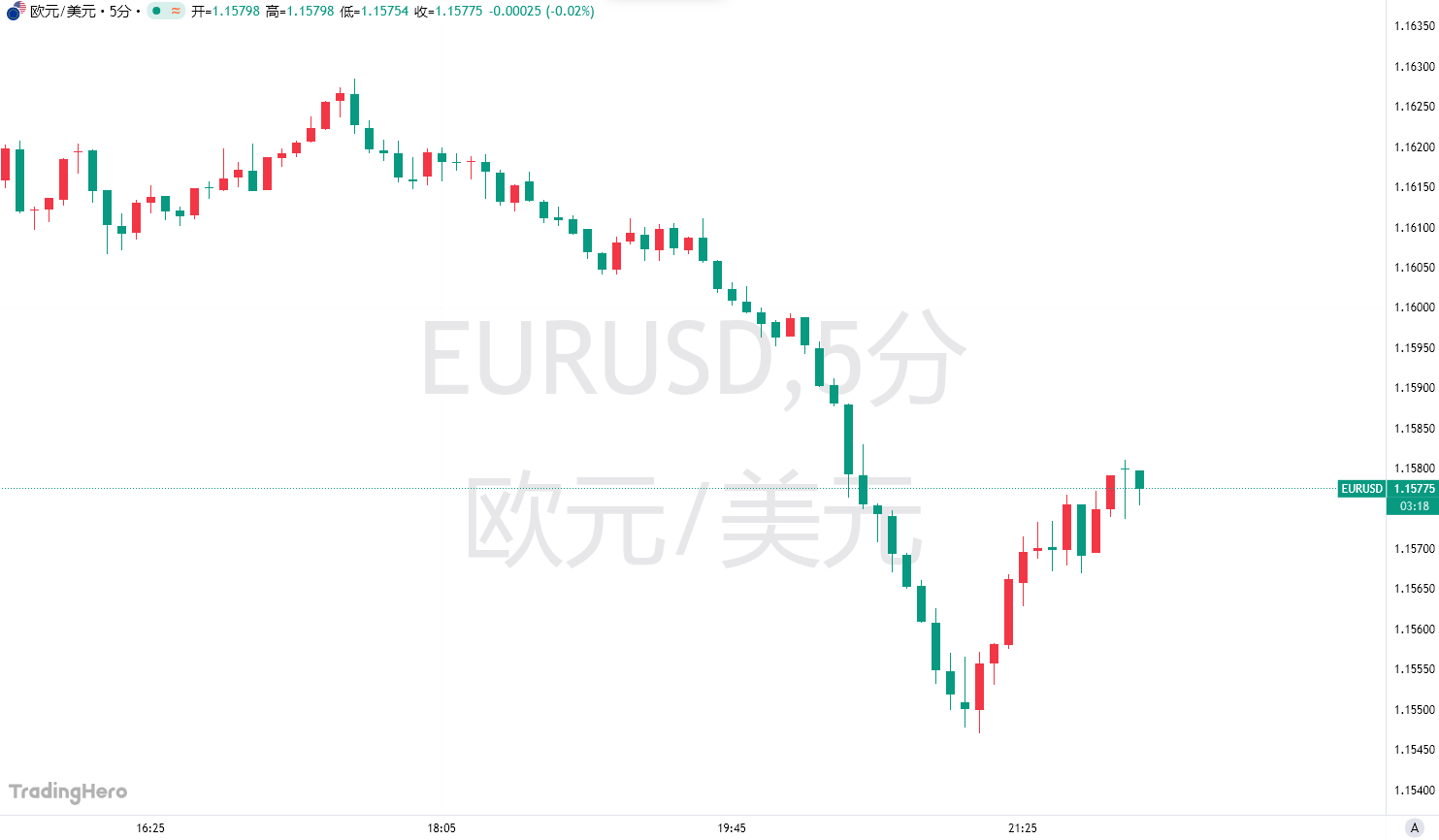
在这个被市场广泛预期的决议公布后,欧元兑美元小幅回升。受益于美元的疲软,2025年欧元兑美元汇率上涨了12%。 欧洲央行连续第三次会议决定将基准利率维持在2%不变,原因是欧元区经济出现了初步增长。 这一决定符合经济学家的普遍预期,此前欧洲央行行长拉加德也多次表示,该货币区的货币政策正"处于一个良好位置"。 然而,由于持续不断的全球贸易争端和地缘政治紧张局势,前景仍然不明朗。 BCA Research首席策略师马修·萨瓦里指出,"欧洲央行的稳健操作表明其有信心认为通胀和增长正走在一条可持续的道路上。因此,欧洲的政策不会带来重 大意外,而是会与市场定价保持一致。这意味着欧元、欧洲股票和债券的走势将在很大程度上取决于美国政策和市场的演变。" 尽管如此,一些政策制定者仍然认为经济增长和通胀放缓的风险更大,因此有理由进一步放松货币政策。金融投资者也抱有同样的担忧,他们认为明年夏季 之前再次降息的可能性在40%到50%之间。 但政策鹰派认为,德国加大国防和基础设施支出从根本上改变了经济前景,即使欧洲央行不采取进一步行动,也将推高经济增长和物价。 欧洲央行行长拉加德也指出,长期通胀预期指标约为2%,但通胀前景比往常更加不确 ...

刚刚宣布:利率不变!
Zhong Guo Ji Jin Bao· 2025-10-30 14:08
Core Viewpoint - The European Central Bank (ECB) has decided to maintain its interest rates at 2%, indicating a cautious approach to future monetary policy adjustments based on incoming data [1][2]. Economic Growth - Eurozone's GDP growth for Q3 was reported at 0.2%, slightly above market expectations of 0.1%, following a growth of 0.6% in Q1 and a slowdown to 0.1% in Q2 [1][2]. - Year-on-year, the Eurozone's economic growth for Q3 was 1.3%, surpassing the expected 1.2%, driven primarily by Spain (0.6% growth) and France (0.5% growth) [2]. Inflation Trends - The Eurozone's inflation rate for September was reported at 2.2%, up from 2% in August, slightly above the ECB's target of 2% [3]. - Consumer inflation expectations have stabilized, with the median expectation for the next 12 months decreasing from 2.8% in August to 2.7% in September [2][3]. Market Sentiment - The Purchasing Managers' Index (PMI) for October rose from 51.2 in September to 52.2, indicating a positive sentiment in the market and alleviating concerns about economic downturn risks [2]. - Despite the positive outlook, economists caution against viewing the current situation as a full economic recovery, highlighting significant downside risks [2]. ECB's Future Policy Stance - The ECB has not provided any signals regarding future policy direction, emphasizing that decisions will be based on the latest data without pre-committing to specific paths [1][3]. - ECB President Lagarde has stated that while the current economic conditions are favorable, the possibility of future rate cuts cannot be ruled out, indicating a readiness to respond to changing circumstances [3].
刚刚宣布,不降息!
券商中国· 2025-10-30 14:07
Core Viewpoint - The European Central Bank (ECB) has decided to pause interest rate cuts, maintaining the deposit facility rate at 2%, which aligns with market expectations. This decision is primarily driven by easing inflation pressures and a recovery in economic growth within the Eurozone [2][4][7]. Group 1: ECB's Decision and Economic Indicators - The ECB's decision to keep the deposit facility rate at 2.00%, the main refinancing rate at 2.15%, and the marginal lending rate at 2.40% reflects a stable inflation outlook and economic growth [4]. - Recent data indicates that inflation pressures in the Eurozone are easing, with consumer inflation expectations stabilizing. The median expectation for inflation over the next 12 months decreased from 2.8% in August to 2.7% in September [7]. - The Eurozone's inflation rate for September was reported at 2.2%, slightly above the ECB's target of 2%, but still considered moderate by economists [7]. Group 2: Economic Growth and Market Reactions - Economic indicators show that the Eurozone is regaining growth momentum, with the composite PMI index rising from 51.2 in September to 52.2 in October, marking the highest level in 17 months [8]. - The ECB's statement emphasizes that its decisions will be based on inflation forecasts and risks, with a readiness to adjust all tools as necessary [4][5]. - Following the ECB's announcement, the Euro experienced a short-term rally, with the Euro to USD exchange rate showing a reduced decline [4]. Group 3: Future Outlook - Analysts suggest that the ECB is likely to maintain a wait-and-see approach in the coming months, with a 50% probability of another rate cut within the next 12 months [8]. - Surveys indicate that the ECB may keep borrowing costs stable at around 2% until 2027, although some dissenting opinions suggest the possibility of resuming rate cuts next year [8].
深圳三季报:工业增速加快,投资还在降|湾区观察
Di Yi Cai Jing· 2025-10-30 12:49
Core Insights - Shenzhen's GDP for the first three quarters reached 27,896.44 billion yuan, showing a year-on-year growth of 5.5%, indicating resilience in a complex environment [1] - The service sector is increasingly contributing to economic growth, aligning with trends observed in developed economies [5] - Fixed asset investment is under pressure but shows quality improvement, particularly in industrial technology transformation investments [6] - There is an accelerating trend in consumption upgrades, enhancing consumption's role in driving economic growth [7] Economic Performance - The first industry recorded a value-added of 17.45 billion yuan, achieving zero growth, an improvement from a 2.1% decline last year [1] - The second industry had a value-added of 9,946.06 billion yuan, growing by 3.5%, a significant slowdown from last year's 8.7% [1][2] - The third industry saw a value-added of 17,932.93 billion yuan, with a growth rate of 6.6%, up from 3.5% last year [1] Industrial Insights - The industrial output value for the first three quarters grew by 5.0%, down from 10.2% last year, but showed a quarterly improvement [2] - Key industries such as general equipment manufacturing grew by 16.6%, while instrument manufacturing and electronic equipment manufacturing grew by 7.5% and 6.0%, respectively [2] - High-tech product outputs saw significant growth, with civil drones up by 46.9%, industrial robots by 38.2%, and 3D printing equipment by 33.6% [3] Service Sector Performance - The financial sector grew by 14.5%, and the information transmission, software, and IT services sector grew by 9.7% [3] - Revenue from large-scale service enterprises increased by 7.4% from January to August, with IT services growing by 10.3% [3] Consumption Trends - Total retail sales of consumer goods reached 7,560.81 billion yuan, growing by 3.6%, a significant increase from last year's 0.7% [3] - Retail sales in home appliances and audio-visual equipment surged by 41.5%, while cultural and office supplies grew by 28.2% [3] Foreign Trade and Investment - Shenzhen's total import and export volume was 33,643.29 billion yuan, with exports at 20,382.04 billion yuan (down 4.7%) and imports at 13,261.25 billion yuan (up 8.4%) [4] - Fixed asset investment decreased by 17.4%, with real estate development investment down by 24.8% [4] Strategic Recommendations - Short-term strategies should focus on supporting industrial technology transformation, stimulating consumption potential, stabilizing real estate market expectations, and expanding foreign trade markets [7] - Long-term strategies should aim at deepening service sector reforms, enhancing technological innovation, and transitioning economic growth from investment and export-driven models to a more balanced approach involving consumption [7]
增长5.5%!深圳,最新公布→
证券时报· 2025-10-30 11:47
Economic Growth - Shenzhen's GDP for the first three quarters of 2025 reached 27,896.44 billion yuan, with a year-on-year growth of 5.5% at constant prices [1] - The primary industry added value was 17.45 billion yuan (0.0% growth), the secondary industry was 9,946.06 billion yuan (3.5% growth), and the tertiary industry was 17,932.93 billion yuan (6.6% growth) [1] Industrial Performance - The industrial added value above designated size in Shenzhen grew by 5.0% year-on-year, accelerating by 0.7 percentage points compared to the first half of the year [1] - Key sectors such as general equipment manufacturing, instrument manufacturing, and computer, communication, and other electronic equipment manufacturing saw growth rates of 16.6%, 7.5%, and 6.0% respectively [1] - High-tech product output continued to grow rapidly, with civil drones, industrial robots, and 3D printing equipment increasing by 46.9%, 38.2%, and 33.6% respectively [1] Service Sector - The added value of the service industry in Shenzhen was 17,932.93 billion yuan, with a year-on-year growth of 6.6%, which is an acceleration of 0.5 percentage points from the first half of the year [2] - Financial services, information transmission, software, and IT services, as well as leasing and business services grew by 14.5%, 9.7%, and 5.6% respectively [2] Consumer Market - The total retail sales of consumer goods in Shenzhen reached 7,560.81 billion yuan, with a year-on-year growth of 3.6%, slightly up by 0.1 percentage points from the first half of the year [2] - Retail sales of essential goods showed strong growth, with food and daily necessities increasing by 8.4% and 7.5% respectively [2] - The policy of replacing old consumer goods continued to show effects, with retail sales of home appliances and audio-visual equipment, cultural and office supplies, and communication equipment increasing by 41.5%, 28.2%, and 6.1% respectively [2] - Online retail sales grew rapidly, with a 17.8% increase in retail sales through the internet [2] Foreign Trade - Shenzhen's total import and export volume reached 33,643.29 billion yuan, with a year-on-year growth of 0.1% [2] - Exports were 20,382.04 billion yuan (down 4.7%), while imports were 13,261.25 billion yuan (up 8.4%) [2] - High-tech product exports increased by 9.7% [2] Investment Trends - Fixed asset investment in Shenzhen decreased by 17.4% year-on-year [3] - Real estate development investment fell by 24.8%, while infrastructure investment grew by 6.8% and industrial technological transformation investment surged by 42.7% [3] Financial Sector - As of the end of September, the balance of deposits in financial institutions (including foreign capital) in Shenzhen was 143,649.54 billion yuan, with a year-on-year growth of 5.6% [3] - The balance of loans in financial institutions (including foreign capital) was 99,404.44 billion yuan, with a year-on-year growth of 5.0% [3]
政协委员提案:鼓励公职人员消费!当地商务局回应:从两方面发力,转变公职人员保守消费观念
Mei Ri Jing Ji Xin Wen· 2025-10-30 09:39
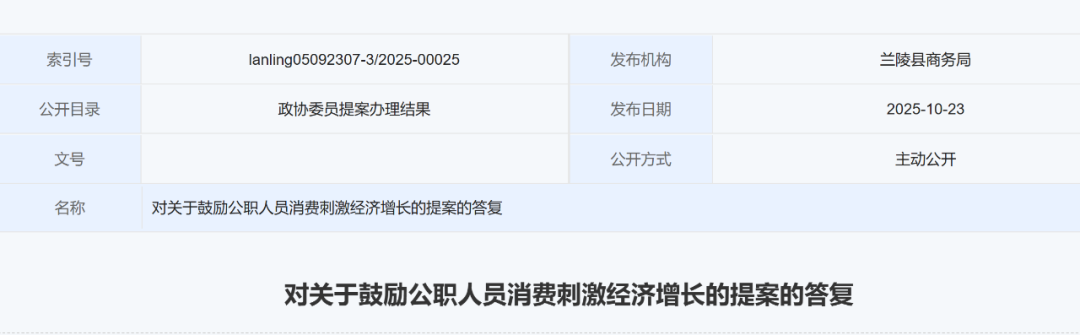
Core Viewpoint - The response from the Shandong Lanling County Business Bureau addresses a proposal from political advisors to encourage public servants' consumption to stimulate economic growth, outlining measures to enhance disposable income, shift consumption attitudes, ensure social equity, and address policy limitations [1][4][5]. Group 1: Income and Consumption Attitudes - The Business Bureau plans to explore a wage growth mechanism that aligns with economic development, considering performance and regional differences to gradually increase public servants' disposable income [4]. - To change conservative consumption attitudes among public servants, the Bureau will implement consumption education and create practical consumption scenarios through cultural and tourism activities [4]. Group 2: Social Equity - The Bureau emphasizes fairness in consumption stimulus policies, avoiding special treatment for public servants, and aims for policies that benefit a broader population, including farmers and low-income groups [4]. Group 3: Policy Limitations and Economic Recovery - The Bureau has developed the "Implementation Plan for Boosting Consumption" tailored to local conditions, focusing on key sectors such as culture, tourism, and e-commerce, while also addressing housing and healthcare [5]. - The county's economic indicators show a mixed performance, with a GDP of 37.25 billion yuan in 2024, a 3% increase year-on-year, and a retail sales total of 15.95 billion yuan, reflecting a 6.5% growth [7].
今年前三季度广州GDP同比增长4.1%,增速继续回升
Sou Hu Cai Jing· 2025-10-30 08:32
Core Insights - Guangzhou's GDP for the first three quarters of 2025 reached 23,265.65 billion yuan, showing a year-on-year growth of 4.1% at constant prices [1] - The economic recovery in Guangzhou is accelerating, with GDP growth improving from 3.8% in the first half of the year to 4.1% in the first three quarters [2] Economic Performance - The primary industry added value was 197.94 billion yuan, growing by 4.2% - The secondary industry added value was 5,564.37 billion yuan, with a growth of 2.7% - The tertiary industry added value was 17,503.34 billion yuan, increasing by 4.6% [1] - The industrial added value for large-scale enterprises grew by 1.4%, an increase of 0.7 percentage points compared to the first half of the year [2] Investment Trends - Fixed asset investment in Guangzhou grew by 1.3%, up by 0.5 percentage points from the first half of the year - Industrial investment surged by 9.6%, while infrastructure investment rose by 2.2% - Real estate development investment increased by 2.4%, driven by urban renewal projects - Investment in the automotive manufacturing sector grew by 15.8%, with a notable 38.6% increase in automotive parts manufacturing investment [2] Contribution to GDP - The tertiary sector contributed over 80% to the city's GDP growth - The financial sector, buoyed by an active securities market, achieved a 6.1% increase in added value, contributing significantly to the overall GDP growth [2] Transportation and Logistics - The total passenger volume for the first three quarters reached 254 million, with a year-on-year growth of 6.5% - Air and rail transport saw passenger volume increases of 2.4% and 0.9%, respectively - Cargo transport also showed stability, with a total cargo volume of 700 million tons, growing by 2.4% [3] Economic Outlook - The overall economic performance in Guangzhou is characterized by steady progress and quality improvement - However, challenges remain, including external uncertainties and structural issues in supply and demand - Future strategies will focus on stabilizing existing economic activities, expanding new investments, and enhancing quality to foster high-quality development [3]
政治僵局中GDP逆势加速 法国经济三季度超预期增长0.5%
智通财经网· 2025-10-30 08:21
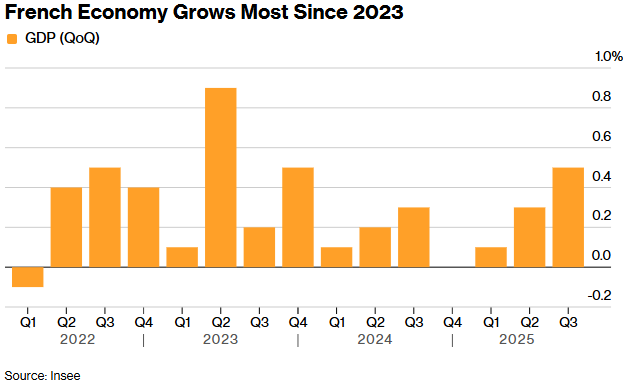
Group 1 - France's economy unexpectedly grew at the fastest pace since 2023, with a 0.5% increase in Q3, surpassing the previous quarter's 0.3% and more than double analysts' expectations [1][4] - The growth was driven by improvements in trade and domestic demand, with Finance Minister Roland Lescure describing the results as "excellent performance" [1][4] - The report is part of a broader release of economic data from the Eurozone, indicating that the region is managing the impacts of trade tensions relatively well, although growth momentum may not be seen until next year [4] Group 2 - Despite strong economic data, France faces significant political uncertainty, with Prime Minister Élisabeth Borne working to stabilize the budget and avoid political fallout [8] - The deterioration in fiscal and political conditions has led to credit rating downgrades, with warnings from the central bank about the inability to manage rising debt levels [8] - Private investment surged, and strong exports in aviation and chemicals contributed to the unexpected resilience of economic growth, although this may not be sustainable due to political uncertainties [8][9] Group 3 - In Q3, business investment rose by 0.9%, marking the strongest growth in over two years, while exports increased by 2.2% and consumer spending grew by 0.1% [9] - A report indicated that consumer spending rose by 0.3% in September, contrary to expectations of stagnation, with previous data for August revised upward [9]
封面新闻专访2025诺贝尔经济学奖得主乔尔·莫基尔:中国对教育和基建投资将有丰厚回报
Sou Hu Cai Jing· 2025-10-30 07:44
Core Insights - Joel Mokyr, along with Philippe Aghion and Peter Howitt, was awarded the 2025 Nobel Prize in Economic Sciences for their contributions to the theory of innovation-driven economic growth, with Mokyr receiving half of the prize for revealing the prerequisites for sustained growth through technological advancement [1][3]. Group 1: Innovation and Economic Growth - The core premise for sustained economic growth is "useful knowledge," which consists of prescriptive knowledge (how to operate technology) and propositional knowledge (understanding the scientific principles behind technology) [4][5]. - The Industrial Revolution marked the first strong feedback loop between these two types of knowledge, laying the foundation for modern economic growth [5]. Group 2: Importance of Understanding Principles - Understanding the principles behind technology is crucial for sustainable innovation; merely knowing how to do something is insufficient [6][8]. - Historical examples, such as the development of agricultural practices and steam engines, illustrate that scientific understanding leads to significant advancements and efficiency improvements [7][8]. Group 3: Measurement of Productivity - Current economic growth rates may not accurately reflect productivity due to outdated measurement methods that fail to account for non-market goods and services that enhance human welfare, such as vaccines [9]. - There is a need for new methods to measure productivity that align with modern economies focused on information and advanced services [9]. Group 4: Openness and Collaboration - For an economy to thrive, it must remain open to trade, talent, and knowledge exchange, emphasizing the importance of a free market for ideas and knowledge [10]. - Collaboration between the public and private sectors is essential for fostering innovation, with the balance depending on industry characteristics [10]. Group 5: China's Investment in Education and Infrastructure - China's significant investments in infrastructure and higher education are expected to yield substantial returns for its economy [11]. - The relationship between state-owned and private enterprises needs to be recalibrated to foster innovation effectively [11]. Group 6: Historical Perspective on Economic Progress - Economic history provides valuable insights into the progress made over time, highlighting that current living standards are unprecedented compared to historical norms [14][15]. - Understanding economic history is essential for comprehending modern economic systems and challenges [14]. Group 7: Lifelong Learning - Young individuals are encouraged to maintain a habit of lifelong learning to adapt to the rapidly changing world, as knowledge becomes outdated quickly [16][17].