
中国经济高质量发展

Search documents
经济总量首次突破140万亿元、增速达到5% 三大维度透视2025中国经济年报
Shang Hai Zheng Quan Bao· 2026-01-20 00:10
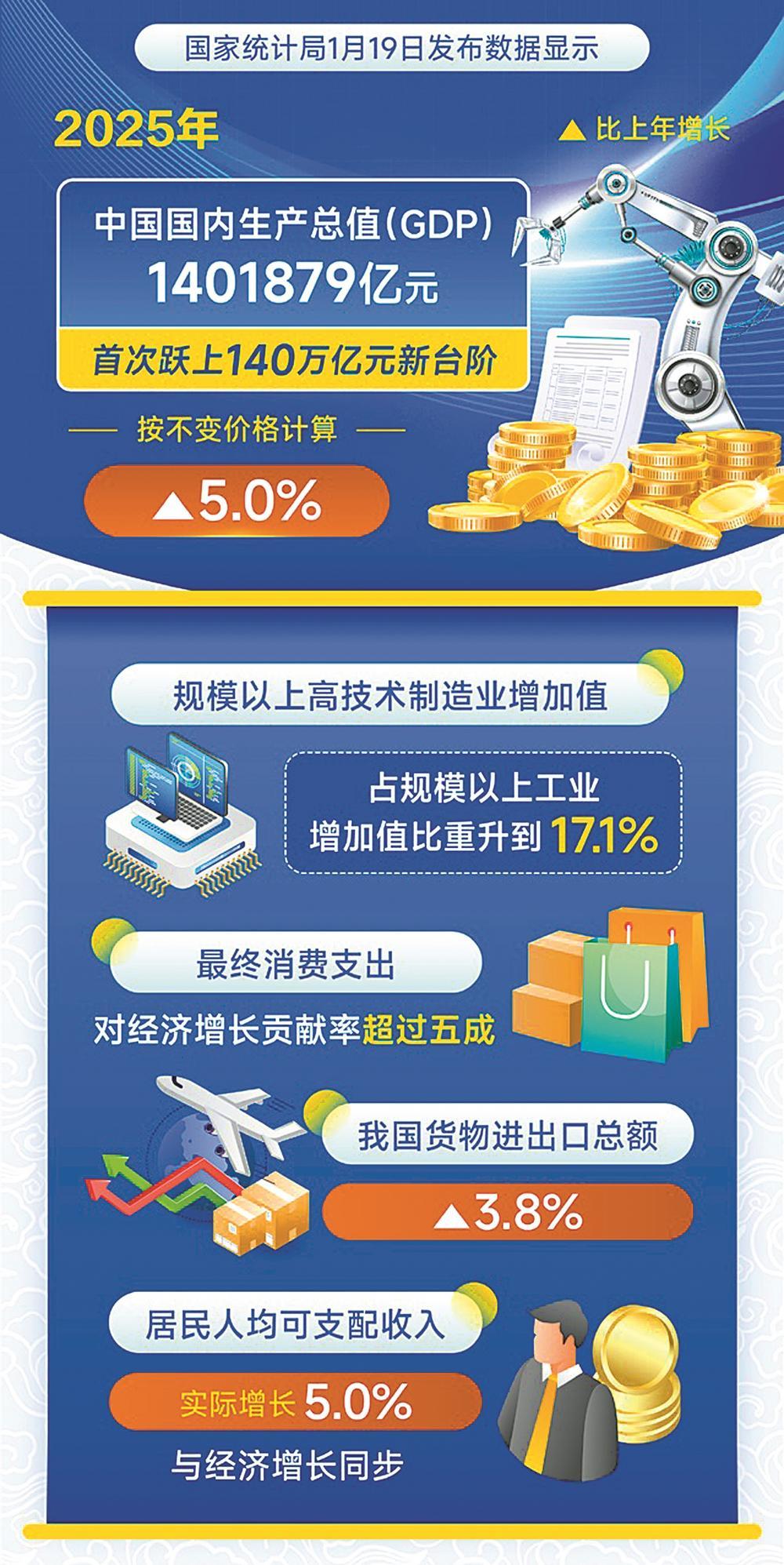
国家统计局1月19日发布数据显示:2025年我国国内生产总值(GDP)首次突破140万亿元,以5%的增速实 现了年初设定的预期目标。消费和工业两大"压舱石"加快增长,消费市场规模突破50万亿元,制造业增 加值达到34.7万亿元,制造业有望继续保持全球第一。 "2025年我国经济顶压前行、向新向优发展,主要的预期目标圆满实现,展现了强大韧性和活力,为今 年经济发展奠定了良好的基础。"国家统计局局长康义19日在国新办新闻发布会上表示。 康义表示,看中国经济,要全面、辩证、长远地看。透过量与质、内与外、形与势的经济"三棱镜",可 以发现,中国经济不仅实现了规模跃升,还实现了结构向优、动能向新;不仅内需释放出了活力和动 能,外需也彰显了韧性;不仅稳定增长之"形"延续,而且2026年有望继续呈现向好之"势"。 量质齐升:经济顶压前行、向优向新 面对国内外经济环境的复杂变化,2025年经济稳定增长。国家统计局发布的数据显示,全年国内生产总 值达到1401879亿元,按不变价格计算,比2024年增长5.0%。 "2025年经济总量达到了140万亿元,这是一个相当了不起的成绩,充分展现了中国经济稳中有进的态 势、顶压前行的韧 ...
“十四五”时期实现“四连跳” 我国经济总量跃上140万亿元新台阶
Ren Min Ri Bao· 2026-01-19 22:23
Core Insights - The 2025 economic report from China shows a GDP of 140,187.9 billion yuan, marking a 5.0% growth from the previous year, with per capita GDP exceeding $13,000 for three consecutive years [1][2] - During the "14th Five-Year Plan" period, China's economy has achieved significant milestones, with GDP surpassing 110 trillion, 120 trillion, 130 trillion, and 140 trillion yuan, reflecting a robust annual growth rate of 5.4% [1][3] Economic Stability - The economic total is steadily increasing, with overall employment stability and foreign exchange reserves exceeding $3.3 trillion [3] - The contribution of final consumption expenditure to economic growth has surpassed 50%, indicating a strong domestic demand [3] - The high-tech manufacturing sector's value added has risen to 17.1% of total industrial value added, showcasing structural optimization [3] Innovation and Growth - R&D expenditure intensity reached 2.8%, with the value added of the digital product manufacturing sector growing by 9.3% year-on-year [3] - High-tech and high-value-added products are driving export growth, with high-tech product exports increasing by 13.2% [3] Resilience and Quality Development - China's economy has effectively navigated significant risks and challenges during the "14th Five-Year Plan," with grain production stabilizing at 1.4 trillion jin for two consecutive years and manufacturing value added remaining the highest globally for 16 years [4] - R&D expenditure has grown by an average of 10% annually, and the value added of high-tech manufacturing has increased by 9.2% annually during this period [4] - The share of non-fossil energy consumption has risen from 16% in 2020 to over 20% by 2025, reflecting a commitment to green transformation [4]
140万亿元! 中国经济再上新台阶
Xin Lang Cai Jing· 2026-01-19 18:12
Economic Growth - China's GDP reached 140 trillion yuan in 2025, marking a significant milestone with a year-on-year growth of 5.0% at constant prices, achieving a "four consecutive jumps" during the 14th Five-Year Plan period [4] - The contribution rate of China to global economic growth is expected to be around 30%, making it the most stable and reliable source of global economic growth [4] Production and Industry - China's grain production has stabilized at 1.4 trillion jin for two consecutive years, and the manufacturing value added has remained the highest in the world for 16 years [5] - The service sector's value added has increased to 57.7% of GDP, supported by the world's largest and most comprehensive network infrastructure [5] - During the 14th Five-Year Plan period, China's average annual economic growth is projected to be 5.4%, significantly surpassing the global average [5] Innovation and Technology - China has entered the top ten in global innovation index rankings, with R&D expenditure intensity reaching 2.8%, exceeding the OECD average for the first time [5] - Significant technological advancements include successful launches of the "Nine Sky" drone and the Tianwen-2 mission, as well as the commissioning of the first electromagnetic aircraft carrier [5] Emerging Industries - New energy vehicles accounted for over 50% of domestic new car sales, with production of civilian drones and industrial robots increasing by 37.3% and 28% respectively [6] - Continuous investment and expansion in high-end equipment, green energy, and smart manufacturing are driving the integration of technological and industrial innovation [6] Consumer Market - The total retail sales of consumer goods surpassed 50 trillion yuan, with a year-on-year growth of 3.7%, reflecting new retail experiences and the integration of digital technologies [7] - The per capita disposable income of residents increased by 5.0%, and the urbanization rate reached 67.89%, indicating positive progress in social welfare sectors [7]

中国经济“十四五”收官答卷透视
Xin Hua Wang· 2026-01-19 15:26
Economic Overview - In 2025, China's GDP surpassed 140 trillion yuan, marking a 5.0% increase from the previous year, solidifying its position as the world's second-largest economy [3][4] - The average annual growth rate during the 14th Five-Year Plan period was 5.4%, with per capita GDP exceeding $13,000 for three consecutive years [4][5] - China's contribution to global economic growth is estimated to be around 30%, reinforcing its role as a reliable "driving force" and "stabilizer" for the world economy [4][10] Economic Structure and Performance - Industrial added value for large-scale industries grew by 5.9%, while the urban unemployment rate averaged 5.2% [5] - High-tech manufacturing's added value accounted for 17.1% of total industrial added value, with final consumption contributing over 50% to economic growth [5][12] - Retail sales of consumer goods exceeded 50 trillion yuan, with service retail growing by 5.5% [12] Innovation and Development - R&D expenditure intensity reached 2.8%, surpassing the OECD average for the first time, and China ranked in the top ten for innovation index globally [14][19] - The production of civil drones and industrial robots increased by 37.3% and 28%, respectively, showcasing advancements in low-altitude economy and intelligent manufacturing [15][17] Green Development - Clean energy generation from hydropower, nuclear, wind, and solar sources grew by 8.8%, with non-fossil energy consumption rising by approximately 2 percentage points [21][23] - New energy vehicle production and sales exceeded 16 million units, maintaining a global leadership position for 11 consecutive years [21] Policy and Economic Stability - A series of proactive policies were implemented to stabilize employment and promote high-quality development, enhancing the economic support framework [9][10] - The agricultural sector saw grain production increase from 1.37 trillion jin in 2021 to 1.43 trillion jin in 2025, ensuring food security [23][25] Future Outlook - The economic foundation remains strong, with expectations for continued growth and stability in the upcoming 15th Five-Year Plan [26][30] - International organizations have raised their growth forecasts for China, indicating confidence in the country's economic resilience and quality-focused growth model [10][30]
从“140万亿元”读懂中国经济发展大势
Xin Lang Cai Jing· 2026-01-19 14:04
新华财经北京1月19日电(记者谢希瑶)经济总量跨越"140万亿元"关口!2025年中国经济成绩单1月19 日发布。过去一年,面对外部环境急剧变化、国内困难挑战增多的复杂严峻形势,中国经济依然保持 5.0%的增长速度,在主要经济体中名列前茅,这份成绩尤为可贵。"难"与"成"的对照中,显现中国经济 高质量发展的大势,蕴含乘风破浪勇往直前的密码。 保持定力、夯实根基,巩固"稳"的势头。尽管外部不利影响加深,我国坚持将发展放在自己力量的基点 上,以高质量发展的确定性应对外部环境急剧变化的不确定性。国内生产总值首次跃上140万亿元新台 阶,货物贸易规模再创新高,粮食产量连续两年稳在1.4万亿斤,制造业增加值连续16年居世界首 位……一系列政策扎实推进、有力托举,中国经济在风浪中稳住了发展底盘、巩固了发展根基。 编辑:刘润榕 主动求变、向新突破,积蓄"进"的动能。向改革要动力,全国统一大市场建设纵深推进,民营经济促进 法施行,综合整治"内卷式"竞争成效显现;向开放要活力,海南自由贸易港启动全岛封关运作,外资准 入负面清单不断缩减,免签"朋友圈"继续扩大;以创新谋发展,一批重大科研成果竞相涌现,创新指数 排名首次进入全球前 ...
新华时评|从“140万亿元”读懂中国经济发展大势
Xin Lang Cai Jing· 2026-01-19 14:04
经济总量跨越"140万亿元"关口!2025年中国经济成绩单1月19日发布。过去一年,面对外部环境急剧变 化、国内困难挑战增多的复杂严峻形势,中国经济依然保持5.0%的增长速度,在主要经济体中名列前 茅,这份成绩尤为可贵。"难"与"成"的对照中,显现中国经济高质量发展的大势,蕴含乘风破浪勇往直 前的密码。 保持定力、夯实根基,巩固"稳"的势头。尽管外部不利影响加深,我国坚持将发展放在自己力量的基点 上,以高质量发展的确定性应对外部环境急剧变化的不确定性。国内生产总值首次跃上140万亿元新台 阶,货物贸易规模再创新高,粮食产量连续两年稳在1.4万亿斤,制造业增加值连续16年居世界首 位……一系列政策扎实推进、有力托举,中国经济在风浪中稳住了发展底盘、巩固了发展根基。 顶压前行,量质提升,彰显"韧"的特性。尽管世界经贸秩序遭受重创,国内新旧动能转换存在阵痛,我 国经济仍然实现了"量的跨越"与"质的提升",充分展现了中国经济在不稳定不确定环境下应变破局的能 力和抗压耐压的韧性。目前我国已成为150多个国家和地区的主要贸易伙伴,稳外贸多样化格局加速形 成,高技术、高附加值产品成为出口增长主力。放眼全球,我国经济增速在主 ...
新华时评丨从“140万亿元”读懂中国经济发展大势
Xin Hua Wang· 2026-01-19 13:45
Core Insights - China's economy has crossed the "140 trillion yuan" threshold, achieving a growth rate of 5.0% amidst challenging external and domestic conditions, positioning it among the top economies globally [1][2] - The report highlights the resilience and high-quality development of the Chinese economy, emphasizing the importance of maintaining stability and solid foundations [1][3] Group 1: Economic Performance - The GDP has reached a new milestone of 140 trillion yuan, with record high goods trade and stable grain production at 1.4 trillion jin for two consecutive years [1] - Manufacturing value added has maintained the world's top position for 16 years, showcasing the strength of China's industrial base [1] Group 2: Reform and Innovation - The construction of a unified national market is advancing, with the implementation of the Private Economy Promotion Law and effective measures against "involution" competition [2] - The Hainan Free Trade Port has begun full island closure operations, and the negative list for foreign investment access continues to shrink, enhancing openness [2] - China has entered the global top ten in innovation index rankings, with significant scientific research achievements emerging [2] Group 3: Trade and Global Positioning - China has become a major trading partner for over 150 countries and regions, with a diversified foreign trade pattern accelerating [2] - High-tech and high-value-added products are driving export growth, reflecting the adaptability and resilience of the Chinese economy in a volatile global environment [2]
智读数据丨从元旦消费“开门红”看中国经济新活力
Sou Hu Cai Jing· 2026-01-14 06:07
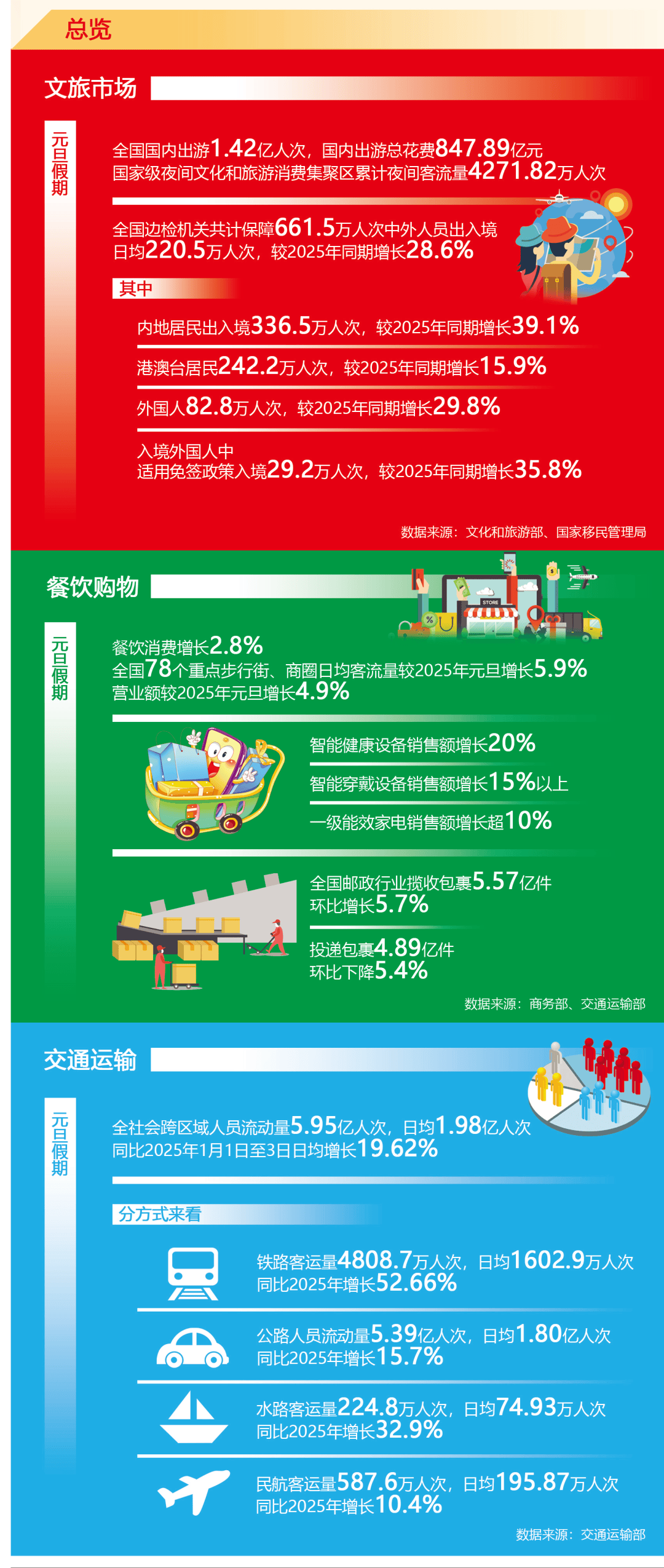
Core Insights - The Chinese consumption market experienced a strong start in 2026, with significant growth in domestic travel and spending during the New Year holiday, indicating robust economic vitality and consumer enthusiasm [8][11] Transportation - The total cross-regional movement of people reached 595 million during the holiday, with an average daily increase of 19.62% compared to the same period in 2025 [9] - Railway passenger volume was 48.1 million, showing a year-on-year increase of 52.66% [9] - Road movement accounted for 539 million people, with a daily average increase of 15.7% [9] - Waterway passenger volume was 2.25 million, with a year-on-year increase of 32.9% [9] - Civil aviation passenger volume reached 5.88 million, with a daily average increase of 10.4% [9] Consumption Trends - Domestic travel reached 142 million trips, with total spending of 84.79 billion yuan, reflecting strong consumer enthusiasm [8][11] - Restaurant consumption grew by 2.8%, while key pedestrian streets and business districts saw daily foot traffic and sales increase by 5.9% and 4.9% respectively compared to 2025 [9] - Sales of smart health devices increased by 20%, and smart wearable devices saw a growth of over 15% [9] - Energy-efficient home appliance sales grew by over 10%, indicating a shift towards higher quality and more sustainable consumer products [9] Regional Highlights - In Beijing, key monitored enterprises reported a cumulative sales of 4.04 billion yuan, with a daily growth of 16.3% [10] - Shanghai welcomed over 6.82 million tourists, achieving a total tourism consumption of 12.27 billion yuan [10] - Guangdong province's tourism revenue increased by 39.8% year-on-year, with a total of 99.8 billion yuan [10] - Hainan's duty-free shopping surged by 93.8% on January 1, indicating a strong demand for luxury goods [10]
报告显示:10年来中国经济高质量发展指数提高24.9%
Ren Min Wang· 2026-01-14 02:59
Core Insights - The "China Economic High-Quality Development Report (2025)" indicates a significant increase in China's economic high-quality development index from 32.43 in 2015 to 40.52 in 2025, marking a 24.9% growth over the decade, with innovation development being a key driver [1] Group 1: Economic Development Index - The five sub-indices of high-quality development have shown substantial growth: innovation development increased by 85.09%, coordinated development by 23.73%, green development by 18.26%, open development by 7.64%, and shared development by 9.19% [1] - Eastern regions maintain a higher economic high-quality development index compared to central, western, and northeastern regions, although central and western provinces have shown faster growth, narrowing the gap with eastern provinces [1] Group 2: Recommendations for Future Development - The report suggests enhancing the overall synergy of the five development concepts: innovation, coordination, green, openness, and sharing, while continuing to leverage the leading role of economically strong provinces [2] - It emphasizes the need for increased investment in technological innovation and improving the institutional environment for innovation [2] - The report advocates for accelerating the construction of a modern industrial system and improving energy efficiency while promoting a green and low-carbon energy transition [2]
理响中国 | 创意长图:活力涌动,内需市场赋能中国经济高质量发展
Huan Qiu Wang· 2026-01-12 10:59
内需是我国经济发展的基本动力 强大的国内市场是中国式现代 活力涌动的内需市场,正成为中国经 it comin the 做好己 系,以新需求引领新供给、以新能 求,促进消费和投资、供给和需求 增强国内大循环内生动力和可靠恰 手货们 完备的工业体系筑牢供给根基, 和全球最大规模中等收入群体 士,科技创新、产业升级、民生 投资空间广阔。 1000万元信用贷款15个] 地,新技术研发和旧产线 f ! ! 内需下动场 中国经济高质量 十九级汶丁统△沁兰阳工疏但"上 十不红小工作云坏自吸 | 明休 | | 局、起好步,确定了2026年经济 日项重点任务,其中,"坚持内需ქ 大国内市场"排在首位。 PX11 14:55 消费者 趁着国补下单, 节省了1000多元! 下载 量公開家 time H 脚踏进冰雪大世界,看到 奇观,感受到的是哈尔滨雪 冰雪文化底蕴! // // // 手机 FEST 现代化生产线将酸汤发酵F 6个月缩短到7天,而且全 // ////// unumumum 食品公司负责人 ///// 用了新系统,运营效率和处 明显提升, 可以让大家网购 EE Jh 24 4 天休匹丛。 // ///// INCIE ...
