
保供稳价

Search documents
硫酸磷肥行业多举措调控保供稳价
Zhong Guo Hua Gong Bao· 2025-12-22 03:04
Core Viewpoint - The meeting held by the China Sulfuric Acid Industry Association and the China Phosphate Fertilizer Industry Association focuses on stabilizing supply and prices in the sulfuric acid and phosphate fertilizer industries to ensure stable fertilizer supply and pricing before the spring farming season, thereby reinforcing the agricultural input security for national food safety [1][2]. Group 1: Current Market Situation - Global sulfur resource supply is tight, leading to a significant price increase, with imported sulfur prices rising over 230% this year, reaching over 4100 yuan/ton at one point [1]. - As of December 11, the average domestic sulfur price hit a yearly high, with solid sulfur averaging 3936.88 yuan/ton (up 169.59% year-on-year) and liquid sulfur at 3992.75 yuan/ton (up 161.61% year-on-year) [1]. Group 2: Regulatory Measures - Export control measures require sulfuric acid exporters to prioritize domestic market needs and reduce export volumes, with any necessary exports priced no lower than domestic prices [2]. - Price control measures set December 11 prices as a baseline, prohibiting smelting acid producers from raising prices arbitrarily to ensure market stability [2]. - Sulfur companies are encouraged to establish an independent pricing system based on the domestic market to avoid significant fluctuations tied to international market prices [2]. Group 3: Industry Responsibilities - The sulfuric acid and phosphate fertilizer industries are urged to recognize the importance of food security and fertilizer supply, enhancing their sense of responsibility and prioritizing supply stabilization efforts [2]. - The China Sulfuric Acid Industry Association and the China Phosphate Fertilizer Industry Association are tasked with industry self-regulation, monitoring, and implementing supply stabilization measures, including promoting long-term purchase agreements between upstream and downstream companies [2]. Group 4: Technological Development - To alleviate sulfur resource supply pressure, the meeting discussed promoting phosphogypsum-based sulfuric acid production technology and coordinating supportive policies [3]. - Approximately 90 million tons of phosphogypsum are produced annually in China, with 1 ton of phosphogypsum capable of producing 0.45 tons of sulfuric acid, which could significantly supplement domestic sulfur supply if scaled effectively [3]. - Leading companies like Guizhou Phosphate Group and Yunnan Yuntianhua Co., Ltd. are advancing the application of phosphogypsum-based sulfuric acid technology, with some projects already operating stably for years [3].

硫磺价格狂飙,下游行业急了
Xin Lang Cai Jing· 2025-12-20 00:09
Core Viewpoint - The sulfur price surge has prompted the phosphate fertilizer and sulfuric acid industries to collaborate on supply stabilization and price control in preparation for the upcoming spring farming season [1][2]. Group 1: Industry Response - On December 18, a special meeting was held by the China Sulfuric Acid Industry Association and the China Phosphate Fertilizer Industry Association to stabilize the fertilizer supply chain [2]. - The meeting called for sulfuric acid export companies to reduce export volumes and set export prices no lower than domestic prices [2]. - The meeting was guided by the National Development and Reform Commission and involved all sulfuric acid, sulfur, sulfur iron ore production companies, and phosphate fertilizer producers [2]. Group 2: Price Trends - As of December 11, the domestic prices for sulfuric acid ranged from 850 to 1000 CNY/ton in Central China, 820 to 880 CNY/ton in Southwest China, and 940 to 1010 CNY/ton in East China [2]. - Following the meeting, some sulfuric acid producers began to lower their prices, with Shandong Shenchi Chemical Co. reducing its price by 10 CNY/ton to 913 CNY/ton [3]. - The price of sulfur has recently exceeded 4000 CNY/ton, marking a historical high compared to a low of less than 1000 CNY/ton in the second half of last year [4]. Group 3: Cost Implications - The rising sulfur prices have significantly increased production costs for phosphate fertilizers, with estimates indicating that every 100 CNY/ton increase in sulfur price raises phosphate fertilizer production costs by approximately 45 CNY/ton [8]. - Leading phosphate fertilizer company Yuntianhua reported that the cost of producing one ton of phosphate fertilizer has risen by around 1000 CNY due to the increase in sulfur prices, leading to thin profits or even losses for some companies [8]. Group 4: Supply Chain Dynamics - China relies on imports for over 50% of its sulfur, making domestic prices closely tied to international market trends [7]. - The global supply of sulfur is tightening due to production cuts in major oil-producing regions and a shift of Russia from an exporter to a net importer of sulfur [10]. - The Chinese government is implementing policies to prioritize domestic supply of sulfuric acid to support the phosphate fertilizer industry, which is crucial for agricultural stability [14]. Group 5: Industry Initiatives - Several phosphate fertilizer companies, including Yuntianhua and Xiangyun Co., have initiated supply and price stabilization proposals since December 9 [16]. - The China Agricultural Production Materials Circulation Association and the China Phosphate Fertilizer Industry Association have recommended maintaining high operating rates for phosphate fertilizer producers and have advised against exports until August 2026 [16]. - China accounts for 30% of global phosphate fertilizer production, maintaining its position as the largest producer [16].

缩减出口规模、不得擅自涨价!硫酸行业明确多项调控措施
Zhong Guo Hua Gong Bao· 2025-12-18 08:58
Core Viewpoint - The meeting held by the China Sulfuric Acid Industry Association and the China Phosphate Fertilizer Industry Association focuses on stabilizing supply and prices in the sulfuric acid and phosphate fertilizer industries to ensure stable fertilizer supply and pricing before the spring farming season, thereby reinforcing the agricultural input security foundation for national food security [1][2]. Group 1: Supply and Price Control Measures - The global price of sulfur resources has significantly increased this year, leading to a surge in raw material costs for fertilizer production in China, which poses severe pressure on winter reserves and spring farming fertilizers [1]. - Export control measures require sulfuric acid exporting companies to prioritize domestic market demand, reduce export volumes, and ensure that export prices do not fall below domestic prices [1]. - Price control measures set December 11 as the baseline price, mandating smelting acid producers to avoid unilateral price increases to ensure market stability [1]. Group 2: Industry Responsibility and Cooperation - The sulfuric acid and phosphate fertilizer industries are urged to recognize the importance of food security and fertilizer supply, enhancing their sense of responsibility and prioritizing supply and price stabilization as key tasks [2]. - The China Sulfuric Acid Industry Association and the China Phosphate Fertilizer Industry Association are tasked with fulfilling industry self-regulation responsibilities, strengthening industry monitoring, and fully implementing supply and price stabilization measures [2]. - The meeting encourages smelting acid and phosphate fertilizer producers to establish stable upstream and downstream purchasing relationships through long-term sales agreements [2]. Group 3: Technological Promotion and Policy Support - The meeting also mentioned the promotion of phosphogypsum acid production technology and the coordination with relevant departments to study supportive measures [3].
党建领航守民生 国有农贸绘就保供新答卷
Hang Zhou Ri Bao· 2025-12-18 02:07
Core Viewpoint - The state-owned agricultural markets play a crucial role in ensuring the supply and stability of essential goods, directly impacting the livelihood of the public. The integration of party building and operational management is essential for enhancing the effectiveness of these markets in serving the community [1][2]. Group 1: Supply and Price Stability - The core mission of state-owned agricultural markets is to ensure supply and stabilize prices, leveraging their public service nature to establish a "平急转换" (normal and emergency transition) supply system [1] - The implementation of a dual mechanism of "direct procurement from bases + reserve adjustment" is necessary to maintain a stable supply of fresh produce [1] - Party members are to be involved in resource coordination and accountability for public welfare, with performance in supply stability included in party branch assessments [1] Group 2: Food Safety and Operational Standards - Party members are to establish a dual defense for food safety and operational standards, ensuring compliance with food safety regulations through daily inspections and immediate removal of non-compliant products [2] - The formation of a "党员巡查队" (party member inspection team) is crucial for addressing issues such as weight discrepancies and expired products [2] - A "党员调解队" (party member mediation team) will be set up to resolve disputes quickly at market points [2] Group 3: Enhanced Community Services - The focus is on upgrading services from basic provision to quality enhancement, aligning with the "十五五" (15th Five-Year Plan) for inclusive public welfare [2] - Initiatives include standardizing market facilities, adding accessibility features, and optimizing consumer experiences through digital platforms [2] - Community engagement through volunteer services, such as assisting the elderly and providing health consultations, aims to extend the reach of public services [2]
东北地区磷铵价格异动引关注
Zhong Guo Hua Gong Bao· 2025-12-12 09:40
Core Insights - The meeting aimed to address the recent fluctuations in phosphate fertilizer prices and ensure sufficient supply and stable prices during the spring farming season [2][3] Group 1: Market Conditions - Recent price volatility in the phosphate fertilizer market has raised industry concerns, driven by rising costs of key raw materials like sulfur and sulfuric acid, along with changes in market expectations and supply adjustments [2] - Major phosphate fertilizer producers reported stable production levels, with companies like Yunnan Yuntianhua Co., Guizhou Phosphate Group, and Hubei Yihua Group indicating sufficient supply for spring sales [2] - Despite stable production, companies face significant pressure from rising raw material costs, impacting their operational performance [2] Group 2: Supply and Demand Strategies - The National Development and Reform Commission indicated that while some regions have seen price increases, overall domestic supply remains stable, providing a solid foundation for winter storage and spring farming [3] - Recommendations to stabilize market expectations include delaying phosphate fertilizer exports until August 2026 to prioritize domestic supply and controlling raw material cost increases through long-term supply agreements [3] - Additional strategies discussed include establishing a long-term trading mechanism, regulating distribution channels, and combating speculative trading practices to maintain reasonable profit margins during critical periods [3]

川发龙蟒:2025年1-6月公司国外收入为5.20亿元,同比增长112.91%
Zheng Quan Ri Bao Zhi Sheng· 2025-12-10 13:39
Core Viewpoint - The company actively responds to national calls for supply assurance and price stability, receiving written commendation from the Ministry of Industry and Information Technology, while strategically adjusting its domestic and international sales ratios to enhance overall profitability [1] Group 1: Company Performance - From January to June 2025, the company's foreign revenue reached 520 million yuan, representing a year-on-year increase of 112.91% [1]

中辉能化观点-20251208
Zhong Hui Qi Huo· 2025-12-08 05:57
1. Report Industry Investment Ratings - Crude Oil: Cautiously bearish [2] - LPG: Bearish with potential rebounds [2] - L: Bearish trend continuation [2] - PP: Bearish trend continuation [2] - PVC: Bearish trend continuation [2] - PX/PTA: Buy on dips [4] - Ethylene Glycol: Bottom - side oscillation, look for short - selling opportunities on rebounds [4] - Methanol: Add long positions on dips [4] - Urea: Buy on dips [4] - Natural Gas: Cautiously bullish [7] - Asphalt: Cautiously bearish [7] - Glass: Bearish trend continuation [7] - Soda Ash: Bearish trend continuation in the second phase [7] 2. Core Views of the Report - The market for most energy and chemical products is affected by factors such as supply - demand balance, geopolitical situations, and cost support. Some products face supply - side pressures, while others are influenced by seasonal demand changes and cost fluctuations. For example, crude oil is pressured by oversupply in the off - season, while natural gas is boosted by increased demand in the winter [2][7]. 3. Summaries by Related Catalogs Crude Oil - **Market Performance**: On the previous Friday, international oil prices rebounded, with WTI up 0.69%, Brent up 0.77%, and SC up 0.47% [8] - **Basic Logic**: Short - term support comes from the Ukraine's attack on the CPC pipeline and South American uncertainties. The core driver is the oversupply of crude oil in the off - season, with OPEC+ maintaining its production policy and global and US inventories rising [9] - **Fundamentals**: As of December 5, the US oil rig count increased by 6 to 413. Russia's Tuapse port's oil product exports in December are expected to increase by 21.4%. Market expects India's imports from Russia to reduce by nearly one - third. As of November 28, US crude and product inventories increased [10] - **Strategy Recommendation**: Hold short positions. Pay attention to the range of [445 - 455] for SC [11] LPG - **Market Performance**: On December 5, the PG main contract closed at 4294 yuan/ton, down 0.16% month - on - month. Spot prices in Shandong, East China, and South China were 4510 (+10), 4411 (+0), and 4470 (+0) yuan/ton respectively [15] - **Basic Logic**: It is closely related to the cost of crude oil. Although it rebounds with short - term oil price increases, the long - term oil price trend is downward. There is some support from downstream chemical demand, but MTBE blending demand has decreased. Supply has increased, while inventory has decreased [16] - **Strategy Recommendation**: Hold short positions. Pay attention to the range of [4250 - 4350] for PG [17] L - **Market Performance**: The L2601 contract closed at 6699 yuan/ton (-8). The basis was +31 yuan/ton (-22) [20] - **Basic Logic**: Cost support strengthened, leading to a short - term oversold rebound, but spot prices did not follow suit. The supply remains sufficient due to seasonal increases in domestic production. The peak season for shed films is ending, and oil prices may decline in the medium - term [21] - **Strategy Recommendation**: Exit short positions. Wait for rebounds to go short in the long - term. Pay attention to the range of [6750 - 6900] [21] PP - **Market Performance**: The PP2601 closed at 6265 yuan/ton (-52). The basis was +89 yuan/ton (+28) [24] - **Basic Logic**: The increase in the parking ratio has alleviated supply pressure, but demand remains weak, and there is a high inventory - reduction pressure. OPEC+ is still in the production - increase cycle, and oil prices may continue to decline. The production of propylene warehouse receipts may lead to a weak market [25] - **Strategy Recommendation**: It may be strong in the short - term. Wait for rebounds to go short in the long - term. Consider going long on PP processing fees. Pay attention to the range of [6350 - 6500] for PP and [5850 - 6000] for propylene [25] PVC - **Market Performance**: The V2601 closed at 4586 yuan/ton (+5). The basis was - 76 yuan/ton (-5) [27] - **Basic Logic**: High - level production has continued, and the main contract hit a record low at night. During the macro - policy window period, trading has returned to the weak fundamentals. High social inventory limits upward movement, but low valuation provides some support. Pay attention to the rhythm of capital position - shifting [28] - **Strategy Recommendation**: Wait and see in the short - term. Wait for continuous inventory reduction to go long in the long - term. Pay attention to the range of [4350 - 4500] [28] PTA - **Market Performance**: The TA05 closed at 4752 yuan/ton (+66) [29] - **Basic Logic**: The processing fee is generally low, and many domestic and overseas devices are under maintenance, reducing supply pressure. Downstream demand is currently good but is expected to weaken. PX is oscillating weakly. There is a risk of inventory accumulation in December [30] - **Strategy Recommendation**: Consider going long on the 05 contract on dips or conducting a 1 - 5 reverse spread. Pay attention to the range of [4635 - 4700] [31] Ethylene Glycol - **Basic Logic**: Domestic and overseas production loads have decreased, but the arrival volume has increased. Downstream demand is currently good but is expected to weaken. There is a risk of inventory accumulation in December. It has a low valuation but lacks upward momentum [33] - **Strategy Recommendation**: Look for short - selling opportunities on rebounds. Pay attention to the range of [3680 - 3770] [34] Methanol - **Market Performance**: Taicang spot prices have continued to weaken [37] - **Basic Logic**: High inventory restricts spot price rebounds. Domestic production loads have increased, while overseas production loads have decreased. Port inventory is decreasing, but the speed has slowed down. The arrival volume in December is expected to be about 1.3 billion tons. Demand has changed little, and cost support has weakened [37] - **Strategy Recommendation**: The rebound height of the main contract may be limited. Consider going long on the 05 contract on dips. Pay attention to the range of [2040 - 2080] for MA01 [39] Urea - **Market Performance**: The spot price of small - particle urea in Shandong has strengthened, with a basis of 47 (+25) yuan/ton [41] - **Basic Logic**: The daily output is currently high but is expected to decrease as some gas - based enterprises shut down for maintenance in mid - December. Demand is currently good but lacks sustainability. Social inventory has decreased slightly but is still at a high level. Exports have maintained a high growth rate since July [41] - **Strategy Recommendation**: Consider going long on dips with a light position. Pay attention to the range of [1665 - 1695] [43] Natural Gas - **Market Performance**: On December 5, the NG main contract closed at 5.063 US dollars/million British thermal units, up 1.36% month - on - month [45] - **Basic Logic**: Entering the consumption peak season, the extremely cold weather in the US has boosted heating demand. The number of US natural gas drilling platforms has decreased, and EU import bans on Russian gas will be gradually implemented. US natural gas inventory has decreased [46] - **Strategy Recommendation**: Gas prices are likely to rise in the short - term due to increased winter demand. Pay attention to the range of [4.980 - 5.185] [47] Asphalt - **Market Performance**: On December 5, the BU main contract closed at 2948 yuan/ton. Spot prices in Shandong, East China, and South China were 2930 (-10), 3180 (+0), and 3000 (-50) yuan/ton respectively [50] - **Basic Logic**: It is mainly affected by the cost of crude oil. Oil prices have fallen due to geopolitical easing. The comprehensive profit of asphalt has decreased. Supply is expected to decrease in December, while demand has increased slightly. Inventory has decreased [51] - **Strategy Recommendation**: Continue to hold short positions. Pay attention to the range of [2900 - 3000] [52] Glass - **Market Performance**: The FG2601 closed at 1053 yuan/ton (-16). The basis was 77 yuan/ton (+16) [55] - **Basic Logic**: The daily melting volume has decreased, and multiple production lines are planned for cold repair in December. The real - estate market is weak, and demand remains low [56] - **Strategy Recommendation**: Pay attention to the implementation of cold - repair plans in the short - term. Wait for rebounds to go short in the long - term. Pay attention to the range of [1020 - 1070] [56] Soda Ash - **Market Performance**: The SA2601 closed at 1239 yuan/ton (+25). The basis was - 39 yuan/ton (+5) [59] - **Basic Logic**: Warehouse receipts have continued to increase, putting pressure on the market through industrial hedging. Supply and demand have both decreased, and long - term supply is expected to be abundant [60] - **Strategy Recommendation**: Hold short positions on the 01 alkali - glass spread. Wait for rebounds to go short in the long - term. Pay attention to the range of [1150 - 1200] [60]
2025年青岛市平价商店名单发布,平价商品低于当地同类市场均价5%-10%
Sou Hu Cai Jing· 2025-12-03 10:05
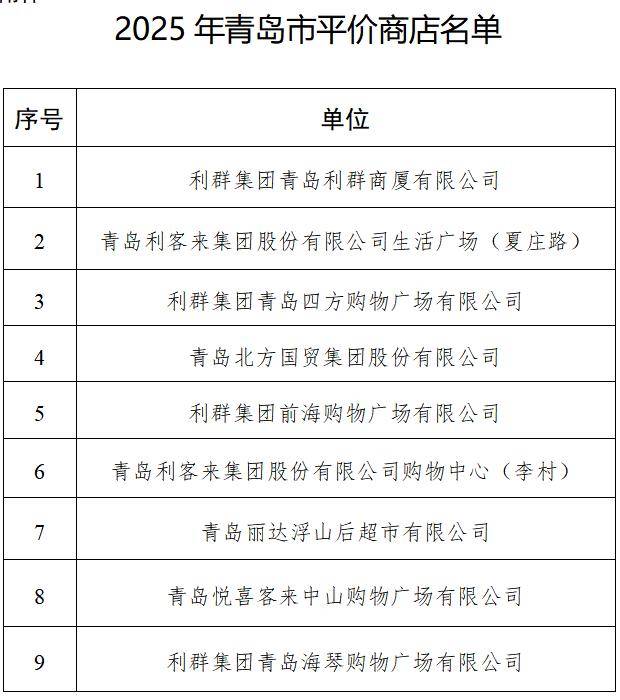
Core Viewpoint - The Qingdao Municipal Development and Reform Commission has recognized nine enterprises as "Qingdao City Price-Discount Stores" to enhance the role of price-discount stores in ensuring supply stability and promoting healthy economic development [1] Group 1: Selection of Price-Discount Stores - Nine enterprises have been selected as "Qingdao City Price-Discount Stores," including Li Qun Group Qingdao Li Qun Department Store Co., Ltd. and others [2] - The selection process followed principles of fairness, inclusiveness, and transparency, involving enterprise applications, district recommendations, expert evaluations, and public announcements [2] - Stores were evaluated based on operational strength, site and layout rationality, and management capabilities, ensuring they are willing to undertake social responsibilities for price stability and public welfare [2] Group 2: Operational Mechanism - The price-discount stores will operate under a flexible model combining "self-management on regular days" and "government regulation during special periods" [3] - During normal times, these stores will independently procure, price, and manage their operations; however, during holidays or price fluctuations, they will implement government-directed price-discount mechanisms [3] - At least four types of essential goods, such as grains, oils, meat, eggs, and vegetables, must be available at prices 5%-10% lower than the local market average during the activation of the price-discount mechanism [3] Group 3: Assurance Measures - The Municipal Development and Reform Commission has established a series of measures to ensure the effective and standardized operation of price-discount stores [4] - Agreements will be signed with the awarded enterprises to clarify rights and obligations regarding supply assurance, price stability, and quality safety [4] - A strict quality supervision system will be implemented, including a performance assessment system for price-discount stores, with biannual reviews and dynamic adjustments [4] - Public supervision will be enforced, with all price-discount stores displaying a unified "Qingdao City Price-Discount Store" sign and clear pricing information [4]
黑色产业链日报-20251128
Dong Ya Qi Huo· 2025-11-28 10:43
1. Report Industry Investment Rating - No relevant content provided 2. Core Views - The overall finished steel is supported by raw material costs at the bottom, but the upward drive is suppressed by inventory. It is expected to fluctuate within a certain range. The operating range of rebar may be between 2,900 - 3,200 yuan/ton, and that of hot-rolled coil may be between 3,100 - 3,400 yuan/ton. Attention should be paid to the destocking speed and downstream consumption. The risk lies in the possible negative feedback caused by the decline in the profit rate of steel enterprises [3] - Recently, iron ore prices have been running strongly, and the short - term trend is dominated by coking coal. The weakening of coking coal prices due to domestic supply - guarantee and price - stabilization policies and the resumption of Mongolian coal shipments provides support for iron ore prices by repairing steel mill profits. The short - term fundamentals of iron ore are balanced, with high - level fluctuations in shipments and stable hot metal production. The structural shortage of medium - grade ore resources leads to tight deliverable resources, strong spot prices, and a widening basis. Macroeconomically, the expectation of a US interest rate cut has been revised, increasing the expectation of a December rate cut, leading to a stock market rebound and a recovery in market risk appetite [22] - The main coking coal contract has been continuously hitting new lows recently, and the support at the lower edge of the shock range is being tested. If it is broken, the wide - range shock pattern that has lasted for a quarter may end. The supply and demand of coking coal and coke are weakening. The domestic mine production is stable. The import of Mongolian coal is at a high level, and seaborne coal also has a price advantage, resulting in a marginal relaxation of the overall coking coal supply. On the demand side, due to the high spot price and the increasing expectation of coke price cuts, downstream procurement is cautious, leading to a marginal accumulation of upstream mine inventory. In the short term, the spot price will still be under pressure. In the medium - term, the bottom support for coking coal is relatively clear. On the one hand, there is still a rigid demand for winter storage, and price corrections will stimulate restocking demand. On the other hand, the macro - policy expectations in the first year of the "14th Five - Year Plan" and the "anti - deflation" policy will build a bottom support for far - month contracts [31] - Ferroalloys are facing the fundamentals of high inventory and weak demand. With the impact of supply - guarantee policies on coking coal prices, the cost center may shift downwards. However, the supply side maintains a trend of production cuts, so the downward space for ferroalloys is limited, and it is expected to fluctuate weakly [47] - Soda ash is mainly priced based on cost. Although the cost - side expectation is solid, the valuation lacks upward elasticity without a trend - like production cut. The medium - and long - term supply of soda ash is expected to remain high. Photovoltaic glass has started to accumulate inventory at a low level, with relatively stable daily melting. The balance of heavy soda ash remains in surplus. In October, soda ash exports exceeded 210,000 tons, remaining at a high level, which continues to relieve domestic pressure to some extent. The high inventory of the upstream and mid - stream restricts the price of soda ash [60] - Unexpected cold repairs of glass production lines have begun to increase, and the expectation of cold repairs in December has resurfaced, but the implementation is to be determined, which will definitely affect the pricing and expectation of far - month contracts. However, the near - month 01 contract will still follow the reality (delivery logic), and the key is whether there is still an expectation of price cuts in Hubei. In reality, the glass spot market is weak, with continuous price cuts in Hubei and Shahe, and the inventory of futures, cash, and traders in Shahe and Hubei remains high. With the arrival of the off - season, the spot market is under great pressure and is prone to negative feedback. Currently, the position of the glass 01 contract is at a high level, and the game may continue until near the delivery [84] 3. Summary by Related Catalogs Steel - **Futures Prices and Spreads**: On November 28, 2025, the closing price of the rebar 01 contract was 3,110 yuan/ton, up 17 yuan from the previous day; the 05 contract was 3,117 yuan/ton, up 12 yuan; the 10 contract was 3,154 yuan/ton, up 10 yuan. The hot - rolled coil 01 contract closed at 3,302 yuan/ton, up 9 yuan; the 05 contract was 3,288 yuan/ton, up 7 yuan; the 10 contract was 3,290 yuan/ton, up 8 yuan. The rebar 01 - 05 spread was - 7 yuan/ton, up 5 yuan from the previous day; the hot - rolled coil 01 - 05 spread was 14 yuan/ton, up 2 yuan [4] - **Spot Prices and Basis**: The rebar summary price in China on November 28, 2025, was 3,291 yuan/ton, up 3 yuan from the previous day. The 01 rebar basis in Shanghai was 140 yuan/ton, down 7 yuan. The hot - rolled coil summary price in Shanghai was 3,290 yuan/ton, unchanged from the previous day. The 01 hot - rolled coil basis in Shanghai was - 12 yuan/ton, down 9 yuan [9][11] - **Other Ratios**: The 01 rebar/01 iron ore ratio was 4 on November 28, 2025, unchanged from the previous day; the 01 rebar/01 coke ratio was 2, also unchanged [19] Iron Ore - **Price Data**: On November 28, 2025, the closing price of the iron ore 01 contract was 794 yuan/ton, down 5.5 yuan from the previous day; the 05 contract was 768 yuan/ton, down 5 yuan; the 09 contract was 743.5 yuan/ton, down 4.5 yuan. The 01 basis was - 0.5 yuan/ton, down 1.5 yuan [23] - **Fundamental Data**: The daily average hot metal production on November 28, 2025, was 234.68 thousand tons, down 1.6 thousand tons from the previous week. The 45 - port desilting volume was 3.3058 million tons, up 0.66 million tons from the previous week. The global shipment volume was 3.2784 billion tons, down 238 million tons from the previous week [26] Coking Coal and Coke - **Futures Spreads and Ratios**: On November 28, 2025, the coking coal 09 - 01 spread was 154 yuan/ton, down 7.5 yuan from the previous day; the coke 09 - 01 spread was 223 yuan/ton, up 12 yuan. The盘面 coking profit was - 50 yuan/ton, down 20.422 yuan from the previous day [35] - **Spot Prices and Profits**: The ex - factory price of Anze low - sulfur main coking coal on November 28, 2025, was 1,580 yuan/ton, down 80 yuan from the previous week. The spot price of Jinzhong quasi - first - grade wet coke was 1,480 yuan/ton, unchanged from the previous week. The immediate coking profit was 38 yuan/ton, up 10 yuan from the previous day [36] Ferroalloys - **Silicon Iron**: On November 27, 2025, the silicon iron basis in Ningxia was 60 yuan/ton, up 26 yuan from the previous day. The silicon iron 01 - 05 spread was 36 yuan/ton, up 20 yuan [48] - **Silicon Manganese**: On November 27, 2025, the silicon manganese basis in Inner Mongolia was 224 yuan/ton, up 4 yuan from the previous day. The silicon manganese 01 - 05 spread was - 50 yuan/ton, up 2 yuan [49] Soda Ash - **Futures Prices and Spreads**: On November 28, 2025, the closing price of the soda ash 05 contract was 1,235 yuan/ton, up 1 yuan from the previous day; the 09 contract was 1,303 yuan/ton, down 1 yuan; the 01 contract was 1,177 yuan/ton, up 1 yuan. The 5 - 9 spread was - 68 yuan/ton, up 2 yuan [61] - **Spot Prices and Spreads**: The heavy soda ash market price in North China on November 28, 2025, was 1,300 yuan/ton, unchanged from the previous day. The difference between heavy and light soda ash in North China was 50 yuan/ton, unchanged [61] Glass - **Futures Prices and Spreads**: On November 28, 2025, the closing price of the glass 05 contract was 1,170 yuan/ton, up 14 yuan from the previous day; the 09 contract was 1,223 yuan/ton, up 10 yuan; the 01 contract was 1,053 yuan/ton, up 12 yuan. The 5 - 9 spread was - 53 yuan/ton, up 4 yuan [85] - **Daily Sales Data**: On November 27, 2025, the sales rate in Shahe was 229, in Hubei was 174, in East China was 110, and in South China was 103 [86]
期货市场利好驱动预期较有限 尿素上有顶下有底
Jin Tou Wang· 2025-11-26 05:55
Core Viewpoint - Urea futures have shown a slight upward trend, with the main contract reaching a peak of 1663.00 yuan and closing at 1660.00 yuan, reflecting a 1.65% increase [1] Group 1: Market Analysis - According to Everbright Futures, the urea market is expected to continue a low-level wide fluctuation trend due to high supply levels and weak demand, with daily production at 201,100 tons, a slight decrease from the previous day [2] - Zhonghui Futures indicates that the supply side pressure remains, with daily production reaching 202,500 tons, and anticipates that production will remain high before the upcoming maintenance of gas-based enterprises [3] - Guotou Anxin Futures notes that while there has been a slight decrease in prices, the overall supply-demand balance remains loose, predicting a return to a stagnant fluctuation after price corrections [4] Group 2: Demand and Supply Dynamics - The demand side is characterized by mixed signals, with limited agricultural demand ahead of the new year, while exports of urea and other fertilizers have been relatively strong [3] - The market shows a divergence in performance across regions, with some areas experiencing higher sales rates, while overall inventory levels remain high compared to previous years [2] - The ongoing "export quota system" and "price stabilization measures" are influencing the market dynamics, leading to a situation where urea prices have both upper and lower limits [3]