全球避险情绪

Search documents
黄金亚盘延续反弹微涨,追多或上方承压空单布局
Sou Hu Cai Jing· 2025-07-30 03:36
Group 1 - The core viewpoint of the articles revolves around the fluctuations in gold prices, influenced by multiple factors including the upcoming Federal Reserve interest rate decision, U.S.-China trade negotiations, and global risk sentiment [1][3][4] - Gold prices experienced a rebound, reaching a peak of $3333.93 per ounce before closing at $3326.35, reflecting a 0.36% increase after a drop to $3302, the lowest since July 9 [1] - The Federal Reserve is expected to maintain interest rates in the 4.25%-4.50% range, but there are indications of potential dovish signals in the policy statement due to mixed economic data [3] Group 2 - The U.S.-China trade talks have led to an extension of the tariff truce, with China confirming efforts to push for the suspension of certain tariffs, although the negotiations are expected to be complex and lengthy [4] - Recent trade agreements between the U.S. and the EU, as well as Japan, may influence the Federal Reserve's decisions, potentially reducing external risks and creating space for a dovish shift [4] - The current gold market is at a critical turning point, with strong support at the $3300 level and resistance around $3350, influenced by both global trade tensions and expectations of a shift in Federal Reserve policy [5]

张德盛:7.30黄金价格回落继续多,沪金银积存金走势分析操作策略
Sou Hu Cai Jing· 2025-07-30 03:12
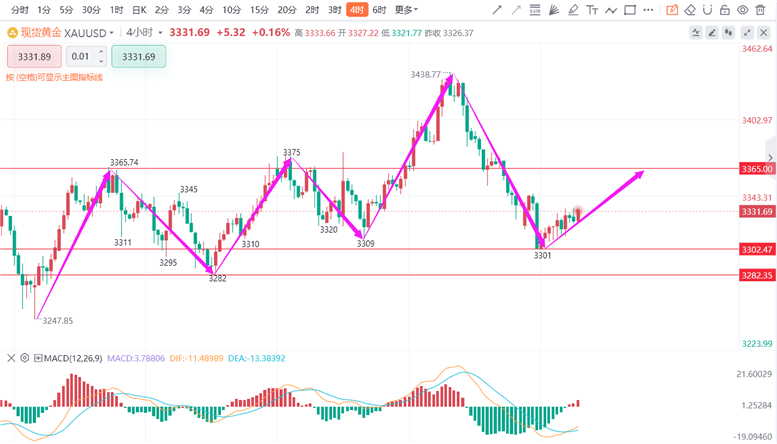
Market Overview - The current gold price is experiencing narrow fluctuations, trading around $3327.35 per ounce, following a rebound after hitting a low of $3302, the lowest since July 9 [2][4] - The market sentiment is shifting rapidly due to multiple key factors, including the upcoming Federal Reserve interest rate decision and ongoing US-China trade negotiations [2] Gold Price Analysis - After two days of low-level fluctuations, gold is showing signs of a potential rebound, with a recent high of $3345 and a closing price of $3326.35, indicating a possible bottom around $3300 [4] - Technical indicators suggest that if gold continues to rise, it could reach targets of $3350, $3375, and $3400 in the coming days, with a strong bullish outlook if the price breaks above $3332 [4] Domestic Futures Market - In the domestic futures market, the Shanghai gold contract (2512) saw a low of 770, with a subsequent rise to 777, indicating a bullish sentiment [5] - The Shanghai silver contract (2512) also showed a rebound from a low of 9150 to a high of 9280, with expectations of further increases towards 9400 and 9550 [5] Trading Strategy - The recommended trading strategy for gold is to maintain a bullish outlook, suggesting to buy around $3320 and add positions at $3315 [4] - A complete trading system is emphasized for long-term success, including position management, risk control, and technical analysis to navigate market fluctuations effectively [5]
中辉有色观点-20250730
Zhong Hui Qi Huo· 2025-07-30 01:43
1. Report Industry Investment Ratings - Not provided in the given content 2. Core Views of the Report - Gold: Adjustment for long - term strategic allocation due to potential dollar weakness, monetary policy easing, and continued gold purchases by countries, despite short - term uncertainties from geopolitics and trade negotiations [1] - Silver: Follow gold and copper adjustments, with long - term upward trend intact due to economic demand and fiscal stimulus, short - term adjustment to focus on support around 9050 [1] - Copper: Short - term struggle at the 79,000 psychological level, recommend dip - buying, long - term bullish due to global copper mine tightness [1][7] - Zinc: Short - term wait - and - see due to uncertain sentiment, long - term supply - increase and demand - decrease, look for short - selling opportunities on rallies [1][10] - Lead: Price rebound is under pressure due to inventory accumulation and weak downstream consumption [1] - Tin: Price rebound is under pressure due to slow复产 in Myanmar, weak supply - demand, and inventory accumulation [1] - Aluminum: Price rebound is under pressure due to high - level imports of bauxite and inventory accumulation in the off - season [1][12] - Nickel: Price rebound is under pressure due to weak demand and inventory accumulation [1][13] - Industrial Silicon: Likely to remain at a high level despite supply increase and demand drag [1] - Polysilicon: Likely to remain at a high level with strong cost support but limited spot trading [1] - Lithium Carbonate: Wide - range oscillation with supply - side risks, focus on 69,000 support [1][15] 3. Summaries by Related Catalogs Gold and Silver - **行情回顾**: Gold and silver prices oscillated at high levels due to the uncertain cease - fire in Russia - Ukraine and weak US data [2] - **基本逻辑**: Short - term tariff risks receded, but long - term gold bullish logic remains due to Fed rate - cut expectations, debt issuance acceleration, central bank gold purchases, and global order reshaping [3] - **策略推荐**: Focus on support around 760 for gold and 9100 for silver, maintain long - term views [4] Copper - **行情回顾**: Shanghai copper stopped falling and rebounded, back to the 79,000 level [6] - **产业逻辑**: Tight copper concentrate supply, increasing electrolytic copper production, weakening rod - making开工率, and potential impact of US tariff policies on exports [6] - **策略推荐**: Short - term dip - buying on copper, long - term bullish, focus on Shanghai copper range [78,000, 80,000] and London copper range [9700, 9900] [7] Zinc - **行情回顾**: Shanghai zinc stopped falling and oscillated narrowly [9] - **产业逻辑**: Abundant zinc concentrate supply in 2025, increasing refined zinc production, weak demand in the off - season [9] - **策略推荐**: Short - term wait - and - see, long - term short - selling on rallies, focus on Shanghai zinc range [22,400, 22,800] and London zinc range [2650, 2850] [10] Aluminum - **行情回顾**: Aluminum prices were under pressure, while alumina prices rebounded [11] - **产业逻辑**: High - level aluminum ingot and bar inventory in the off - season, weakening downstream开工率, and abundant alumina supply [12] - **策略推荐**: Short - term short - selling on aluminum rallies, focus on the range [20,000, 20,800] [12] Nickel - **行情回顾**: Nickel prices faced pressure on rebounds, while stainless steel prices rebounded slightly [13] - **产业逻辑**: Weak nickel supply - demand, inventory accumulation, and over - supply in the stainless steel market during the off - season [13] - **策略推荐**: Short - selling on nickel and stainless steel rallies, focus on the nickel range [120,000, 123,000] [13] Lithium Carbonate - **行情回顾**: The main contract LC2509 significantly reduced positions with a 6% decline [14] - **产业逻辑**: Inventory accumulation, production increase despite some corporate cut - offs, and potential impact of mining license risks [15] - **策略推荐**: Wait - and - see, focus on the 69,000 support level [15]
今日金价最新行情出炉,7月15日黄金还能涨多久?
Sou Hu Cai Jing· 2025-07-16 00:17
Group 1 - The core viewpoint is that gold is experiencing a resurgence as a safe-haven asset amid global economic uncertainty, with current international gold prices surpassing $3,370 per ounce, marking the largest single-day increase of the year [1] - The domestic gold price in China has reached 774.42 yuan per gram, reflecting a daily increase of over 5 yuan, which translates to a 0.67% rise [1] - There is a slight discrepancy between domestic and international gold prices, with a difference of 0.24 yuan per gram, influenced by factors such as exchange rate fluctuations and import costs [1] Group 2 - Various banks have set different prices for gold bars, with Industrial and Commercial Bank of China offering the highest at 794.76 yuan per gram, while other banks range from 787 to 789 yuan per gram [2] - Gold jewelry prices in retail stores are significantly higher, with brands like Chow Sang Sang and Chow Tai Fook priced at 1,012 yuan and 1,008 yuan per gram respectively, indicating a premium due to craftsmanship and brand value [2] - The recent rise in gold prices is attributed to increased global risk aversion and fluctuations in the US dollar, leading to higher demand for gold as a store of value [4] Group 3 - Investors are advised to consider gradual purchases of gold to mitigate risk, rather than investing all funds at once, and to wait for price corrections to average out investment costs [4] - The optimal time to sell gold is when domestic and international prices rise simultaneously, particularly when there is a daily increase of 5-10 yuan per gram, to avoid losses [6] - The potential recovery price for gold at retail stores may be lower than the market price, emphasizing the importance of timing in selling gold assets [6]
以伊停火暂缓中东“油阀”危机?油价坐上“跳楼机”,油气股跌麻了!
Ge Long Hui· 2025-06-24 05:59
Group 1: Market Reactions - The announcement of a potential ceasefire between Israel and Iran led to a significant drop in oil prices, with WTI and Brent crude oil falling nearly 9% and over 7% respectively [1] - In the Asia-Pacific market, WTI crude futures initially dropped over 5%, and as of the report, both WTI and ICE Brent crude were down over 2% [1] - Gold prices also saw a decline of 0.3% amid the easing geopolitical tensions [1] Group 2: Stock Performance - Hong Kong oil and gas stocks experienced sharp declines, with Baikin Oil Services plunging nearly 30%, Shandong Molong down over 18%, and Sinopec Oilfield Services falling over 14% [2][3] - In the A-share market, oil and gas service stocks also faced significant losses, with companies like Beiken Energy and Zhun Oil shares hitting the daily limit down [4] Group 3: Geopolitical Context - Trump's unilateral announcement of a ceasefire was met with skepticism, as both Israel and Iran did not confirm the agreement, with Iran's foreign minister stating no ceasefire "agreement" had been reached [6][8] - The ongoing conflict continued despite the announcement, with reports of missile attacks from Iran towards Israel [6] - The situation in the Strait of Hormuz, a critical oil shipping route, was highlighted, with previous threats from Iran to close it, which could have led to oil prices soaring to $120-$130 per barrel [11]




全球避险情绪升温!黄金何时迎来明朗趋势?能否再度挑战高点?阿汤哥正在实时分析订单流,点击观看
news flash· 2025-05-22 12:44
Group 1 - The article highlights the rising global risk aversion, indicating a potential increase in demand for gold as a safe-haven asset [1] - There is speculation about whether gold will challenge its previous high points again, suggesting a possible bullish trend in the near future [1] - Real-time analysis of order flow is being conducted to provide insights into market movements and investor sentiment regarding gold [1]
国际金价冲上3500美元,金价见顶需要具备哪些条件?
Sou Hu Cai Jing· 2025-04-22 23:38
Core Viewpoint - The international gold price has surged above $3,500, with a year-to-date increase of 30% and a monthly rise of nearly 10% [2] - The rise in gold prices is attributed to various factors, including increased central bank purchases, heightened global risk aversion, and rising inflation expectations [3] Group 1: Gold Price Trends - Since April 8, gold prices have rapidly increased from below $3,000 to $3,500 within two weeks, driven by fluctuating U.S. tariff policies [2] - Gold has entered a new bull market since 2016, with prices rising from $1,100 to $3,500 over nine years, showing performance comparable to the U.S. stock market [2] - The Dow Jones index has more than doubled from around 17,000 to 39,000, while the Nasdaq index has increased from 5,000 to 16,000 during the same period, indicating significant market growth [2] Group 2: Influencing Factors - The current bull market in gold is influenced by several factors, including the positive attitude of global central banks towards gold, increased risk aversion, and rising inflation expectations [3] - The instability of the U.S. tariff policy and potential challenges to the independence of the Federal Reserve have led to a decline in global trust in the U.S. dollar, driving up demand for gold [3] Group 3: Historical Context - Historical analysis shows that gold price cycles typically last around 10 years, with the current bull market starting in 2016, following previous cycles in 1971-1980 and 2001-2011 [4][3] - The adjustment cycles of gold prices lack clear patterns, with significant adjustments occurring after 1981 and a shorter adjustment period after 2011 [5] Group 4: Future Outlook - If the current upward trend continues, 2025-2026 may represent a critical turning point for the gold market, as it is currently in an accelerated upward phase [5] - Investors should analyze both fundamental and technical aspects to determine if the current bull market is ending, with a technical bear market indicated by a drop of over 20% from peak prices [6] - The ongoing influence of U.S. tariff policies and the Federal Reserve's independence will be crucial in shaping future gold price movements and market sentiment [6]