医保改革

Search documents
看好健康险的二次腾飞机遇:——《关于推动健康保险高质量发展的指导意见》点评
Shenwan Hongyuan Securities· 2025-10-10 11:09
Investment Rating - The report maintains an "Overweight" rating for the health insurance industry, indicating a positive outlook compared to the overall market performance [6][12]. Core Insights - The recent "Guiding Opinions on Promoting the High-Quality Development of Health Insurance" released by the regulatory authority marks a significant policy support for the health insurance sector, suggesting a favorable environment for growth [3][4]. - The report identifies four major categories of health insurance products: commercial medical insurance, long-term care insurance, disability income loss insurance, and critical illness insurance, each with specific development policies [4][5]. - The integration of health insurance with health management and the health industry is emphasized, promoting a comprehensive service system that includes prevention, management, and coverage [4]. - The report highlights the potential for health insurance products to experience a second wave of growth due to low interest rates and healthcare reforms, with commercial medical insurance expected to become a key product [6][7]. Summary by Sections Health Insurance Product Categories - The report categorizes health insurance into four types: 1. Commercial medical insurance: Actively developed with a focus on comprehensive coverage and risk matching 2. Long-term care insurance: Strongly promoted, emphasizing cash benefits and care services 3. Disability income loss insurance: Strongly promoted with an expanded coverage base 4. Critical illness insurance: Steadily developed with updates based on disease spectrum changes [4]. Policy Support and Innovations - The report outlines new policy measures, including: 1. Allowing well-rated insurers to offer dividend-type long-term health insurance 2. Supporting personal account-based long-term medical insurance 3. Encouraging innovative collaborations between insurance and pharmaceutical companies 4. Promoting group health insurance development [5]. Market Outlook - The report anticipates that health insurance products will benefit from a combination of low interest rates and evolving customer needs, leading to increased focus on protection-oriented products [6][7]. - Key companies recommended for investment include China Life, New China Life, China Pacific Insurance, China Ping An, and Sunshine Insurance, with a suggestion to pay attention to China Taiping [6].





E目了然 | 创新驱动与国际崛起下的医药投资机遇
Sou Hu Cai Jing· 2025-09-23 06:03
Core Insights - The pharmaceutical industry is experiencing a resurgence driven by innovation, favorable policies, and an aging population, positioning it as a key investment opportunity [2][5][6] Historical Market Review - The pharmaceutical sector has undergone multiple market cycles over the past fifteen years, with significant performance variations influenced by unique driving factors [2] - From 2009 to 2010, the industry saw a substantial rebound due to the "four trillion" policy, resulting in a 148.46% increase in the CSI Pharmaceutical Index, outperforming the Shanghai Composite Index's 54.22% rise [2][3] - Between 2013 and 2015, the sector faced stricter regulations, leading to a mixed performance where it did not outperform the ChiNext Index, although new themes like smart healthcare gained traction [3] - The period from 2019 to 2021 was marked by a strong performance driven by the pandemic, with the CXO Index surging 277.13% [3] - In 2024, the pharmaceutical sector faced challenges, with the CSI Pharmaceutical Index declining 14.53%, underperforming the CSI 300 Index [4] Current Investment Value Analysis - The current valuation of the pharmaceutical sector is considered reasonable after prior adjustments, with some indices showing attractive investment metrics [5] - Leading pharmaceutical companies are expected to maintain stable growth due to the commercialization of innovative drugs and steady performance in traditional drug segments [5] - The aging population is projected to drive increased healthcare demand, with 22.0% of the population aged 60 and above by the end of 2024 [5] - There has been a notable inflow of funds into the medical device sector, indicating growing market confidence in certain pharmaceutical sub-sectors [5][6] Policy Environment - The policy focus is shifting from cost control to innovation-driven growth, with reforms in the medical insurance payment system and expedited drug approval processes [6] - The National Medical Insurance Administration plans to expand the medical insurance drug list, which will benefit the industry's innovation and profitability [6] Innovation in Pharmaceuticals - Innovative drugs are becoming the focal point of the Chinese pharmaceutical industry, with significant advancements in areas like oncology and antibody-drug conjugates [7] - The total value of license-out deals for Chinese innovative drugs surpassed $60 billion in the first half of 2025, indicating a strong international presence [7] Investment Participation Strategies - Investors are encouraged to adopt a systematic investment approach to mitigate short-term volatility, as the pharmaceutical sector is characterized by long-term growth potential [9] - Focus on sectors with strong policy support and international expansion opportunities, such as innovative drugs and medical devices, is recommended [9]
2025医保改革对我们生活的影响
Sou Hu Cai Jing· 2025-09-23 00:57
Core Insights - The 2025 healthcare reform introduces broader reimbursement coverage and improved access to medical services while imposing new requirements on personal healthcare spending habits [1][7] Summary by Categories Changes in Account Structure and Outpatient Reimbursement - Personal account funds will decrease, with ordinary outpatient expenses included in the overall reimbursement system, reducing immediate financial burdens for minor illnesses but limiting discretionary spending in personal accounts [3] - Frequent healthcare users may benefit in the long term, while healthy individuals may notice a decrease in account contributions [3] Changes in Reimbursement Scope and Drug Directory - The drug directory will expand by adding 287 new medications, enhancing coverage for chronic disease medications, although some drugs and consumables will still require out-of-pocket expenses [3] - The financial burden for major and chronic disease medications will significantly decrease, but certain non-therapeutic drugs and specialized materials may incur higher personal costs [3] Improvements in Medical Access and Processes - The reform will facilitate mutual recognition of examination results, eliminate prepayment for outpatient services, promote cross-regional medical settlement, and encourage the use of electronic vouchers, leading to a smoother overall medical experience [3] - These changes aim to reduce the hassle of repeated examinations and waiting times, making it easier to seek care across different regions [3] Incentives and Constraints for Insurance Participation - Continuous participation in insurance and zero reimbursement from funds can increase the payment limits for major illness insurance, while interruptions in participation will lead to waiting periods for benefits [3] - The reform emphasizes the importance of stable insurance participation, with higher costs associated with lapses in contributions [3] Strategies to Adapt to New Changes - Individuals are encouraged to make rational decisions regarding medical expenses, such as discussing the cost-effectiveness of medical supplies with healthcare providers and prioritizing visits to community hospitals for common ailments [5] - Planning family healthcare strategies is advised, as personal account balances can now be used for immediate family members' medical expenses and potentially for purchasing supplementary commercial health insurance [5] - Continuous insurance participation is crucial, and individuals should stay informed about local policies to fully benefit from the reforms [5]

个人账户缩水28%?2.3万亿缺口待补,2025年委托投资扩至2.4万亿救局
Sou Hu Cai Jing· 2025-09-14 19:20
Core Viewpoint - The article discusses the challenges and potential solutions in China's healthcare insurance reform, particularly focusing on the imbalance in personal account funds between different age groups and the need for strategic investment to address a significant funding gap in the system [1][10]. Group 1: Structural Issues in Personal Accounts - By 2025, the contribution standard for employee health insurance personal accounts has decreased by 28% compared to historical peaks, with those under 35 seeing their contribution rate reduced to 2% [4]. - The aging population is leading to a significant disparity, with retirees having a hospitalization rate nearly four times that of currently employed individuals, while those over 80 have an average personal account balance of less than 200 yuan [4]. - In some developed regions, individual health insurance accounts have accumulated balances exceeding 120,000 yuan, exacerbating the intergenerational financial burden on the healthcare system [4]. Group 2: Investment Strategies and Fund Management - As of March 2025, the entrusted investment scale of the basic pension insurance fund has surpassed 2.4 trillion yuan, marking a 20% increase from the previous year [7]. - The investment strategy is shifting towards a higher allocation in equity assets, aiming to reach a policy limit of 15%, which could potentially generate an additional 180 billion yuan in annual investment returns based on historical market performance [7]. - Innovative mechanisms for regional balance, such as directing 30% of investment returns to cover current fund deficits, have already resulted in increased monthly benefits for retirees in certain provinces [7]. Group 3: Technological Enhancements in Oversight - The use of blockchain technology for real-time monitoring of investment projects has been implemented, covering 92% of investment activities and enabling rapid tracking of fund flows [8]. - A smart risk control system developed by a major state-owned bank successfully intercepted 23 potential abnormal transactions within three months, preventing over 800 million yuan in potential losses [8]. Group 4: Challenges and Future Trends - There exists a cognitive gap among younger insured individuals regarding the "family mutual aid" mechanism, with 43% believing that personal account funds are private property, which poses a challenge for reform implementation [9]. - The introduction of a dynamic adjustment mechanism for fund allocation will link the distribution of healthcare accounts to key indicators like aging rates, enhancing the system's adaptability [14]. - Future trends indicate a rise in service penetration rates, with community service stations expected to exceed 65%, and AI investment advisors managing over 40% of pension fund assets for personalized risk-reward matching [12].

推动医保报销待遇向基层医院倾斜,国务院发文→
第一财经· 2025-09-11 04:26
Core Viewpoint - The article emphasizes that the integration of the "three medical" systems and the downward flow of quality resources are key to addressing the weak capacity of grassroots medical services in China. The government plans to enhance medical insurance reimbursement for grassroots institutions and improve the linkage mechanism for medication between different levels of healthcare facilities [3][4]. Summary by Sections Implementation Plan Overview - The State Council has officially released the "Implementation Plan for Strengthening Basic Medical and Health Services," which aims to enhance the capacity of grassroots medical services during the 14th Five-Year Plan period. The plan is a crucial part of building a healthy China and promoting comprehensive rural revitalization [3][4]. Goals and Objectives - By 2027, the plan aims for a more rational layout of grassroots medical institutions, with a target for residents to reach the nearest medical service point within 15 minutes. By 2030, the service volume of county-level and below medical institutions is expected to increase significantly, and the construction of a hierarchical diagnosis and treatment system will show notable results [4]. Key Tasks - The plan outlines 12 key tasks focusing on system improvement, service optimization, strengthening disease control, and enhancing resource support. Specific targets include achieving a 70% management rate for hypertension and type 2 diabetes patients at the grassroots level by 2030 [4][5]. Financial and Resource Allocation - The plan encourages the participation of social medical institutions in government-purchased basic public health services. It sets quantitative indicators for improving grassroots diagnostic capabilities, such as ensuring that counties with a population of over 50,000 can perform cataract surgeries and dialysis by 2030 [5][6]. Incentives and Reforms - To enhance grassroots medical capabilities, the plan proposes various reforms, including adjusting medical service prices, reforming medical insurance payment methods, and establishing a dynamic adjustment mechanism for staffing. It aims to create a robust incentive mechanism for grassroots development [6][7]. Fiscal Support - The plan highlights the need for increased fiscal investment, ensuring that the government fulfills its financial responsibilities for public health institutions and basic public health services, with a focus on increasing funding for grassroots medical institutions [8].

迈瑞医疗(300760):国际持续高端突破 国内即将迎来拐点
Xin Lang Cai Jing· 2025-09-04 00:53
Core Viewpoint - The company reported a significant decline in revenue and net profit for the first half of 2025, with expectations of a market turnaround in the domestic sector and continued growth in international markets [1][2][3]. Financial Performance - In the first half of 2025, the company achieved operating revenue of 16.743 billion yuan, a year-on-year decrease of 18.45% - The net profit attributable to shareholders was 5.069 billion yuan, down 32.96% - The second quarter saw operating revenue of 8.506 billion yuan, a decline of 23.77%, and net profit of 2.440 billion yuan, down 44.55% [1]. Market Trends - Domestic market conditions are expected to improve in the third quarter of 2025, following a significant drop in medical equipment bidding data since December 2024, which affected revenue recognition cycles [2]. - The international market experienced a 5.39% year-on-year growth in the first half of 2025, with double-digit growth in the CIS and Middle East regions [2]. Business Segment Performance - The IVD segment generated revenue of 6.424 billion yuan, down 16.11%, but saw double-digit growth internationally, with international revenue accounting for 37% [2]. - The medical imaging segment reported revenue of 3.312 billion yuan, a decline of 22.51%, but international sales grew in the mid-to-high single digits, increasing its share to 62% [3]. - The life information and support segment achieved revenue of 5.479 billion yuan, down 31.59%, with international sales rising to 67% [3]. Profitability and Cost Structure - The company's overall gross margin decreased by 4.58 percentage points to 61.67% due to pricing pressures in the domestic market [4]. - The second quarter's gross margin was 60.84%, with a notable decline in overall net profit margin by 10.75 percentage points to 28.69% [4]. Future Outlook - Revenue projections for 2025-2027 are 37.189 billion yuan, 42.487 billion yuan, and 48.556 billion yuan, with expected growth rates of 1.26%, 14.25%, and 14.28% respectively [5]. - Net profit forecasts for the same period are 11.505 billion yuan, 13.590 billion yuan, and 15.910 billion yuan, with growth rates of -1.40%, 18.13%, and 17.07% respectively [5].

兴农评丨广东医保新政激活村医动能
Nan Fang Nong Cun Bao· 2025-08-09 11:05
Core Viewpoint - The new healthcare policy in Guangdong aims to enhance the capabilities of village health stations, thereby activating the professional motivation of rural doctors and providing a stronger health security framework for rural residents [6][8]. Group 1: Policy Initiatives - The Guangdong Provincial Medical Security Bureau issued a notification on August 6 regarding the reform of outpatient medical insurance payment methods, which includes multiple measures to support village health stations [6][7]. - The reform addresses the weak management of chronic diseases and accessibility issues in rural areas by innovating payment mechanisms and upgrading service models [10][11]. Group 2: Key Measures - The policy optimizes the per capita payment mechanism for ordinary outpatient services at village health stations, encouraging insured individuals to choose these stations as designated institutions [12]. - It promotes the sinking of outpatient services for specific diseases, prioritizing support for village health stations to manage high-demand chronic diseases like hypertension and diabetes [15][16]. - The initiative encourages rural doctors to join family doctor teams, expanding home services and long-term prescriptions to enhance healthcare accessibility for immobile villagers [18][19]. Group 3: Expected Outcomes - The per capita payment mechanism links rural doctors' income to the overall health status of signed villagers, promoting a shift towards the role of health "gatekeepers" [20]. - The sinking of chronic disease services directly addresses grassroots pain points, significantly reducing patients' medical costs [21]. - Family doctor services integrate healthcare deeply into rural life, achieving a more compassionate approach to health protection [22]. Group 4: Challenges Ahead - Despite the positive policy changes, challenges remain, such as inadequate medical equipment at village health stations and varying professional capabilities among rural doctors [23][24]. - There is a need for increased investment to address hardware shortcomings, improve rural doctors' compensation, and enhance professional training to ensure effective policy implementation [24][25].

“十四五”以来 医保基金累计支出12.13万亿元
Zheng Quan Ri Bao· 2025-08-08 07:05
Group 1 - The core viewpoint of the news is the progress and achievements of China's medical insurance reform during the "14th Five-Year Plan" period, emphasizing a people-centered approach and innovation in the healthcare system [1][2] - The basic medical insurance coverage rate remains stable at around 95%, with the number of insured individuals expected to reach 1.327 billion by 2024 [1] - The cumulative balance of the medical insurance fund is projected to be 3.86 trillion yuan by the end of 2024, with a total expenditure of 12.13 trillion yuan during the "14th Five-Year Plan" period, reflecting an annual growth rate of 9.1% [2] Group 2 - The medical insurance system has implemented various measures to enhance fund security, including a comprehensive regulatory framework and the recovery of 104.5 billion yuan in misused funds [2] - As of June 2025, 2.53 million people are enrolled in maternity insurance, with total expenditures reaching 438.3 billion yuan, benefiting over 96 million individuals [2] - The use of smart healthcare services has increased, with over 1.236 billion people using medical insurance codes for direct settlement, and the online service availability rate rising from 55% in 2020 to 92% in 2024 [3]
医药行业集采“反内卷”趋势与展望
2025-08-05 03:20
Summary of Key Points from the Conference Call on the Pharmaceutical Industry Industry Overview - The conference call discusses the pharmaceutical industry, particularly focusing on the impact of recent government policies regarding centralized procurement and price control measures [1][2]. Core Insights and Arguments 1. **Government Regulation and Price Control**: The National Development and Reform Commission (NDRC) and the State Administration for Market Regulation are intensifying controls on price wars across various industries, including pharmaceuticals, to combat deflation [1][2]. 2. **Impact of Medical Insurance Reform**: Medical insurance reforms have led to lower drug and consumable prices but have also caused issues such as production halts, quality declines, and reduced investment in innovative drug development [1][4]. 3. **Centralized Procurement Effects**: Centralized procurement has significantly reduced drug prices, with over 70% of drugs used in public hospitals procured through this method. However, this has resulted in production stoppages and quality issues for some companies [3][4]. 4. **Support for Innovative Drugs**: The government is implementing measures to support the development of innovative drugs, including optimizing procurement rules and ensuring the stability of clinical drug supplies [1][3][6]. 5. **Future Trends in Pricing**: The rate of price reductions for drugs and consumables is expected to slow down, with domestic alternatives becoming more prevalent as the price drop from centralized procurement decreases [2][11]. Additional Important Content 1. **Challenges Faced by Companies**: Many companies are facing losses due to aggressive price competition, which has led to a reluctance to participate in negotiations for new drug listings in the medical insurance directory [4][6]. 2. **Policy Changes in Procurement**: Future procurement rules may include dynamic adjustment mechanisms and a dual regulation system for reporting quantities, aimed at improving market fairness and encouraging genuine innovation [8][9]. 3. **Monitoring and Compliance Measures**: Enhanced supervision measures are being proposed, including strict checks on production lines and the establishment of a blacklist for companies with violations [10]. 4. **Market Dynamics for Medical Devices**: The competition in the medical device sector is characterized by malicious low-price competition, particularly in imaging equipment and orthopedic implants, but policy adjustments are expected to improve this situation [12][13]. 5. **Potential Inclusion of Anesthetic Drugs in Procurement**: The likelihood of anesthetic drugs being included in centralized procurement is low due to strict regulations and limited competition among manufacturers [17][18]. This summary encapsulates the key points discussed in the conference call, highlighting the current state and future outlook of the pharmaceutical industry in light of recent regulatory changes.
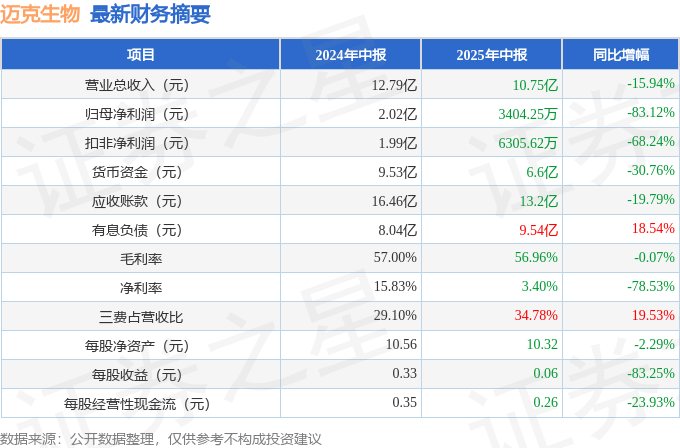
迈克生物2025年中报简析:净利润减83.12%,公司应收账款体量较大
Zheng Quan Zhi Xing· 2025-08-01 22:59
Core Viewpoint - The financial performance of Maike Biological (300463) for the first half of 2025 shows significant declines in revenue and net profit, raising concerns about the company's financial health and operational efficiency [1][4]. Financial Performance Summary - Total revenue for the reporting period reached 1.075 billion yuan, a year-on-year decrease of 15.94% [1]. - Net profit attributable to shareholders was 34.04 million yuan, down 83.12% year-on-year [1]. - In Q2 alone, total revenue was 565 million yuan, a decline of 14.76% compared to the same quarter last year [1]. - The gross margin was 56.96%, a slight decrease of 0.07% year-on-year, while the net profit margin fell to 3.4%, down 78.53% [1]. - Total expenses (selling, administrative, and financial) amounted to 374 million yuan, accounting for 34.78% of revenue, an increase of 19.53% year-on-year [1]. - Earnings per share were 0.06 yuan, a decrease of 83.25% year-on-year [1]. Balance Sheet Changes - Accounts receivable decreased by 15.53%, attributed to improved management and accelerated collection [2]. - Inventory increased by 14.85% to support the marketing of smart laboratories [2]. - Construction in progress rose by 12.34% due to increased investment in the Tianfu International Biological City IVD Industrial Park project [2]. Debt and Liabilities - Short-term borrowings increased by 30.04% due to financing needs [3]. - Long-term borrowings surged by 169.81% to fund the Tianfu International Biological City IVD Industrial Park project [3]. - Accounts payable rose by 20.29% due to increased raw material purchases [3]. Operational Insights - The company’s return on invested capital (ROIC) was 1.87%, indicating weak capital returns, with a historical median ROIC of 15.06% since its listing [7]. - The business model relies heavily on R&D, marketing, and capital expenditures, necessitating careful evaluation of capital projects [7]. Cash Flow and Receivables - The cash flow situation is concerning, with cash and cash equivalents covering only 92.95% of current liabilities [8]. - Accounts receivable have reached 1041.25% of net profit, indicating potential liquidity issues [8]. Future Projections - Analysts expect the company's performance in 2025 to yield a net profit of 264 million yuan, with an average earnings per share of 0.43 yuan [8]. - The Tianfu International Biological City IVD Industrial Park project, initially projected to generate an additional net profit of 438 million yuan annually, has faced delays and is now expected to be operational by mid-2025 [9].