可回收火箭技术

Search documents
商业火箭资本化加速-航天产业化变革启新
2025-12-29 15:51
Summary of Key Points from Conference Call Records Industry Overview: Commercial Aerospace - The domestic commercial aerospace industry is experiencing rapid capitalization, with several companies initiating IPO preparations, potentially accelerating listings to Q2 and Q3 of 2026 [1][5] - Reusable rocket technology is deemed crucial for the development of domestic commercial aerospace, with companies like Interstellar Glory and CAS Space planning their maiden flights and attempting first-stage recovery [1][6] - The domestic market is integrating market-oriented approaches with national systems to catch up with international standards, aiming to achieve global leadership in reusable technology [1][8] Key Developments and Predictions - The Shanghai Stock Exchange has introduced favorable listing standards for high-quality commercial aerospace companies, particularly those utilizing reusable rocket technology, requiring a minimum market value of 4 billion [2] - SpaceX's internal valuation is reported at $800 billion, with Ark Invest predicting a post-IPO market cap of $2.5 trillion, driven by expectations from Starlink and Starship [1][7] - Major satellite constellation projects, GW and Qianfan, are advancing rapidly, with Qianfan aiming to deploy 15,000 satellites by 2030 and GW planning at least 1,300 launches by 2030 [1][9] Technological Impact and Challenges - The success of reusable rocket technology is expected to significantly lower launch costs, thereby increasing market demand and frequency of commercial space missions [12] - The complexity and risks associated with technological innovation necessitate a degree of tolerance for potential failures during initial attempts at recovery [6] - Security challenges are emerging with the increasing intelligence of satellite payloads, necessitating enhanced management and protection measures [17] Infrastructure and Market Dynamics - The domestic capacity for satellite manufacturing has exceeded 3,000 units, supported by multiple state-owned and private enterprises [16] - Infrastructure developments include the establishment of commercial launch sites and demand-side investments in specialized networks, enhancing the overall commercial aerospace ecosystem [18] Investment Opportunities - Companies such as Aerospace Electronics, Fudan Microelectronics, China Satellite, and China Satcom are recommended for investment due to their strong market positions and liquidity [26] - The domestic market for large aircraft and engine manufacturing is identified as a significant investment theme for 2026, with companies like AVIC Xi'an Aircraft and Aero Engine Corporation of China presenting good opportunities [4][22] - The focus on military-to-civilian transitions and military trade is expected to drive growth, with specific recommendations for quartz fiber leaders and key players in the aerospace sector [28][29] Conclusion - The commercial aerospace sector is poised for significant growth driven by technological advancements in reusable rockets and satellite constellations, with various investment opportunities emerging as companies prepare for IPOs and expand their operational capabilities [1][26][29]


长征十二号甲首飞入轨成功,我国持续探索可回收火箭技术
Changjiang Securities· 2025-12-29 14:29
Investment Rating - The industry investment rating is "Positive" and maintained [8] Core Viewpoints - The successful launch of the Long March 12甲 rocket marks a significant step in China's exploration of reusable rocket technology, despite the failure to recover the first stage. This event lays a solid foundation for future reusable launches, which are expected to significantly reduce launch costs and accelerate the development of China's commercial space industry [10][11] - The report emphasizes that short-term setbacks are a necessary part of industry development, and as technology advances, the cost of rocket launches is likely to decrease, thereby promoting the growth of the commercial space sector. It is recommended to pay attention to key suppliers across the industry chain, particularly those related to satellite applications [10][11] Summary by Sections Event Description - On December 23, at 10:00 AM, the Long March 12甲 rocket was launched from the Dongfeng Commercial Space Innovation Test Area, successfully placing its second stage into the designated orbit, although the first stage was not successfully recovered. The flight test was deemed a basic success [5][10] Event Commentary - The Long March 12甲 rocket, designed for "first-stage reuse," is approximately 70.4 meters long and weighs about 437 tons. Although the first stage recovery was not achieved, valuable data was collected for future launches. The report highlights that reusable technology will greatly enhance rocket capacity and reduce average launch costs, supporting the acceleration of satellite constellation deployment [10][11] - The report notes that both state-owned and commercial space sectors are progressing together, with various companies working on reusable rockets across different payload capacities and technologies, which will complement China's aerospace industry [10][11]
北交所科技成长产业跟踪第五十七期(20251228):11-12月商业航天产业迎来密集催化,关注北交所商业航天产业链标的
Hua Yuan Zheng Quan· 2025-12-29 03:32
Group 1: Policy and Industry Development - The Shanghai Stock Exchange has introduced new listing standards for commercial rocket companies, facilitating their entry into the Sci-Tech Innovation Board during a critical period of commercialization [6][7]. - The National Space Administration has issued a plan to promote high-quality and safe development of commercial aerospace, outlining 22 key measures to support the industry [7][9]. - In Q1-Q3 2025, China conducted 17 commercial space launches, with projections indicating that the commercial aerospace market could exceed 9 trillion yuan by 2030 [16][28]. Group 2: Market Performance and Trends - The average stock price change for technology growth stocks on the Beijing Stock Exchange was -2.24% from December 22 to December 26, 2025, with notable increases in companies like Guangdao Tui (+74.8%) and Fangsheng Co. (+15.97%) [2][3]. - The average price-to-earnings (P/E) ratio for the automotive industry on the Beijing Stock Exchange decreased to 30.6X, while the electronic equipment sector's P/E ratio fell to 55.9X [2][3]. - The commercial aerospace industry is experiencing a structural shift, with the proportion of commercial launches increasing from approximately 13% in 2020 to over 60% in 2024, indicating a growing role of commercial entities in driving industry growth [27][32]. Group 3: Key Companies in Commercial Aerospace - The report identifies 13 core companies in the commercial aerospace sector on the Beijing Stock Exchange, including software systems like Xingtou Measurement and Control, and component manufacturers such as Tianli Composite and Fujida [50][56]. - Notable companies in the aerospace materials sector include Jilin Carbon Valley, Minshida, and Kelong New Materials, which are contributing to advancements in high-performance materials [56]. - The report highlights the competitive landscape, with private companies like Blue Arrow Aerospace and Xingshe Power making significant strides in rocket development and launch services [42][45].
商业航天2025:拐点前夜的助攻、躁动与可回收验证冲刺
Tai Mei Ti A P P· 2025-12-29 00:08
Core Insights - The article discusses the rapid development and transformation of China's commercial space industry, highlighting the significant policy support and market dynamics that are shaping its future [2][4][6]. Policy Support - The Chinese government has introduced a series of "nuclear bomb" level policies to support the commercial space sector, marking 2025 as a pivotal year for the industry [4][6]. - The 14th Five-Year Plan identifies commercial space as a key strategic emerging industry, with the establishment of a 20 billion yuan national fund to support its development [6][9]. - Various local governments have also implemented targeted measures to promote the growth of the commercial space industry [10]. Market Dynamics - The commercial space sector is experiencing unprecedented capital market activity, with significant stock price increases and a surge in IPO applications from leading companies [11][12]. - The commercial space index has seen a remarkable increase of 60.12% in 2025, outperforming the Shanghai Composite Index [16][18]. - The number of registered commercial space-related companies in China has surged, with over 24,800 new registrations in 2025 alone, reflecting a 57.5% increase compared to the previous year [19]. Technological Challenges - Despite the excitement, the industry faces critical challenges, particularly in achieving cost reductions through rocket reuse, which remains a key hurdle [3][28]. - The successful implementation of reusable rocket technology is essential for reducing launch costs by approximately 38%-58% [28][44]. - The industry is also exploring advanced manufacturing techniques, such as 3D metal printing, to further reduce costs and improve production efficiency [31][32]. Competitive Landscape - The competition in the commercial space sector is intensifying, with a focus on low Earth orbit satellite constellations and space computing capabilities [37][45]. - The upcoming IPO of SpaceX, with a projected valuation of $1.5 trillion, is expected to set a new benchmark for the global commercial space industry, influencing domestic players [34][36]. - China's commercial space industry is characterized by a dual structure of state-owned and private enterprises, with private companies expected to fill the capacity gaps left by state-owned entities [42]. Future Outlook - The successful validation of reusable rocket technology and the establishment of a commercial closed-loop system are critical for the industry's long-term sustainability [44][46]. - The development of space computing capabilities is seen as a potential breakthrough for the commercial space sector, offering new revenue streams and competitive advantages [45][46].


机械行业周报:看好商业航天和机器人-20251228
SINOLINK SECURITIES· 2025-12-28 11:20
Investment Rating - The report does not explicitly state an investment rating for the industry Core Insights - The SW Machinery Equipment Index increased by 4.50% in the last week, ranking 6th among 31 primary industry categories, while the CSI 300 Index rose by 1.95% [3][13] - Year-to-date, the SW Machinery Equipment Index has risen by 39.84%, also ranking 6th, compared to an 18.36% increase in the CSI 300 Index [3][16] - The report highlights the urgency of launching reusable rockets to secure space resources, predicting that 2026 will be a pivotal year for reusable rocket launches [5][22] - The acquisition of a 43% stake in Fenglong by UBTECH is noted as a significant move in the humanoid robot sector, emphasizing the importance of capital market opportunities [5][30] Summary by Sections 1. Stock Portfolio - Recommended stocks include Chaojie Co., Bluelight, and Hengli Hydraulic [11] 2. Market Review - The SW Machinery Equipment Index's performance over the last week and year-to-date is detailed, showing significant growth compared to the broader market [3][16] 3. Core Insights Update 3.1 Urgency in Rocket Launches - The report discusses the competitive landscape of satellite launches, particularly focusing on SpaceX's Starlink and the need for China to enhance its commercial rocket capabilities [5][22][24] - The cost structure of rockets is analyzed, emphasizing the importance of reusable technology in reducing launch costs [27][29] 3.2 UBTECH's Acquisition of Fenglong - UBTECH's strategic acquisition is positioned as a move to strengthen its humanoid robotics capabilities, with a focus on mass production and cost efficiency [5][30] 4. Key Data Tracking 4.1 General Machinery - The general machinery sector is under pressure, with the PMI indicating a contraction [32] 4.2 Engineering Machinery - The engineering machinery sector is experiencing an upward trend, with excavator sales showing significant growth [41][43] 4.3 Railway Equipment - The railway equipment sector is stable, with consistent investment growth [49] 4.4 Shipbuilding - The shipbuilding sector is experiencing a slowdown, with new ship price indices showing a decline [52] 4.5 Oil Service Equipment - The oil service equipment sector is stabilizing, with positive developments in the Middle East [54] 4.6 Industrial Gases - The industrial gases sector is expected to benefit from improved steel profitability and increased demand [59] 4.7 Gas Turbines - The gas turbine sector is showing robust growth, with significant order increases reported [61]


天龙三号可回收火箭即将首飞,运力水平接近SpaceX,国产技术有望迎来突破
Jin Rong Jie· 2025-12-26 01:53
Group 1 - The core viewpoint of the articles highlights the advancements in China's commercial space industry, particularly with the upcoming maiden flight of the Tianlong-3 reusable rocket, which boasts a length of 72 meters and a near-Earth orbit capacity of 17 tons, marking significant improvements over competitors like the Zhuque-3 and Long March 12A rockets [1][2] - The Tianlong-3's specifications indicate a breakthrough in heavy rocket manufacturing and reusable technology, with its 17-ton capacity approaching international standards, such as SpaceX's Falcon 9, which has a capacity of approximately 23 tons [1] - The recent progress of other reusable rockets, such as Zhuque-3 and Long March 12A, reflects an industry-wide verification phase, accelerating the iteration of domestic reusable rocket technology and promoting upgrades in core components like rocket structure, engines, and control systems [1] Group 2 - The Chinese government has emphasized the goal of becoming a "space power" in its 14th Five-Year Plan, with expectations for a series of policies to be introduced in the aerospace sector [2] - The commercial space industry in China has seen a significant increase in launch activities, with nearly 90 launches completed this year, indicating a rapid development phase for the domestic commercial space sector [2] - Projections suggest that the global commercial space market will exceed $700 billion by 2025, while China's market is expected to reach 2.8 trillion yuan, highlighting the growth potential in this sector [2] - The development of reusable rockets is anticipated to lower launch costs, thereby stimulating demand across the supply chain, including high-end materials, rocket engines, satellite internet, and application services [2]
傻了吧???
债券笔记· 2025-12-25 11:53
Group 1: Equity Market - The commercial aerospace sector is experiencing a strong rebound, with a significant increase in global launches, totaling 325 this year and 4,026 satellites placed into orbit, including 87 launches from China, of which 23 were by private companies [3][4] - The cost of launches has dramatically decreased due to reusable rocket technology, transforming satellites from "luxury items" to "affordable networking products" [4] - The high frequency of launches is driving industrialization and standardization in satellite manufacturing, leading to efficiency upgrades [4] Group 2: Macro and Fixed Income - The bond market shows clear differentiation, with short-term stability and long-term uncertainty, as evidenced by a 0.25 basis point increase in the 10-year government bond yield and a 0.2 basis point decrease in the 30-year yield [7] - A new housing policy in Beijing reduces the social security requirement for non-local residents, allowing for easier access to home purchases [7] - China's foreign trade has reached a milestone, with a trade surplus of $1.08 trillion in the first 11 months of 2025, a 21.7% year-on-year increase, driven by exports of electric vehicles, lithium batteries, and photovoltaic products [7]

商业航天腾飞:Q1迎接更大进展,十五五攻坚开启
2025-12-24 12:57
Summary of Key Points from the Conference Call Industry Overview - The Chinese commercial space industry is rapidly developing, aiming to achieve a total of 4,000 tons of in-orbit spacecraft quality by 2030, requiring hundreds of launches annually [1][2] - The Long March 10B rocket is expected to have its maiden flight in April next year, while the Long March 10A rocket plans to conduct recovery tests, indicating China's efforts to catch up with international standards [1][2] Core Insights and Arguments - Successful launches of Long March 12A and Zhuque 3 rockets have demonstrated strong commercial potential, although complete success in first-stage recovery was not achieved [4] - The need for new launch sites using non-toxic fuels is critical, with ongoing constructions in Hainan and Lianli Island to meet increasing demand [6][7] - Reusable technology is essential for cost reduction, with a target to lower transportation costs to $2,000-$3,000 per kilogram from the current $5,000-$10,000 [7] - Private companies like Blue Origin and Galactic Glory are actively participating in the commercial space sector, injecting innovation into the industry despite some project delays [8] Challenges and Future Directions - China faces challenges in reusable rocket technology, primarily due to insufficient experimental data regarding engine performance in recovery conditions [5] - Future improvements will include testing new engines in Long March 12B and exploring novel recovery methods like net recovery [5] - The commercial space sector is expected to grow significantly, with projections of 100 rocket launches annually by 2030, compared to SpaceX's anticipated 150 launches in 2025 [2] Investment Opportunities - Investment opportunities in the rocket supply chain are emerging, particularly in companies that are vertically integrated and developing their engines, such as Blue Arrow and Tianbing [10] - The shift towards reusable rockets may reduce the demand for new engines but increase the need for maintenance and reassembly services [11] - China's rocket companies, like China Rocket and Yuanshen, are gaining attention due to asset securitization and significant orders for rockets like Long March 8A [15][16] Market Dynamics - The U.S. market features key players like SpaceX's Falcon 9 and Blue Origin's New Glenn, with a trend towards large, low-cost rockets expected by 2030 [9] - Starlink, a major player in satellite internet, is projected to generate approximately $15 billion in annual revenue, with significant competition from Amazon's LEO project [3][17] Conclusion - The Chinese commercial space industry is poised for rapid growth, with significant investments and technological advancements expected in the coming years. However, challenges related to reliability and production capacity must be addressed to achieve the ambitious goals set for 2030 [24][25]
超捷股份(301005) - 2025年12月23日投资者关系活动记录表
2025-12-23 13:10
Group 1: Automotive Business Overview - The company focuses on the research, production, and sales of high-strength precision fasteners and special connectors, primarily used in automotive engine turbocharging systems, transmission control systems, exhaust systems, and key components of electric vehicles [2] - The automotive business has seen steady revenue growth, driven by the expansion of overseas markets and new customer development, including partnerships with major clients like NIO and BYD [9][10] - The gross margin of the automotive business has declined due to factors such as rising material costs and increased depreciation from new projects, but profitability is expected to improve in 2026 [11] Group 2: Commercial Aerospace Business Overview - The commercial aerospace sector is expanding, with the company manufacturing rocket structural components, including body segments and fuel tanks, and has completed production line construction in 2024 [3] - The company has a production capacity of 10 rockets per year and is building a second production line to meet increasing demand [3] - Structural components account for approximately 25% of the cost of a commercial rocket, indicating significant market potential [3] Group 3: Market Dynamics and Competitive Landscape - The commercial aerospace industry is experiencing a supply-demand imbalance, with limited suppliers capable of large-scale delivery, particularly in key regions [3] - The company has established stable relationships with leading private rocket companies, enhancing its competitive edge through experienced personnel and resource advantages [3][4] - The demand for rocket structural components is expected to grow, driven by increased launch frequency and the maturation of reusable rocket technology [6][7] Group 4: Future Outlook and Strategic Initiatives - The company is actively expanding its customer base in the commercial aerospace sector and anticipates new clients entering into bulk cooperation by Q1 2026 [5][6] - The development of reusable rocket technology is expected to enhance launch frequency and operational efficiency, creating new business opportunities for the company [7] - The company is conducting feasibility studies for fuel tank production lines, aiming to align with market trends and customer needs [8]
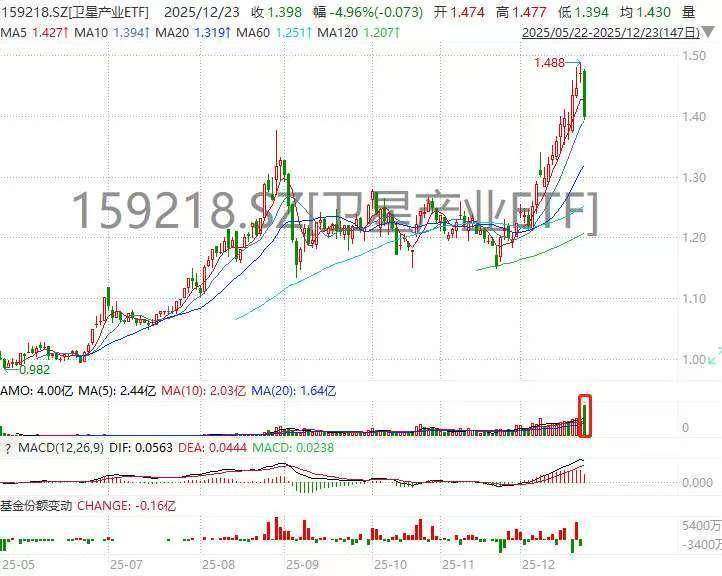
突破了!卫星产业ETF(159218)盘中成交站上4亿历史大关,中国卫星跌5.36%
Sou Hu Cai Jing· 2025-12-23 07:12
分析称,资金对卫星产业的长期看好,基于产业基本面的三重破局: 应用破局:国家设定"千万用户"发展目标,卫星通信功能正加速向大众消费市场普及。 12月23日,延续强势的卫星板块盘中震荡下探。数据显示,截至14时44分,卫星产业ETF(159218)放量 跌5.03%,前几大权重股方面,航天电子跌9.71%,中国卫星跌5.36%,中科星图跌4.98%,中国卫通跌 9.65%。交投持续升温,成交站上4亿历史大关,环比前日放量118.60%,资金热度不减,据Wind Level2 实时行情结合均价预估,盘中净流入约1.1亿。 尽管回收环节遭遇挫折,但本次发射的核心入轨成功,意味着我国在可回收火箭这一关键技术上取得了 实质性突破。它验证了技术路线的可行性,为后续迭代提供了宝贵数据,并未动摇产业"制度-技术-应 用"共振的长期逻辑。对于普通投资者而言,卫星产业ETF(159218)仍是布局这一高确定性长周期赛 道的高效工具。 风险提示:基金有风险,投资需谨慎。 制度破局:国家航天局近期设立"商业航天司",发布商业航天行动计划,从顶层设计推动产业发展。 技术破局:长征十二号甲与月初民营火箭"朱雀三号"的成功入轨,共同验证可 ...