
欧洲央行货币政策

Search documents
欧元区二季度薪资加速增长 欧洲央行暂停降息获支持
智通财经网· 2025-08-22 10:53
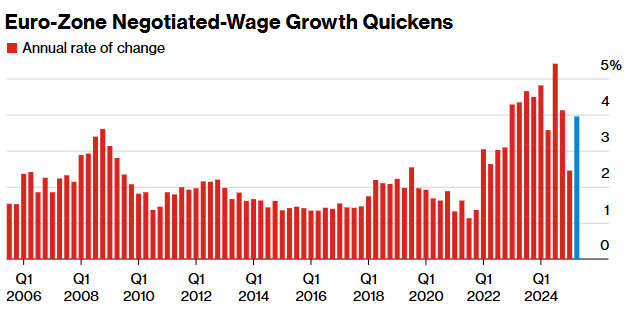
Group 1 - A key indicator measuring wage growth in the Eurozone has significantly increased, prompting the European Central Bank (ECB) to maintain a cautious stance on further rate cuts [1][4] - In the second quarter, negotiated wages rose by 4% year-on-year, up from 2.5% in the first quarter, but still below the peak of 5.4% expected in 2024 [1][4] - The ECB is confident in stabilizing inflation at 2%, based on expectations that wage growth will slow and inflation in labor-intensive service sectors, currently around 3%, will also decline [1] Group 2 - Data tracking wages across 20 Eurozone member countries indicates a significant decline in wage levels is expected by early next year [4] - Despite a substantial increase in wages reported by the German central bank, a decline is anticipated due to falling inflation rates and a poor economic environment [4] - Bloomberg economist Martin Ademmer suggests that the rise in negotiated wage growth may be temporary, driven by one-time payments, and expects wage pressures to ease in the coming quarters, which could help lower high service sector inflation [4]

欧元区8月PMI数据好于预期 经济展现韧性但挑战犹存
Huan Qiu Wang· 2025-08-22 02:21
Group 1 - Eurozone composite PMI rose from 50.9 in July to 51.1 in August, exceeding analyst expectations of 50.6 [2] - Manufacturing PMI increased from 49.8 to 50.5, marking the first time since June 2022 that it surpassed the neutral level of 50, also above the expected 49.5 [2] - Service sector PMI slightly decreased to 50.7 but remained in the expansion zone [2] Group 2 - Germany's composite PMI unexpectedly accelerated to a five-month high of 50.9, with manufacturing PMI jumping to 49.9, nearing expansion territory [2] - Manufacturing output index in Germany rose to 52.6, indicating growth [2] - France's composite PMI improved from 47.4 to 49.8, although still below the neutral line, it was better than expected [2] Group 3 - The impact of US trade policies is becoming evident, with Eurozone manufacturing foreign orders declining for the second consecutive month, influenced by US tariff policies [3] - European Central Bank President Christine Lagarde noted that the new 15% tariff on most EU goods is slightly higher than previous predictions but lower than more severe scenarios [3] - Recent PMI data provides more evidence for ECB policymakers, with expectations that the ECB will maintain the key deposit rate at 2% in September [3]
就市论市丨关税冲击叠加美联储年会将至 欧股和欧元如何走向?
Sou Hu Cai Jing· 2025-08-19 06:34
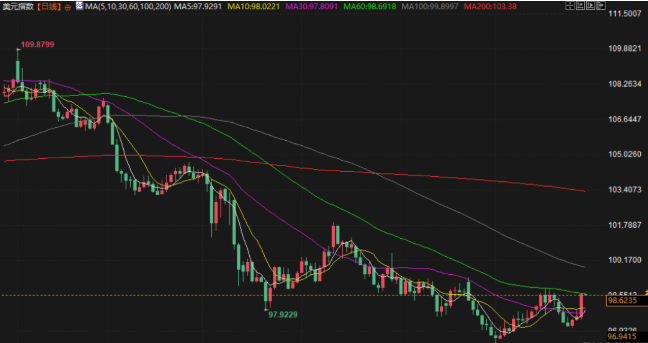
Group 1 - Recent trade agreement between the US and EU on tariffs is expected to weaken the EU's export competitiveness, potentially dragging down economic growth prospects in the region [1] - The outcome of US-EU tariff negotiations raises questions about whether the Federal Reserve's monetary policy will influence the European Central Bank's decisions [1] - Despite the challenges, the European economy shows resilience, and the weak dollar environment may provide value for European equities [1] Group 2 - There is a cautious market expectation regarding interest rate cuts from the European Central Bank and the Bank of England within the year [1] - Investment in growth sectors within the Eurozone remains insufficient, indicating a potential area of concern for future economic performance [1] - A global shift in investment portfolios towards Europe is anticipated to support the euro [1]
法德通胀升温叠加美联储按兵不动 欧洲央行降息概率骤减
Zhi Tong Cai Jing· 2025-07-31 11:03
Core Viewpoint - The market expectations for the European Central Bank's (ECB) interest rate policy have significantly shifted, with traders now believing that the ECB will maintain the 2% benchmark rate until the end of the year, reducing the likelihood of a 25 basis point rate cut to less than 50% [1][2] Group 1: ECB Rate Policy - Since initiating the rate cut cycle in June last year, the ECB has lowered the benchmark rate by a total of 200 basis points to the current level [1] - The ECB's decision to pause the rate cut cycle is supported by recent economic data, including a 0.1% quarter-on-quarter GDP growth and a 1.4% year-on-year increase in the Eurozone's GDP [1] - The Eurozone's June CPI showed a year-on-year increase of 2%, slightly up from the previous value of 1.9%, aligning with the ECB's target inflation rate [1] Group 2: Influencing Factors - The Federal Reserve's policy direction significantly impacts the ECB's decisions, with Fed Chair Jerome Powell emphasizing that future policy will be "fully data-dependent" [2] - Recent inflation indicators from parts of France and Germany have shown slight rebounds, contributing to the adjustment of market expectations [2] - There are internal divisions within the ECB regarding further rate cuts, with dovish officials advocating for cuts if economic growth underperforms, while hawkish officials believe the current inflation slowdown is in line with expectations [2]
万腾外汇:美元周一强势反弹 阶段性修复还是新一轮升值周期起点?
Sou Hu Cai Jing· 2025-07-29 11:04
Group 1 - The core point of the articles is the strengthening of the US dollar against major currencies, particularly the euro and yen, driven by a recent US-EU tariff agreement that signals a reduction in global trade tensions [1][3]. - The dollar's rise against the euro exceeded 1.2% in a single day, marking the largest increase since mid-May, while it rose 0.59% against the yen, indicating a shift in investor sentiment from risk aversion to optimism regarding the US economy [1][3]. - The euro has notably declined, with the euro to dollar exchange rate dropping to 1.1591, erasing all gains since July, reflecting a lack of clear direction in European monetary policy despite some recovery in manufacturing data [3][4]. Group 2 - The upcoming meetings of the Federal Reserve and the Bank of Japan are expected to be crucial in determining short-term currency trends, with market expectations leaning towards no changes in policy [4]. - The current yield on US two-year bonds has risen to 3.93%, providing support for the dollar against lower-yielding currencies, which is a key factor in maintaining the dollar's strength [4]. - Political pressures on the Federal Reserve, including calls for interest rate cuts, may impact market perceptions of the Fed's independence and policy credibility, influencing the dollar's risk premium [4].
【财经分析】欧元区经济数据回暖但危机仍存 欧洲央行按兵不动以观形势演变
Xin Hua Cai Jing· 2025-07-25 13:52
Group 1 - The Eurozone PMI rose to an 11-month high in July, indicating a mixed economic outlook with services expanding while manufacturing remains in contraction [1][2] - The July composite PMI increased from 50.6 in June to 51.0, suggesting a slight recovery in demand, particularly in the services sector [2][3] - Manufacturing output in the Eurozone saw a significant increase in May, driven by a 27.7% rise in pharmaceutical production, although this growth was concentrated in Ireland [2][4] Group 2 - The German composite PMI stood at 50.3, with manufacturing PMI at 49.2 and services PMI at 50.1, indicating a fragile economic environment [3][4] - France's composite PMI rose to 49.6 but remained below the critical threshold of 50, marking 11 consecutive months of decline, influenced by political controversies [3][4] - Spain's services sector continued to lead with a PMI above 54, while Ireland's manufacturing PMI increased to 53.7, although its services sector showed signs of slowing [3][4] Group 3 - The European Central Bank (ECB) maintained key interest rates amid economic uncertainty and rising tariff risks, with the deposit facility rate at 2.00% and the main refinancing rate at 2.15% [4][5] - The ECB's monetary policy decisions are heavily influenced by trade-related uncertainties, which are affecting business and consumer behavior [4][5] - The Eurozone's GDP growth for Q2 was reported at 0.6%, with future growth dependent on upcoming economic indicators and the outcome of tariff negotiations [4][5]
综述|欧洲央行维持利率不变 关税谈判加剧政策不确定性
Xin Hua She· 2025-07-25 08:16
Group 1 - The European Central Bank (ECB) decided to maintain key interest rates unchanged, marking the first pause in rate cuts since June of the previous year, amid moderate economic growth and inflation reaching the 2% target [1][2] - The ECB's deposit facility rate, main refinancing rate, and marginal lending rate remain at 2.00%, 2.15%, and 2.40% respectively, with inflation forecasts for 2025 and 2027 set at 2.0% and 2026 at 1.6% [1] - The uncertainty surrounding US-EU trade negotiations, particularly the potential for tariffs up to 30% on EU goods, is a significant external factor impacting the ECB's policy space [1][2] Group 2 - Analysts suggest that the ongoing trade negotiations are affecting corporate decision-making and may lead to a shift in production capacity towards the eurozone, potentially lowering product prices and increasing price instability [2] - The ECB's assessment indicates a 0.6% quarter-on-quarter growth in actual GDP for the eurozone in Q1, driven by preemptive shipping by businesses and stronger consumption and investment [2][3] - The July Purchasing Managers' Index (PMI) for the eurozone rose to 51 from 50.6 in June, indicating a notable expansion in the services sector, although manufacturing remains in contraction [2]
欧元兑英镑涨幅扩大至0.4%,刷新4月份以来高位至0.87%。彭博此前援引知情人士报道称,欧洲央行内部鸽派决策者们面临阻力,现阶段对9月份的基本假设是“继续按兵不动”。
news flash· 2025-07-24 15:59
Group 1 - The euro has appreciated against the pound, increasing by 0.4% to reach a high of 0.87%, the highest level since April [1] - Bloomberg reported that dovish policymakers within the European Central Bank are facing resistance, with the current assumption for September being to "remain on hold" [1]
欧洲央行官员们的基本假设是,9月份再次按兵不动。他们称,那些寻求再次降息的人(与会的决策者)面临一场战斗。(彭博)
news flash· 2025-07-24 15:33
Core Viewpoint - European Central Bank officials are expected to maintain the current interest rates in September, indicating a struggle among decision-makers who advocate for further rate cuts [1] Group 1 - ECB officials believe that those advocating for another rate cut will face significant opposition [1]
欧洲央行维持利率不变 行长拉加德称央行处于“观望”模式
news flash· 2025-07-24 15:27
Core Viewpoint - The European Central Bank (ECB) is currently in a "wait-and-see" mode, having maintained interest rates for the first time in over a year due to uncertainties in U.S. trade policy [1] Interest Rates - The ECB has kept the deposit rate at 2%, aligning with analysts' predictions [1] - This decision reflects a cautious approach amid unclear future tariff levels [1] Inflation and Economic Position - With inflation reaching 2%, the ECB believes it is in a favorable position to observe how risks develop in the coming months [1] - ECB President Lagarde emphasized the importance of monitoring future economic conditions before making further policy adjustments [1]