算力芯片

Search documents
科创50ETF指数(588040)涨近3%,八部门发文推进“人工智能+制造”专项行动
Xin Lang Cai Jing· 2026-01-08 02:23
Group 1 - The core viewpoint of the news highlights the strengthening of the computing chip concept in the early market, driven by the Ministry of Industry and Information Technology and eight other departments issuing the "Implementation Opinions on the Special Action of 'Artificial Intelligence + Manufacturing'" [1] - The document emphasizes the need to enhance the supply of artificial intelligence computing power and promote the coordinated development of intelligent chips, supporting breakthroughs in key technologies such as high-end training chips, edge inference chips, AI servers, high-speed interconnects, and intelligent cloud operating systems [1] - East China Securities points out that the domestic trend of AI and computing chip localization continues, with companies like Moer Thread and Muxi Co. set to list on the STAR Market in December, while others like Tian Shuzhixin and Biran Technology are pushing for listings in Hong Kong [1] Group 2 - As of January 8, 2026, the STAR Market 50 Index (000688) saw a strong increase of 1.88%, with notable gains from stocks such as Haiguang Information (688041) up 11.25% and Zhongkong Technology (688777) up 5.74% [1] - The STAR Market 50 ETF Index (588040) rose by 2.93%, marking a fourth consecutive increase, with the latest price reported at 1.51 yuan [1] - The STAR Market 50 Index consists of 50 securities with large market capitalization and good liquidity, reflecting the overall performance of the most representative innovative enterprises in the market [2]
算力芯片概念盘初走强 海光信息涨近10%
Xin Lang Cai Jing· 2026-01-08 01:39
Group 1 - The core viewpoint of the article highlights a strong performance in the computing chip sector, with notable gains in stock prices for several companies [1] Group 2 - Haiguang Information saw an increase of nearly 10% in its stock price [1] - Other companies such as Huadong Heavy Machine, Dongxin Co., Yuntian Lifeng, Cambricon, and Moer Thread also experienced significant upward movement [1]

科创100ETF华夏(588800)涨超2.3%,半导体板块领涨市场
Xin Lang Cai Jing· 2026-01-05 03:53
Group 1 - The Shanghai Stock Exchange Sci-Tech Innovation Board 100 Index (000698) rose by 2.30% as of January 5, 2026, with notable increases in constituent stocks such as BeiGene (688235) up 10.56%, Chengdu Huami (688709) up 10.46%, and Huashu High-Tech (688433) up 7.57% [1] - The semiconductor industry chain experienced a strong upward trend, driven by announcements from companies like Huahong Semiconductor regarding the acquisition of a 97.5% stake in Huali Microelectronics and Zhongwei's plan to acquire a 64.69% stake in Hangzhou Zhonggui Electronics [1] - Aijian Securities highlighted that the domestic semiconductor industry chain is making significant progress in core equipment, materials, and software, supported by national policies and international dynamics, particularly in the third-generation semiconductor materials, computing power chips, RF communication chips, and high-bandwidth storage sectors [1] Group 2 - The Sci-Tech Innovation 100 ETF (588800) closely tracks the Sci-Tech 100 Index, which is the first and only mid-cap style index on the Sci-Tech Innovation Board, focusing on high-growth technology companies, particularly in the semiconductor, pharmaceutical, and new energy sectors [2]
76只翻倍基创近五年新高,“两倍基”重现江湖
第一财经· 2026-01-05 00:48
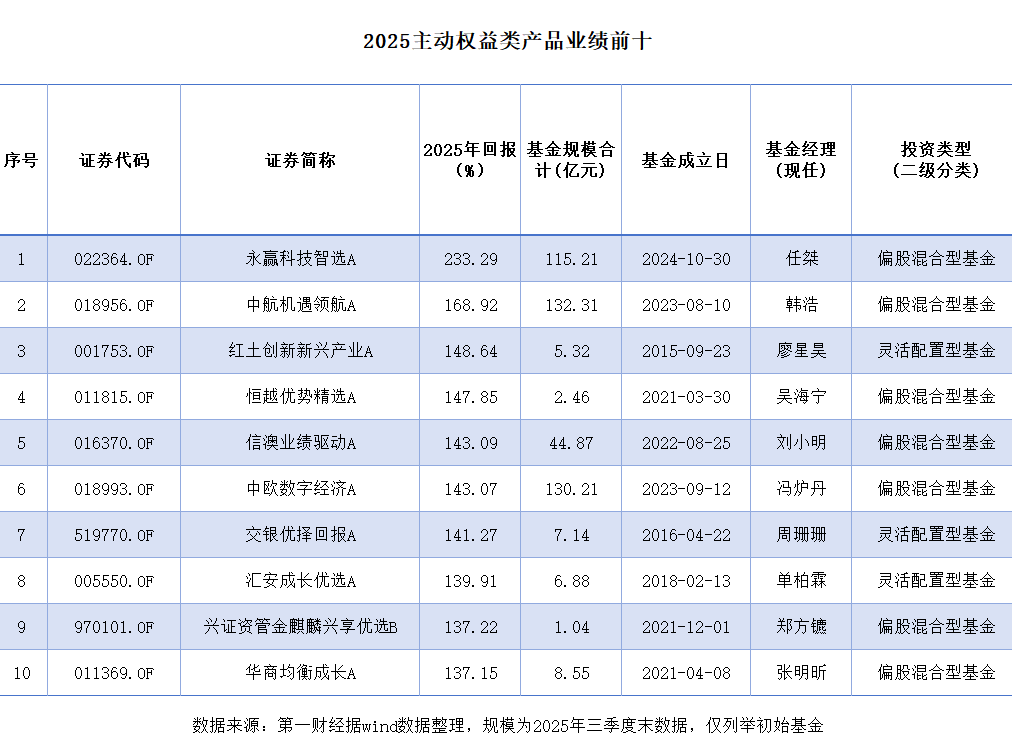
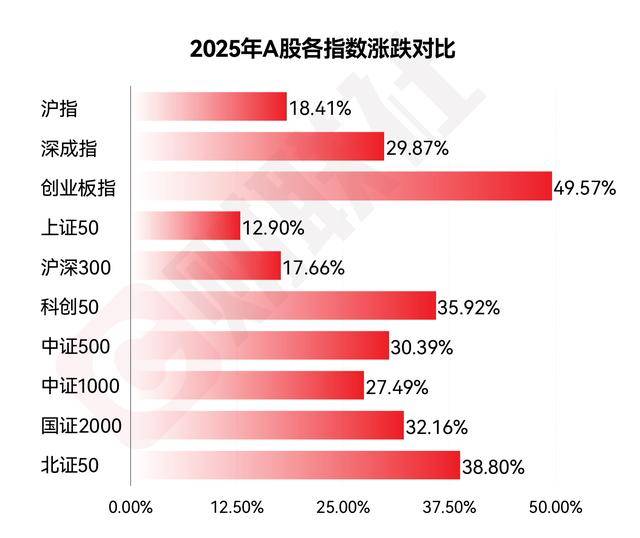
Core Viewpoint - The A-share market concluded 2025 with a structural bull market, with the Shanghai Composite Index rising by 18.41%, leading to significant performance improvements in active equity funds, where over 95% achieved positive returns, and 76 funds doubled their returns, marking a strong comeback of "double funds" after 17 years [3][4][7]. Group 1: Market Performance - The Shanghai Composite Index ended the year at 3968.84 points, recovering from fluctuations and achieving an 18.41% annual increase [4]. - Among 31 sectors, 29 experienced gains, with non-ferrous metals and communications leading at 94.73% and 84.75% respectively, while food and beverage and coal sectors saw declines exceeding 5% [4]. - The active equity fund performance saw over 95% of 4711 comparable funds achieving positive returns, a significant increase from 65% the previous year, marking the best performance in five years [4][9]. Group 2: Top Performing Funds - The top-performing fund, Yongying Technology Smart A, achieved a remarkable return of 233.29%, surpassing the second-place fund by over 64 percentage points and breaking the previous record set in 2007 [5][7]. - The second and third positions were held by Zhonghang Opportunity Navigation A with a return of 168.92% and Hongtu Innovation Emerging Industry A with 148.64%, respectively, showcasing intense competition among the top funds [8]. - A total of 76 active equity funds achieved returns exceeding 100%, the highest number in the last five years, with 39 fund companies represented [8]. Group 3: Investment Trends and Future Outlook - The leading funds predominantly invested in the artificial intelligence (AI) sector, indicating a high "science and technology content" as a key to success [3][11]. - Looking ahead, the AI industry is expected to see further valuation increases, transitioning from valuation-driven to a dual-driven model of fundamentals and structural reforms [11][12]. - Investment strategies for 2026 are anticipated to focus on AI, overseas expansion, and commodities, with a cautious outlook on potential market corrections [12][13].


76只翻倍基创近五年新高,“两倍基”重现江湖
Di Yi Cai Jing· 2026-01-04 10:35
Core Insights - The A-share market concluded 2025 with a structural bull market, with the Shanghai Composite Index rising by 18.41%, leading to the best performance of active equity funds in five years, with over 95% of products achieving positive returns [1][2] - The top-performing fund, Yongying Technology Select A, achieved an impressive return of 233.29%, marking the return of "double funds" after 17 years and breaking the previous record set in 2007 [5][6] - The performance of leading funds was largely driven by a high allocation to the artificial intelligence industry chain, indicating that "technology content" was a key factor for success [1][7] Market Performance - The Shanghai Composite Index fluctuated around 4000 points throughout the year, closing at 3968.84 points on December 31, 2025, after a series of eleven consecutive gains [2] - Among the 31 sectors in the Shenwan classification, 29 sectors saw gains, with non-ferrous metals and telecommunications leading with annual increases of 94.73% and 84.75%, respectively [2] - The active equity fund market saw a significant recovery, with over 95% of 4711 comparable active equity funds achieving positive returns, a notable increase from 65% the previous year [2][6] Top Performing Funds - Yongying Technology Select A, managed by Ren Jie, topped the annual returns with 233.29%, significantly ahead of the second-place fund by over 64 percentage points [5] - The second-place fund, China Aviation Opportunity Navigator A, achieved a return of 168.92%, while the competition for third place was intense, with Red Soil Innovation Emerging Industry A and Hengyue Advantage Selection A closely contesting [5][6] - A total of 76 funds achieved returns exceeding 100%, the highest number in the past five years, with E Fund having the most top-performing products [6] Investment Trends - The leading funds predominantly invested in artificial intelligence-related stocks, particularly in sectors like computing chips and optical modules, which were crucial for their standout performance [7] - Looking ahead to 2026, the investment focus is expected to remain on overseas expansion, artificial intelligence, and commodities, with a cautious outlook on potential market corrections [8][9] - Analysts predict a significant probability of sector style shifts in 2026, with high-end manufacturing and core assets gaining attractiveness as the market undergoes a rebalancing phase [9]
年终盘点2025年十大牛熊股出炉:18倍上纬新材夺魁 算力硬件概念股受题材资金追捧
Sou Hu Cai Jing· 2025-12-31 10:35
Market Overview - The A-share market concluded the last trading day of 2025 with active trading, where daily transactions exceeding 1 trillion yuan became the norm. The market experienced a structural "technology bull" trend throughout the year, with all major indices showing significant gains. The ChiNext Index led with an annual increase of nearly 50%, while the Shanghai Composite Index broke the 4,000-point mark on October 28, reaching a nearly ten-year high. The total market capitalization of A-shares surged to nearly 109 trillion yuan, adding approximately 23 trillion yuan within the year, setting a historical record [1]. Top Performing Stocks - The top ten stocks in 2025 all recorded gains exceeding 500%. Among them, Aowei New Materials topped the list with an impressive 1,821% increase, followed by Tianpu Co. with a 1,662% rise. Other notable performers included *ST Yushun (719%), *ST Yazhen (636%), and Shenghong Technology (588%). The surge in these stocks was primarily driven by themes related to computing power, with four out of the top ten stocks belonging to this category [3][6]. Aowei New Materials - Aowei New Materials emerged as the stock king of 2025 with an 18-fold increase in its share price, currently boasting a market capitalization exceeding 51.3 billion yuan. The company transitioned from a traditional chemical materials provider to a core player in the robotics industry through a two-step process involving "agreement transfer + tender offer." This transformation was supported by national policies promoting humanoid robot innovation and local policy enhancements. The company's fundamentals also showed strong performance, with a 23.73% year-on-year increase in revenue and a 49.66% rise in net profit for the third quarter [6]. Tianpu Co. - Tianpu Co. achieved a remarkable 16-fold increase in its stock price, driven by the TPU theme and expectations surrounding the reverse merger with Zhonghao Xinying. The positive developments in domestic computing power since the fourth quarter have further stimulated the stock's performance, leading to a continuous rise even after multiple trading suspensions for regulatory checks [7]. Shenghong Technology - Shenghong Technology recorded a 588% increase in its stock price, ranking fifth among the top performers. The surge was attributed to the booming demand for AI computing power, which significantly boosted PCB demand. The company successfully integrated into the Nvidia supply chain, resulting in a 324% increase in net profit for the first three quarters. Additionally, it announced the mass production of 800G switch products and the industrialization of 1.6T optical modules, benefiting from the current CPO concept trend [10]. Underperforming Stocks - In contrast, the A-share market also saw significant declines, with the top 20 underperforming stocks all experiencing drops exceeding 40%. Among these, 11 were ST stocks. Excluding ST stocks, the worst performer was Shanda Electric Power, which fell by 52.75% due to multiple risk factors and a significant decline in performance, with a 5.59% year-on-year drop in net profit for the third quarter [12][14].


沪指十连阳,人形机器人“领涨收官”
Yang Zi Wan Bao Wang· 2025-12-30 23:11
Group 1 - The stock of Tianpu Co., Ltd. (605255) has increased by 718.39% from August 22 to December 30, leading to a suspension for further investigation due to significant price volatility and deviation from the company's fundamentals [2] - Jiamei Packaging (002969) has experienced a significant stock price increase, and the company may apply for a trading suspension if prices continue to rise abnormally, although there have been no major changes in its fundamentals [3] - Zijin Mining (601899) expects a net profit of approximately 51 billion to 52 billion yuan for 2025, representing a year-on-year increase of 59% to 62%, driven by increased production and rising sales prices of gold, copper, and silver [3] Group 2 - The market saw a low opening but recovered, with the Shanghai Composite Index achieving a ten-day consecutive rise, while the ChiNext Index increased by 0.63% [1] - The trading volume in the Shanghai and Shenzhen markets reached 2.14 trillion yuan, an increase of 32 billion yuan compared to the previous trading day [1] - The market experienced rapid rotation of hotspots, with over 3,400 stocks declining, while sectors such as humanoid robots, film and television, AI, and computing chips saw significant gains [1]



资金风向标|两融余额突破2.54万亿元再创新高 电子行业获融资净买入额居首
Sou Hu Cai Jing· 2025-12-25 03:13
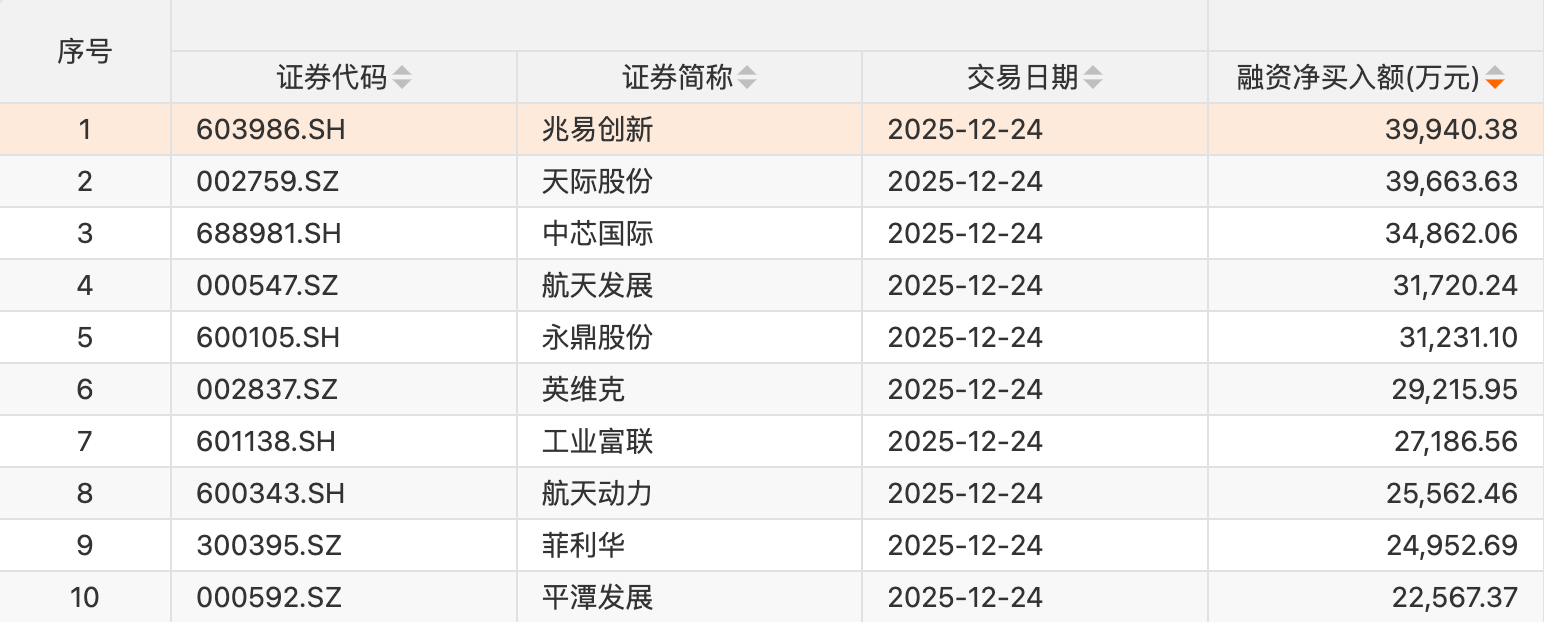
Group 1 - The A-share margin balance reached a historical high of 25,416.83 billion yuan as of December 24, increasing by 101.2 billion yuan from the previous trading day, accounting for 2.59% of the A-share circulating market value [1] - The margin trading volume on the same day was 2,075.22 billion yuan, a decrease of 101.62 billion yuan from the previous trading day, representing 10.92% of the total A-share trading volume [1] - Among the 31 primary industries, 20 experienced net financing inflows, with the electronics sector leading at a net inflow of 2.36 billion yuan [1] Group 2 - A total of 43 stocks had net financing inflows exceeding 100 million yuan, with Zhaoyi Innovation leading at a net inflow of 399 million yuan [1] - Other notable stocks with significant net financing inflows included Tianji Shares, SMIC, Aerospace Development, Yongding Shares, Yingweik, Industrial Fulian, Aerospace Power, Feilihua, and Pingtan Development [1] - Huachuang Securities' report highlighted that GPUs are fundamental to domestic AI development, with several domestic GPU manufacturers launching AI computing chip products, gradually catching up to international standards [2]


海光信息(688041):国产CPU领军企业,DCU卡位算力芯片千亿蓝海
Donghai Securities· 2025-12-23 09:18
Investment Rating - The report assigns a "Buy" rating for the company, marking its first coverage [1]. Core Insights - The company is positioned as a leading domestic CPU manufacturer, with its DCU products targeting the rapidly expanding AI chip market, projected to reach $92 billion globally by 2025, growing at a rate of 29.58% [2]. - The company has established deep partnerships with major internet firms and has achieved compatibility with mainstream AI models, enhancing its market presence [2]. - Revenue growth is expected to remain robust, with projections of CAGRs of 56.13%, 45.23%, and 38.43% for the years 2025, 2026, and 2027 respectively [6]. Company Overview - The company, founded in 2014, specializes in high-end processors and accelerators, including CPUs and DCUs, with a comprehensive product layout that meets the demands of various sectors such as telecommunications, finance, and AI [12]. - The company has a strong R&D focus, continuously iterating its product lines, with significant advancements in CPU and DCU technologies [12][28]. - The company operates under a fabless model, with a high customer concentration, where the top five clients account for over 90% of sales [18]. Product Lines - The company offers two main product lines: CPUs, which are compatible with the x86 architecture, and DCUs, which utilize a GPGPU architecture compatible with mainstream AI software [18][17]. - The CPU product series includes high-performance processors for data centers and mid-range processors for various applications, while the DCU series supports AI training and inference [18][17]. Financial Performance - The company has demonstrated significant revenue growth, with a forecasted revenue of approximately 143.05 billion yuan in 2025, reflecting a year-on-year increase of 56.13% [6][28]. - The gross margin is expected to exceed 60%, indicating a strong competitive position within the industry [32]. - The company has maintained a high level of R&D investment, with over 90% of its workforce holding master's degrees or higher, ensuring a strong foundation for future innovations [37].
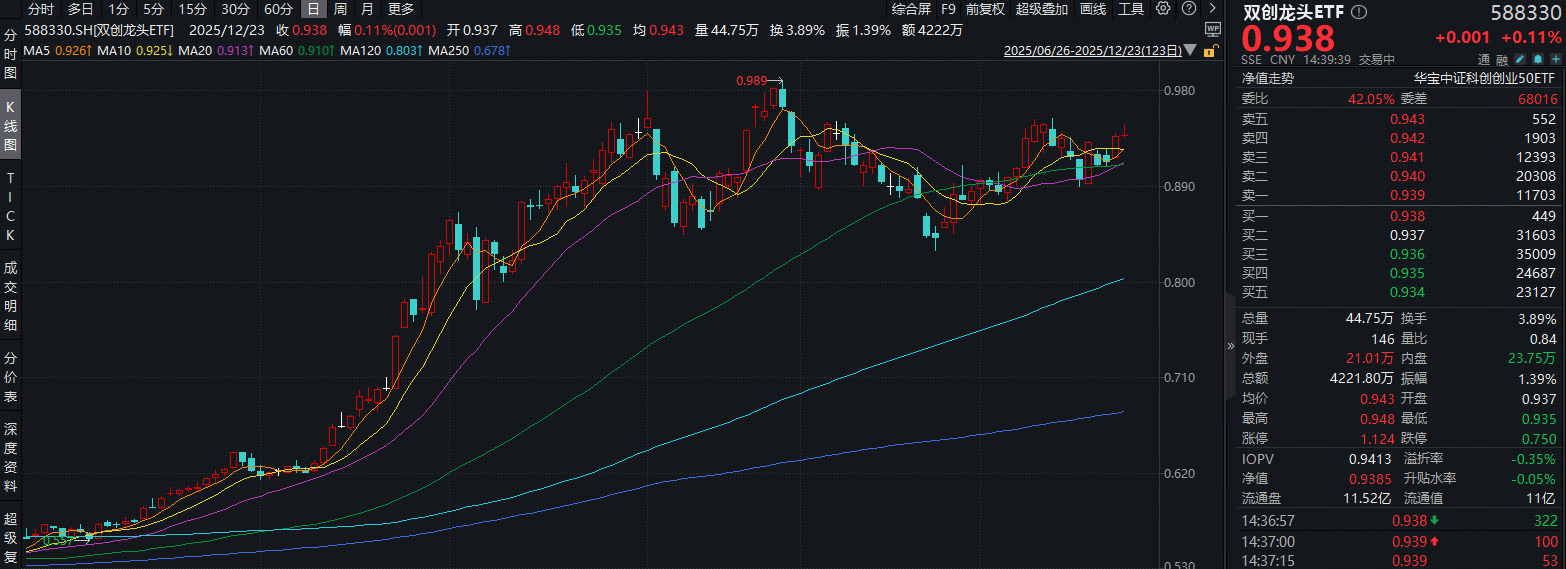
ETF盘中资讯 | 算力芯片概念震荡回升,寒武纪涨超3%登顶A股吸金榜!硬科技宽基——双创龙头ETF(588330)盘中拉升1%
Jin Rong Jie· 2025-12-23 08:00
Core Viewpoint - The electric equipment sector is leading the market, with the Double Innovation Leading ETF (588330) showing strong momentum and significant trading volume, indicating a robust technical outlook for investments in hard technology and strategic emerging industries [1][2]. Group 1: Market Performance - The Double Innovation Leading ETF (588330) has seen a price increase of over 1% during trading, with a current trading volume exceeding 420 million yuan [1]. - Key stocks in the electric equipment sector include: - LONGi Green Energy (阿特斯) with a 4.75% increase - Cambricon Technologies (寒武纪-U) up by 3.72% - Ruijie Networks (锐捷网络) rising by 2.96% [2][4]. Group 2: Sector Insights - In the electronics sector, the computing chip concept is rebounding, with notable gains from Cambricon and Haiguang Information, driven by advancements in GPU architecture [3]. - The communication sector is experiencing breakthroughs in optical chip technology, which is crucial for data center interconnectivity, indicating potential growth as AI data centers expand [3]. - The electric equipment sector is transitioning to a new pricing era, with component prices entering the "1 yuan/W" stage, suggesting a shift towards technological upgrades and a more mature market [3]. Group 3: Investment Opportunities - The Double Innovation Leading ETF focuses on strategic emerging industries, including new energy, photovoltaic, optical modules, and semiconductors, providing a diversified investment tool for capturing growth in these sectors [6]. - The ETF has shown a cumulative increase of 89.61% since its low point on April 8, significantly outperforming other major indices, indicating its potential as a high-return investment vehicle [6][7].