
资产负债表

Search documents
鲍威尔:缩表或在未来几个月结束
Sou Hu Cai Jing· 2025-10-14 21:25
Core Viewpoint - The Federal Reserve, led by Chairman Powell, may soon conclude its long-standing efforts to reduce its balance sheet, known as quantitative tightening, to ensure sufficient liquidity in the financial system [1] Group 1: Federal Reserve's Actions - Powell indicated that the Fed is closely monitoring various indicators to determine if the goal of maintaining liquidity has been achieved [1] - Signs of tightening liquidity conditions have begun to emerge, including a general tightening of repo rates and noticeable but temporary liquidity pressures on specific dates [1] - The experience since 2020 suggests that the Fed can use its balance sheet more flexibly in the future [1]
AI“对决”黄金
3 6 Ke· 2025-10-10 09:44
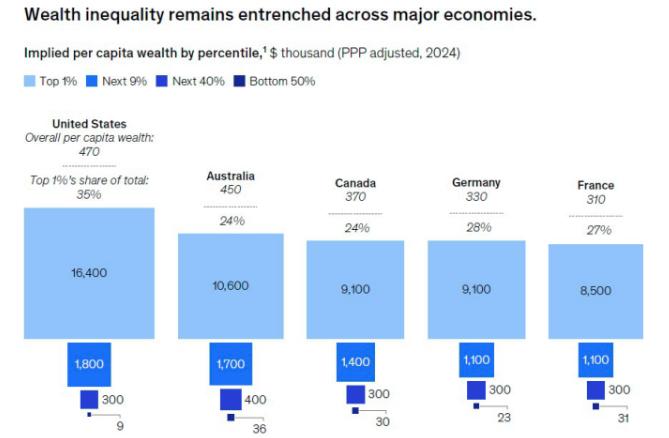
Group 1 - The core viewpoint of the articles highlights the dual investment trends in AI and gold, reflecting investor sentiment towards both technological advancement and inflation hedging [1][2][11] - The S&P 500 index has reached over 30 historical highs in 2025, driven by AI stocks, while gold prices have surged over 50%, surpassing the unprecedented $4000 mark [1][11] - The global net worth has quadrupled since 2000, reaching $600 trillion by the end of last year, indicating a significant disconnection between wealth accumulation and actual economic performance [3][6] Group 2 - McKinsey's report indicates that the expansion of balance sheets exceeding economic growth rates exposes vulnerabilities, with over 40% of wealth growth attributed to accumulated inflation rather than new investments [6][9] - Two potential scenarios are outlined: a "productivity explosion" driven by AI advancements leading to sustainable economic growth, or prolonged high inflation that could harm lower-income families and overall economic stability [10][11] - The disparity in wealth accumulation across different regions is increasing, with potential differences in average wealth per person reaching $160,000 by 2033 depending on the economic scenario [10][11]

美联储:银行准备金九周来首次上升,突破3万亿美元
Sou Hu Cai Jing· 2025-10-09 21:59
Core Points - The U.S. banking system's reserves have increased for the first time in nine weeks, surpassing $3 trillion [1] - As of the week ending October 8, bank reserves rose by approximately $54 billion, reaching $3.034 trillion [1] - Prior to this increase, reserves had been declining for eight consecutive weeks, marking the longest continuous drop since July 2020 [1] Summary by Relevant Sections - **Bank Reserves**: The increase in bank reserves is a significant indicator for the Federal Reserve's decision to continue reducing its balance sheet [1] - **Recent Trends**: The decline in reserves was influenced by the U.S. Treasury's increased issuance of debt following the raising of the debt ceiling in July, aimed at rebuilding cash balances [1] - **Liquidity Impact**: The reduction in reserves was also linked to the depletion of liquidity in other Federal Reserve liabilities, such as the overnight reverse repurchase (RRP) agreements [1]
财报小知识:什么是现金流量表的勾稽关系?怎么看待它如何与资产负债表和利润表联动?
Sou Hu Cai Jing· 2025-10-07 01:12
Core Insights - The article emphasizes the importance of the cash flow statement in assessing a company's financial health, as it reflects the company's "blood-making ability" more accurately than profit figures from the income statement [1] - Understanding the interrelationship between the three main financial statements—income statement, balance sheet, and cash flow statement—is crucial for a comprehensive evaluation of a company's financial status [2] Group 1: Cash Flow Statement - The cash flow statement records cash inflows and outflows over a specific period, divided into operating, investing, and financing activities [1] - The core logic of the cash flow statement is that the beginning cash balance plus the net cash flow for the period equals the ending cash balance, which directly impacts the "monetary funds" item on the balance sheet [1] Group 2: Relationship with Other Financial Statements - There is a significant relationship between the income statement and the cash flow statement, as the income statement is based on the accrual basis while the cash flow statement follows the cash basis [1] - A company may show profits on the income statement, but if accounts receivable increases significantly or inventory accumulates, the operating cash flow may be negative, indicating that profits have not converted into actual cash [1] Group 3: Profit Quality - Net profit serves as the starting point for calculating operating cash flow, and adjustments for non-cash items (like depreciation and amortization) and changes in working capital can derive the net operating cash flow [1] - A persistent situation where net profit significantly exceeds operating cash flow may suggest low earnings quality [1]
DLS MARKETS:多数经济学家偏向沃勒,却认为哈塞特将接替鲍威尔
Sou Hu Cai Jing· 2025-09-29 05:48
Group 1 - The overwhelming preference among academic economists for Waller as the next Federal Reserve Chair, with 82% of respondents selecting him, significantly surpassing other candidates [3] - Despite being a popular choice, only 20% of scholars believe he can succeed Powell in 2026, while 39% favor Hassett, indicating a split in expectations [3] - Waller's stance aligns with the academic expectation of a "prudent central bank manager," as he has opposed extreme monetary policy proposals [3] Group 2 - The real challenge for the next Federal Reserve Chair will be in policy execution, as the U.S. economy faces a weak labor market and inflation driven by tariffs [4] - Most Federal Reserve officials believe Trump's tariff policies will only cause temporary price increases for a few goods, potentially slowing job growth [4] - Academic economists express concerns about rising stagflation risks, predicting simultaneous deterioration in unemployment and inflation [4]

美联储洛根:升级(通胀)目标不会干扰资产负债表。
Sou Hu Cai Jing· 2025-09-25 18:04
Core Viewpoint - The Federal Reserve's Logan stated that upgrading the inflation target will not interfere with the balance sheet [1] Group 1 - The Federal Reserve is considering adjustments to its inflation target [1] - Logan emphasized that any changes to the inflation target will not impact the management of the asset balance sheet [1]
中金:股市“三步曲”
中金点睛· 2025-08-29 00:07
Core Viewpoint - The article discusses the recent improvement in the Chinese stock market, emphasizing the importance of understanding the financial cycle perspective to explain the market's positive performance despite ongoing economic downward pressure [2][5]. Group 1: Financial Cycle vs Economic Cycle - The financial cycle adjustment leads to a significant deterioration in balance sheets, while the economic cycle adjustment has a relatively smaller impact on balance sheets [6][9]. - In the financial cycle adjustment phase, the stock market may experience a "reallocation" effect driven by balance sheet changes, whereas in the economic cycle adjustment, the stock market's recovery is more synchronized with economic improvements [12][11]. - The ideal policy mix differs between the two cycles; the financial cycle requires more fiscal stimulus, while the economic cycle relies more on monetary policy [7][30]. Group 2: Three-Step Process of Stock Market Recovery - The recovery of the stock market post-financial cycle adjustment can be divided into three steps: 1. Housing market adjustment and deterioration of private balance sheets, leading to an increase in the proportion of safe assets [3][12]. 2. Policy intervention to stabilize growth and improve private balance sheets, increasing the attractiveness of risk assets relative to safe assets, resulting in a rise in the stock market [3][12]. 3. Economic recovery, transitioning the stock market from being driven by reallocation effects to being driven by earnings [3][12]. Group 3: Factors Supporting Stock Market Rebound - Several factors support the current rebound in the Chinese stock market, including accelerated technological advancements and a correction of overly cautious market expectations regarding the medium to long-term economic outlook [3][47]. - The government's increased focus on the economy, housing market, and stock market has led to a perception that downside risks are limited [3][47]. - The decline in the cost-effectiveness of safe asset allocations has motivated investors to increase their allocation to risk assets, further supporting the stock market [3][47]. Group 4: Comparison with International Experiences - The article draws comparisons with the U.S. financial cycle, noting that the U.S. stock market recovery post-financial cycle adjustment occurred earlier than the recovery of nominal GDP and the housing market [17][15]. - The U.S. experience shows that stock prices may recover before economic indicators due to improvements in corporate balance sheets, even when the economy has not yet shown signs of recovery [11][21]. - Japan's experience illustrates that addressing debt issues is crucial for stock market recovery, as the Japanese market did not stabilize until after significant debt problems were resolved [41][43]. Group 5: Implications for China - The financial cycle adjustment in China is expected to have a lesser impact on various sectors' balance sheets compared to the U.S. and Japan during their respective financial crises [51][56]. - The heavy debt burden on local governments in China poses challenges, but improving balance sheets could support corporate development and enhance stock market potential [56][53]. - The article suggests that the ongoing structural improvements in the Chinese economy, particularly in innovation, may lead to a more resilient market compared to past financial cycle adjustments in other countries [56][58].

9月资金面吃紧?美联储洛根:缩表还有空间
Jin Shi Shu Ju· 2025-08-26 03:10
Core Viewpoint - The Federal Reserve has room to continue reducing its balance sheet despite potential short-term pressures in the money market around the end of the quarter, as stated by Dallas Fed President Lorie Logan [2][3]. Group 1: Balance Sheet Reduction - Since 2022, the Federal Reserve has been reducing its balance sheet with the goal of lowering bank reserves to a "minimum adequate level" to avoid market turmoil [2]. - Current bank reserve balances are approximately $3.3 trillion, while the estimated minimum adequate level is around $2.7 trillion [3]. - Logan emphasized that there is still more room to reduce reserves, as recent repo market rates have averaged about 8 basis points lower than the interest paid on reserves by the Fed [3]. Group 2: Liquidity Mechanisms - The Fed has mechanisms like the overnight liquidity tool and the discount window to prevent liquidity shortages, allowing eligible firms to quickly convert Treasury holdings into cash [2]. - Logan suggested that the Fed should consider increasing or removing limits on discount window loans and may benefit from daily auctions of these loans to better allocate liquidity within the banking system [3]. Group 3: Communication and Policy Framework - Logan expressed satisfaction with the Fed's recent policy framework assessment but noted that there is room for improvement in communication, particularly regarding the quarterly release of the Summary of Economic Projections (SEP) [4]. - She highlighted the need to avoid overemphasizing the median while considering diverse viewpoints in economic forecasts and responses [4].
九龙仓集团跌超3% 中期股东应占溢利5.35亿港元 花旗称公司增加股东回报可能性较低
Zhi Tong Cai Jing· 2025-08-15 06:27
Core Viewpoint - Kowloon Warehouse Group reported a significant turnaround in its financial performance, moving from a loss to a profit, despite a decline in revenue [1] Financial Performance - For the half-year period ending June 30, 2025, the company reported revenue of HKD 5.669 billion, a year-on-year decrease of 19.38% [1] - Shareholders' profit was HKD 535 million, compared to a loss of HKD 2.637 billion in the same period last year, indicating a successful turnaround [1] - Basic earnings per share were HKD 0.18, with an interim dividend proposed at HKD 0.20 per share [1] Investment Property Revenue - Revenue from investment properties decreased by 4% to HKD 2.281 billion, down from HKD 2.364 billion in 2024 [1] - Operating profit also saw a decline of 6%, falling to HKD 1.484 billion from HKD 1.573 billion in 2024, attributed to soft rental rates for malls and office buildings [1] Debt and Cash Position - Citigroup reported that the company's debt ratio stands at 4.4%, and when considering its long-term investments of HKD 48 billion, with HKD 39.8 billion in stocks treated as quasi-cash, the net cash position is approximately HKD 33 billion, representing 50% of its market value [1] - The company is not in a hurry to reinvest due to macroeconomic uncertainties and may focus on monetizing existing land reserves [1] Shareholder Returns and Valuation - Citigroup believes that investors may be pricing in expectations for increased shareholder returns, but anticipates that the company will maintain stable dividends per share without increases [1] - The likelihood of share buybacks is considered low, and the company is viewed as having the highest valuation in the industry, with a strong balance sheet allowing for various actions within the group, though not necessarily beneficial for the stock price [1]

花旗:下调九龙仓集团目标价至18.3港元 维持“沽售”评级 不预期增加对股东回报
Zhi Tong Cai Jing· 2025-08-13 07:36
Core Viewpoint - Citigroup's report indicates that Kowloon Warehouse Group (00004) has a debt ratio of 4.4%, and when considering its long-term investments of HKD 48 billion, with HKD 39.8 billion in stock holdings treated as near cash, the company effectively holds HKD 33 billion in net cash, representing 50% of its market value [1] Summary by Relevant Sections Financial Position - Kowloon Warehouse Group's debt ratio stands at 4.4% [1] - The company has long-term investments totaling HKD 48 billion, with HKD 39.8 billion in stock holdings considered as near cash [1] - The effective net cash held by the company is HKD 33 billion, which accounts for 50% of its market capitalization [1] Investment Strategy - The company is not in a hurry to reinvest due to macroeconomic uncertainties and market conditions, and may focus on monetizing existing land reserves [1] - Citigroup maintains a "sell" rating on the company, lowering the target price from HKD 18.8 to HKD 18.3 [1] Shareholder Returns - There is an expectation among investors for the company to increase shareholder returns, but Citigroup anticipates that the company will maintain stable dividends per share without any increase [1] - The likelihood of share buybacks is considered low by Citigroup [1] Valuation - Citigroup believes that Kowloon Warehouse Group has the highest valuation in the industry, and its strong balance sheet allows for various actions within the group, though this may not necessarily benefit the stock price [1]