金融危机

Search documents
李在明接受外媒采访:若无保障接受美方投资要求,韩国或面临金融危机
Huan Qiu Wang· 2025-09-22 01:36
这段采访于上周五(19日)在韩国总统办公室进行。李在明还提及美国近期一次大规模移民执法行动,期间有数百名韩国人被拘留。他表示,"我不认为这 是故意的,美国已经为这一事件道歉,我们同意在这方面寻求合理的措施,我们正在为此努力。" 报道称,李在明本周一将赴纽约在联合国大会发表讲话。总统办公室表示,此次行程没有与特朗普会面的计划,贸易谈判也不在本次访问议程之内。 韩美双方在3500亿美元对美投资的具体方案上存在分歧,贸易谈判进入"拉锯战",正艰难前行。根据特朗普此前说法,韩国输美产品将适用15%关税税率, 美国产品在韩国则不会被征收关税。韩国将向美国投资3500亿美元,同时还将从美国采购价值1000亿美元的液化天然气或其他能源产品。韩国将对美国全面 开放贸易并接受美国汽车和农产品等。 李在明本月3日在接受美国《时代》杂志采访时也曾直言,若接受美方条件达成协议,我恐怕会遭弹劾。 【环球网报道 记者 姜蔼玲】据路透社当地时间21日报道,韩国总统李在明在接受该媒体采访时表示,如果在停滞的贸易谈判中没有任何保障措施就接受美 方的现有要求,那么韩国将面临类似1997年金融危机的局面。 "如果没有货币互换,而我们按照美国要求的 ...


美韩谈判陷僵局!李在明:若接受美国要求,韩国将陷金融危机
Feng Huang Wang· 2025-09-22 01:14
Group 1 - The core issue in the US-Korea trade agreement negotiations is the disagreement over investment details, which has led to a stalemate [1][3] - South Korea has committed to invest $350 billion in exchange for reduced tariffs from the US, but the agreement has not been formally signed due to differences in handling the investment [2][3] - South Korea proposed establishing a currency swap mechanism to mitigate the impact of the investment on the Korean won's exchange rate, but the US has not agreed to this proposal [3][4] Group 2 - The South Korean President warned that accepting US investment demands without protective measures could lead to a crisis similar to the 1997 financial crisis [1][4] - The US Commerce Secretary suggested that South Korea should emulate Japan's recent trade agreement with the US, which involved a 15% tariff payment and a $550 billion investment from Japan [4] - The President emphasized that South Korea's situation differs from Japan's due to its lower foreign exchange reserves and the absence of a currency swap agreement with the US [4] Group 3 - Achieving a detailed agreement that ensures commercial viability is the main challenge in the negotiations, with current proposals failing to bridge the gap [5] - The recent immigration enforcement actions against Korean workers in the US have caused public outrage in South Korea, potentially affecting investment sentiment [6][8] - Despite the immigration incident, the President believes it will not damage the US-Korea alliance and considers it an overzealous enforcement action rather than a deliberate act by the US government [6][7]
美国低利率时代,有哪些投资机遇?
2025-09-09 14:53
Summary of Key Points from the Conference Call Industry or Company Involved - The discussion revolves around the U.S. economy and its response to three major economic crises: the Internet bubble burst, the financial crisis, and the COVID-19 pandemic. Core Insights and Arguments 1. **Monetary Policy Evolution**: The U.S. has implemented various monetary policies across different crises, including interest rate cuts and quantitative easing, to stimulate economic recovery. For instance, during the Internet bubble, the Fed cut rates by 550 basis points over 30 months, while during the financial crisis, rates were brought close to zero and multiple rounds of quantitative easing were initiated [1][11][12]. 2. **Fiscal Policy Measures**: The U.S. government responded to crises with fiscal stimulus measures, including tax cuts and increased public spending, leading to significant increases in government deficit and leverage ratios. For example, the deficit rate reached 14% during the COVID-19 pandemic [1][9][14]. 3. **Asset Price Performance**: Different asset classes reacted variably during the crises. After the Internet bubble burst, stock prices fell significantly, while real estate prices increased. Conversely, during the financial crisis, both stock and real estate markets faced severe declines, with the Dow Jones Industrial Average dropping by 49% [2][4][6][10][16]. 4. **Investment Opportunities**: The low-interest-rate environment has created investment opportunities primarily in gold, real estate, and specific sectors like energy and materials. Technology stocks, however, require a longer recovery period [3][19]. 5. **Impact of COVID-19**: The pandemic led to a sharp decline in GDP by 7.5% in Q2 2020, with significant unemployment and business disruptions. The Fed responded with aggressive rate cuts and expanded its balance sheet significantly [8][9][10]. 6. **Long-term Trends**: The U.S. stock market has maintained a long bull market due to technological advancements and sustained inflows from long-term funds like pensions and mutual funds. This shift in asset allocation from real estate to financial assets reflects changing risk preferences among investors [19][20]. Other Important but Possibly Overlooked Content 1. **Comparison with Japan**: The U.S. bond fund market did not experience the same contraction as Japan's, attributed to the U.S. economy's resilience and quicker recovery from crises [18]. 2. **Inflation and Interest Rates**: The low-interest-rate environment has led to a general increase in asset prices, with housing prices rising over 40% during the pandemic period [9][10]. 3. **Government Debt Levels**: The federal government’s leverage ratio increased significantly during the crises, reaching 141% during the pandemic, indicating a substantial rise in government debt relative to GDP [14][19]. 4. **Sector-Specific Performance**: The technology, consumer, and healthcare sectors have shown particularly strong performance during the recovery phases following the crises [7][10]. This summary encapsulates the key points discussed in the conference call, highlighting the U.S. economic landscape's response to significant crises and the resulting investment implications.
公共债务濒临失控,舆论担忧政府垮台,法总理提信任投票令市场陷入恐慌
Huan Qiu Shi Bao· 2025-08-27 22:53
Core Viewpoint - France is facing a significant political and financial crisis due to Prime Minister François Bérou's proposed €44 billion austerity plan, which aims to reduce the budget deficit but has met with widespread opposition and market panic [1][2][3]. Financial Situation - The French government plans to reduce the budget deficit from approximately 5.8% in 2024 to 4.6% by 2026, with measures including the cancellation of two national holidays, which has sparked public outrage [2][4]. - France's public debt has exceeded €3.34 trillion, representing 113.9% of GDP, and the country has the third-highest debt level globally, trailing only the US and Japan [4][5]. Market Reactions - Following the announcement of the austerity plan, the Paris CAC 40 index fell by about 1.7%, and the yield on 10-year French government bonds surged above 3.5%, nearing Italian levels [2][3]. - Concerns about the potential collapse of the government have led to fears of increased financing costs, with warnings that France could soon have higher costs than Italy if the situation deteriorates [3][4]. Economic Challenges - The French economy is projected to grow at around 1% this year, significantly below pre-pandemic levels, with consumer spending and investment hampered by limited purchasing power and uncertainty [5][6]. - The International Monetary Fund (IMF) has indicated that France needs "additional significant budget efforts" to avoid losing control over its debt trajectory [5]. Broader Implications - The rising yields on French debt could have repercussions for the global bond market, as France is a key player in the Eurozone, and any instability could affect investor confidence in the euro [6][7]. - The situation raises questions about whether Paris could become the center of the next European financial crisis, especially given the lack of consensus in the political arena [6][7].
机构看金市:8月27日
Xin Hua Cai Jing· 2025-08-27 03:06
Core Viewpoint - The recent dismissal of Federal Reserve official Lisa Cook by Trump has heightened concerns over the independence of the Federal Reserve, leading to increased demand for gold as a safe-haven asset [1][2][3] Group 1: Market Reactions - Trump's unexpected action has intensified fears regarding the Federal Reserve's independence and has raised expectations for potential interest rate cuts, pushing investors towards gold [1] - Following the dismissal, the gold price rebounded to a two-week high, supported by a decline in the dollar index [2] - The market now anticipates a greater than 87% probability of a 25 basis point rate cut by the Federal Reserve in September [1] Group 2: Economic Indicators - The upcoming U.S. core PCE inflation data is being closely monitored as it may provide insights into the Federal Reserve's policy direction [1][2] - Powell's dovish remarks at the global central bank meeting suggest a shift to a straightforward 2% inflation target, which may further support the case for a rate cut [2] Group 3: Long-term Outlook - The trend of central banks purchasing gold, combined with global monetary expansion and de-dollarization, is expected to support a long-term upward trend in gold prices [2] - Zang Enterprises highlights that physical precious metals may become the only safe haven amid potential financial crises triggered by inflationary policies and vulnerabilities in the U.S. debt market [3] Group 4: Technical Analysis - The next resistance level for gold is identified at $3,409, with subsequent levels at $3,439 and $3,451, while the first support level is at $3,268 [3]
第二个“恒大”出现了!年收入超6000亿,这下许家印可不孤单了
Sou Hu Cai Jing· 2025-08-23 06:37
Core Viewpoint - The article discusses the financial troubles of Wang Wenyin and his company, Zhengwei Group, drawing parallels to the collapse of Evergrande and its founder Xu Jiayin, highlighting the interconnectedness of their financial fates [1][26]. Group 1: Background of Wang Wenyin and Zhengwei Group - Wang Wenyin, born in a poor rural family in Anhui, transformed his life through education and entrepreneurship, eventually founding Zhengwei Group, which achieved over 600 billion in revenue by 2022 [3][11]. - Zhengwei Group became a major player in the copper industry, acquiring significant assets during financial crises, including mines and processing facilities [9][11]. Group 2: Relationship with Xu Jiayin and Evergrande - Wang Wenyin invested nearly 90 billion in Evergrande, motivated by a close personal and business relationship with Xu Jiayin, which led to mutual benefits during Evergrande's growth [15][18]. - The collapse of Evergrande in 2021 severely impacted Zhengwei Group, leading to significant financial losses and a strained cash flow situation [18][20]. Group 3: Current Financial Situation of Zhengwei Group - As of May 2023, Wang Wenyin's total debt exceeded 10 billion, with numerous legal actions and asset freezes complicating the company's financial recovery [21][24]. - Despite the dire situation, Zhengwei Group's diversified operations in various industries may provide some resilience compared to Evergrande's heavy reliance on real estate [24].

美联储曾发现超过2.2万笔类似特朗普“房管局局长”Pulte提到的抵押贷款问题
Sou Hu Cai Jing· 2025-08-20 22:57
Core Insights - The report from the Philadelphia Federal Reserve assesses the prevalence of "fraudulent investors" in the mortgage market, defined as individuals holding multiple home purchase loans within four quarters after obtaining their first loan [1] - The data analyzed includes 584,499 loans issued between 2005 and 2017, with 22,431 identified as fraudulent loans [1] - Prior to the 2008 financial crisis, the proportion of loans claimed to be for primary residences to obtain better mortgage terms peaked, but has stabilized at around 2% to 3% for most of the following decade [1] Regulatory Context - In the summer of 2025, former President Trump and allies called for the resignation of Federal Reserve Governor Lisa Cook over allegations of primary residence fraud, which the Federal Reserve has found to be "widespread" across the U.S. [1] - Bill Pulte, Director of the Federal Housing Finance Agency, noted that Cook secured a mortgage on a property in Ann Arbor, Michigan, claiming it as her primary residence, only to obtain another mortgage shortly after on a property in Georgia [1]
美银敲警钟:“2007的幽灵”与“漂亮50的回声”同时浮现!
Jin Shi Shu Ju· 2025-08-20 06:44
Group 1 - The market anticipates that the Federal Reserve is likely to cut interest rates in September, with expectations of at least two more cuts by the end of the year, and a prediction that rates will fall below 3% by 2026 [2] - Bank of America Securities' model indicates that even with moderate monthly CPI increases, year-on-year inflation will remain at 2.9% or higher by December, exceeding the 2.3%-2.4% range expected in early 2025 [2] - The current monetary and inflation environment shows unsettling similarities to the period before the 2007-2008 financial crisis, as noted by BofA Securities strategists [2] Group 2 - The analysis highlights that the scenario of lowering policy rates while inflation accelerates is extremely rare, occurring only 16% of the time since 1973 [2] - Concerns are raised that multiple rate cuts this year could lead to significantly negative real policy rates, potentially weakening the dollar, similar to the situation in 2007 [2][3] - The dollar is on track for its weakest year since 1999, with its trajectory closely resembling that of 2007, where it depreciated sharply before rate cuts [3] Group 3 - The current "seven giants" in the market, particularly Nvidia, are compared to the "Nifty Fifty" of the early 1970s, which saw a significant market shift following the onset of "stagflation" [3] - The report indicates that while large-cap stocks have led the market for seven years, cracks began to appear in July, suggesting a potential shift in market dynamics [3][4] - Historical patterns show that during previous recoveries, small-cap and value stocks outperformed, indicating a possible market opportunity beyond large-cap growth stocks [3][4]
美国7月CPI同比涨幅低于预期 美债收益率盘中跳水
Xin Hua Cai Jing· 2025-08-13 01:20
Core Insights - The July inflation data in the U.S. showed a moderate performance, with the CPI rising 2.7% year-on-year, matching June's rate and falling short of market expectations of 2.8% [1] - The core CPI, excluding volatile food and energy prices, increased by 3.1% year-on-year, surpassing both June's 2.9% and market predictions of 3% [1][3] - The market maintains expectations for the Federal Reserve to cut interest rates in September, with a 90.1% probability for a 25 basis point cut [3] Inflation Data - The U.S. CPI for July rose 2.7% year-on-year and 0.2% month-on-month, lower than June's 0.3% [1] - The core CPI increased by 3.1% year-on-year and 0.3% month-on-month, marking the largest monthly increase since January [1][3] - Housing costs were a significant driver of the CPI increase, with a month-on-month rise of 0.2% [1] Market Reactions - U.S. Treasury yields experienced volatility, with the 2-year yield dropping to 3.73% and the 10-year yield stabilizing at 4.29% [1] - Traders are betting on three rate cuts by the Federal Reserve this year, with a low probability of maintaining rates in September [3] Economic Outlook - Analysts suggest that while tariff-related price increases have not been significant, service prices are rebounding, indicating challenges in controlling inflation [2] - UBS noted that tariff impacts are slowly transmitting to the CPI, primarily affecting goods, while inflation pressures appear manageable [3] - The overall inflation trend is expected to enter a structural upward phase, with core CPI remaining above the Fed's 2% target [3] Fiscal Concerns - The U.S. national debt has surpassed $37 trillion, raising alarms about the fiscal imbalance and potential for a financial crisis if corrective actions are not taken [4]
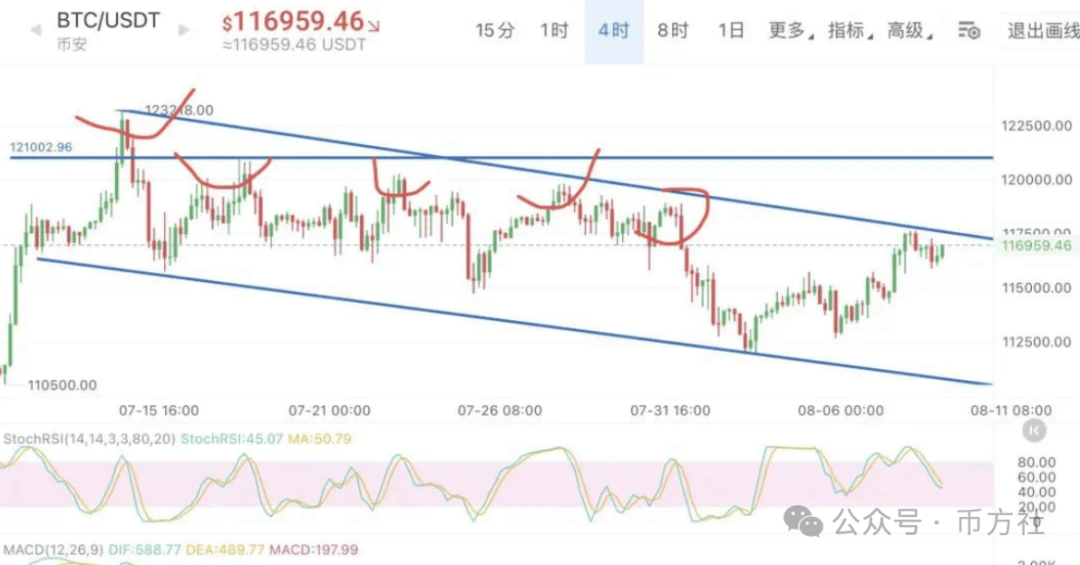
比特币涨不动?以太坊暴涨4200,5000还远吗?山寨跟风新高:SOL、BONK、PENGU翻倍行情!9月降息有变?
Sou Hu Cai Jing· 2025-08-09 07:51
Group 1: Cryptocurrency Market Analysis - Bitcoin has recently broken through the key resistance level of $116,000, forming a potential double bottom structure, indicating a strong technical pattern [1] - Ethereum has formed a somewhat irregular W bottom pattern, with indicators suggesting a high probability of continued upward movement and new highs in the coming week [3][5] - Ethereum's price has surged from $4066 to $4220, with the potential to turn the previous resistance of $4112 into a support level [5] Group 2: Investment Opportunities - Solana is currently undervalued in the market, with on-chain transaction volumes comparable to Ethereum, despite its market cap being significantly lower [8] - Two major catalysts for Solana include upcoming micro-strategies aiming to raise substantial funds for investment and a high probability of approval for a spot ETF [10][11] - The ideal entry points for Solana are around $158 and $130, with potential for significant returns as the market is expected to rebound [14] Group 3: Economic Indicators and Federal Reserve Impact - The upcoming CPI inflation data is a significant variable that may affect the Federal Reserve's decision on interest rate cuts in September, with expectations of a 0.1% increase in both CPI and core CPI [22] - Despite potential inflation concerns, the likelihood of the Federal Reserve canceling the September rate cut remains low due to previous labor market weaknesses [24] - Historical patterns suggest that economic downturns often follow periods of interest rate hikes, raising concerns about potential recession risks in the coming year [24][25]