
风险分散

Search documents
为什么说炒股不是穷人玩的游戏?这3点让你看清现实
Sou Hu Cai Jing· 2025-10-09 06:56
Core Insights - The stock market is perceived as unfavorable for small investors, with a significant majority (85%) of retail investors experiencing losses averaging 28%, while wealth accumulates among the top 0.5% of affluent investors [1] - A substantial portion (90%) of retail investors have less than 100,000 yuan in capital, limiting their ability to recover from losses and cover basic expenses [1][3] - Transaction costs for retail investors can consume 10%-20% of their capital annually, making it difficult for small investors to sustain their investments [3] Group 1 - Retail investors often lack the time to conduct thorough research due to work commitments, leading to poor investment decisions and a tendency to hold onto losing stocks for too long [3][6] - The average holding period for retail investors is only 3-6 months, driven by a desire for quick profits, which contrasts with the strategies of institutional investors who are more patient and strategic [6] - Retail investors struggle with risk diversification, as they may invest in multiple stocks without sufficient capital to mitigate losses effectively, unlike institutional investors who can spread risk across various asset classes [6][8] Group 2 - The perceived low entry barrier of the stock market (e.g., the ability to open an account with just 500 yuan) masks the true challenges faced by small investors, such as the need for financial resilience and investment knowledge [8] - Many small investors use essential funds for trading, which can jeopardize their financial stability when faced with market downturns [8] - The article emphasizes that investing in stocks should not be viewed as a quick path to wealth but rather as a complex process requiring adequate capital, time, and expertise [8]

侃股:买板块比买个股更安全
Bei Jing Shang Bao· 2025-09-23 12:26
Core Viewpoint - Investing in entire sectors rather than individual companies can mitigate risks associated with specific firms, as even strong industries may have companies that face significant operational challenges [1][2]. Group 1: Investment Strategy - Investing in entire sectors allows for risk diversification, reducing the likelihood of substantial losses from individual company failures [1]. - Investors can achieve this diversification by purchasing multiple stocks or sector-specific ETFs, which spreads risk across various companies [1][2]. - The overall growth of a sector benefits most companies within it, creating a synergistic development environment [2]. Group 2: Efficiency and Accessibility - Investing in entire sectors is more efficient for average investors, as it requires less time and effort compared to analyzing each potential investment individually [2]. - Sector ETFs provide a quick and convenient way to gain exposure to an entire industry, facilitating asset diversification [2]. Group 3: Challenges and Considerations - Despite the advantages, investing in sectors presents challenges, such as the need for investors to select representative stocks or quality ETFs [3]. - Market fluctuations can impact the entire sector, necessitating a calm approach and avoiding impulsive decisions [3]. - Continuous adjustment of holdings based on industry trends is essential, as poor sector selection can still lead to significant investment risks [3].
7张图,看懂多元配置的优势!
天天基金网· 2025-09-02 11:30
Core Viewpoint - The article emphasizes the importance of global asset allocation and diversification in investment strategies, highlighting the benefits of a multi-asset approach to mitigate risks and enhance returns [2][4][12]. Group 1: Globalization of Investment - Global asset allocation has become a standard practice in developed countries, helping to reduce the impact of market volatility on overall portfolios [4][7]. - Examples from the U.S., Japan, and Norway illustrate that significant portions of their pension funds are allocated to global markets, with Norway's sovereign fund exceeding 90% in global allocation [7]. Group 2: Economic Growth Perspective - Analyzing global per capita GDP trends shows that while individual countries may experience significant economic fluctuations, the global economy demonstrates a relatively stable growth trajectory [9][11]. - The annual volatility of global GDP is approximately 1.6%, compared to over 2% for individual countries, indicating that diversification can effectively buffer against economic volatility [11]. Group 3: Multi-Asset Allocation Trends - There is a growing consensus among public funds in China to embrace multi-asset strategies, as evidenced by the increasing proportion of commodity funds, QDII funds, and REITs in their portfolios [13]. - This shift reflects ongoing advancements in asset class expansion and investment strategy optimization within public funds [13]. Group 4: Advantages of FOF - FOF (Fund of Funds) emphasizes risk control and volatility management, aligning with the principles of diversified investment [16]. Group 5: Role of ETFs in Asset Allocation - ETFs are highlighted as ideal tools for achieving diversified asset allocation, with the total scale of domestic ETFs in China surpassing 5 trillion yuan, offering a wide range of investment options [21]. - The variety of ETF types, including equity, bond, currency, and commodity ETFs, provides investors with numerous choices for building diversified portfolios [23]. - FOF's enthusiasm for ETFs is growing, with the scale of ETF holdings in FOF's top ten funds increasing from 13.4 billion yuan to 14.3 billion yuan [25].

康斯特2025年上半年营收实现2.46亿元
Zheng Quan Ri Bao· 2025-08-26 06:11
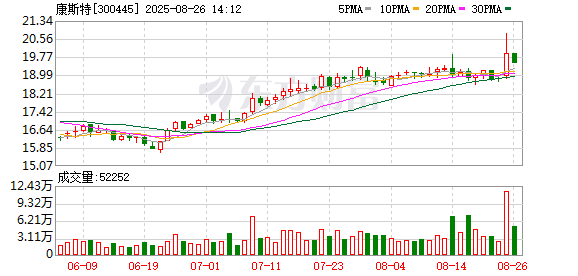
Core Insights - The company reported a revenue of 246 million yuan for the first half of 2025, representing a year-on-year increase of 3.76% [2] - The net profit attributable to shareholders was 54.13 million yuan, showing a year-on-year decline of 7.71% [2] Business Performance - The company's main business and key products, including digital pressure detection, process signal detection, and temperature and humidity detection, have not undergone significant changes [2] - The company implemented a global regional strategy focusing on "regional deep cultivation + risk diversification," achieving stable development amid complex economic conditions [2] Market Strategy - The company optimized its market expansion strategy by enhancing product capabilities and accelerating the application of intelligent and automated calibration testing products [2] - The company aims to strengthen growth momentum in non-US markets while continuing overall cost optimization [2] Revenue Breakdown - International market revenue reached 127 million yuan, a year-on-year increase of 3.2% [2] - Domestic market revenue was 119 million yuan, reflecting a year-on-year growth of 4.4% [2] Order Trends - The conversion of orders on hand began to accelerate during the reporting period, driven by differentiated recovery in downstream industry conditions [2] - Domestic market orders showed steady growth and revenue recognition is gradually increasing [2]

千亿独角兽IPO受阻,给所有中国出海企业的警示
Sou Hu Cai Jing· 2025-08-21 11:43
Core Insights - A Chinese unicorn company with a valuation exceeding 100 billion faced a delay in its IPO plans in the U.S. due to regulatory policy changes, signaling a warning for other Chinese companies looking to go global [2] - The tightening of overseas listing policies has raised concerns regarding data security, information disclosure, and foreign control, making it crucial for companies to prepare adequately [2][6] Regulatory Environment - Recent years have seen stricter overseas listing policies, with regulatory bodies focusing on financial audits, tax disclosures, and data security as key areas of scrutiny [2][6] - Companies must ensure compliance with financial auditing and tax regulations to maintain transparency in overseas investments and operations [6][12] Risk Management Strategies - Companies are advised to establish overseas company registrations, tax compliance, and international notarization as foundational steps to mitigate policy risks [4][12] - A client successfully optimized international payments through a Hong Kong company and overseas bank accounts, avoiding risks associated with policy changes [5] Financing and Investment Strategies - Delays or obstacles in IPOs can impact financing plans and lead to valuation reductions, highlighting the risks of relying solely on overseas financing or listings [6][8] - Companies should diversify their financing channels, combining overseas listings, offshore bonds, and private equity to spread risk [9] Comprehensive Outbound Strategy - Outbound strategies should encompass not just IPOs or financing but also international trade, brand protection, and tax compliance [8][12] - The recent IPO delay serves as a critical reminder for companies to avoid concentrating their hopes on a single market or business model [8] Recommended Actions - Companies should open overseas bank accounts to ensure liquidity and establish a controlled fund flow system [9][12] - A comprehensive plan should include company registration, bank account setup, financial auditing, tax compliance, and international notarization to ensure operational sustainability [11][12]

2025 年三大类资产配置新趋势
Sou Hu Cai Jing· 2025-08-20 09:13
Group 1: Stock Market Insights - The technology sector in the Hong Kong stock market has seen a significant increase in trading volume, surpassing 800 billion HKD in August, indicating a complex capital market environment [1] - Emerging technology companies are becoming the backbone of the stock market, with a quantum computing firm experiencing a 127% increase in share price and a market cap exceeding 200 billion HKD due to breakthroughs in room-temperature superconducting chips [1] - Traditional real estate stocks are under pressure due to new REITs regulations, while space resource development stocks are experiencing soaring valuations, highlighting a clear market divergence [1] Group 2: Bond Market Developments - Following the Federal Reserve's pause in interest rate hikes, the bond market is entering a favorable allocation period, with the 10-year U.S. Treasury yield stabilizing between 3.2% and 3.5% [2] - Chinese offshore bond indices have shown a year-to-date return of 5.8%, outperforming similar products, while green infrastructure bonds are offering a yield premium of 120 basis points over government bonds [2] - High-yield bonds present hidden opportunities, with a Southeast Asian data center project bond yielding 8.9% and a hydrogen industry park bond receiving an upgraded outlook from international rating agencies [2] Group 3: Gold Market Dynamics - Global central banks are increasing their gold holdings, with gold prices maintaining high levels above 2500 USD per ounce, and physical gold ETF holdings reaching record highs [3] - The derivatives market is experiencing increased volatility in gold prices, while new gold mines are being discovered in West Africa, and nano-gold plating technology has achieved production breakthroughs [3] - Digital gold assets are evolving, with a gold-backed stablecoin achieving a weekly trading volume exceeding 1 billion USD and a gold NFT product completing its first round of financing [3]
今日视点:险资频频举牌港股公司有四大逻辑
Zheng Quan Ri Bao· 2025-08-08 07:24
Core Viewpoint - The frequent equity stakes taken by insurance capital in Hong Kong-listed companies reflect a strategic shift towards value investment in a low-interest-rate environment, driven by the search for high dividend yields and quality assets [1][2][5]. Group 1: Investment Trends - Insurance capital has made a total of 17 equity stakes in the first half of the year, with 14 of these in Hong Kong-listed companies [1]. - 63% of insurance institutions plan to increase their investment in Hong Kong stocks by 2025 [1]. Group 2: Valuation and Market Conditions - The low valuation of Hong Kong stocks is a significant factor for insurance capital's interest, with the Hang Seng Index's P/E ratio at 10.7, compared to 13.1 for the CSI 300 [2]. - The AH premium index, despite a 9.13% decline, remains at 129.94, indicating that H-shares are undervalued compared to A-shares [2]. Group 3: Quality of Hong Kong Companies - The influx of high-quality mainland companies to the Hong Kong market, along with the active performance of technology and consumer sectors, enhances the attractiveness of Hong Kong stocks [3]. - Companies like Tencent, Meituan, and Xiaomi are leading in innovation, while brands like Anta and Li Ning are capitalizing on global market opportunities [3]. Group 4: Diversification and Risk Management - The internationalization of the Hong Kong market allows for better asset price diversification, reducing overall portfolio volatility for insurance capital [4]. - Hong Kong's mature financial infrastructure supports the global asset allocation strategies of insurance companies [4]. Group 5: Financial Reporting Standards - The implementation of IFRS 9 and IFRS 17 accounting standards necessitates a strategic approach to asset classification, with high-dividend stocks being favored to stabilize earnings [5]. - By classifying high-dividend Hong Kong stocks under FVOCI, insurance companies can smooth out performance fluctuations while securing stable income [5].






投资的第一性原理是风险控制
雪球· 2025-08-03 05:33
Core Viewpoint - The article emphasizes the importance of risk control in investment, particularly through diversification, especially in the current high valuation environment of the market [4][10][14]. Market Overview - The market experienced significant volatility, with a notable drop on Thursday and a slight decline on Friday, indicating a turbulent market environment since around July 30, 2023 [2][8]. - The current market sentiment is concerning, with many investors overly optimistic despite high valuation levels, particularly in dividend indices [4][5]. Risk Control Strategies - The article reiterates three core risk control strategies: risk diversification, stop-loss measures, and volatility control [4]. - It highlights the necessity of diversification during bull markets, as those who concentrate their investments often face severe losses in bear markets [10][11]. Diversification Techniques - The "Three-Part Method" is introduced as a means to effectively manage risk through time, asset, and market diversification [12]. - **Time Diversification**: Advocates for dollar-cost averaging and adjusting investment based on market valuations [12]. - **Asset Diversification**: Encourages not to concentrate investments in a single asset class, suggesting a mix of stocks, bonds, and commodities, while also considering alternative investments when traditional options are overvalued [12]. - **Market Diversification**: Recommends allocating assets across different markets to mitigate regional risks, such as including U.S. Treasuries in the portfolio [13]. Investment Philosophy - The ultimate goal of investment is to achieve stable cash flow and financial independence, which can be accomplished through a diversified and risk-managed approach [14][15]. - The article concludes by urging investors to reflect on their portfolio's diversification and to adopt a mindset that prioritizes risk management [14].

【财经分析】巴西稳固对华大豆出口主导地位 结构重塑与风险分散成核心议题
Xin Hua Cai Jing· 2025-07-27 12:51
Core Insights - Brazil's soybean exports to China are at a high level, reflecting the country's increasing strategic position in the international agricultural supply chain [1][2] - The current export advantage of Brazil is attributed to enhanced structural supply capabilities rather than opportunistic factors [2] - Brazil's agricultural export strategy will be crucial for maintaining its sustainable position in the global supply landscape [1] Export Performance - In June, Brazil exported 10.62 million tons of soybeans to China, accounting for 86.6% of China's total soybean imports for the month, a 9.2% increase from 9.73 million tons in the same month last year [2] - For the first half of the year, Brazil's soybean exports to China totaled 31.86 million tons, while the U.S. exported 16.15 million tons, with both countries together accounting for over 98% of China's soybean imports [2] - Despite significant growth in June, Brazil's total soybean exports to China for the first half of the year decreased by 7.5% compared to the previous year [4] Market Dynamics - The Brazilian soybean production for the 2024/25 season is projected to reach 147.5 million tons, a 4% decrease from the previous season, but still near historical highs due to improved climate conditions [3] - The depreciation of the Brazilian real against the U.S. dollar has enhanced the international price competitiveness of Brazilian soybeans [3] - Forecasts suggest that Brazil's soybean exports could reach 8.7 million tons by July 2025, significantly higher than 7.36 million tons in the same period last year [3] Structural Changes and Risks - The reliance on a single market for soybean exports poses increasing risks, with experts warning of a potential slowdown in export pace in the third quarter due to global inventory levels and fluctuating demand expectations [4] - Brazil is facing medium to long-term risks related to soybean price volatility, trade policy adjustments, and extreme climate conditions, necessitating diversification of export markets [5] - Efforts are underway to strengthen agricultural trade agreements with East Asian countries and improve non-tariff barriers to enhance market access [5] Future Outlook - Brazil is transitioning from being a global supply hub to a stable strategic exporter, with a focus on improving agricultural infrastructure efficiency and enhancing the value-added of export products [6] - The Brazilian government is actively working to deepen agricultural cooperation with China, emphasizing the importance of diversifying import sources and enhancing traceability mechanisms [5][6] - The ability to negotiate effectively in a complex international landscape will be crucial for Brazil's future role and influence in the global food market [6]
8月1日起,现金买黄金超10万元需上报!关注跟踪现货黄金的黄金基金ETF(518800)投资机会
Mei Ri Jing Ji Xin Wen· 2025-07-02 08:43
Group 1 - The People's Bank of China issued the "Management Measures for Anti-Money Laundering and Anti-Terrorist Financing in Precious Metals and Gemstone Industries," effective from August 1, 2025, which clarifies regulations for the entire industry chain [1] - The threshold for submitting large transaction reports has been raised from 50,000 yuan to 100,000 yuan, impacting numerous precious metals and gemstone retail outlets [1] - Recent improvements in the Middle East situation have been noted, but risks from regional and trade conflicts remain, with U.S. stock indices reaching yearly highs while the Russell 2000 index is still 11% below its previous peak [1] Group 2 - The Gold Fund ETF (518800) tracks the spot price of gold (Au99.99 contract) and is closely related to the trading price of high-purity (99.99%) physical gold in China, reflecting real-time market conditions [2] - The price movements of the Gold Fund ETF are highly correlated with international gold prices and the RMB exchange rate, making it suitable for investors seeking asset preservation, risk diversification, or inflation hedging [2]