Workflow
PMI
icon
Search documents
最新PMI数据发布!
Jin Rong Shi Bao· 2025-12-01 02:37
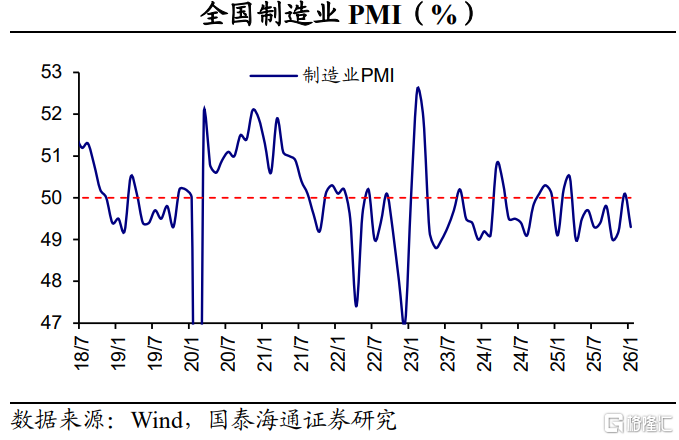
Group 1: Manufacturing Sector Overview - The manufacturing Purchasing Managers' Index (PMI) in China for November is reported at 49.2%, showing a slight increase of 0.2 percentage points from the previous month, indicating an improvement in economic conditions [1] - The production index and new orders index for November are at 50.0% and 49.2%, respectively, with increases of 0.3 and 0.4 percentage points, suggesting a recovery in production and demand [1] - The new export orders index rose by 1.7 percentage points to 47.6%, marking the second highest point since April, reflecting strong resilience in exports [1] Group 2: Business Confidence and Expectations - The manufacturing production and business activity expectation index increased by 0.3 percentage points to 53.1%, indicating heightened confidence among manufacturers regarding market developments [2] - Small and medium-sized enterprises (SMEs) showed significant improvement, with their PMIs rising to 49.1% and 48.9%, respectively, while large enterprises saw a decline to 49.3% [2] - High-tech manufacturing continues to expand, with a PMI of 50.1%, remaining above the critical point for ten consecutive months, demonstrating sustained growth in this sector [2] Group 3: Price Trends and Inventory Levels - The purchasing price index for major raw materials increased to 53.6%, while the factory price index rose to 48.2%, indicating a supportive environment for market prices due to improved supply and demand dynamics [3] - The procurement willingness index improved to 49.5%, reflecting a positive shift in purchasing behavior among enterprises [3] - The construction sector's business activity index rose to 49.6%, showing signs of recovery, although it remains below the threshold of expansion [3] Group 4: Service Sector Performance - The service sector's business activity index fell to 49.5%, a decrease of 0.7 percentage points, indicating a return to contraction territory [4] - The new orders index for the service sector dropped to 45.6%, highlighting pressure on demand and insufficient recovery momentum [4] - Despite short-term demand disruptions, the service sector's confidence remains supported, with expectations for recovery as policy benefits are realized [4]
11月股指期货市场运行报告
Hua Long Qi Huo· 2025-12-01 01:50
1. Report Industry Investment Rating - Not provided in the report 2. Core View of the Report - The market is expected to maintain a short - term volatile pattern. Although the economic fundamentals show structural improvement, the short - term repair market is insufficient to boost market confidence. The long - term positive trend remains unchanged, but valuation pressure and external uncertainties will restrict the upward space of the index. Investors should be patient and wait for clearer market signals [34]. 3. Summary by Relevant Catalog 3.1 Market Review - In November, the stock index futures market showed an overall volatile and corrective trend, with all major contracts recording monthly declines. Among them, the CSI 500 index futures had the most significant adjustment, followed by the SSE 300 index futures, while the SSE 50 and CSI 1000 index futures were relatively resilient. Specific data for major futures contracts on November 28th: SSE 300 futures (IF) closed at 4,505.8 with a monthly decline of 2.71% (125.6); SSE 50 futures (IH) closed at 2,963.2 with a monthly decline of 1.72% (52.0); CSI 500 futures (IC) closed at 6,974.2 with a monthly decline of 3.70% (- 268.2); CSI 1000 futures (IM) closed at 7,260.8 with a monthly decline of 1.46% (- 107.4) [5]. - In November, all bond futures declined. On November 28th, the 30 - year Treasury bond futures closed at 114.490 with a monthly decline of 1.60% (- 1.86); the 10 - year Treasury bond futures closed at 107.940 with a monthly decline of 0.43% (- 0.465); the 5 - year Treasury bond futures closed at 105.745 with a monthly decline of 0.32% (- 0.245); the 2 - year Treasury bond futures closed at 102.378 with a monthly decline of 0.12% (- 0.120) [6]. 3.2 Fundamental Analysis - In November, the manufacturing PMI was 49.2%, up 0.2 percentage points from the previous month, with improved business levels [7]. - In November, the non - manufacturing business activity index was 49.5%, down 0.6 percentage points from the previous month [11]. - In November, the composite PMI output index was 49.7%, down 0.3 percentage points from the previous month [12]. 3.3 Valuation Analysis - As of November 28th, the PE of the SSE 300 index was 13.94 times, the percentile was 80.2%, and the PB was 1.45 times; the PE of the SSE 50 index was 11.83 times, the percentile was 88.43%, and the PB was 1.29 times; the PE of the CSI 500 index was 32.03 times, the percentile was 76.47%, and the PB was 2.19 times; the PE of the CSI 1000 index was 46.44 times, the percentile was 73.33%, and the PB was 2.44 times [15]. 3.4 Other Data - Stock - bond spread: There are two calculation formulas. One is (1/Index static P/E ratio) - 10 - year Treasury bond yield, and the other is 10 - year Treasury bond yield - Index static dividend yield [28]. - China - Buffett indicator: On November 28, 2025, the ratio of total market capitalization to GDP was 88.25%. The current "total market capitalization/GDP" was at the 87.44% percentile in historical data and the 91.31% percentile in the past 10 - year data [32]. 3.5 Comprehensive Analysis - Macroeconomically, the official manufacturing PMI in November rebounded slightly but remained in the contraction range. The high - tech manufacturing PMI has been in the expansion range for 10 consecutive months, indicating continuous economic structural transformation. The non - manufacturing business activity index declined, with the construction industry showing obvious improvement in business levels and significantly improved market expectations [34]. - In terms of valuation, although the market has adjusted, the valuation percentiles of major indices are still at relatively high historical levels. The ratio of total market capitalization to GDP remains high, indicating that the overall market valuation pressure still exists [34]. 3.6 Operation Suggestions - Adopt a neutral approach, pay attention to layout opportunities after market adjustments, and closely monitor subsequent economic data and policy trends. For unilateral trading, consider bottom - fishing but beware of valuation risks; for arbitrage, stay on the sidelines; for options, consider covered strategies to increase returns [35][36].
X @外汇交易员
外汇交易员· 2025-12-01 01:49
中国10月RatingDog制造业PMI录得49.9,预期50.5,前值50.6。7月后首次出现恶化,新业务增长减弱,导致用工重陷收缩,企业采取措施控制成本,一定程度上造成人员离职和裁员。制造业平均购进价格继续上扬,金属涨价是主要原因。https://t.co/i2gxywNMPJ https://t.co/BnUy7pwWmk外汇交易员 (@myfxtrader):#数据中国11月官方制造业PMI为49.2,预期49.3,前值49.0;非制造业PMI为49.5,预期50.0,跌至荣枯线下方;综合PMI为49.7,前值50.0。 https://t.co/DDI79QM5Zv ...
11月份我国制造业PMI小幅回升
Jin Rong Shi Bao· 2025-12-01 01:29
Core Insights - The manufacturing Purchasing Managers' Index (PMI) in China for November is reported at 49.2%, indicating a slight improvement from the previous month [1] - The overall economic sentiment in China remains stable, with improvements in both production and demand in the manufacturing sector [1] - Small enterprises have shown a significant recovery in PMI, while high-tech manufacturing continues to expand [2] Manufacturing Sector - The production index and new orders index for November are 50.0% and 49.2%, respectively, reflecting increases of 0.3 and 0.4 percentage points from the previous month [1] - New export orders index rose by 1.7 percentage points to 47.6%, marking the second highest point since April of this year, indicating strong resilience in exports [1] - The manufacturing production and operational expectations index increased by 0.3 percentage points to 53.1%, suggesting enhanced confidence among manufacturers [2] Enterprise Size Analysis - Large enterprises' PMI stands at 49.3%, a decrease of 0.6 percentage points from last month, while medium and small enterprises' PMIs are 48.9% and 49.1%, showing increases of 0.2 and 2.0 percentage points, respectively [2] - The recovery in PMI is primarily driven by medium and small enterprises, with small enterprises reaching a six-month high [2] Industry Performance - High-tech manufacturing PMI is at 50.1%, remaining above the critical point for ten consecutive months, indicating sustained growth [2] - Equipment manufacturing and consumer goods industries have PMIs of 49.8% and 49.4%, both showing declines from the previous month [2] - High-energy-consuming industries' PMI increased by 1.1 percentage points to 48.4%, indicating a low-level recovery [2] Price Trends - The purchasing price index and factory price index for November are 53.6% and 48.2%, respectively, both showing increases from the previous month [3] - The procurement willingness of enterprises improved, with the procurement volume index rising to 49.5% [3] - The construction industry shows a steady recovery, with the business activity index at 49.6%, a slight increase from last month [3] Service Sector - The service sector's business activity index fell to 49.5%, down 0.7 percentage points from the previous month, indicating a return below the critical line [4] - The new orders index for the service sector dropped to 45.6%, reflecting insufficient recovery in market demand [4] - Despite short-term demand disruptions, the service sector's confidence remains supported, with expectations for recovery as policies are implemented [4] Future Outlook - Experts anticipate that the manufacturing PMI will stabilize and potentially improve in December, driven by year-end demand [5] - The overall economic sentiment will largely depend on the effectiveness and timing of growth-stabilizing policies [5]
11月PMI:反弹的底色
Ge Long Hui· 2025-12-01 00:57
Core Viewpoint - The November manufacturing PMI shows a seasonal rebound post-holiday, but underlying signals indicate unusual trends that warrant deeper analysis [1]. Group 1: Manufacturing PMI Overview - The November manufacturing PMI typically rises due to increased working days compared to October's holiday month, with an average increase of 0.17 percentage points from 2015 to 2024; this year, it increased by 0.2 percentage points, aligning with seasonal trends [1]. - The main drivers of the PMI increase are the new orders index and production index, with the former rising by 0.4 percentage points to 49.2% and the latter by 0.3 percentage points to 50.0% [3]. Group 2: Demand and Supply Dynamics - Although the production index has reached the neutral line, the demand side shows stronger improvement, with the new orders index reflecting seasonal growth while the production index remains weak; this divergence suggests that "anti-involution" policies are facilitating orderly adjustments on the supply side, potentially leading to a balanced supply-demand landscape [4]. Group 3: Price Indicators - Price indicators are sending positive signals, with the raw materials purchasing price index rising by 1.1 percentage points to 53.6% and the factory price index increasing by 0.7 percentage points to 48.2%, indicating potential for continued improvement in overall PPI growth; however, the greater improvement in upstream prices compared to downstream suggests that corporate profit margins may be narrowing [7]. Group 4: Export and Sector Performance - The November export sector showed significant improvement, with the new export orders index rising by 1.7 percentage points, driven by two main factors: a phase one trade agreement between China and the U.S. and the upcoming overseas Christmas order season [9]. - The construction PMI has risen by 0.5 percentage points to 49.6%, marking the largest increase since June, reflecting the effectiveness of new policy financial tools; in contrast, the service sector PMI has decreased by 0.7 percentage points, indicating a need for stronger measures to enhance service consumption mechanisms [9].
中国:10 月工业利润与营收双降;11 月 PMI 前瞻-China_ Both industrial profits and revenue fell in October; November PMI preview
2025-12-01 00:49
Summary of Key Points from the Conference Call Industry Overview - The report focuses on the **Chinese industrial sector**, highlighting significant declines in both industrial profits and revenue for October 2023 compared to previous months [1][2][6]. Core Findings 1. **Industrial Profits Decline**: - Year-over-year, China's industrial profits fell by **8.9%** in October, a stark contrast to a **23.0%** increase in September. Sequentially, profits decreased by **8.3%** non-annualized after seasonal adjustment, following a **9.7%** decline in September [1][2][6]. 2. **Downstream vs. Upstream Performance**: - Downstream industries experienced a profit decline of **5.6%** year-over-year in October, compared to a **20.5%** increase in September. Upstream industries saw a more significant drop of **14.9%** year-over-year, down from a **35.8%** increase in September. The equipment manufacturing sector contributed positively, adding **2.8 percentage points** to the **1.9%** year-over-year growth of industrial profits in the first ten months of the year [6]. 3. **Industrial Revenue Decline**: - Industrial revenue also fell by **4.0%** year-over-year in October, compared to a **3.3%** increase in September. Sequentially, revenue decreased by **4.8%** non-annualized in October, contrasting with a **0.8%** increase in September. Overall profit margins declined on a 12-month average basis, with both upstream and downstream profit margins deteriorating [1][2][6]. 4. **PMI Forecasts for November**: - The NBS manufacturing PMI is expected to rise slightly to **49.3** in November from **49.0** in October. The RatingDog manufacturing PMI is forecasted to remain flat at **50.6**. The NBS non-manufacturing PMI is anticipated to decrease to **50.0** from **50.1** in October, reflecting subdued construction activity due to slower fiscal spending [6][7]. Additional Insights - The report indicates a **weakening in port activity** in coastal regions compared to the previous month, although there is a noted positive seasonal bias in the RatingDog manufacturing PMI for November. The services PMI is expected to remain largely unchanged, impacted by ongoing challenges in the property sector [7]. This summary encapsulates the critical insights from the conference call regarding the current state of the Chinese industrial sector, highlighting both the challenges and the anticipated trends moving forward.
国家统计局:11月中小型企业PMI回升 高技术制造业保持扩张
Group 1: Manufacturing Sector - The manufacturing Purchasing Managers' Index (PMI) for November is reported at 49.2%, an increase of 0.2 percentage points from the previous month, indicating an improvement in the manufacturing sector's economic conditions [1][2] - The production index and new orders index for November are at 50.0% and 49.2%, respectively, with increases of 0.3 and 0.4 percentage points, suggesting a recovery in both production and demand [2] - Small enterprises show significant improvement with a PMI of 49.1%, up 2.0 percentage points, marking the highest level in six months [2] Group 2: Non-Manufacturing Sector - The non-manufacturing business activity index for November is at 49.5%, a decrease of 0.6 percentage points from the previous month, indicating a decline in the non-manufacturing sector's economic conditions [4] - The service industry is experiencing a seasonal decline due to the high base effect from the previous month’s holidays, contributing to the drop in the non-manufacturing index [4] - The construction industry shows signs of recovery with a business activity index of 49.6%, up 0.5 percentage points, and a business activity expectation index of 57.9%, indicating increased confidence among construction firms [4][5] Group 3: Market Expectations - The production and business activity expectation index for November is at 53.1%, reflecting increased confidence among manufacturing enterprises regarding market development [3] - Analysts predict that the manufacturing sector will continue to stabilize and recover, supported by year-end project accelerations and effective policy implementations [3][5] - The service sector maintains a positive outlook despite a slight decline in the business activity expectation index, which remains at a high level of 55.9% [4]
国家统计局:11月中小型企业PMI回升
具体来看,产需两端有所改善。11月份,生产指数和新订单指数分别为50.0%和49.2%,比上月上升0.3 个和0.4个百分点,其中生产指数升至临界点,制造业产需两端均有改善。 "海外节日购物季备货需求带动出口趋稳,推动市场需求整体回暖。需求端恢复对企业的生产意愿有所 提振,制造业生产活动平稳运行。"中国民生银行首席经济学家温彬表示。 小型企业PMI明显回升。11月份,大型企业PMI为49.3%,比上月下降0.6个百分点,景气水平回落;中 型企业PMI为48.9%,比上月上升0.2个百分点,景气度有所改善;小型企业PMI为49.1%,比上月上升 2.0个百分点,为近6个月高点,景气水平显著回升。 高技术制造业保持扩张。11月份,高技术制造业PMI为50.1%,连续10个月位于临界点以上,相关行业 继续保持增长。装备制造业和消费品行业PMI分别为49.8%和49.4%,比上月下降0.4个和0.7个百分点。 高耗能行业PMI为48.4%,比上月上升1.1个百分点,景气水平低位回升。 市场预期稳中有升。霍丽慧表示,11月份,生产经营活动预期指数为53.1%,比上月上升0.3个百分点, (下转A02版) (上接A01版 ...
需求改善带动生产趋稳 11月制造业PMI回升
需求改善带动生产趋稳 11月制造业PMI回升 ◎记者 陈芳 国家统计局服务业调查中心和中国物流与采购联合会11月30日发布的数据显示,11月,制造业采购经理 指数(PMI)为49.2%,比10月上升0.2个百分点。其中,新出口订单回升提振制造业,特别是拉动中小 企业景气度改善;受年底重点项目加快推进影响,建筑业景气度回升。 专家分析,11月,制造业景气度小幅回升,市场信心有所改善,但三大PMI指数仍位于荣枯线以下,应 加大宏观政策实施力度,推动全年经济平稳收官。 制造业出口趋稳 从制造业的分项指数看,出口需求回升,尤其是消费品制造业出口较10月好转。需求改善带动制造业生 产趋稳运行,企业销售加快。 11月,制造业新订单指数为49.2%,比10月上升0.4个百分点。其中,新出口订单指数从10月45.9%回升 至11月的47.7%,回升了1.7个百分点,明显改善。 中国物流信息中心分析师文韬表示,11月制造业出口是全面性地趋稳,制造业四大行业以及大中小企业 的新出口订单指数全部较10月上升。其中,消费品制造业新出口订单指数较10月上升超过2个百分点。 在需求端带动下,制造业生产活动也呈现企稳态势。11月,制造业生 ...
数据点评 | PMI修复的“短期掣肘”?(申万宏观·赵伟团队)
赵伟宏观探索· 2025-11-30 16:35
Core Viewpoints - The PMI for November shows limited recovery, primarily influenced by high inventory levels and the fading effects of holidays [2][4][88] - In the manufacturing sector, the PMI increased slightly to 49.2%, reflecting weak overall performance despite a low base [2][10][44] - The production index remains weak, with only a minor increase to the threshold line of 50%, indicating ongoing production challenges [2][10][19] Manufacturing Sector - The manufacturing PMI rose by 0.2 percentage points to 49.2%, with production and new orders indices showing slight improvements of 0.3 and 0.4 percentage points, respectively [5][44][89] - High inventory levels from previous months continue to constrain current production, with the finished goods inventory index decreasing to 47.3% [2][19][87] - Key industries such as high-tech manufacturing and consumer goods have seen their PMIs fall into contraction territory, while energy-intensive industries have shown some improvement [3][22][88] Non-Manufacturing Sector - The non-manufacturing PMI decreased to 49.5%, primarily due to a high base from the previous month and the impact of holiday effects [3][36][59] - Service industries, including retail and hospitality, experienced declines in their PMIs, while sectors like telecommunications and financial services remained in a high growth zone [3][36][88] - The construction sector's PMI improved to 49.6%, with significant increases in new orders and employment indices, indicating a potential recovery in this area [30][36][76] Economic Outlook - The short-term disturbances from high inventory levels are expected to dissipate, and with supportive fiscal policies being implemented, economic growth is anticipated to remain resilient [4][42][88] - The easing of debt-related investment constraints is reflected in the improvements seen in energy-intensive and construction sectors [4][42][88] - Overall, the combination of external demand stability and the rollout of fiscal measures is projected to support economic resilience through the end of the year [4][42][88]