
扩内需

Search documents
住房城乡建设部:建“好房子”不等同于建“大房子”“贵房子”
news flash· 2025-06-05 11:52
Core Points - The newly implemented "Residential Project Standards" aims to enhance housing quality rather than just focusing on size or cost, emphasizing good design, construction, materials, and services [1] - The standards, effective from May 1, 2023, are seen as a baseline requirement for constructing "good houses" and are expected to support the transformation of the construction and real estate industries [1] Group 1 - The Ministry of Housing and Urban-Rural Development highlights that building "good houses" addresses pain points in living conditions and should vary by region, size, and price [1] - The implementation of the standards is crucial for standardization activities, with a focus on training and guiding relevant personnel to familiarize themselves with the new regulations [2] - The Ministry plans to support local adaptations of the standards and ensure compliance through supervision and management, including penalties for violations [2] Group 2 - The standards provide opportunities for the application of new technologies, products, and materials, which can stimulate domestic demand and consumption [1] - The Ministry will oversee the implementation of the standards, ensuring that all parties involved in construction adhere to the regulations [2] - Regular checks will be conducted to ensure that project designs, construction, and materials meet the established standards, with a focus on accountability [2]
前四月中国社会物流总额达115.3万亿元
Zhong Guo Xin Wen Wang· 2025-06-03 07:41
Core Insights - China's logistics demand continues to recover, with a total social logistics volume reaching 115.3 trillion yuan, a year-on-year increase of 5.6% from January to April [1] - In April, the total social logistics volume grew by 5.5% year-on-year, a decrease of 1.4 percentage points compared to the previous month, influenced by a complex international environment [1] - Industrial and consumer logistics demand remains stable, with industrial goods logistics volume increasing by 5.7% and consumer goods logistics volume rising by 5.9% from January to April [1] Group 1: Logistics Demand Trends - The logistics demand is effectively supported by production and consumption needs, with 87.8% of 41 major industry categories showing growth in April [1] - Equipment manufacturing logistics, which accounts for nearly 40% of the industrial sector, saw a year-on-year growth rate of 9.8% [1] - High-tech manufacturing logistics demand grew by 10% in April, continuing to outpace the overall industrial goods logistics growth [1] Group 2: Consumer Logistics Dynamics - The potential for consumer logistics demand is being released, driven by policies promoting consumption and new business models such as live streaming and short videos [1] - The retail sales of items related to home upgrades, such as smart home products and building decoration, have contributed to the growth in logistics demand [1] - Online retail of physical goods increased by 5.8% from January to April, indicating strong vitality in e-commerce consumption [1] Group 3: International Logistics Challenges - International logistics demand is impacted by US-China trade tensions, with the logistics volume of imported goods declining by 4.1% year-on-year from January to April, although the rate of decline has narrowed [2] - Multiple policies are being implemented to stabilize foreign trade and logistics, including expanding open sectors and enhancing trade cooperation with countries involved in the Belt and Road Initiative [2] - Future trends suggest that ongoing policies aimed at expanding domestic demand and promoting consumption may accelerate the manufacturing sector's transition towards high-end and intelligent development, necessitating improvements in logistics service capabilities and efficiency [2]
银行板块早盘拉升,300红利低波ETF(515300)小幅上涨,已连续6个交易日获资金净流入
2 1 Shi Ji Jing Ji Bao Dao· 2025-05-30 02:57
Core Viewpoint - The A-share market showed a decline in the morning session on May 30, with the banking sector experiencing a rise, and the 300 Dividend Low Volatility Index increasing by 0.20% at the time of reporting [1] Group 1: Market Performance - The 300 Dividend Low Volatility ETF (515300) rose by 0.07% with a trading volume exceeding 45 million yuan and a premium rate of 0.01%, indicating frequent premium trading during the session [1] - The 300 Dividend Low Volatility ETF (515300) received a net inflow of over 140 million yuan yesterday, marking six consecutive trading days of net inflows, totaling over 260 million yuan [1][2] Group 2: Component Stocks - Among the constituent stocks, Shanghai Port Group, Ningbo Expressway, and Nanjing Bank saw increases of over 1%, while Jiangsu Bank, Hangzhou Bank, and Chengdu Bank also experienced gains [2] Group 3: Investment Insights - Xiangcai Securities noted that high-dividend sectors are favored by institutions, and dividend assets serve as a good alternative to pure bonds. The banking sector is recommended for attention despite performance pressure from narrowing interest margins, as bank convertible bonds are relatively scarce [2] - Caixin Securities indicated that until trading volume expands consistently, the structural market with index fluctuations and sector rotations is likely to continue. Concepts related to export industrial chains, self-sufficiency, domestic demand expansion, high dividend yields, and mergers and acquisitions may remain active [2]
策略周观点:矛盾与缓和并存,“以我为主”保持定力-20250529
Great Wall Securities· 2025-05-29 14:50
Economic Indicators - In April 2025, the PPI decreased by 2.7% year-on-year, marking 31 consecutive months of negative growth[1] - The CPI showed a slight decline of 0.1% year-on-year, remaining around 0% for 25 months[1] - The GDP deflator index has been negative for 8 consecutive quarters, setting a historical record for duration[1] Price Trends - Food prices, including pork, have been declining, with pork CPI turning positive since April 2024, but overall support for CPI remains weak[1][2] - The decline in PPI is broad and significant, with both production and living materials experiencing substantial price drops[2] Consumption and Policy Recommendations - Social retail sales grew by 5.1% year-on-year in April 2025, but the growth rate has decreased compared to the previous month[3] - To stimulate consumption, it is essential to enhance residents' income, particularly for low- and middle-income groups, and stabilize property and stock market incomes[3] - The report suggests implementing more proactive fiscal and monetary policies, including government-led investments in new infrastructure and urban renewal[2] Market Strategy - Investment strategies should focus on defensive sectors, "expanding domestic demand," and self-sufficiency in technology[6][7] - The report highlights the importance of supporting struggling enterprises and enhancing financing to stabilize foreign trade[5][6] Risks - Potential risks include policy implementation falling short of expectations, underperformance of listed companies, geopolitical conflicts, and insufficient consumer recovery[8]
金十图示:2025年05月29日(周四)新闻联播今日要点
news flash· 2025-05-29 13:09
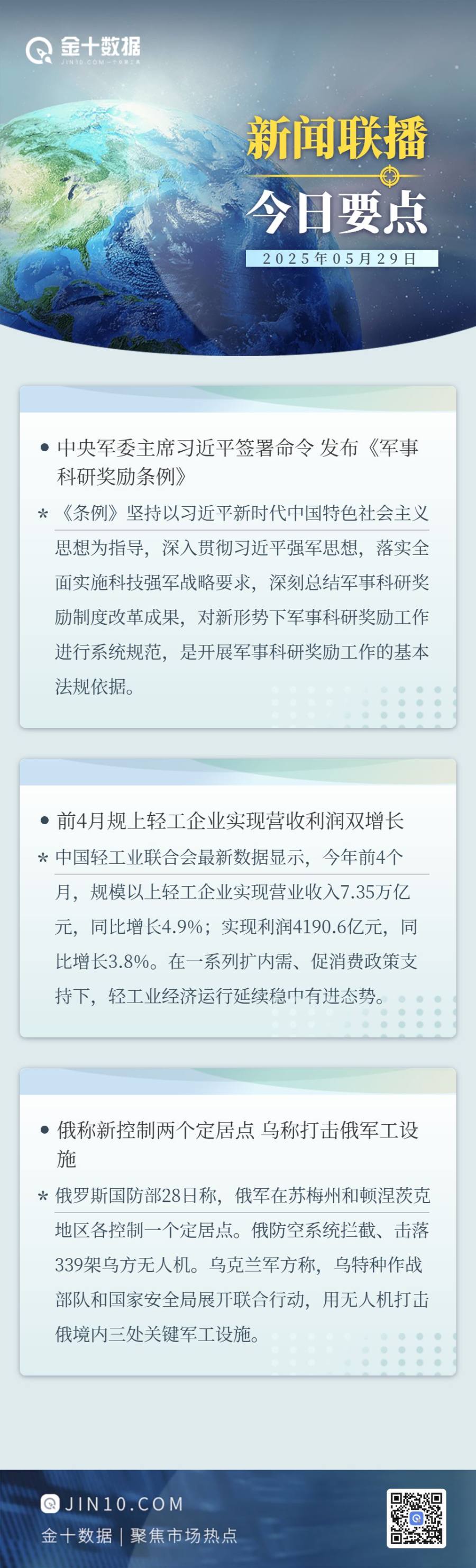
● 俄称新控制两个定居点 乌称打击俄军工设 施 * 俄罗斯国防部28日称,俄军在苏梅州和顿涅茨克 地区各控制一个定居点。俄防空系统拦截、击落 339架乌方无人机。乌克兰军方称,乌特种作战 部队和国家安全局展开联合行动,用无人机打击 俄境内三处关键军工设施。 金十图示:2025年05月29日(周四)新闻联播今日要点 @JIN10.COM 金十数据 | 聚焦市场热点 法规依据。 ● 前4月规上轻工企业实现营收利润双增长 * 中国轻工业联合会最新数据显示,今年前4个 月,规模以上轻工企业实现营业收入7.35万亿 元,同比增长4.9%;实现利润4190.6亿元,同 比增长3.8%。在一系列扩内需、促消费政策支 持下,轻工业经济运行延续稳中有进态势。 ...

长城策略周观点:矛盾与缓和并存,“以我为主”保持定力-20250529
Great Wall Securities· 2025-05-29 11:18
Core Insights - The report highlights the persistent low inflation in China, with April 2025 PPI down 2.7% year-on-year for 31 consecutive months and CPI down 0.1% year-on-year, remaining around 0% for 25 months [1][2] - The report emphasizes the need for more proactive macroeconomic policies to address the low inflation, suggesting the use of fiscal and monetary tools to stimulate demand and support economic recovery [2][3] Economic Conditions - The prolonged low inflation is attributed to several factors, including a deep adjustment in the real estate market, which negatively impacts both upstream manufacturing and downstream sales, leading to insufficient consumer demand [2] - The report notes that since April 2023, emerging industries such as new energy and photovoltaics have experienced overcapacity, resulting in declining product prices and profits [2] Policy Recommendations - To combat low inflation, the report recommends implementing more aggressive fiscal policies, focusing on government-led investment in new infrastructure and urban renewal [2] - It suggests utilizing special government bonds and other unconventional fiscal tools to stimulate the economy and support trade and enterprise relief efforts [2] Consumer Demand - The report indicates that consumer spending needs to be further stimulated, with retail sales in April 2025 growing by 5.1% year-on-year, showing a decline in growth rate compared to the previous month [3] - It calls for measures to increase residents' income, particularly for low- and middle-income groups, and to stabilize property and stock market incomes [3] Industry Focus - The report advocates for enhancing supply-side policies to create demand in sectors such as service consumption and new consumption, including areas like hospitality, healthcare, and digital consumption [3] - It emphasizes the importance of pushing for capacity clearance and structural upgrades in certain industries to avoid "involution" and promote healthy competition [5] Market Strategy - The report suggests focusing on defensive sectors, expanding domestic demand, and promoting self-sufficiency in investment strategies, especially in light of ongoing trade tensions and market uncertainties [6][7] - It identifies consumer sectors such as home appliances, automobiles, and pharmaceuticals as beneficiaries of domestic consumption policies, while also recommending investments in technology and strategic resources [7]
中国社科院财经战略研究院市场流通与消费研究室主任依绍华:线上线下融合加速 餐饮消费助力服务消费发展
Bei Jing Shang Bao· 2025-05-29 10:15
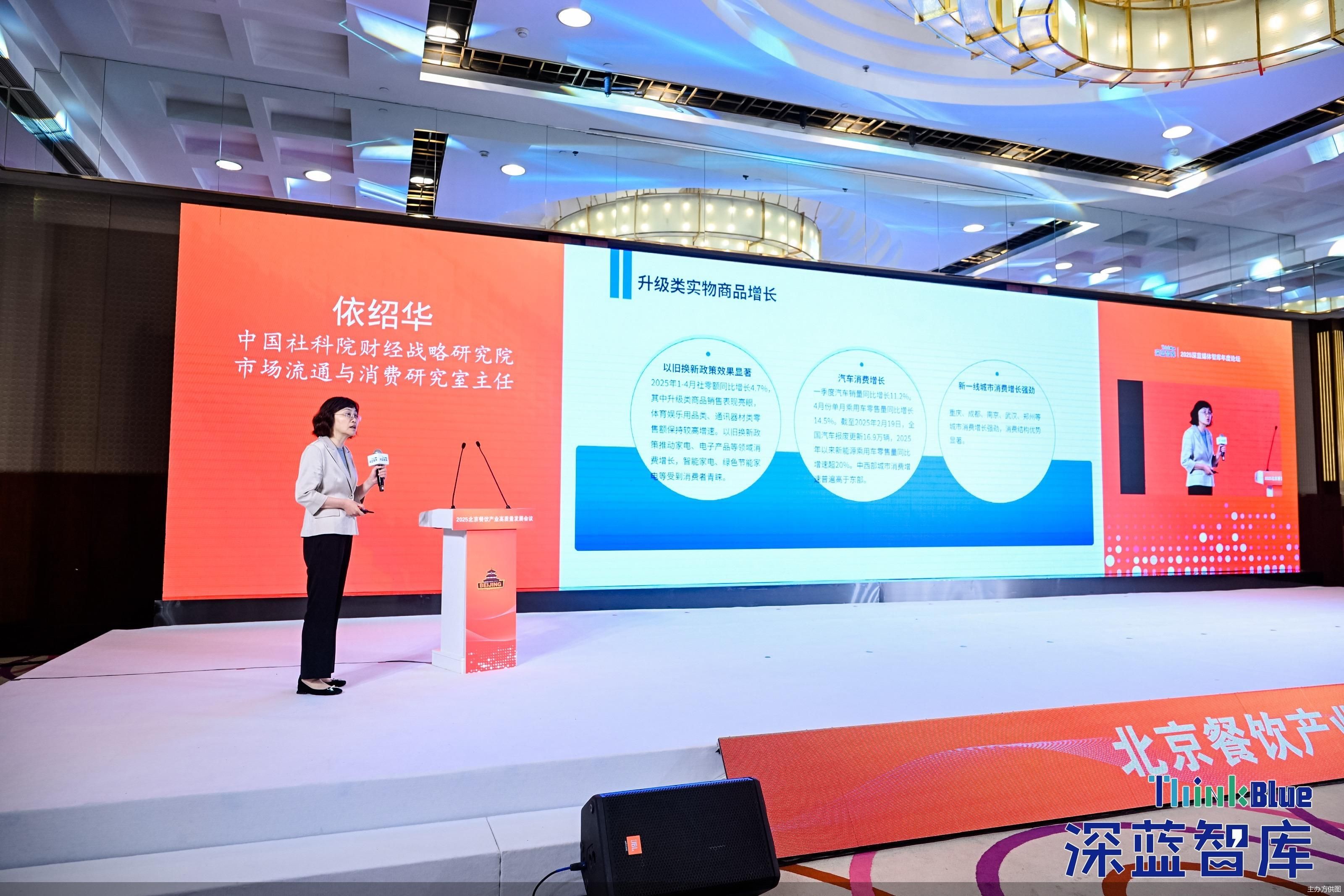
Core Viewpoint - The 2025 Beijing Conference on High-Quality Development of the Catering Industry emphasizes the importance of catering consumption as a key driver for domestic demand, highlighting the sector's robust growth and digital transformation efforts in Beijing [4][5]. Group 1: Catering Industry Growth - Service consumption in China is expanding, with catering consumption showing significant performance, becoming a crucial engine for domestic demand [4]. - From January to April, the national service retail sales increased by 5.1% year-on-year, with April's catering revenue growth reaching 5.2%, accelerating by 0.5 percentage points compared to the first quarter [4]. Group 2: Digital Transformation - Beijing's catering industry is experiencing notable digital transformation, with the "internet penetration rate" of key catering enterprises rising to 61.1% [4]. - New business models such as live streaming sales and instant retail are promoting deep integration of online and offline operations [4]. Group 3: Future Consumption Strategies - Recommendations for boosting future consumption include optimizing service supply through new technologies to enhance quality and experience [5]. - There is a call for deeper integration of business, culture, tourism, and sports to create diversified consumption scenarios [5]. - Strengthening county-level layouts and improving rural consumption infrastructure are suggested to activate the county market [5].

两则大消息定调A股!
摩尔投研精选· 2025-05-27 10:36
Core Viewpoint - The A-share market is experiencing fluctuations with a collective decline in major indices, reflecting a strong wait-and-see sentiment among investors [1] Group 1: Market Performance - The A-share market saw a significant drop, with total trading volume shrinking to 1.01 trillion yuan, indicating a cautious market atmosphere [1] - Certain sectors such as pesticides and chemicals showed strong performance in the afternoon, with multiple stocks hitting the daily limit [1] - New consumption stocks, particularly in beverages and IP economy, also performed well, with several stocks reaching their daily limit [1] - Conversely, the robotics sector faced adjustments, with stocks like Green Harmony dropping over 5% [1] Group 2: Key Messages from Central Financial Authorities - The Central Huijin Company emphasized its role in managing state-owned financial capital and supporting the real economy during its 2025 work meeting [2][5] - The meeting highlighted three main objectives: to serve as the "main force" for the real economy, to build first-class financial institutions, and to act as a "ballast" for financial stability [5][6] - The Ministry of Finance's response to Moody's maintaining China's sovereign credit rating reflects a positive outlook on China's economic prospects, especially in light of Moody's downgrade of the U.S. credit rating [6] Group 3: Structural Market Trends - The market is expected to continue its structural trend with limited downside potential for indices, influenced by easing U.S.-China trade tensions and domestic demand expansion policies [7] - The focus should be on sectors benefiting from export chains, domestic demand expansion, high dividend yields, and merger and acquisition activities [7] - Suggested investment directions include: 1. Consumer sectors supported by policy, such as health, cultural tourism, sports, beauty care, IP economy, and pet economy [8] 2. High dividend sectors, including banking, coal, public utilities, and transportation [8] 3. Merger and acquisition concepts, particularly in small and mid-cap stocks [8]

小城烟火气更浓
Jin Rong Shi Bao· 2025-05-27 03:16
Core Viewpoint - Shandong Xiaojin Rural Commercial Bank focuses on expanding domestic demand, promoting consumption, improving people's livelihoods, and stabilizing employment by innovating financial products and providing quality financial services to support local economic development [1] Group 1: Financial Support for Consumption - The bank has issued a total of 356 million yuan in various consumer loans since 2025 [1] - It has provided over 53 million yuan in loans related to the cultural tourism industry, supporting local tourism and entrepreneurship [2] - The bank has issued 410 million yuan in online loans this year, catering to the urgent funding needs of individual businesses [3] Group 2: Support for Specific Industries - The bank has actively supported the home appliance sector by providing 30 million yuan in loans to businesses like home appliance stores, enhancing their inventory and sales [4] - A total of 1.715 billion yuan has been allocated to the consumer sector, focusing on the "old-for-new" policy for appliances and vehicles [5]
多维数据勾勒扩内需新图景
Zhong Guo Zheng Quan Bao· 2025-05-25 21:08
Group 1 - The consumption upgrade policy, including the trade-in program, has shown significant results, with 48.8 million consumers purchasing digital products, generating sales of 143.26 billion yuan [1][2] - The "618 shopping festival" has seen a surge in sales for various categories, including a 3-fold increase in sales for action cameras and over 110% growth for gaming laptops on platforms like JD [2] - The automotive sector is experiencing steady growth, with April passenger car sales reaching 1.755 million units, a year-on-year increase of 14.5%, and new energy vehicle sales growing by 33.9% [2][3] Group 2 - New consumption trends are emerging, particularly in the pet and trendy toy sectors, with pet brand sales doubling during the "618" event and significant growth reported by companies like Pop Mart [3][4] - Health-related consumption is also on the rise, with retail sales of sports and entertainment goods increasing by 23.3% in April, driven by smart health monitoring devices [4][5] - The A-share market has seen a strong performance in consumer sectors, with a notable increase in companies from the new consumption field listed abroad, reflecting investor confidence in China's consumption market [5][6] Group 3 - Various cities are implementing comprehensive measures to boost consumption, focusing on new consumption models and local economic development [6][7] - Supportive policies for consumption and technology are expected to continue, with potential increases in fiscal spending in the consumption sector [7]