
高股息红利

Search documents
财信证券宏观策略周报(3.30-4.3):指数震荡磨底,低吸业绩高增方向-20260329
Caixin Securities· 2026-03-29 12:24
Group 1: Market Overview - The market is expected to maintain a volatile consolidation phase until the end of April, with a trend-driven market still needing to wait [5][8] - The technical indicators show weak recovery after the recent decline, with the Shanghai Composite Index and the Wind All A Index not filling previous gaps, indicating a cautious sentiment among investors [5][8] - The performance of industrial enterprises is crucial for market direction, with a focus on sectors that exceed earnings expectations [5][8] Group 2: Investment Recommendations - Attention should be given to high dividend assets such as coal, oil, and transportation [17] - Opportunities in energy substitution sectors, including new energy, energy storage, and coal chemical industries, are highlighted [17] - High-growth technology sectors, such as optical modules, PCBs, and storage, are recommended for investment [17] Group 3: Economic Indicators - In January and February, profits of industrial enterprises above designated size increased by 15.2% year-on-year, with a notable acceleration compared to the previous year [10][11] - The profit margin for industrial enterprises improved, with the cost per hundred yuan of revenue decreasing for the first time since 2022 [10][11] - High-tech manufacturing and raw materials sectors showed significant profit growth, with high-tech manufacturing profits rising by 58.7% and raw materials manufacturing profits increasing by 88.3% [11] Group 4: Policy Changes - The collection ratio of state-owned capital profits is set to increase, with adjustments made to the categories of enterprises subject to profit collection [12] - The new policy aims to enhance fiscal balance and support key areas such as national strategy and technological innovation [12] Group 5: Geopolitical Factors - The ongoing Middle East conflict adds uncertainty to the market, with potential impacts on oil prices and overall market sentiment [13][14] - The situation in the Strait of Hormuz is critical, as its closure could lead to prolonged market volatility and shifts in trading logic [13]
金鹰基金:节后关注科技成长+顺周期+高股息的“三角组合”
Xin Lang Cai Jing· 2026-02-24 05:57
Core Viewpoint - The spring market excitement for 2026 has partially shifted to January, with a round of growth style realization before the festival, combined with regulatory easing and significant ETF outflows. It is expected that the overall index in February will mainly fluctuate, with a stronger performance anticipated after the festival. In this environment, a "structure-first, index-second" approach may be more suitable [1][8]. Group 1: Investment Focus Areas - **Technology Growth: AI + Humanoid Robots**: Focus on midstream components (gear reducers, servo motors, sensors, actuators), core materials, and some main body manufacturers. The resonance between the Spring Festival Gala and overseas world model progress may lead to a shift from "event-driven" to "scene landing" throughout the year. The computing chain includes storage chips, optical modules, PCB/IC substrates, and data center distribution and liquid cooling in power equipment, directly supporting the capital expenditure expansion of overseas cloud vendors. It is recommended to focus on large-cap leaders and some high-growth niche leaders while controlling overall valuation and position concentration to prevent short-term crowded trades and overseas volatility-induced pullbacks [2][9]. - **Cyclical Price Increases: Oil, Petrochemicals + Non-ferrous Metals + Building Materials/Chemicals**: Due to the rebound in oil prices and bulk commodity prices, marginal improvement in PPI, and the rhythm of the "14th Five-Year Plan" infrastructure commencement, it is suggested to pay attention to oil, petrochemicals, and oil and gas services. Additionally, focus on non-ferrous metals like copper and aluminum, steel building materials, and some chemical products with more sustainable price increases [3][10]. - **High Dividend Yield: Banks + Energy + Telecom/Public Utilities**: Before the festival, A-shares showed a clear preference for dividend and defensive sectors due to external disturbances and regulatory easing, with banks and food and beverage sectors being favored. After the festival, it may be beneficial to continue using high-dividend sectors like banks, energy, telecom, and public utilities as a base, which can hedge against overseas volatility and geopolitical risks while providing stable absolute returns in the context of macroeconomic stabilization and strong dividend yield and valuation attractiveness [4][11]. - **Domestic Consumption: Automotive Chain + Home Appliances + Travel Consumption**: Supported by the old-for-new policy and Spring Festival consumption data, the automotive and automotive electronics, home appliances, and white goods components benefit from the old-for-new policy and sales recovery. In the context of rising external demand and tariff uncertainties, these consumption directions, which are mainly driven by domestic demand and are policy-friendly, may exhibit both defensive and offensive characteristics [5][12].
切入Q布赛道的新面孔公司,引进日本领先研发团队+接洽上下游!
摩尔投研精选· 2026-01-28 10:51
Core Viewpoint - The market is experiencing clear industry differentiation, with a notable contrast between the steadily rising cyclical "five flowers" and the weakening high dividend yield sector, reflecting the competition for funds driven by technological growth prospects and domestic demand policy stimulation [1]. Group 1: Industry Analysis - The cyclical industries such as non-ferrous metals, chemicals, and building materials have seen a company adjustment ratio of 200%, 171%, and 250% respectively, indicating a positive outlook due to fiscal infrastructure efforts and demand-side stimulus [2]. - The non-bank sector has a company adjustment ratio of 1200%, highlighting the importance of short-term insurance premium growth and mid-term investment income enhancement for performance [2]. - In the technology sector, the adjustment ratios for electric new energy, telecommunications, and electronics are 133%, 163%, and 130% respectively, with a focus on clear performance growth trends in satellite navigation, commercial aerospace, storage devices, optical modules, and circuit boards [2]. Group 2: Economic Perspectives - The core of the physical re-inflation logic is based on three perspectives: price increases must be accompanied by liquidity activation, supply clearing due to anti-involution, and demand-side stimulation [1].


慢牛拾级而上!标普A股红利ETF华宝(562060)稳步创新高,连续5日吸金超1.8亿元!
Xin Lang Cai Jing· 2026-01-13 09:54
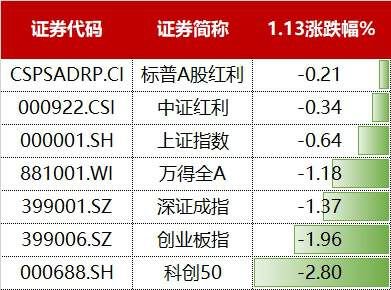
Group 1 - The Shanghai Composite Index ended a 17-day winning streak, experiencing its first decline, while high-dividend sectors like oil and insurance showed resilience by gaining in a generally down market [1][16] - The S&P A-Share Dividend Index fell by 0.21%, indicating strong defensive characteristics amidst broader market corrections [1][16] - The S&P A-Share Dividend ETF (Huabao, 562060) reached a new historical high of 0.635 yuan, with a slight premium adjustment to 0.631 yuan at closing [2][17] Group 2 - Major stocks in the S&P A-Share Dividend Index included China National Offshore Oil Corporation, which rose by 3.57%, and several others like Shenhuo Co., Tunnel Co., and CITIC Bank, all gaining over 2% [4][19] - The S&P A-Share Dividend ETF has seen significant inflows, with over 1.8 billion yuan raised in five consecutive days and a total of 2.5 billion yuan over the last 20 trading days, marking a 165.31% increase in size since the beginning of 2025 [23][25] - The S&P A-Share Dividend Index has a current dividend yield of 4.76%, with a notable spread of 2.9 percentage points over the 10-year government bond yield, enhancing its attractiveness for investors [26][29] Group 3 - According to Guangfa Securities, A-share valuations are expected to break historical patterns and rise for three consecutive years, suggesting a balanced investment strategy between large tech and high-dividend stocks [25] - The regulatory changes requiring state-owned insurance companies to allocate 30% of new premiums to A-shares are expected to support long-term investments in high-dividend assets [25] - The S&P A-Share Dividend Index has outperformed similar indices with a return of over 13% in 2025, showcasing a strong performance with a Sharpe ratio of 1.55 [9][27]
港股新基金上演资金突围:提前结募火速建仓 抢筹估值洼地
2 1 Shi Ji Jing Ji Bao Dao· 2025-12-21 00:11
Core Viewpoint - A trend of "counter-market buying" is emerging in the Hong Kong stock market amidst ongoing fluctuations, with institutional investors recognizing the valuation opportunities and actively seizing the market pullback as a layout window [1][4]. Group 1: Fundraising and Investment Trends - Since October 10, at least 15 new Hong Kong-themed funds have announced early fundraising closures, covering various types including passive index funds, equity mixed funds, and QDII funds [2]. - The early fundraising trend is characterized by significantly shortened timelines, with some funds reducing their fundraising periods by over a month [2]. - Newly launched ETFs have established high stock positions quickly, indicating strong bullish signals, with some ETFs reaching stock positions of 69.53% and 63.32% before listing [3]. Group 2: Market Conditions and Valuation - The recent market adjustment has provided a favorable entry point for new funds, as many heavy-weight stocks have seen significant weekly declines while maintaining stable fundamentals [4]. - The Hang Seng Index's price-to-earnings ratio (TTM) is approximately 12 times, and the Hang Seng Tech Index's is about 23 times, both at historical low levels, reflecting institutional recognition of undervalued Hong Kong stocks [5]. Group 3: Market Challenges - The Hang Seng Index has dropped 5.85% and the Hang Seng Tech Index has fallen 18.01% since October 3, indicating a clear market correction [6]. - Factors contributing to the market adjustment include fluctuating liquidity expectations, concerns over the "AI bubble" in the U.S., increased IPO activity, and reduced southbound capital inflows [7][8]. Group 4: Long-term Outlook and Investment Opportunities - Despite short-term pressures, institutions maintain an optimistic long-term outlook for the Hong Kong stock market, predicting a "slow bull" market in 2026 with improved liquidity conditions [9]. - Key investment themes for 2026 include technology and high-end manufacturing, with a focus on sectors such as computing power, semiconductors, and consumer electronics [9]. - High dividend yield assets are also favored in a low-interest-rate environment, with institutions highlighting the value of leading copper and aluminum mining companies [9]. - The innovative drug and biotechnology sectors are seen as having significant investment opportunities due to industry acceleration and favorable policy adjustments [10].
红利低波50ETF(515450)近19日资金净流入超8.5亿元,最新规模、份额均创近3月新高,机构:关注高股息红利板块的防御性价值
Xin Lang Cai Jing· 2025-12-03 02:25
Group 1 - The core viewpoint of the news highlights the performance and potential of the Dividend Low Volatility 50 ETF (515450), which has shown a recent upward trend and significant net inflows, indicating strong investor interest [1][2] - As of December 2, the latest scale of the Dividend Low Volatility 50 ETF reached 13.937 billion yuan, with a total of 9.549 billion shares, both hitting new highs in the past three months [1] - The ETF has experienced continuous net inflows over the past 19 days, totaling 0.852 billion yuan, reflecting a positive sentiment towards high dividend stocks [1] Group 2 - Huatai Securities notes that the market's risk appetite has declined, with the current All A ERP near the five-year rolling average, while high dividend sectors, particularly banks and oil, have performed relatively well [1] - Looking ahead to December, Huatai Securities suggests that the market risk appetite may recover, and the configuration value of high dividend sectors remains attractive despite a marginal decline compared to November [1] - China Galaxy Securities indicates that the A-share market is in a consolidation phase with rapid sector rotation, and institutions are preparing for next year's economic outlook, focusing on themes like "anti-involution" and dividends [2]
策略日报:隐波上行-20251118
Tai Ping Yang Zheng Quan· 2025-11-18 14:12
Group 1: Major Asset Tracking - The bond market is expected to experience short-term upward fluctuations, while the long-term downtrend remains unchanged. The target is set near the low point of September 30, 2024 [18][10]. - The A-share market has recently broken through short-term support levels, with the Shanghai Composite Index nearing the critical support level of 3920. If this level is breached, further downside potential may open up [21][5]. - The U.S. stock market is anticipated to enter a short-term adjustment phase, particularly in the rapidly rising AI sector, which may face valuation corrections [27][25]. Group 2: Investment Strategies - Investors are advised to adopt a strategy of "building high walls (dividends), accumulating grain (reducing positions), and waiting for opportunities" in the A-share market [21][10]. - In the U.S. market, the S&P 500 index has a support level around 6630, and investors are encouraged to wait for "buy the dip" opportunities [27][10]. - The commodity market is currently in a state of observation, with the overall performance being weak and suggesting a cautious approach [32][10]. Group 3: Foreign Exchange Market - The onshore RMB against the USD reported at 7.1110, showing an increase of 36 basis points from the previous close. There is a potential for the RMB to weaken in the short term [28][10]. - The offshore RMB/USD is forming a triple bottom structure, indicating possible future movements [30][10]. Group 4: Important Policies and News - The Ministry of Industry and Information Technology aims to establish around 200 high-standard digital parks by 2027, enhancing digital infrastructure and application [36][10]. - The U.S. Federal Reserve officials have expressed caution regarding further rate cuts, indicating a careful approach to monetary policy [40][10].
长城基金杨建华:关注“十五五”规划指引
Xin Lang Ji Jin· 2025-11-11 08:46
Core Viewpoint - The A-share market has shown increased volatility since November, with notable style switching between traditional value sectors and previously strong sectors like metals, new energy, and innovative pharmaceuticals [1] Market Outlook - The market is expected to experience a phase of consolidation after reaching a temporary high, with a focus on positioning for next year [1] - The completion of the annual economic growth target is largely assured, with potential policy measures likely to be implemented at the beginning of next year [1] Investment Opportunities - Key areas to focus on include: - High-prosperity energy storage industry chain - Bottoming cyclical industry chain - Traditional manufacturing upgrades under the "anti-involution" theme - Overseas industry chain - High dividend yield stocks [1]
哑铃策略成为四季度投资优选!港股科技扛鼎进攻端,攻守兼备应对震荡市
Mei Ri Jing Ji Xin Wen· 2025-11-11 02:57
Core Viewpoint - The Hong Kong stock market is showing a clear upward trend in the fourth quarter, with the "barbell strategy" being the optimal choice to respond to market changes, where the technology sector serves as the "offensive spear" of this strategy [1] Group 1: Market Strategy - The barbell strategy consists of two ends: the technology sector benefiting from the AI revolution and new productivity, focusing on high-growth opportunities, while high-dividend sectors provide stable cash flow to mitigate market risks [1] - This allocation aligns with the current market environment characterized by "policy support + technological breakthroughs" and matches the preferences of foreign institutions for leading growth stocks and high-dividend dual lines [1] Group 2: Investment Opportunities - For investors, positioning in the Hong Kong technology sector represents the most imaginative growth opportunity in a volatile market, achieving a balance between offensive and defensive strategies [2] - Relevant ETFs include the Hong Kong Stock Connect Technology ETF (159101), which covers the entire technology industry chain, and the Hang Seng Internet ETF (513330), which focuses on leading internet companies [2]
“红利+科技”双管齐下!港股央企红利ETF“越涨越吸金”,10月超30亿元抄底恒生科技指数ETF
Ge Long Hui· 2025-10-23 03:09
Group 1 - The market is experiencing increased uncertainty due to external tariff disturbances, leading to a shift in capital preference towards defensive sectors such as banks and high-dividend assets, with the Hong Kong Central Enterprise Dividend ETF rising over 4% this month and a net inflow of 310 million yuan [1] - The stability of state-owned enterprises' performance and their high dividend characteristics are attracting risk-averse capital, especially following Hubei Province's proposed reforms in state asset management [1] - Despite trade frictions impacting the narrative around AI in the Hong Kong stock market, there is still significant inflow into related technology sectors, with the largest constituent of the Hang Seng Technology Index ETF seeing a net inflow of 3.149 billion yuan in October [1] Group 2 - The Hang Seng Technology Index ETF includes core Chinese technology assets such as SMIC (chip manufacturer), Alibaba, Tencent, Baidu (internet giants), and smart hardware companies like Xiaomi and Lenovo [2] - Goldman Sachs believes that the Chinese stock market is entering a more sustained upward phase, predicting a 30% increase in key indices by the end of 2027, driven by AI reshaping profit structures and capital expenditures boosting profits [1]