
自主可控

Search documents
苏大维格5.1亿拿下半导体缺陷检测“小巨人” 构建光刻掩模“制造+检测”闭环
Zheng Quan Shi Bao Wang· 2025-11-09 09:13
Core Viewpoint - Su Dawei Ge plans to acquire 51% of Changzhou Weipu Semiconductor Equipment Co., Ltd. for 510 million yuan, marking its entry into the semiconductor detection equipment sector, enhancing its core competitiveness and contributing to the domestic semiconductor equipment industry's "manufacturing + detection" closed loop [1][2]. Group 1: Acquisition Details - The acquisition will make Changzhou Weipu a subsidiary of Su Dawei Ge, which is a "little giant" enterprise in Jiangsu province, specializing in semiconductor photomask defect detection equipment [1]. - Changzhou Weipu has achieved large-scale production in a field traditionally dominated by Japanese and American companies, with a domestic production rate of less than 3% [2]. Group 2: Financial Performance - In the first ten months of 2025, Changzhou Weipu reported revenues exceeding 114 million yuan and net profits surpassing 51 million yuan, with a backlog of orders amounting to 250 million yuan [2]. - The founding shareholders have committed to a cumulative net profit of no less than 240 million yuan from 2025 to 2027, with current orders expected to support nearly 70% of this target [2]. Group 3: Strategic Synergy - The acquisition creates a comprehensive synergy between Su Dawei Ge and Changzhou Weipu, establishing a competitive barrier through an integrated "optomechanical-electronic" approach [4]. - Su Dawei Ge's expertise in laser direct writing lithography complements Changzhou Weipu's capabilities in defect detection, allowing for a bundled "lithography-detection integrated solution" that reduces market expansion costs and time [4][5]. Group 4: Market Context - The global semiconductor detection equipment market is projected to grow from 1.81 billion USD in 2023 to 3 billion USD by 2030, indicating significant market potential for domestic alternatives [7]. - The acquisition aligns with Su Dawei Ge's strategic shift towards high-end semiconductor equipment, aiming to break the long-standing foreign monopoly in this sector [7][8].

兴业证券:海外扰动下的布局思路
智通财经网· 2025-11-09 08:23
Core Viewpoint - The report from Industrial Securities highlights significant volatility in global risk assets due to concerns over tightening overseas liquidity and discussions surrounding an "AI bubble" [1] Group 1: Market Conditions - Global risk assets have experienced substantial fluctuations this week, influenced by a lack of economic data, frequent hawkish statements from the Federal Reserve, and rising liquidity pressures in the money market due to government shutdown and fiscal constraints [1] - The strong dollar has suppressed global stock markets and commodity prices, with technology-heavy indices like Nikkei 225, Korean stock index, and Nasdaq leading the decline [1] Group 2: Future Outlook - The probability of overseas liquidity tightening evolving into systemic risk is low, as solutions from the Federal Reserve and bipartisan negotiations to reopen the government are progressing, which may gradually alleviate external disturbances on risk appetite [2] - If the U.S. government shutdown ends as expected in mid-November and more economic data is released, market expectations for Federal Reserve rate cuts will be recalibrated, potentially creating a window for global recovery [3] Group 3: AI Industry Analysis - The current discussions around the "AI bubble" have caused some disturbances in the domestic AI industry chain, but Industrial Securities believes that AI's empowerment of traditional industries is still in its early stages, making it incomparable to the internet bubble of 1999-2000 [4] - The development logic of the AI industry is clear, with major global tech companies continuously defining their AI strategies, and the fundamentals of leading companies in the U.S. stock market remain strong due to ongoing R&D investments and capital expenditures [4] Group 4: Investment Strategies - The "14th Five-Year Plan" emphasizes AI as a key driver for national competition and technological innovation, indicating that the AI industry chain will be a focus area with favorable prospects next year [5] - The year-end market is seen as an important window for positioning in sectors expected to perform well in the coming year, with a focus on cyclical sectors such as steel, chemicals, construction materials, and new consumption [6][7] - High-growth sectors expected to see net profit growth of over 30% next year include AI hardware, new energy, and military industries, while sectors with expected growth of 10%-30% include pharmaceuticals and AI downstream applications [7][8]

光大证券:华虹半导体(01347)3Q25涨价落地 量价齐升帮助毛利率持续修复 维持“买入”评级
Zhi Tong Cai Jing· 2025-11-09 00:13
Core Viewpoint - The report from Everbright Securities indicates that downstream demand is recovering, leading to a price increase cycle for Huahong Semiconductor (01347). However, accelerated capacity expansion is expected to increase depreciation pressure, resulting in adjusted net profit forecasts for 2025-2027 [1] Group 1: Financial Performance - In Q3 2025, the company achieved revenue of $635 million, a year-on-year increase of 20.7% and a quarter-on-quarter increase of 12.2%, aligning with previous guidance [2] - The gross margin for Q3 2025 was 13.5%, exceeding the company's guidance range of 10%-12% and the market expectation of 11.3%, with a year-on-year increase of 1.3 percentage points [2] - The net profit attributable to shareholders for Q3 2025 was $25.73 million, slightly below the market expectation of $27.17 million [2] Group 2: Market Demand and Pricing - Demand is expected to continue improving in 2026, with significant growth in power management and storage chips driven by AI demand [3] - The ASP (Average Selling Price) increased by 5.2% year-on-year and quarter-on-quarter in Q3 2025, indicating a successful price increase [3] - The "Local for Local" strategy is anticipated to start contributing to revenue from Q4 2025, with early production of ST's 40nm MCU [3] Group 3: Capacity and Production - The utilization rate in Q3 2025 was 109.5%, reflecting a year-on-year increase of 4.2 percentage points due to recovering semiconductor demand [4] - The company shipped 1.4 million 8-inch wafers in Q3 2025, a year-on-year increase of 16.7% [4] - Fab 9 is expected to complete its capacity release of 83,000 wafers per month by the end of 2026, which will drive revenue growth [4] Group 4: Future Guidance - The company has guided Q4 2025 revenue to be between $650 million and $660 million, which is lower than the market expectation of $662 million [5] - The gross margin guidance for Q4 2025 is set at 12%-14%, which is higher than the market expectation of 11.3% [5] - The company anticipates continued revenue growth in 2026 due to improved semiconductor demand and the "Local for Local" strategy [5]

光大证券:华虹半导体3Q25涨价落地 量价齐升帮助毛利率持续修复 维持“买入”评级
Zhi Tong Cai Jing· 2025-11-09 00:11
Core Viewpoint - The report from Everbright Securities indicates that downstream demand is recovering, leading to a price increase cycle for Huahong Semiconductor (01347). However, accelerated capacity expansion is expected to increase depreciation pressure, prompting adjustments to the company's net profit forecasts for 2025-2027 [1] Group 1: Financial Performance - In Q3 2025, the company achieved revenue of $635 million, a year-on-year increase of 20.7% and a quarter-on-quarter increase of 12.2%, aligning with the company's guidance of $620-640 million [1] - The gross margin for Q3 2025 was 13.5%, exceeding the company's guidance of 10%-12% and the market expectation of 11.3%, with a year-on-year increase of 1.3 percentage points and a quarter-on-quarter increase of 2.6 percentage points [1] - The net profit attributable to shareholders in Q3 2025 was $25.73 million, slightly below the market expectation of $27.17 million [1] Group 2: Market Demand and Growth Drivers - The company anticipates continued demand growth in 2026, particularly in power management and storage chips, driven by AI demand [2] - In Q3 2025, revenue from analog and power management increased by 33% year-on-year, while embedded and standalone non-volatile memory revenues grew by 20% and 107% respectively [2] - The "Local for Local" strategy is expected to start contributing to revenue from Q4 2025, with early production of ST's 40nm MCU already underway [2] Group 3: Capacity and Production - The company reported a capacity utilization rate of 109.5% in Q3 2025, a year-on-year increase of 4.2 percentage points, driven by recovering semiconductor demand [3] - The total production capacity for 8-inch wafers reached 468,000 pieces per month in Q3 2025, with expectations for accelerated capacity expansion at Fab9, potentially reaching 830,000 pieces per month by the end of 2026 [3] - The acquisition of Huahong Micro is progressing smoothly, with expectations to complete the transaction by mid-2026 [3] Group 4: Future Guidance - The company provided a revenue guidance of $650-660 million for Q4 2025, which represents a year-on-year increase of 21.5% and a quarter-on-quarter increase of 3.1%, but is below the market expectation of $662 million [4] - The gross margin guidance for Q4 2025 is set at 12%-14%, which is higher than the market expectation of 11.3% [4] - The company expects revenue growth to remain robust in 2026 due to increased semiconductor demand and the "Local for Local" strategy, alongside anticipated capacity releases at Fab9 [4]
「AI新世代」国内生成式AI用户规模超5亿,科大讯飞董事长刘庆峰谈如何兑现AI红利
Hua Xia Shi Bao· 2025-11-07 13:12
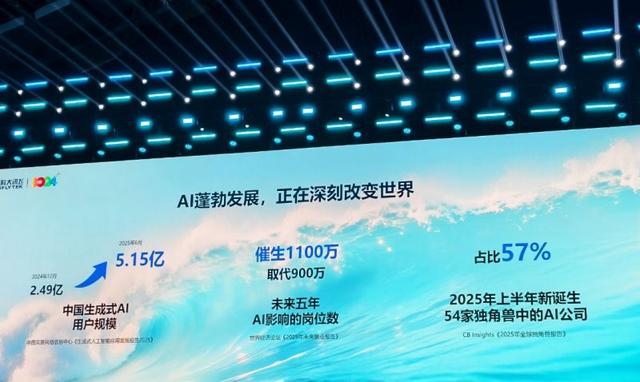
Core Insights - The core viewpoint of the articles emphasizes the importance of converting growth in the AI model market into tangible commercial benefits for companies in the industry, with a focus on four key areas: self-control, integrated hardware and software, industry depth, and personalization [2][3]. Group 1: AI Market Growth and Company Performance - The generative AI user base in China is projected to reach 515 million by June 2025, up from 249 million in December last year, indicating rapid growth in the market [3]. - iFlytek ranks first in the industry for the number and amount of bids won for large model projects in the first three quarters of this year, with a third-quarter bid amount of 545 million yuan, which is 1.88 times that of the combined total of the second to fifth places [7]. - iFlytek's third-quarter revenue reached 6.078 billion yuan, a year-on-year increase of 10.02%, while net profit attributable to shareholders was 172 million yuan, up 202.4% year-on-year [7]. Group 2: Key Strategies for AI Dividend Realization - The first key point for realizing AI dividends is "self-control," with iFlytek launching the fully self-controlled deep reasoning model, iFlytek Spark X1.5, which achieves 95% of the performance of GPT-5 with half the model parameters [3][4]. - The second key point is the integrated hardware and software product strategy, which differentiates iFlytek from other large model manufacturers, as seen in the launch of solutions that combine AI with various hardware arrays [5][6]. - The third key point is industry depth, showcasing AI applications in education, healthcare, automotive, office, and emotional companionship [6]. Group 3: Financial Challenges and Management - iFlytek's financial reports exhibit significant seasonal characteristics, with losses in the first half of the year and profits in the second half, attributed to the nature of government and institutional projects [8]. - High accounts receivable, reaching 15.913 billion yuan by the end of the third quarter, poses cash flow pressure on the company [8]. - Recommendations for iFlytek include strengthening project lifecycle management and optimizing management processes to control costs and improve delivery efficiency [8].


雷科防务拟收购尧云科技剩余24.4%股权 提高决策效率
Zhi Tong Cai Jing· 2025-11-07 09:44
Core Viewpoint - The company, 雷科防务, has announced the acquisition of a 24.4004% stake in its subsidiary, 尧云科技, from minority shareholders, which will result in 尧云科技 becoming a wholly-owned subsidiary of the company [1] Group 1 - The acquisition involves the purchase of shares from 西安鼎力云尧科技合伙企业 and 北京雷科瑞恒科技中心 [1] - The strategic focus of 尧云科技 is on the development and sales of storage modules, standard storage products, and specialized recording equipment, aligning with the national strategy for self-controllable development in the information technology sector [1] - This transaction is expected to enhance the company's decision-making efficiency regarding its subsidiary [1]

长城基金投资札记:市场或延续结构性震荡行情格局
Xin Lang Ji Jin· 2025-11-07 07:49
Group 1 - The market is expected to enter a phase of "self-centered" development following the recent US-China meeting, with a focus on domestic economic indicators and the "14th Five-Year Plan" [1] - The "14th Five-Year Plan" emphasizes upgrading traditional industries, technological self-reliance, and boosting domestic demand, which are key areas for investment [1] - The A-share market is likely to experience a period of consolidation after reaching a high point, with potential investment opportunities in the energy storage industry, cyclical industries, and traditional manufacturing upgrades [1] Group 2 - The market is anticipated to have a volatile performance in November, with limited upward and downward movement, focusing on sectors with reversal expectations such as AI applications and innovative pharmaceuticals [2] - Despite recent underperformance, the medical technology sector, including AI healthcare, is seen as a potential area for capital rotation, especially if industry trends continue to evolve positively [3] - There is a cautious optimism regarding the financial sector, with banks and insurance companies expected to see performance improvements in the coming year [5] Group 3 - Consumer demand is projected to have opportunities in the coming year due to low stock prices and a low base in consumption this year, suggesting potential for valuation recovery [6] - The long-term outlook for the non-ferrous metals sector remains positive, with expectations of upward price movements due to supply constraints [6] - The overseas expansion of Chinese companies in capital goods and consumer goods is viewed as a significant opportunity for growth [7] Group 4 - The market is expected to maintain a cautious optimism in the short term, with limited new capital inflow but a significant amount of capital waiting for a market correction to enter [8] - There is a focus on sectors with independent industrial logic and low correlation to overall economic trends, indicating a potential for structural market performance [9] - The ongoing US-China trade tensions are likely to lead to a prolonged period of market adjustments, with an emphasis on self-sufficiency and resource value reassessment [9]
基金经理请回答 | 价值投资者如何分享AI时代的红利?
中泰证券资管· 2025-11-07 07:03
Core Viewpoint - The article discusses the perceived dichotomy between value investing and technology investing, particularly in the context of the AI era, and explores the reasons behind this stereotype [4][5]. Group 1: Value vs. Technology Investing - The stereotype that value investing and technology investing are oppositional stems from the low proportion of technology investments made by well-known value investors [5]. - Value investors often struggle to share their technology investment cases, reinforcing the stereotype [5]. - A key principle of value investing is that value must be assessable, which is challenging in the rapidly changing technology sector [5][6]. Group 2: Characteristics of Technology Companies - Not all technology companies are unprofitable at inception; some, like Nvidia, can be profitable from the start [6]. - The financial losses of some tech companies do not negate their long-term value, as profitability can be established once business models and payment capabilities are confirmed [6][9]. - Understanding the business model of technology companies often requires specialized knowledge, creating a barrier for value investors [7][13]. Group 3: AI's Impact on Industries - The demand for computing power driven by AI has significantly enhanced the value of the semiconductor foundry industry, which has a stable business model and clear competitive advantages [16][18]. - AI has transformed the storage industry by increasing the demand for storage capacity and bandwidth, leading to supply shortages and rising prices [19][20]. - The shift from traditional computing to AI-driven models has created bottlenecks in storage, as the new computing methods require more frequent data storage [19]. Group 4: Semiconductor Industry Dynamics - The semiconductor industry is experiencing a slowdown in the pace of innovation, as evidenced by the observed deceleration of Moore's Law [25][28]. - Future advancements in semiconductor manufacturing may occur at a slower rate, with increased reliance on chip clusters to enhance computing power [29]. - The competitive landscape in semiconductor manufacturing is evolving, particularly in the context of national policies promoting self-sufficiency in technology [21][24].

全国产算力托底、告别 AI 内卷,科大讯飞如何让每个人站在 AI 肩膀上?
AI前线· 2025-11-07 06:41
Core Viewpoint - The rapid development of AI has created significant opportunities and challenges, with a notable increase in AI user applications in China, reaching 515 million by mid-2023, up from 249 million at the end of 2022 [2][3]. Group 1: AI Development and Impact - AI is projected to replace 9 million jobs while creating 11 million new ones over the next five years, highlighting the transformative impact of AI on the job market [2]. - In the bidding market, leading companies have adopted AI solutions, such as iFlytek's "Bidding Assistant," which processed approximately 180,000 projects with a 97% accuracy rate, saving direct costs of 170 million yuan [3]. - iFlytek's AI model, "Xinghuo Industry Analyst," achieved a score of 92 in a national exam, surpassing 85% of human candidates, indicating the growing capabilities of AI in specialized fields [3]. Group 2: AI Integration Challenges - The integration of AI into robotics and real-world applications faces challenges, particularly in achieving natural interaction and deep understanding of industry-specific contexts [4]. - iFlytek emphasizes the need for AI to transition from virtual capabilities to real-world applications, requiring advancements in AI account systems and industry comprehension [4]. Group 3: Core Breakthrough Directions - iFlytek identifies four key areas for realizing AI industry benefits: autonomy and control, integration of software and hardware, industry understanding, and personalized adaptation [5]. Group 4: Domestic Computing Power and Model Development - iFlytek has initiated the construction of China's first domestic computing power platform, achieving an adaptation rate of 84% and increasing the domestic technology replacement rate from 30% to 93% [7][9]. - The newly released iFlytek Xinghuo X1.5 model features a total parameter count of 293 billion and is designed for deployment on a single standard server, achieving performance comparable to international models like GPT-5 [10]. Group 5: Sector-Specific AI Applications - In healthcare, iFlytek's medical model has reached a level equivalent to senior hospital physicians, improving diagnostic accuracy from 87% to 96% and halving medical record writing time [12]. - In education, iFlytek's intelligent grading technology has advanced to analyze student errors with a precision surpassing that of ordinary teachers, creating a seamless connection between detailed grading and personalized teaching [13]. Group 6: Hardware and Real-World Integration - iFlytek has developed hardware solutions that enhance AI's performance in noisy environments, achieving recognition rates of 97.1% in complex settings [15][17]. - The integration of AI with hardware aims to create natural human-computer interactions, making AI more accessible in everyday life [14]. Group 7: Personalized AI Experience - iFlytek's AI aims to provide personalized experiences by understanding individual user needs and preferences, including the ability to replicate voices and create customized content [19][25]. - The launch of the "AI Star Friend" emphasizes the goal of creating an AI that serves as a growth partner, capable of understanding and adapting to user preferences [25]. Group 8: Developer Engagement and Community - The 2025 iFlytek AI Developer Competition attracted 36,898 teams from 17 countries, showcasing the growing interest and participation in AI development [22]. - As of October 2023, the number of developers on iFlytek's open platform reached 9.68 million, with a significant increase in developers focused on large models [22].

马斯克放话自建“巨型”芯片厂!芯片ETF天弘(159310)本周获资金净流入超2400万元
2 1 Shi Ji Jing Ji Bao Dao· 2025-11-07 06:19
Group 1 - A-shares indices collectively turned positive on November 7, with the Chip ETF Tianhong (159310) narrowing its decline to 0.38%, while component stocks like Zhongke Feimiao rose over 8% and Jiangbolong over 6% [1] - The Chip ETF Tianhong (159310) saw a net subscription of 2 million units during the trading session, continuing a trend of net inflows exceeding 24 million yuan from November 3 to 5 [1] - The Tianhong ETF tracks the CSI Chip Industry Index, which is expected to see a 37.62% year-on-year growth in net profit attributable to shareholders in the first half of 2025 due to policy support and surging demand [1] Group 2 - Google is set to launch its most powerful AI chip, Ironwood, which is claimed to be over four times faster than its predecessor, with major clients already lined up [2] - The semiconductor industry is experiencing a slow recovery in demand, with unexpected price increases in storage chips, and there is a high market interest for investments [2] - As self-sufficiency continues to advance, the AI sector is driving growth in related demands, leading to improved performance in semiconductor equipment, materials, components, chip design, packaging, and manufacturing sectors [2]
