
量化投资

Search documents
量化大势研判:质量类资产盈利触底回升
Minsheng Securities· 2025-11-04 08:59
Quantitative Models and Construction Quantitative Model Framework: Asset Style Rotation - **Model Name**: Asset Style Rotation Framework - **Model Construction Idea**: The model identifies asset styles based on intrinsic attributes tied to industry lifecycle changes, categorizing assets into five style stages: external growth, quality growth, quality dividend, value dividend, and bankruptcy value. It aims to determine the dominant market style by comparing asset advantages using a priority sequence of g > ROE > D[5][6][9] - **Model Construction Process**: - **Step 1**: Define five asset style stages based on industry lifecycle changes - **Step 2**: Compare asset advantages using the sequence g > ROE > D, where: - g represents growth rate - ROE represents return on equity - D represents dividend yield - **Step 3**: Evaluate whether assets are "good" and whether they are "expensive" to identify advantageous assets - **Step 4**: Focus on the most advantageous sectors based on the current market environment[5][6][9] - **Model Evaluation**: The framework has demonstrated strong explanatory power for A-share style rotation since 2009, achieving an annualized return of 27.35%[16] - **Model Testing Results**: - Annualized return since 2009: 27.35% - Historical excess returns in specific years (e.g., 2017: 27%, 2020: 44%, 2024: 52%)[16][19] --- Quantitative Factors and Construction Factor: Pre-Expected Growth (gf) - **Factor Name**: Pre-Expected Growth (gf) - **Factor Construction Idea**: Focuses on analyst expectations for high growth sectors, regardless of lifecycle stage[6] - **Factor Construction Process**: - **Step 1**: Use analyst forecasts to identify sectors with high expected growth - **Step 2**: Calculate the spread (Δgf) between top-performing and bottom-performing groups to measure growth advantage[21] - **Factor Evaluation**: Δgf continues to expand, indicating strong analyst optimism for high-growth sectors[21][31] - **Factor Testing Results**: Δgf expansion observed, with top-performing sectors showing significant upward adjustments[21][31] Factor: Actual Growth (g) - **Factor Name**: Actual Growth (g) - **Factor Construction Idea**: Measures performance momentum during transition and growth stages[6] - **Factor Construction Process**: - **Step 1**: Calculate the spread (Δg) between top-performing and bottom-performing groups based on actual growth rates - **Step 2**: Evaluate industry momentum and growth differentiation[25] - **Factor Evaluation**: Δg continues to contract, suggesting reduced differentiation in growth performance across sectors[25] - **Factor Testing Results**: Δg contraction observed, with top-performing groups declining and bottom-performing groups improving[25] Factor: ROE (Return on Equity) - **Factor Name**: ROE (Return on Equity) - **Factor Construction Idea**: Focuses on valuation levels under the PB-ROE framework during mature stages[6] - **Factor Construction Process**: - **Step 1**: Identify high ROE sectors - **Step 2**: Evaluate valuation levels using PB-ROE residuals - **Step 3**: Measure asset advantage differences using ROE spread[27] - **Factor Evaluation**: ROE advantage has bottomed out and started to recover, indicating potential fundamental improvement[27][31] - **Factor Testing Results**: ROE spread shows recovery, with low beta exposure and reduced crowding in top-performing groups[27][30] Factor: Dividend Yield (D) - **Factor Name**: Dividend Yield (D) - **Factor Construction Idea**: Focuses on dividend yield and additional characteristics during mature stages[6] - **Factor Construction Process**: - **Step 1**: Identify high dividend yield sectors - **Step 2**: Measure crowding levels and evaluate attractiveness based on yield spreads[31] - **Factor Evaluation**: High dividend yield assets remain crowded, and further overweighting is not recommended[31] - **Factor Testing Results**: Elevated crowding levels observed since mid-2024, with limited attractiveness under current market conditions[31][33] Factor: Bankruptcy Value (PB+SIZE) - **Factor Name**: Bankruptcy Value (PB+SIZE) - **Factor Construction Idea**: Focuses on valuation and restructuring expectations during stagnation and recession stages[6] - **Factor Construction Process**: - **Step 1**: Identify sectors with low PB and small market capitalization - **Step 2**: Evaluate attractiveness based on PB+SIZE scores[49] - **Factor Evaluation**: Demonstrated significant excess returns during specific periods (e.g., 2015-2016, 2021-2023)[49] - **Factor Testing Results**: Recent recommendations include sectors such as animal vaccines, fuel gas, and textile products, with positive performance over the past three months[49] --- Backtesting Results for Strategies Pre-Expected Growth Strategy - **Recommended Sectors**: Culture and entertainment, lithium batteries, PCB, shipbuilding, tungsten[35] - **Performance Metrics**: - Culture and entertainment: +12.80% - Lithium batteries: +49.71% - PCB: +37.74% - Shipbuilding: +7.21% - Tungsten: +52.27%[35] Actual Growth Strategy - **Recommended Sectors**: Coal chemical, battery services, lithium chemical products, rare earth and magnetic materials, other home appliances[38] - **Performance Metrics**: - Coal chemical: +13.04% - Battery services: +28.25% - Lithium chemical products: +62.42% - Rare earth and magnetic materials: +26.15% - Other home appliances: +53.68%[38] ROE Strategy - **Recommended Sectors**: Agriculture, liquor, power distribution equipment, non-dairy beverages, network connection and tower setup[40] - **Performance Metrics**: - Agriculture: +4.31% - Liquor: +2.35% - Power distribution equipment: +13.72% - Non-dairy beverages: +4.82% - Network connection and tower setup: +80.30%[40] Quality Dividend Strategy - **Recommended Sectors**: Glass fiber, boiler equipment, automotive motors and controls, lithium battery equipment, network connection and tower setup[43] - **Performance Metrics**: - Glass fiber: +28.94% - Boiler equipment: +28.42% - Automotive motors and controls: +59.57% - Lithium battery equipment: +68.04% - Network connection and tower setup: +80.30%[43] Value Dividend Strategy - **Recommended Sectors**: Security, daily chemicals, pet food, service robots, network connection and tower setup[46] - **Performance Metrics**: - Security: +16.06% - Daily chemicals: -0.98% - Pet food: -5.82% - Service robots: +0.01% - Network connection and tower setup: +80.30%[46] Bankruptcy Value Strategy - **Recommended Sectors**: Animal vaccines, fuel gas, textile products, dyeing, building decoration[49] - **Performance Metrics**: - Animal vaccines: +8.59% - Fuel gas: +15.29% - Textile products: +10.19% - Dyeing: +9.37% - Building decoration: +11.57%[49]
黄金暴跌7%背后:机构早已悄然离场
Sou Hu Cai Jing· 2025-11-03 14:15
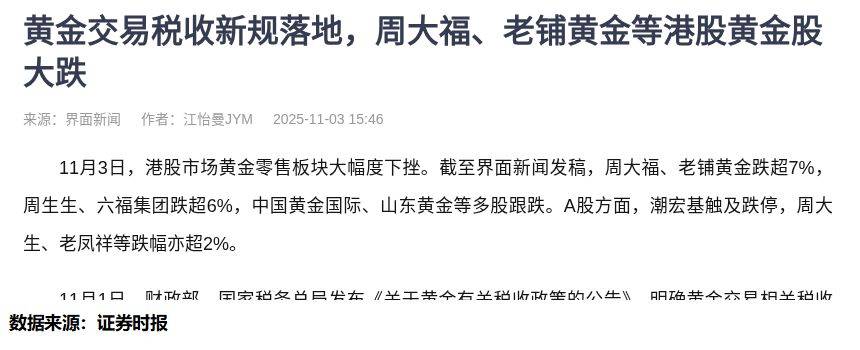
Core Insights - The recent volatility in the gold market has been attributed to a new tax policy announced by the Ministry of Finance and the State Taxation Administration, which differentiates between investment and non-investment uses of gold, causing significant market disruption [3] - The price of spot gold fell below $3970 per ounce on November 3, marking a decline of 0.84% from a high of $4381.29 per ounce on October 20, indicating a sharp market correction [3][10] - The disparity in gold price forecasts, with Capital Economics predicting a drop to $3500 by the end of next year and Standard Chartered raising its 2026 forecast by 16% to $4488, highlights the uncertainty in the market [10] Market Analysis - The gold retail sector in Hong Kong experienced a collective drop, with companies like Chow Tai Fook and Lao Pu Gold seeing declines exceeding 7%, while A-share company Chao Hong Ji hit its daily limit down [1][3] - The analysis emphasizes the importance of understanding institutional trading behavior, as many investors fail to outperform the market during bullish trends, leading to potential losses during market corrections [3][5] - Quantitative data analysis has become crucial in identifying institutional movements, which can provide early warnings of market shifts, as evidenced by the withdrawal of institutional funds prior to the gold market's decline [10][11] Investment Strategy - The article suggests that investors should focus on "understandable" opportunities rather than competing in industry hot spots, emphasizing the need to comprehend the underlying trading behaviors [3][10] - The use of quantitative tools is advocated as essential for navigating the current market environment, where information asymmetry between institutions and retail investors is increasing [11][13] - The volatility in the gold market serves as a microcosm of broader capital market dynamics, underscoring the necessity for investors to acquire timely and accurate information to gain a competitive edge [13]

重磅论坛在港举行!
Zhong Guo Ji Jin Bao· 2025-11-03 11:41
Core Insights - The "China Asset Management Forum 2025 (Hong Kong)" highlighted the significant opportunities in China's asset management industry, emphasizing the transition from savings to investments among residents, which is expected to release trillions of yuan annually, creating substantial wealth management demand [1][2][3] - China has become the world's second-largest asset management market, with a robust supply advantage due to its large-scale market, complete industrial chain, technological innovation, and talent resources [1][4] - The forum aimed to showcase new opportunities in China's capital market and promote collaboration between mainland China and Hong Kong to enhance the global influence of China's asset management industry [1][2] Industry Development - The Chinese fund industry has attracted numerous foreign institutions since the removal of foreign ownership limits in public fund management companies in early 2020, with 9 institutions approved to establish wholly-owned public fund companies [2] - As of mid-2025, China has become the second-largest public fund market globally, with the ETF market surpassing Japan, making it the largest in the Asia-Pacific region [3] - The asset management industry in China has matured over 27 years, with significant growth in public and private funds, and over 30 public funds establishing overseas subsidiaries [4][5] International Interest - International investors are increasingly interested in China, with the potential for significant investment growth, particularly in emerging sectors like renewable energy, electric vehicles, artificial intelligence, and biotechnology [4][5] - The Hong Kong asset management industry serves as a convenient channel for international funds entering China's stock and bond markets, enhancing the connectivity between China and global markets [4][6] Future Trends - The Chinese public fund industry is transitioning towards high-quality development, focusing on long-term value creation and investor trust, with a shift from "scale dividends" to "value cultivation" [7][8] - Key trends include fee reform, internationalization, technological innovation, index-based investment, and the integration of ESG principles into investment strategies [7][8][9] - The industry is expected to leverage China's economic development to enhance global competitiveness and provide better long-term returns for investors [8][9] Economic Context - China's strong supply-side competitiveness in manufacturing is expected to remain resilient, despite uncertainties from U.S.-China trade tensions [9][10] - The forum attracted over 200 representatives from domestic and international industry institutions, indicating a robust interest in China's asset management landscape [10]
重磅论坛在港举行!
中国基金报· 2025-11-03 11:34
Core Viewpoint - The "China Asset Management Forum 2025 (Hong Kong)" highlighted the significant opportunities in China's asset management industry, emphasizing the transition from savings to investments among residents and the expected high-quality development of the sector during the 14th Five-Year Plan period [2][4][5]. Group 1: Market Position and Growth - China has become the world's second-largest asset management market, with a substantial annual release of wealth amounting to trillions of yuan, creating immense demand for wealth management [2][5]. - As of mid-2025, China has established itself as the second-largest public fund market globally, and by July 2023, its ETF market surpassed Japan, becoming the largest in the Asia-Pacific region [5][6]. Group 2: International Engagement and Opportunities - The forum showcased the opening of China's capital markets and the unique advantages of Hong Kong, aiming to enhance the global influence of China's asset management industry [2][4]. - Since the removal of foreign ownership limits in public fund management companies in early 2020, nine institutions have been approved to establish wholly-owned public fund companies in China, and over 300 foreign private equity managers are now operating in the country [4][5]. Group 3: Future Trends in Asset Management - The Chinese asset management industry is transitioning towards high-quality development, focusing on value creation rather than just scale [16][18]. - Key trends identified include fee reform, internationalization, technological innovation, the rise of index-based investments, and the integration of ESG principles into investment strategies [18][19][21]. Group 4: Economic Context and Structural Opportunities - China's economic structure is undergoing a transformation, with emerging industries such as renewable energy, electric vehicles, artificial intelligence, and biotechnology presenting high-growth investment opportunities [8][22]. - The forum emphasized the importance of understanding local managers for international investors looking to enter the Chinese market, as well as the need for Chinese asset managers to comprehend overseas institutional investors [10][12].

九成指增ETF年内斩获超额收益
中国基金报· 2025-11-03 03:09
Core Viewpoint - Nearly 90% of enhanced index ETFs have achieved excess returns this year, particularly in the small-cap broad-based products, indicating a significant performance advantage in a differentiated market environment [2][3]. Performance Analysis - As of October 31, 29 enhanced strategy ETFs have outperformed their benchmark returns, with only 4 failing to do so. Eight ETFs exceeded excess returns of 10 percentage points, with the招商中证2000增强策略ETF achieving over 20% excess return [4]. - The strong performance of enhanced index ETFs is attributed to two main factors: the inefficiency of the A-share market and the strong small-cap style this year, allowing these funds to outperform their benchmarks despite market constraints [4][5]. Market Dynamics - The current market's high volatility has created opportunities for enhanced indices to outperform, with quantitative models effectively capturing price deviations for excess returns [4][6]. - Enhanced ETFs have shown a daily tracking error of less than 0.3%, with AI algorithms dynamically adjusting industry exposure to mitigate single-style risks [5][6]. Growth Potential - The enhanced index ETF market has seen rapid growth, with 51 products currently available, a 35% increase in total assets to 9.573 billion yuan this year, although they still represent only 0.26% of the stock ETF market [8]. - The development potential for enhanced index ETFs is primarily in broad-based indices, as higher market recognition of these indices may lead to greater opportunities for excess returns [8][9]. Future Trends - The future growth of enhanced index ETFs is expected to continue with the maturation of quantitative technology and evolving demand. Two promising categories include mid-cap broad-based strategies and industry-themed enhancement strategies, particularly in sectors like AI and energy [9].
九成指增ETF年内斩获超额收益
Zhong Guo Ji Jin Bao· 2025-11-03 02:36
Core Insights - Nearly 90% of enhanced index ETFs have achieved positive excess returns this year, with small-cap broad-based products performing particularly well [1][2] - The future outlook suggests that mid-cap broad-based enhanced products and industry-themed enhanced products will align with long-term capital preferences and adapt to sector rotation trends, becoming key areas for industry innovation and growth [1][5] Performance Summary - As of October 31, 29 enhanced strategy ETFs (excluding newly established funds this year) have outperformed their benchmark returns, with only 4 failing to do so [2] - Eight ETFs have exceeded excess returns of 10 percentage points, with the China Securities 2000 Enhanced Strategy ETF achieving over 20% excess return, and others like the ICBC China Securities 1000 Enhanced Strategy ETF and Hai Fu Tong China Securities 2000 Enhanced Strategy ETF exceeding 16% [2] Market Dynamics - The strong performance of enhanced index ETFs is attributed to two main factors: the inefficiency of the A-share market and the strong small-cap style this year, allowing enhanced index funds to outperform benchmarks despite market cap constraints [2][3] - The current market's high volatility has created opportunities for enhanced indices to outperform, with quantitative models effectively capturing price deviations for excess returns [2][3] Development Potential - The enhanced index ETF market has seen rapid growth, with 51 products currently available and a total scale of 9.573 billion yuan, reflecting a 35% increase since the beginning of the year, although they only account for 0.26% of the stock ETF market [4] - Enhanced index ETFs are characterized by "high growth, low penetration," primarily covering core broad-based indices and small-cap themes [4] Future Opportunities - The development potential for enhanced index ETFs is expected to continue as quantitative technology matures and demand evolves, particularly in mid-cap broad-based and industry-themed strategies [5] - Mid-cap broad-based enhanced strategies focusing on emerging industry leaders and industry-themed strategies like the Sci-Tech Innovation Index are anticipated to attract attention for their potential to generate excess returns [5]
【广发金工】转债市场震荡,整体定价偏差较高:量化转债月度跟踪(2025年11月)
广发金融工程研究· 2025-11-03 02:35
Core Viewpoint - The quantitative convertible bond portfolio experienced a slight decline in October, with a year-to-date return of 21.01% and an excess return of 4.02% [1] Group 1: Portfolio and Performance - The quantitative convertible bond portfolio is generated based on three factor systems: fundamental factors, low-frequency price-volume factors, and high-frequency price-volume factors, with monthly adjustments [5] - The portfolio's performance in October showed a return of -0.83% and an excess return of -0.72% [1] Group 2: Factor Data Tracking - A total of 32 fundamental factors, 80 low-frequency price-volume factors, and 32 high-frequency price-volume factors are tracked for convertible bonds [2][8] - The report provides a detailed list of factors used in the portfolio construction, referencing various research reports [8] Group 3: Risk Warnings - The report includes risk warnings for convertible bonds based on forced delisting and risk alert rules, as well as event-based and credit scoring methods [3][12] - Specific convertible bonds are flagged for trading-related forced delisting risks, financial-related forced delisting risks, and other credit risks [12] Group 4: Timing of Convertible Bond Index - The report employs price-volume models, pricing deviations, and convertible bond elasticity for timing and position management of the CSI Convertible Bond Index [4][13] - As of the end of October, the price-volume model and pricing model indicate a bullish signal, with a recommended position of 2/3 [4][13] Group 5: Pricing Deviation Factors - The report showcases the latest pricing deviation factors, which represent the difference between market prices and theoretical pricing for various convertible bonds [10][11] - A table lists specific convertible bonds along with their pricing deviation factors, indicating significant deviations for some bonds [11]

中银量化大类资产跟踪:权益市场波动率呈放大状态,小盘相对占优
Bank of China Securities· 2025-11-03 02:20
- The report does not contain any specific quantitative models or factors for analysis [1][2][3][4] - The report provides an overview of the A-share market, including style performance and crowding levels, highlighting the relative performance of growth vs dividend, small-cap vs large-cap, micro-cap stocks vs CSI 800, and momentum vs reversal [24][25][33] - Growth vs Dividend: Crowding level is at a historically high position (69%), with cumulative excess net value also at a high level, showing an increase over the past week [33][34][36] - Small-cap vs Large-cap: Crowding level is at a historically low position (34%), with cumulative excess net value at a balanced level, showing an increase over the past week [36][38][39] - Micro-cap stocks vs CSI 800: Crowding level is at a historically high position (82%), with cumulative excess net value at an extremely high level, remaining stable over the past week [39][41][42] - Momentum vs Reversal: Momentum style outperformed reversal style this week, contrary to long-term trends, as the total amount of active stock funds decreased [44][46][49] - The report discusses the relationship between U.S. bond yields and style indices, noting deviations from long-term trends in the past week [44][46][47] - The report provides detailed calculations for style crowding levels and cumulative excess net value, including methodologies for Z-score standardization and rolling historical percentiles [127][128] - The report highlights the historical percentile of institutional research activity across indices, sectors, and industries, with notable activity in upstream cycles and industries like steel and consumer services [109][111][111] - The report includes data on A-share valuation and equity-bond risk premium (ERP), indicating that overall equity allocation is at a balanced level [66][77][86] - The report provides insights into fund flows, including issuance and existing scale of active and passive equity funds, showing mixed trends in recent weeks [90][100][103] - The report tracks major capital indices, showing relative performance against the Wind All A Index, with QFII and private equity indices leading gains [87][88][90] - The report discusses trends in bond yields and the China-U.S. yield spread, highlighting recent changes and historical positions [112][113][117] - The report analyzes currency market trends, noting the appreciation of the onshore and offshore RMB against the USD in the past week [119][121][122] - The report provides an overview of commodity market performance, with mixed results across different indices in China and the U.S. [123][125][126]

宽投资产钱成:在量化红海中做长期主义坚守者
Zhong Guo Zheng Quan Bao· 2025-11-03 00:18
Core Viewpoint - Quantitative investment has become a significant force in the A-share market, with Kuan Investment Asset Management gaining attention for its stable performance and commitment to long-termism [1][3]. Group 1: Company Philosophy - Kuan Investment's core philosophy emphasizes survival and long-termism, prioritizing absolute returns for clients over aggressive growth [3][4]. - The founder, Qian Cheng, has invested all personal funds into the company's fund, demonstrating a strong commitment to capital preservation [3]. - The company maintains a rigorous risk control system throughout the investment research process, aiming for moderate returns while managing risks effectively [3][5]. Group 2: Market Outlook - Qian Cheng expresses a cautious optimism about the A-share market's performance over the next one to two years, advising investors to temper their expectations [4]. - The competitive landscape of the quantitative investment sector is described as a "red ocean," with increasing pressure from new entrants [5]. Group 3: Technological Innovation - Continuous technological iteration and 100% in-house development are identified as key strategies for navigating the competitive market [5][6]. - The company emphasizes the importance of deep research and rapid technological adaptation, with a focus on studying new AI developments [5][6]. - Kuan Investment aims to provide long-term, customized services to clients, leveraging AI to enhance the precision of quantitative investment practices [6].

在量化红海中做长期主义坚守者
Zhong Guo Zheng Quan Bao· 2025-11-02 20:16
Core Viewpoint - Quantitative investment has become a significant force in the A-share market, with Kuan Investment Asset Management gaining attention for its stable performance and commitment to long-termism [1][2]. Group 1: Company Philosophy - The founder, Qian Cheng, emphasizes the importance of survival in the investment industry, stating that the goal is to create absolute returns for clients rather than focusing solely on growth [1][2]. - Qian Cheng has invested all his personal funds into the company's fund, demonstrating a strong commitment to protecting investors' capital [1]. Group 2: Risk Management - Kuan Investment employs a rigorous risk control system throughout the investment research process, aiming for moderate returns while managing exposure risks [2]. - The philosophy of seeking stable, moderate returns provides investors with a sense of security in long-term investments [2]. Group 3: Market Outlook - Qian Cheng expresses a cautious optimism about the A-share market's performance over the next one to two years, advising investors to maintain a prudent mindset as the market rises [2]. Group 4: Industry Dynamics - The quantitative investment sector is described as a "red ocean" market, characterized by intense competition and a high influx of talented individuals [2][3]. - Continuous technological iteration and 100% in-house development are seen as essential for navigating the competitive landscape [2][3]. Group 5: Research and Development - Kuan Investment's core competitiveness lies in in-depth research and rapid technological iteration, with a focus on reading and discussing new AI papers within a month of their release [3]. - The company has built a diverse research team with backgrounds in statistics and computer science, ensuring stability and avoiding reliance on third-party strategies [3]. Group 6: Future Vision - The vision for Kuan Investment is not merely about scaling but providing long-term effective services to clients, with an emphasis on health industry development and technological leadership [3][4].