
可再生能源

Search documents
新闻发布︱新华社:前三季度全国可再生能源新增装机同比增长47.7%
国家能源局· 2025-11-01 03:03
Core Viewpoint - The article highlights the significant growth in renewable energy capacity and generation in China, emphasizing the government's commitment to carbon neutrality and energy security through the expansion of renewable energy sources [2][3]. Group 1: Renewable Energy Capacity - By the end of September 2025, China's newly installed renewable energy capacity reached 310 million kilowatts, a year-on-year increase of 47.7%, accounting for approximately 84.4% of the total new capacity [2]. - The breakdown of new installations includes 7.16 million kilowatts from hydropower, 61.09 million kilowatts from wind power, 240 million kilowatts from solar power (including solar thermal), and 1.05 million kilowatts from biomass power [2]. - As of September 2025, the total installed renewable energy capacity in China approached 2.2 billion kilowatts, reflecting a year-on-year growth of 27.2%, representing about 59.1% of the country's total power generation capacity [2]. Group 2: Renewable Energy Generation - In the first three quarters of 2025, the total renewable energy generation reached 2.89 trillion kilowatt-hours, marking a year-on-year increase of 15.5%, which accounted for around 40% of the total electricity generation [2]. - This renewable energy generation supported approximately 60% of the industrial electricity consumption during the same period [2]. Group 3: Investment in Energy Projects - In the first eight months of the year, investment in key energy projects reached 1.97 trillion yuan, reflecting a year-on-year growth of 18.2%, indicating a robust increase in energy project investments [3].


3.10亿千瓦、7.46亿吨……中国经济三季度报数据亮眼“多点开花”
Yang Shi Wang· 2025-11-01 02:41
Group 1: Renewable Energy - In the first three quarters of this year, the newly installed capacity of renewable energy reached 310 million kilowatts, representing a year-on-year growth of 47.7%, accounting for approximately 84.4% of the total new installed capacity [3] - Renewable energy generation amounted to 2.89 trillion kilowatt-hours, which is about 40% of the total electricity generation, significantly supporting the overall electricity supply [3] Group 2: Steel Industry - In the first three quarters, the total crude steel production in the country was 746 million tons, achieving the production control target [5] - The total profit of key steel enterprises reached 96 billion yuan, a year-on-year increase of 190%, indicating that the overall operational situation of the industry is better than expected and its risk resistance capability is continuously improving [5] Group 3: Foreign Trade - In the first three quarters, the national trade promotion system issued various certificates, including certificates of origin, with a year-on-year growth of 17.64% [7] - The number of RCEP certificates issued totaled 242,500, reflecting a year-on-year increase of 25.57%, demonstrating the strong resilience of China's foreign trade in the first three quarters [7]
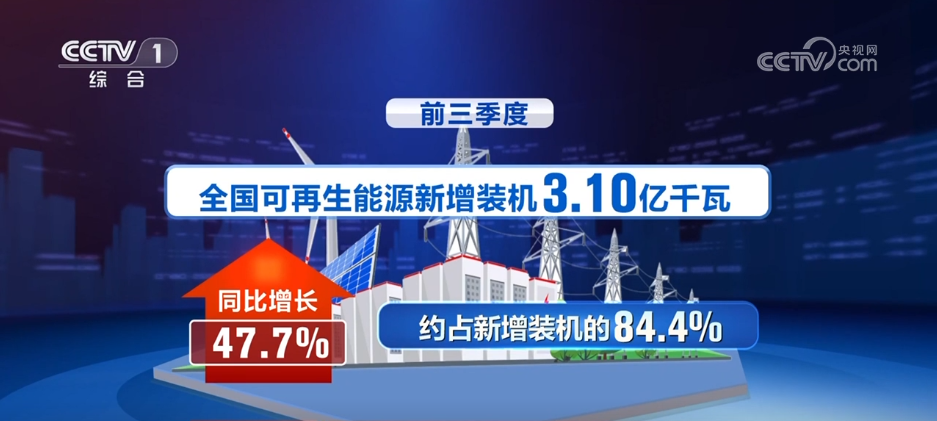
多部门发布中国经济三季报 涉及能源生产、钢铁企业运行、外贸、老旧小区改造
Yang Shi Wang· 2025-10-31 16:40
Renewable Energy - In the first three quarters of this year, the newly installed capacity of renewable energy reached 310 million kilowatts, representing a year-on-year growth of 47.7%, accounting for approximately 84.4% of the total newly installed capacity [3] - Renewable energy generation amounted to 2.89 trillion kilowatt-hours, which is about 40% of the total electricity generation, significantly supporting the overall electricity supply [3] Steel Industry - In the first three quarters, the total crude steel production in the country was 746 million tons, achieving the production control target [6] - The total profit of key steel enterprises reached 96 billion yuan, a year-on-year increase of 190%, indicating that the overall operational situation of the industry is better than expected and its risk resistance capability is continuously improving [6] Foreign Trade - In the first three quarters, the national trade promotion system issued various certificates, including certificates of origin, with a year-on-year growth of 17.64% [8] - The number of RCEP certificates issued totaled 242,500, reflecting a year-on-year increase of 25.57%, demonstrating the strong resilience of China's foreign trade in the first three quarters [8]

MasTec(MTZ) - 2025 Q3 - Earnings Call Transcript
2025-10-31 14:00
Financial Data and Key Metrics Changes - Revenue for the third quarter was just shy of $4 billion, representing a 22% year-over-year increase [4] - Adjusted EBITDA was $374 million, a 20% year-over-year increase, marking the highest level since Q1 2024 [4] - Adjusted earnings per share was $2.48, exceeding consensus by nearly $0.20 [4] - Backlog at quarter end was $16.8 billion, a sequential increase of approximately $325 million [4] Business Line Data and Key Metrics Changes - Communications segment revenue grew by 33% year-over-year, with EBITDA increasing by 38% [5] - Clean energy and infrastructure segment revenue increased by 20% year-over-year, with EBITDA improving by 36% [5] - Power delivery segment revenue grew by 17% year-over-year, with EBITDA increasing by 21% [5] Market Data and Key Metrics Changes - Total backlog increased by 21% year-over-year, with a book-to-bill ratio of 1.1 times [7] - Communications segment backlog totaled $5.1 billion, showing a slight sequential increase despite record quarterly revenue [18] - Power delivery backlog increased by 11% year-over-year, with expectations for continued growth [10] Company Strategy and Development Direction - The company is focused on diversifying its business to benefit from the changing landscape of power generation and delivery [6] - There is a strong outlook for continued growth driven by significant investments in infrastructure across communications, energy, and power sectors [27] - The company is actively pursuing a disciplined, return-focused capital allocation strategy, including investments in equipment and capacity expansion [27] Management's Comments on Operating Environment and Future Outlook - Management expressed confidence in the growth trajectory of the business across all operating segments, citing strong infrastructure investment needs [27] - The company remains optimistic about the power delivery segment, expecting double-digit growth in revenues and EBITDA for the full year 2025 [10] - Management highlighted the importance of ongoing investments in operating productivity and cost management to achieve better margins [25] Other Important Information - The company generated cash flow from operations of $89 million in Q3 and free cash flow of $36 million [26] - Total liquidity at the end of the quarter was approximately $2 billion, with net leverage of 1.95 times [27] - The company has a share repurchase authorization and will deploy capital for buybacks opportunistically [27] Q&A Session Summary Question: Can you provide guidance on pipeline backlog revenue for 2026? - Management indicated optimism about achieving double-digit growth in 2026, with substantial growth expected in 2027 and beyond based on committed projects [30][31] Question: What is the expected CapEx level for 2026? - CapEx is expected to be around $350 million, slightly above depreciation levels, reflecting growth opportunities in the pipeline segment [32][33] Question: How are permitting issues with GreenLink impacting guidance? - The change in guidance is primarily due to GreenLink, with expected revenue for 2025 now around $250 million, significantly lower than previous expectations [38][39] Question: How many large projects can the company handle simultaneously? - Management expressed confidence in handling multiple projects, emphasizing that most of the power delivery business is maintenance-driven, providing a stable revenue base [41][42] Question: Is $8 EPS still achievable for next year? - Management is comfortable with consensus estimates of over $8 EPS, supported by expected revenue and EBITDA growth [44][45] Question: What is the outlook for margins in the communications segment? - Margins in the communications segment improved to 11.3%, with expectations for continued growth driven by investments in new geographies [50][51] Question: How does the delay in GreenLink affect overall project profitability? - Management does not expect any negative impact on profitability from the GreenLink project, only a shift in timing [54][55]

前三季度中国可再生能源新增装机同比增长47.7%
Zhong Guo Xin Wen Wang· 2025-10-31 13:26
Core Insights - In the first three quarters of 2023, China's newly installed renewable energy capacity reached 310 million kilowatts, marking a year-on-year increase of 47.7%, accounting for approximately 84.4% of the total new installed capacity [1][2] - By the end of September 2023, the total installed renewable energy capacity in China reached 2.198 billion kilowatts, a year-on-year increase of 27.2%, representing about 59.1% of the country's total power generation capacity [1] - Renewable energy generation maintained steady growth, contributing significantly to the overall electricity supply, with renewable energy generation accounting for around 60% of industrial electricity consumption [1] Installed Capacity Breakdown - Hydropower capacity reached 443 million kilowatts - Wind power capacity reached 582 million kilowatts - Solar power capacity (including solar thermal) reached 1.127 billion kilowatts - Biomass power capacity reached 47 million kilowatts [1] Generation Volume and Market Share - In the first three quarters of 2023, renewable energy generation totaled 2.89 trillion kilowatt-hours, a year-on-year increase of 15.5%, accounting for approximately 40% of total electricity generation and about 60% of industrial electricity consumption [1] - Combined wind and solar generation reached 1.73 trillion kilowatt-hours, representing a year-on-year increase of 28.3%, and accounted for 22% of total electricity consumption, an increase of 4.1 percentage points compared to the same period last year [2]
专访泰国开泰研究中心首席经济学家布林:中泰供应链合作持续深化
2 1 Shi Ji Jing Ji Bao Dao· 2025-10-31 11:29
Group 1 - Renewable energy is a key area for China-ASEAN economic cooperation, with China leading in clean technology, which will attract more investments into Thailand and other ASEAN countries [1][4] - The China-ASEAN Free Trade Area 3.0 upgrade is expected to significantly change business operation models, particularly through the establishment of a unified "single window" system to enhance trade flow [1][3] - The upgrade of the free trade area, which began negotiations in November 2022 and concluded in October 2024, aims to address not only traditional tariff issues but also new areas such as digital economy rules and green economy [2][3] Group 2 - China has been ASEAN's largest trading partner for 16 consecutive years, while ASEAN has been China's largest trading partner for 5 years, indicating strong trade dynamics [2] - The report from the China Financial Forty Forum and the Krung Thai Research Center highlights a continuous increase in China's exports to Thailand and a record high in greenfield investments from China in sectors like automotive manufacturing and electronics [2][3] Group 3 - The cooperation between China and Thailand is evolving from a complementary relationship to strategic integration, with a focus on creating a "win-win model" for regional collaboration [3][13] - The potential for cooperation in renewable energy and food safety is significant, providing more export opportunities for Thailand and the entire ASEAN region [4][11] Group 4 - Thailand's investment environment has unique competitive advantages despite challenges in capital gains and dividend taxes compared to Singapore, particularly in attracting foreign direct investment (FDI) [5][6] - The Thai government is expected to implement measures to enhance transparency and digitize government processes to attract more foreign investments [6][9] Group 5 - Geopolitical risks and trade tensions are prompting companies to adjust their supply chain strategies, with many global firms considering Thailand for diversified production locations to mitigate risks [11][12] - The integration of China and ASEAN is expected to enhance long-term competitiveness, although it may also increase competition for local businesses [13][14]
广州发展(600098.SH):电力集团拟参与禄丰公司35%股权竞拍
Ge Long Hui· 2025-10-31 10:03
Core Viewpoint - Guangzhou Development (600098.SH) aims to accelerate the construction of a new power system and optimize its industrial structure by expanding into new areas of energy business, particularly focusing on increasing the proportion of renewable and green low-carbon energy [1] Group 1 - The company’s wholly-owned subsidiary has approved the acquisition of a 35% stake in China Electric Power Construction (Lufeng) Pumped Storage Development Co., Ltd. [1] - The acquisition will be conducted at a value not exceeding 53.7999 million yuan based on the asset appraisal report [1]

AI“超级周期”推动,美国电力公司(AEP)资本支出大增33%,CEO称“电价涨幅会在合理范围内”
Hua Er Jie Jian Wen· 2025-10-31 06:53
Core Insights - The American Electric Power Company (AEP) is significantly increasing its capital expenditure plan by 33% to $72 billion over the next five years to meet unprecedented electricity demand driven by artificial intelligence and data centers [1][4] - AEP anticipates a 76% increase in peak load from 37 GW to 65 GW by 2030, leading to an upward revision of its annual earnings per share growth forecast from 6%-8% to 7%-9% [4][5] - AEP aims to keep the average annual residential electricity price increase at a reasonable level of 3.5% despite the substantial investment [4][8] Capital Expenditure and Demand Growth - AEP's electricity sales volume increased by 6% year-over-year, with commercial sales rising by 7.9%, and approximately 2 GW of data center load connected to the grid in Q3 alone [5] - The expected load growth includes 28 GW of new customer demand, with about 80% coming from major data center operators like Google, AWS, and Meta [5][6] - AEP's competitive advantage lies in its extensive 765 kV transmission network, which covers 2,100 miles across six states, facilitating the connection of data center loads [5] Generation Capacity Expansion - AEP's integrated resource plan requires an increase of approximately 27.2 GW of generation capacity by 2035, with natural gas generation being a significant component, including the addition of 12.8 GW of gas-fired generation [7] - AEP has secured 8.7 GW of gas turbine capacity and high-pressure equipment through agreements with a major industry supplier [7] - The capital expenditure plan allocates over $7 billion for solar, wind, and energy storage projects, reflecting AEP's commitment to renewable energy development [7] Pricing Strategy and Consumer Impact - AEP is focused on balancing investment with consumer electricity price affordability, projecting a 9% annual operating profit growth by 2030 while maintaining a 3.5% average annual increase in residential electricity prices [8] - The company is implementing various affordability measures, including optimizing rate designs and controlling operational and maintenance costs, to mitigate the impact of increased costs on residential customers [8]

马来西亚学者展望APEC:中国方案助推深化亚太地区合作
Nan Fang Du Shi Bao· 2025-10-31 05:26
Core Insights - The APEC 32nd Informal Leaders' Meeting will be held in Gyeongju, South Korea from October 31 to November 1, focusing on multilateral cooperation amidst rising unilateralism and trade protectionism [1][2] - The theme "Building a Sustainable Tomorrow - Connectivity, Innovation, Prosperity" reflects APEC members' consensus on promoting sustainable, innovative, and cooperative development in the new era [1] Group 1 - APEC serves as an inclusive and influential economic cooperation mechanism, providing a non-confrontational platform for multilateral cooperation among its members [2] - Strengthening regional cooperation and connectivity is essential for maintaining open and stable economic growth in a turbulent world [1][2] - Technological innovation is identified as the main driver of economic growth for Asia-Pacific economies in the 21st century, with APEC members sharing common goals in digital economy, green technology, artificial intelligence, and renewable energy [1] Group 2 - Malaysia, as a core member of ASEAN, can leverage APEC to enhance supply chain resilience and trade facilitation, attracting high-end manufacturing and green investments [2] - China's proposals, such as the "Digital Silk Road" and "Smart Connectivity," aim to promote digital trade, cross-border e-commerce, and AI cooperation, sharing technological benefits with other Asia-Pacific countries [2] - China's open and win-win philosophy, green transformation practices, and digital cooperation ideas provide a reference for APEC's future agenda, promoting more inclusive, sustainable, and high-quality regional cooperation [2]
财经观察:“核能时代落幕”,德国电力靠什么保障
Huan Qiu Shi Bao· 2025-10-30 22:44
Core Viewpoint - Germany has officially abandoned nuclear power, marking the end of an era that has provided electricity for approximately 60 years, raising concerns about rising electricity costs for consumers and the impact on energy-intensive industries [1][2]. Group 1: Germany's Nuclear Phase-Out - Germany is the first major industrial nation to completely phase out nuclear power, which has been a significant source of electricity since the 1960s [1]. - The decision to abandon nuclear energy was solidified after the Fukushima disaster in 2011, leading to the closure of the last three nuclear plants in April 2023 [2]. - The closure of nuclear plants has resulted in increased carbon emissions, as Germany has had to rely more on coal to meet electricity demands, creating a conflict between environmental goals and energy policy [2][3]. Group 2: Public Sentiment and Economic Impact - A significant portion of the German public opposes the nuclear phase-out, with surveys indicating that nearly two-thirds of Germans are against closing the remaining nuclear plants [4]. - Since 2011, German consumers have incurred an additional cost of €57 billion due to the transition away from nuclear energy [4]. - The high electricity prices are prompting energy-intensive companies to relocate production to Eastern Europe or Asia, contributing to a decline in Germany's industrial competitiveness [5]. Group 3: Energy Transition Challenges - Germany aims for 80% of its electricity to come from renewable sources by 2030, but currently, renewables only account for about 57% of the energy supply, leading to instability [6]. - The country has become a net importer of electricity, with significant imports recorded in the second quarter of 2023, highlighting the challenges of domestic energy production [6]. - The reliance on gas-fired power plants is increasing, with plans to invest €20 billion in new gas plants to ensure energy security, but this may not lower electricity costs significantly [7]. Group 4: Future of Nuclear Energy in Europe - The EU plans to increase nuclear capacity from 98 GW to 109 GW by 2050, requiring an investment of €205 billion for new plants and €36 billion for extending existing reactors [3]. - Countries like Poland are moving forward with nuclear projects, contrasting Germany's phase-out, as the EU seeks to reduce dependence on foreign energy and achieve climate goals [2][3].