AI大模型

Search documents
“百镜大战”渐入深水区——智能眼镜产业一线观察
Xin Hua Cai Jing· 2025-12-31 02:33
Market Overview - The smart glasses market is expected to transition from concept to reality in 2025, with competition intensifying in 2026 as multiple companies enter the "hundred glasses battle" [1] - Following the launch of Google Glass in 2013, the market has seen fluctuations, but recent advancements in AI have reignited interest in smart glasses [2] Key Players and Production Capacity - Meta and EssilorLuxottica have set market benchmarks with their products, Ray-Ban Meta and Meta Ray-Ban Display, with over 2 million units sold by February 2025 and plans to increase annual production capacity to 10 million units by the end of 2026 [2] - Domestic manufacturers like Rokid aim for a shipment target of 1 million units in 2025, supported by strategic partnerships for automation and production efficiency [2][3] - Companies like Luxshare Precision and Goertek are also expanding their presence in the smart glasses market, with Luxshare being the manufacturer of Quark AI glasses [3] Product Development and Features - Rokid is focusing on refining product details, including nose pad iterations and power optimization, to prepare for large-scale shipments [3] - Smart glasses are being integrated into various use cases, such as business communication and smart home applications, enhancing their practicality [4] - The market is witnessing a trend towards building offline retail channels to improve consumer experience and reduce return rates, which are a concern due to comfort and aesthetic factors [5][6] Technological Advancements - The competition is driving rapid technological advancements, particularly in optical technologies like waveguide technology and the use of silicon carbide materials for better product performance [7][8] - Waveguide technology is becoming the mainstream solution due to its advantages in size, weight, and image quality, with different manufacturers adopting various approaches [8] - Meta is leading in color display technology, with a roadmap for product iterations from monochrome to dual-color displays, while domestic brands are exploring similar advancements [8] Future Outlook - The smart glasses industry is at a critical juncture, evolving from "voice companions" to "augmented reality (AR) terminals," with major players like Google and Apple expected to launch new products by the end of 2026 [9] - The success of the "hundred glasses battle" will depend on balancing technology, cost, and user experience, as consumer demand and price sensitivity remain significant factors [9]
2026年家电以旧换新政策出台,有望提振家电消费景气
Guotou Securities· 2025-12-31 02:04
Investment Rating - The report assigns an "A" rating for the investment in major appliance companies such as Midea Group, Haier Smart Home, and Gree Electric Appliances, indicating a "Buy" recommendation with target prices of 94.68, 31.81, and 50.60 CNY respectively [4]. Core Insights - The 2026 appliance replacement policy is expected to boost consumer demand for home appliances, focusing on energy-efficient products and providing subsidies of 15% of the product price, capped at 1500 CNY per item [1][2]. - The 2026 policy has optimized the subsidy scope, reducing the number of supported appliance categories from eight to six, and lowering the subsidy rate from 20% to 15% for high-efficiency products [2][11]. - The first batch of funding for the 2026 policy amounts to 625 billion CNY, a 23% decrease from the previous year's 810 billion CNY, indicating a potential decline in total subsidy funds for the year [2][12]. Summary by Sections Policy Changes - The 2026 policy focuses on six categories: refrigerators, washing machines, televisions, air conditioners, computers, and water heaters, excluding other appliances like stoves and microwaves [2][11]. - The subsidy for high-efficiency products is now set at 15% of the sales price, with a cap of 1500 CNY per item, and consumers can only receive one subsidy per product category [2][11]. Market Impact - The 2025 replacement policy effectively stimulated appliance consumption, with retail sales of home appliances increasing by 14.8% year-on-year from January to November 2025, and over 12.84 million units replaced [3]. - The introduction of the 2026 policy is expected to improve domestic appliance sales, despite some pressure on consumption due to earlier demand release and high base effects [3][9]. Investment Recommendations - The report suggests focusing on three investment themes: 1. High-quality white goods companies with strong cash flow and high dividend yields, such as Midea Group and Haier Smart Home [9]. 2. Companies with strong global capabilities, particularly in emerging markets where appliance penetration is low [9]. 3. Technology-driven appliance companies that are expanding into new business areas, leveraging AI and robotics to enhance product offerings [9].



八大关键词见证 2025私募业规模、质量双升
Zheng Quan Shi Bao· 2025-12-30 18:20
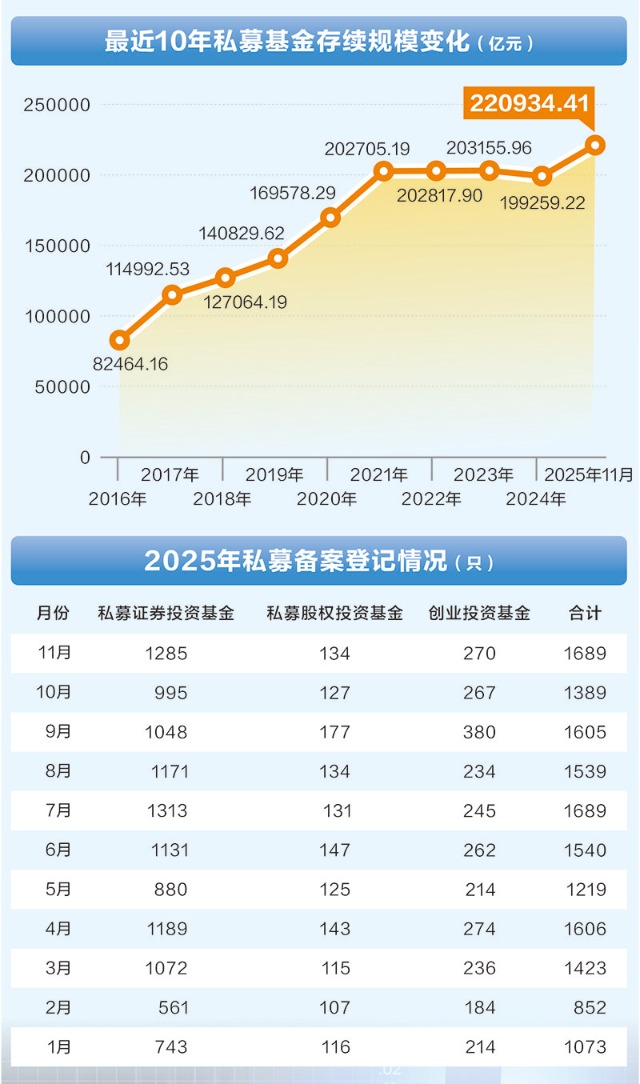
Core Insights - The private equity industry in 2025 experienced a recovery and restructuring phase, with the total management scale surpassing 22 trillion yuan, marking a significant rebound from previous downturns [5][6] - The industry is witnessing a concentration effect, with leading firms gaining more market share amid stricter regulations and a more rational investor base [5][10] Group 1: Industry Growth and Scale - By the end of November 2025, the private equity fund scale reached 22.09 trillion yuan, up from 19.91 trillion yuan at the beginning of the year, indicating a net increase of over 2 trillion yuan within the year [6][7] - The private securities investment funds have been the primary driver of this growth, with their scale increasing from 5.21 trillion yuan at the start of the year to 7.04 trillion yuan by November [6][7] Group 2: Market Dynamics and Investor Behavior - The recovery in private equity scale is attributed to a rebound in the stock market, leading to improved performance of private equity funds, which in turn has shifted investor risk preferences towards more selective and proactive asset allocation [7][10] - The number of private equity firms with over 100 billion yuan in assets has increased significantly, with 113 firms reported by the end of October 2025, indicating a return to the "double hundred" era [8][10] Group 3: Fundraising Trends - The number of newly registered private equity funds showed a notable increase, with 1,689 new funds registered in July 2025, marking the highest monthly registration in nearly four years [10][11] - There is a pronounced disparity in fundraising, with top-tier quantitative firms significantly outperforming mid-tier and lower-tier managers, reflecting a stronger "Matthew effect" in fundraising dynamics [10][11] Group 4: Quantitative Strategies and AI Integration - Quantitative strategies have gained prominence, particularly in small-cap indices, with some products achieving over 50% returns in 2025, driven by favorable market conditions [11][12] - AI technology is increasingly integrated into the quantitative investment process, enhancing data analysis and decision-making capabilities, thus reshaping the competitive landscape of the industry [15][16] Group 5: Regulatory Environment and Industry Consolidation - The regulatory framework for algorithmic trading has been strengthened, promoting transparency and fair competition within the market, which is expected to lead to a healthier long-term development of the capital market [13][14] - The number of private equity managers that have been deregistered reached 1,118 in 2025, indicating a significant industry cleanup and a shift towards compliance and sustainable operations [17][18]

ThinkPad×极豆科技:重构人车边界,与思考者同行
36氪· 2025-12-30 13:13
在极豆科技的实践中,自研"沧海大模型"正将这一愿景变为现实。它实时融合处理来自摄像头、麦克风、生物传感器的多模态数据流,情感引擎解析情绪细 微变化,场景引擎预测潜在需求。"我们不再满足于让座舱'听懂指令',而是要让其'理解人心',"极豆科技CEO汪奕菲解释道,"当系统感知到驾驶疲劳时, 它会联动灯光、音响、空调、导航系统,主动调亮氛围色调、空调香氛开启、播放提神旋律、建议最近休息区,提供一套有温度的关怀方案,而非机械的功 能响应。" ThinkPad助力极豆科技, 以自研AI大模型重新定义人车关系。 过去十年,汽车座舱虽从物理按键进化到触摸屏,交互逻辑却陷入"指令迷宫",功能割裂,数据孤立,体验拼凑。更深层的是,系统缺乏对人的场景化理 解:能执行"调低温度"的命令,却读不懂阳光透过车窗的真实体感。 变革始于认知重构。当座舱从"功能容器"转向"数字神经网络",技术全面升级驱动着质的跨越:多模态感知让座舱能"看见"表情、"听见"情绪;情感计算捕 捉状态变化;场景引擎理解出行情境;而大模型,最终赋予系统理解复杂意图的认知能力。 从车迷到产业破局者 汪奕菲的办公桌上,至今还保留着2014年创业初期使用的那台Think ...
MiniMax拟1月在港上市:融资超6亿美元 阿里等成为基石投资者
Feng Huang Wang· 2025-12-30 12:58
截至发稿,MiniMax、阿布扎比投资局和IDG资本的代表拒绝置评。阿里和韩国未来资产尚未回应置评 请求。(作者/箫雨) 据知情人士透露,MiniMax寻求通过这次IPO筹集超过6亿美元资金,预计最早将从周三开始接受投资者 认购,明年1月挂牌上市。 知情人士称,除了阿里和阿布扎比投资局外,IDG资本、高毅资产以及韩国未来资产也将成为MiniMax 此次IPO的基石投资者。相关磋商仍在进行中,IPO的规模和时间安排仍可能发生变化。 MiniMax 凤凰网科技讯北京时间12月30日,据彭博社报道,知情人士称,AI大模型创业公司MiniMax(上海稀宇 科技)即将在中国香港首次公开招股(IPO),目前已锁定阿里巴巴集团、阿布扎比投资局为基石投资者。 ...

机器人概念股午后拉升,相关ETF涨约3%
Sou Hu Cai Jing· 2025-12-30 10:32
Group 1 - The core viewpoint of the articles highlights a significant rise in robotics-related stocks, with notable increases in companies such as Mingzhi Electric, which rose over 5%, and others like Green Harmonics and Top Group, which increased over 4% [1] - Robotics-related ETFs also experienced a boost, with an approximate increase of 3% across the board [1] - Analysts suggest that breakthroughs in AI large models are propelling robots into a new phase of embodied intelligence, creating opportunities for companies with clear application scenarios and those that can implement these technologies quickly [2] Group 2 - Specific ETFs related to robotics, such as the Penghua Robotics ETF, saw a price increase of 3.15%, while the E Fund and Huatai-PineBridge ETFs both rose by 2.95% [2] - Companies positioned advantageously within the upstream and downstream supply chains are expected to benefit significantly from the acceleration of industrialization and performance realization [2]


算力芯片方向盘初走强,芯片ETF易方达(516350)、半导体设备ETF易方达(159558)标的指数双双涨超1%
Mei Ri Jing Ji Xin Wen· 2025-12-30 08:06
Group 1 - The semiconductor equipment and computing chip sectors showed strength in early trading on December 30, with companies like Kema Technology, Changchuan Technology, and Northern Huachuang rising over 3%, leading to a 1.9% increase in the CSI Chip Industry Index and a 1.3% increase in the CSI Semiconductor Materials and Equipment Theme Index [1] - According to Guojin Securities, semiconductor equipment is positioned upstream in the industry chain and is a core industry supporting chip manufacturing and testing. Data from SEMI indicates that the performance of leading domestic equipment companies is impressive, with eight leading companies achieving a combined revenue growth of 37.3% and a net profit growth of 23.9% year-on-year in the first three quarters of 2025 [1] - The domestic semiconductor equipment industry chain is expected to experience a new round of rapid growth opportunities driven by the evolution of storage technology towards 3D, influenced by AI large models [1] Group 2 - The CSI Chip Industry Index consists of 50 stocks involved in chip design, manufacturing, packaging and testing, as well as semiconductor materials and production equipment, with over 50% of the index comprising digital chip design and approximately 18% from the semiconductor equipment sector [1] - The CSI Semiconductor Materials and Equipment Theme Index includes 40 stocks related to semiconductor materials and equipment, with the semiconductor equipment and materials sectors accounting for 62% and 22% of the index, respectively [1] - The E Fund Chip ETF (516350) and the E Fund Semiconductor Equipment ETF (159558) track the aforementioned indices, providing investors with convenient access to leading companies in the industry chain [1]
Manus被收购,智谱也定了8天后上市
机器之心· 2025-12-30 04:06
Core Viewpoint - The article discusses the recent developments surrounding the IPO of Zhiyuan Technology, which is set to become a significant player in the AI large model market, highlighting its ambitious fundraising and market positioning strategies [2][3][5]. Group 1: IPO Details - Zhiyuan Technology has officially launched its IPO process in Hong Kong, with the offering period running from December 30, 2025, to January 5, 2026, and plans to list on January 8, 2026, under the stock code "2513" [2]. - The company aims to issue a total of 37.42 million H shares, with 1.87 million shares available for public offering in Hong Kong and 35.55 million shares for international investors [3]. - The IPO price is set at HKD 116.20 per share, with an expected fundraising amount of approximately HKD 4.3 billion, leading to an anticipated market capitalization exceeding HKD 51.1 billion [3]. Group 2: Investment and Market Context - The cornerstone investor lineup is notable, with total subscriptions amounting to HKD 2.98 billion, representing nearly 70% of the total offering, involving 11 investment institutions [4]. - The high level of cornerstone subscriptions indicates strong market confidence in Zhiyuan Technology amidst a challenging environment for tech assets in the Hong Kong market [5]. Group 3: Company Performance and Strategy - In the first half of the year, Zhiyuan reported revenues of CNY 191 million but incurred a significant loss of CNY 2.358 billion, with R&D costs reaching CNY 1.595 billion [11]. - The company has shifted its focus from A-share listing attempts to the Hong Kong market to secure more sustainable funding for its high-investment, long-cycle AI model competition [13]. - Zhiyuan's technology framework centers around the GLM model, which integrates autoregressive generation and masked prediction for unified modeling of understanding and generation tasks [16]. Group 4: Product Development and Market Position - Zhiyuan has developed a range of models, including the GLM series, with the latest GLM-4.7 showing significant improvements in coding capabilities and user interface generation [22]. - The company has also launched various multimodal models and an AI agent model named AutoGLM, which has been fully open-sourced [26]. - As of June 30, 2025, Zhiyuan's models have supported over 8,000 institutional clients and approximately 80 million devices [27]. Group 5: Future Outlook - The transition to the public market is viewed as a long-term test rather than an endpoint, with ongoing scrutiny of R&D investments and the commercial viability of general large models [29][30].

智谱突击上市背后:烧钱百亿却赚不过小团队,模型神话该破了
Sou Hu Cai Jing· 2025-12-30 03:30
Core Viewpoint - The article discusses the urgent need for Chinese AI large model companies to go public in Hong Kong due to financial difficulties, highlighting that technological superiority does not guarantee product success in the industry [1]. Group 1: Urgency for IPO - AI companies like Zhipu and MiniMax are rapidly submitting their prospectuses and have passed the Hong Kong Stock Exchange's hearing, aiming to list within four weeks [3]. - The speed of their IPO process is facilitated by the Hong Kong Stock Exchange's "Tech Company Fast Track," which lowers entry barriers and allows for confidential submissions [3]. Group 2: Financial Struggles - Zhipu has only 25.5 billion in cash left and incurred a loss of 24 billion in the first half of the year, indicating a critical financial situation [5]. - MiniMax has a better cash position with 74 billion but has faced significant losses, including 33 billion last year and 36 billion in the first nine months of this year, risking insolvency without further funding [5]. Group 3: Revenue Discrepancies - The spending in the AI sector is substantial, with high salaries for talent and expensive model training, leading to a cash burn rate that is unsustainable [6]. - Zhipu's total revenue last year was only 3.12 billion, while MiniMax's was even lower at 2.18 billion, which is drastically less compared to OpenAI's projected revenue of 13 billion this year [8]. Group 4: Market Competition - Smaller teams in the AI sector are outperforming larger companies like Zhipu and MiniMax in terms of revenue, despite having fewer resources [10]. - Companies like Lovart and Genspark are generating significant income by leveraging existing models rather than developing their own, challenging the notion that owning a model equates to market success [11]. Group 5: User Preferences - The success of AI products is increasingly determined by their usability rather than the sophistication of the underlying models, as evidenced by user preferences shifting between different AI tools based on functionality [13].

【IPO追踪】获中兴、瑞银和第四范式等入股,天数智芯启动招股
Sou Hu Cai Jing· 2025-12-30 03:07
Core Viewpoint - Tianshu Zhixin (09903.HK), a general-purpose GPU company, has launched its global public offering in Hong Kong, aiming to raise approximately HKD 34.79 billion for product development, marketing, and operational expenses [2][5]. Group 1: IPO Details - The company plans to issue approximately 25.43 million shares, with an offer price set at HKD 144.60 per share [2]. - The public offering period is from December 30, 2025, to January 5, 2026, with the final pricing and allocation results to be announced on January 7, 2026 [2]. - Trading on the Hong Kong Stock Exchange is expected to commence on January 8, 2026, under the stock code 9903, with an entry fee of approximately HKD 14,605.83 [2]. Group 2: Use of Proceeds - Approximately 80% of the raised funds will be allocated to research and development of products and solutions [2]. - About 10% will be used for sales and marketing efforts, while the remaining 10% will serve as working capital and for general corporate purposes [2]. Group 3: Investor Participation - The IPO has attracted several cornerstone investors, including ZTE Corporation, UBS Group, and others, with a total investment of approximately HKD 15.83 billion, accounting for 43.02% of the total shares offered [3][4]. - Cornerstone investors will collectively subscribe to 10.94 million shares, representing about 4.30% of the company's post-issue total share capital [3][4]. Group 4: Company Overview - Tianshu Zhixin specializes in general-purpose GPU products and AI computing solutions, including GPU chips and customized AI solutions [5]. - The company has shown significant growth, with GPU shipments increasing from 7,800 units in 2022 to 16,800 units in 2024 [5]. - Despite rapid revenue growth, the company has not yet achieved profitability, reporting losses of RMB 5.24 billion, RMB 7.91 billion, RMB 8.92 billion, and RMB 6.09 billion for the years 2022 to 2025 [5].