
物理AI

Search documents
两个世界首富吵起来了,贝索斯融资 447 亿复出搞 AI,马斯克:跟屁虫
3 6 Ke· 2025-11-18 02:39
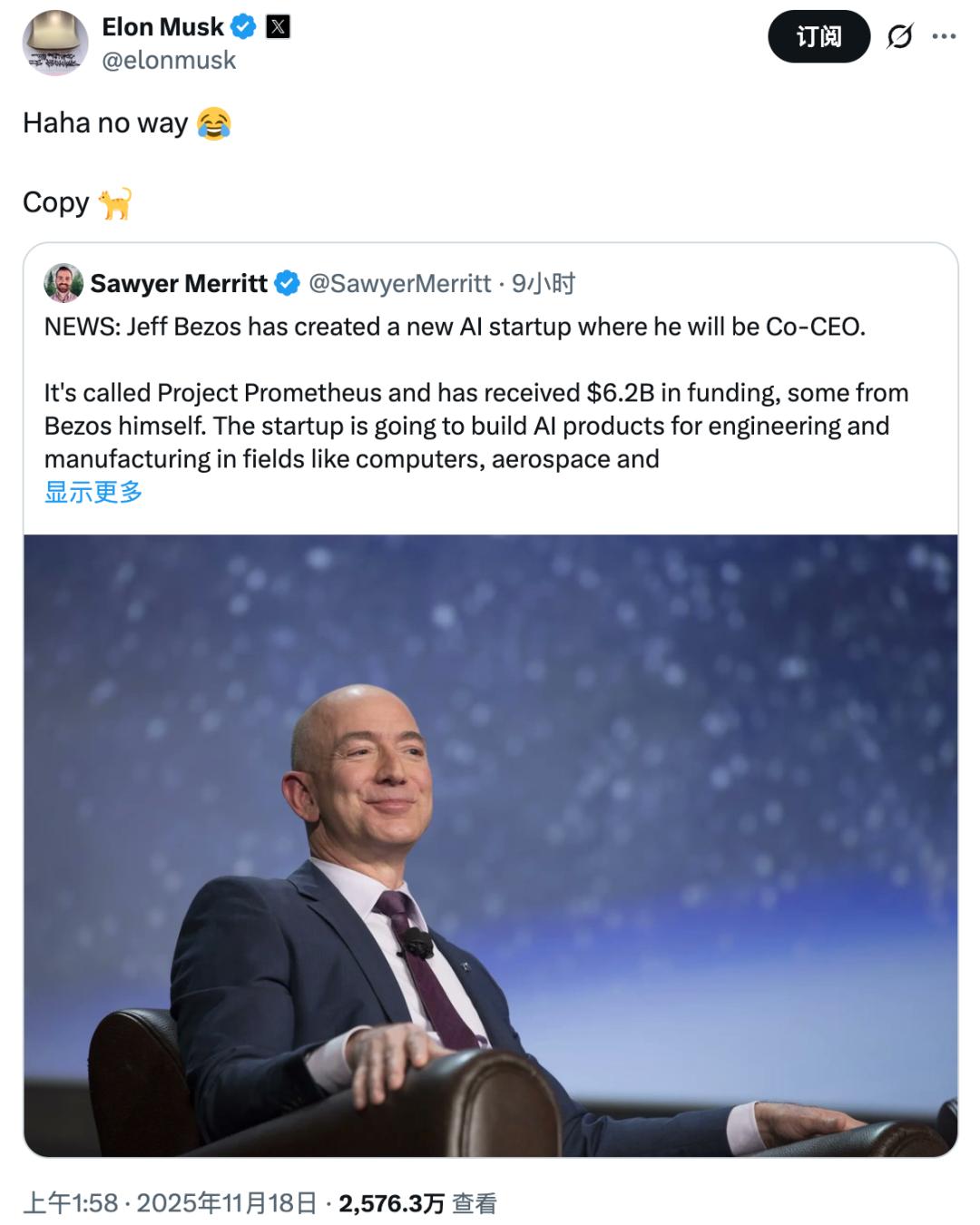
本该是前世界首富杰夫·贝索斯的高光时刻,结果被一只猫咪表情包搅了局。 今天凌晨,当贝索斯要亲自下场做 AI 公司的消息刚在网上发酵,马斯克就火速转发推文,并附带一句话: 哈哈,不可能。Copy cat(跟屁虫) 如果你关注科技圈,这剧情大概见怪不怪了。 从卫星到火箭,这两位科技圈的顶流已经互怼了整整二十年。只是,如今吵架的战场,变成了眼下最火的物理 AI。 62 亿美元,贝索斯开启史上最壕创业 2021 年贝索斯把亚马逊 CEO 的位置让给了安迪·贾西,本以为他要专心当富豪享受人生。结果四年后,这位电商之王突然宣布:我要重返一线, 这次他瞄准的新项目,叫普罗米修斯计划(Project Prometheus)。 据纽约时报的报道,这个计划一出场就拿了 62 亿美元(折合人民币 447 亿元)的融资启动资金,其中相当一部分是贝索斯自己掏的腰包。 凭借这笔巨款,普罗米修斯在硅谷展开了「人才大抢购」,已经挖来了近 100 名顶级研究员,这些人之前都在 OpenAI、Google DeepMind 和 Meta 工作。 那让贝索斯选择二次创业的普罗米修斯到底要做什么? 简单说,就是让 AI 从虚拟世界走进现实世界。现在 ...


61岁贝佐斯创业物理AI,亲任CEO,首轮获投62亿美元融资
3 6 Ke· 2025-11-18 02:05
Core Insights - Jeff Bezos has personally entered the field of physical AI by founding a new company, Project Prometheus, and serving as co-CEO, marking his first operational role since stepping down as Amazon's CEO [4][5] - The company has secured substantial funding of $6.2 billion, approximately 44 billion RMB, indicating strong financial backing [5] - Project Prometheus aims to apply AI to physical tasks in high-tech sectors such as robotics, drug design, and scientific discovery, with a focus on developing more complex AI models that learn from the physical world [5] Company Overview - Project Prometheus was founded by Jeff Bezos and Vik Bajaj, a physicist and chemist with a strong academic background and experience in AI and data science [5][7] - The company has already attracted a workforce of over a hundred employees, including top researchers from leading AI firms like OpenAI and DeepMind [5] Industry Context - The physical AI sector is becoming increasingly competitive, with major tech companies like OpenAI, Google, and Meta already investing in technologies aimed at accelerating advancements in physical sciences [9] - There is a notable trend of former employees from these tech giants forming startups in the physical AI space, such as Periodic Labs, which has raised $300 million to develop "AI scientists" and autonomous laboratories [9][10]

小鹏Q3业绩会实录:明年计划推出乘用车Robotaxi有人驾驶的L4模式
Xin Lang Ke Ji· 2025-11-18 01:29
Core Insights - Xiaopeng Motors reported Q3 2025 total revenue of 20.38 billion yuan, a year-on-year increase of 101.8% and a quarter-on-quarter increase of 11.5% [1] - The net loss for the quarter was 380 million yuan, down from 1.81 billion yuan in the same period last year and 480 million yuan in the previous quarter [1] - Adjusted net loss, excluding U.S. GAAP, was 150 million yuan, compared to 1.53 billion yuan a year ago and 390 million yuan in the last quarter [1] Financial Performance - Total revenue reached 20.38 billion yuan, marking a significant year-on-year growth of 101.8% and a quarter-on-quarter growth of 11.5% [1] - The net loss for the third quarter was 380 million yuan, a notable improvement from the previous year's loss of 1.81 billion yuan and a reduction from the last quarter's loss of 480 million yuan [1] - Adjusted net loss was reported at 150 million yuan, significantly lower than the 1.53 billion yuan loss in the same quarter last year and the 390 million yuan loss in the previous quarter [1] Strategic Developments - The company is focusing on "physical AI" research and development, aiming to redefine automotive technology through a combination of AI and physical integration [3][4] - Xiaopeng Motors is collaborating with Volkswagen, with revenue from this partnership expected to start reflecting in Q4 2025 [5][6] - The company anticipates that technology collaboration revenue will remain consistent with Q3 levels in Q4 and expects similar revenue for the entirety of 2026 [6] Robotics and Future Plans - Xiaopeng Motors aims to achieve a sales target of 1 million robots by 2030, with a focus on humanoid robots that integrate seamlessly into daily life [7][10] - The company is currently in the process of preparing for mass production of its IRON robot, with significant challenges still to be addressed [9][10] - Future applications for robots are expected to expand beyond current commercial uses, potentially entering household environments within five years [10] Vehicle Development - The company plans to launch four new models in 2026, including both pure electric and extended-range versions, targeting various market segments [14][16] - Xiaopeng Motors is also expanding its international market presence, with plans to introduce new models in overseas markets [14][19] - The company has initiated local production in Indonesia and Austria to support its international growth strategy [19]

AMD20251117
2025-11-18 01:15
Summary of AMD Conference Call Company Overview - **Company**: AMD (Advanced Micro Devices) - **Industry**: Semiconductor and Data Center Solutions Key Points and Arguments Market Share and Growth Projections - AMD expects its data center business market share to reach double digits in the next 3 to 5 years, with an AI business CAGR of 80% and a data center business CAGR of 60% [2][3] - Overall revenue is projected to grow at a CAGR of 35%, exceeding Wall Street's expectations of 20% to 30% [3] - By 2030, AMD anticipates its addressable market for data centers to reach $1 trillion, up from a previous estimate of $500 billion [2][5] Revenue Expectations - AMD forecasts data center revenue to reach $100 billion by 2030, with the business currently accounting for about half of total revenue [2][6] - Expected revenue for 2025 is approximately $16 billion, indicating significant growth potential [2][6] Product Development and Innovations - AMD plans to launch cabinet-level products in 2026, similar to NVIDIA's NVL72, utilizing Infiniband Fabric to connect GPUs and CPUs [2][7][9] - The MI400 and MI500 series GPUs are set to be released in 2026 and 2027, respectively, showcasing AMD's commitment to advancing GPU architecture [2][5] AI and Data Center Collaborations - AMD has signed a 6 GW collaboration agreement with OpenAI, with deployment expected to begin in the second half of the year [2][10] - Oracle has started deploying systems based on AMD cards, with new customers anticipated to choose AMD products in 2026 [2][10] Financial Guidance - AMD's long-term financial guidance includes a total revenue growth target of 35%, with gross margins projected between 50% and 58% and operating margins expected to improve to 35% [4][22] - EPS is anticipated to exceed $20, compared to the current consensus of $16 to $18, indicating potential for significant upside [22] Data Center CPU Market Outlook - The global data center CPU market is projected to reach $60 billion by 2030, nearly doubling from $26 billion in 2025, with a CAGR of 18% [4][13] Emerging Markets - The AI PC market is expected to surpass 1 billion devices in the coming years, while the physical AI market could reach $200 billion by 2035 [17] - Client business is projected to maintain low single-digit growth over the next 3 to 5 years, highlighting the potential of emerging sectors [17] Challenges and Considerations - The successful delivery of new cabinet and product launches in 2026 is critical, as supply chain challenges may impact market performance [21] - AMD's reliance on third-party suppliers for switch devices may affect the deployment timeline of new technologies [9] Overall Outlook - AMD's optimistic outlook includes a $1 trillion market for computing cards, GPUs, CPUs, and network cards, with significant revenue elasticity expected if the supply chain operates smoothly [23][24]

61岁贝佐斯创业物理AI!亲任CEO,首轮获投62亿美元融资
量子位· 2025-11-18 00:59
Core Viewpoint - Jeff Bezos has personally entered the field of physical AI by co-founding a new company, Project Prometheus, and taking on the role of co-CEO, marking his first operational role since stepping down as CEO of Amazon [2][6]. Funding and Financial Strength - Project Prometheus has secured substantial funding, amounting to $6.2 billion, which is approximately 44 billion RMB, including contributions from Bezos himself [3][8]. Team and Talent Acquisition - The company has assembled a team of over a hundred employees, including researchers recruited from top AI firms such as OpenAI and DeepMind [9]. Research Focus and Applications - Project Prometheus aims to apply AI to physical tasks, with research projects focusing on robotics, drug design, and scientific discovery, particularly in high-tech fields like computing, automotive, and aerospace [9][11]. Leadership and Expertise - Bezos's co-CEO is Vik Bajaj, a physicist and chemist with a strong academic background and experience in AI and data science, having previously worked with Google and co-founded several tech initiatives [12][14][15][17]. Competitive Landscape - The physical AI sector is becoming increasingly competitive, with major tech companies like OpenAI, Google, and Meta already investing in similar technologies, and new startups emerging from the ranks of former employees of these companies [18][21].

全文|小鹏Q3业绩会实录:明年计划推出乘用车Robotaxi有人驾驶的L4模式
Xin Lang Ke Ji· 2025-11-18 00:41
Core Insights - Xiaopeng Motors reported Q3 2025 total revenue of 20.38 billion yuan, a year-on-year increase of 101.8% and a quarter-on-quarter increase of 11.5% [1] - The net loss for the quarter was 380 million yuan, down from a net loss of 1.81 billion yuan in the same period last year and 480 million yuan in the previous quarter [1] - Adjusted net loss, not in accordance with US GAAP, was 150 million yuan, compared to 1.53 billion yuan in the same period last year and 390 million yuan in the previous quarter [1] Financial Performance - Total revenue for Q3 2025 reached 20.38 billion yuan, marking a significant growth of 101.8% year-on-year and 11.5% quarter-on-quarter [1] - The company reported a net loss of 380 million yuan, a notable improvement from the previous year's loss of 1.81 billion yuan and a reduction from the last quarter's loss of 480 million yuan [1] - Adjusted net loss was 150 million yuan, significantly lower than the 1.53 billion yuan loss in the same quarter last year and the 390 million yuan loss in the previous quarter [1] Strategic Developments - Xiaopeng Motors is focusing on "physical AI" research and development, aiming to redefine technological advancements in the automotive industry [2][3] - The company plans to enhance its competitive advantage in "physical AI" through a combination of full-stack self-research and cross-domain integration [3] - The partnership with Volkswagen for the Turing chip is expected to generate revenue starting in Q4 2025, with significant growth anticipated as joint vehicle development progresses [4][5][6] Robotics and Future Outlook - Xiaopeng Motors aims to achieve a sales target of 1 million robots by 2030, with a focus on humanoid robots that integrate seamlessly into daily life [7][8] - The company is working on overcoming challenges related to the mass production of its IRON robot, with expectations for a new generation of robots to enter production soon [9][10] - The anticipated commercialization of robots is expected to expand into various applications, including industrial and household settings within five years [10][11] Product Launches and Market Expansion - Xiaopeng Motors plans to launch four new models in 2026, including both pure electric and extended-range versions, targeting different market segments [13][14] - The company is expanding its international presence with local production facilities in Indonesia and Austria, aiming to increase production capacity and support overseas growth [16][17] - The introduction of super extended-range models is expected to significantly drive sales growth in the upcoming year [15]
财报后小鹏股价暴跌超10%!小鹏电话会全文
美股IPO· 2025-11-18 00:34
小鹏汽车周一发布2025年三季度财报,关键指标全面创下新高,营收同比翻番,综合毛利率突破20%创历史新高,净亏损同比大幅收窄近80%,预计 Q4交付和营收同比增长均超过30%。在随后的财报电话会上,何小鹏称, 随着物理世界大模型的出现,无人驾驶的时代正在加速到来。 他表示,只有深度融合的物理世界大模型,才能让机器逐步具备在物理世界中交互、沟通、改变,甚至未来创造的能力,从而重塑出行和生活方式。 只有前端量产,并且拥有泛化能力极强的Robotaxi才能够大规模普及,并且同时跑通商业模型。 何小鹏透露, 在2026年,小鹏汽车会推出三款Robotaxi,Robotaxi技术路线不使用激光雷达,反而可以很好的解决Robotaxi行业成本高昂,特别是 部署成本高昂,出行限制多泛化能力弱的系列问题。 他认为,这会加速全球范围内的Robotaxi规模化的部署。 此外, 小鹏计划在2026年在中国开启小鹏Robotaxi的试运营,并且进一步打磨好Robotaxi的软硬件和运营生态。 Q3业绩与物理AI总体战略 何小鹏在财报电话会上表示,物理世界大模型正在推动无人驾驶时代加速到来,只有前装量产且具备强泛化能力的Robotax ...
小鹏汽车发了三季报,何小鹏:收入、毛利率、在手现金创新高
Nan Fang Du Shi Bao· 2025-11-17 12:51
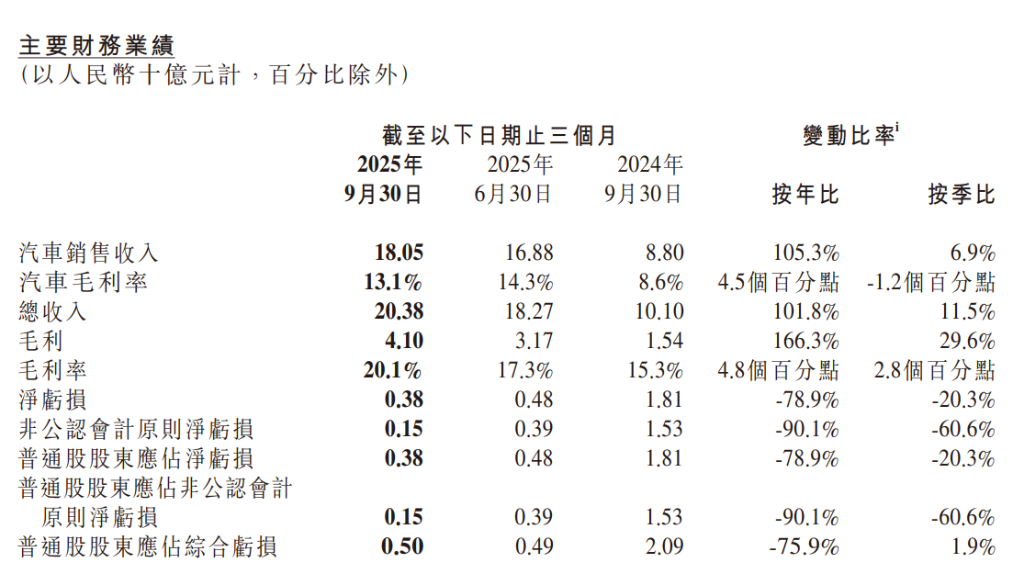
Core Viewpoint - Xiaopeng Motors reported strong financial performance for Q3 2025, with significant increases in key operational metrics such as delivery volume, revenue, and gross margin [1][3]. Group 1: Delivery and Sales Performance - In Q3, Xiaopeng Motors delivered approximately 116,000 vehicles, a year-on-year increase of 149.3% [1]. - The monthly delivery volume reached a new high of 42,013 vehicles in October [1]. Group 2: Revenue Growth - Automotive sales revenue for Q3 amounted to 18.05 billion yuan, representing a year-on-year increase of 105.3% and a quarter-on-quarter growth of 6.9% [3]. - Total revenue for the quarter was 20.38 billion yuan, up 101.8% year-on-year and 11.5% quarter-on-quarter [3]. Group 3: Profitability and Margins - Xiaopeng Motors reported a net loss of 380 million yuan in Q3, significantly reduced from 1.81 billion yuan in the same period last year [3]. - The gross margin improved to 20.1%, an increase of 4.8 percentage points year-on-year, with automotive gross margin at 13.1% [3]. Group 4: Research and Development Focus - The company is committed to investing in physical AI research, with planned R&D expenditures reaching approximately 9.5 billion yuan by 2025, including 4.5 billion yuan specifically for AI [5]. - Xiaopeng Motors has already invested over 2 billion yuan in training costs for VLA technology since 2024 [5]. Group 5: Financial Position and Future Outlook - As of September 30, Xiaopeng Motors had cash and cash equivalents totaling 48.33 billion yuan, a record high [6]. - For Q4, the company expects vehicle deliveries to range between 125,000 and 132,000, with total revenue projected between 21.5 billion and 23 billion yuan [6].
小鹏Q3营收翻番,净亏损大幅收窄近80%,Q4交付、营收预计同比均增超30% | 财报见闻
Hua Er Jie Jian Wen· 2025-11-17 11:31
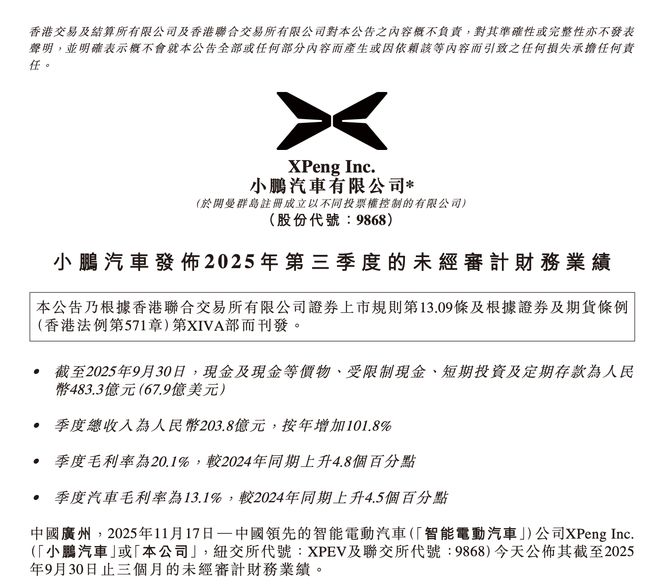
Core Viewpoint - Xiaopeng Motors achieved record highs in key performance indicators for Q3, with revenue doubling year-on-year, gross margin exceeding 20%, and net loss significantly narrowing by nearly 80%. The company anticipates over 30% growth in both deliveries and revenue for Q4 [1]. Financial Performance - Q3 total revenue reached 20.38 billion yuan, a year-on-year increase of 101.8% [2][3] - Automotive sales revenue was 18.05 billion yuan, up 105.3% year-on-year [2][3] - Gross margin surpassed 20.1%, an increase of 4.8 percentage points year-on-year [2][3] - Automotive gross margin stood at 13.1%, a quarter-on-quarter decline of 1.2 percentage points [2][3] - Non-GAAP net loss was 150 million yuan, a significant reduction of 90.1% year-on-year [2][3] - Cash reserves amounted to 48.33 billion yuan, an increase of 760 million yuan quarter-on-quarter [2]. Business Progress - Q3 delivery volume reached 116,007 units, a year-on-year surge of 149.3% [4] - Revenue from services and technology R&D was 2.33 billion yuan, with a gross margin of 74.6%, becoming a major support for overall gross margin [4] - The sales network expanded to 690 stores, with 2,676 charging stations (including 1,623 supercharging stations) [4] - Q4 delivery guidance is set at 125,000 to 132,000 units, representing a year-on-year growth of 36.6% to 44.3% [4]. Strategic Transformation - The company has clearly shifted its focus to becoming a "global embodied intelligence company," betting on physical AI, Robotaxi, and humanoid robots [4] - Q3 R&D expenditure was 2.43 billion yuan, a year-on-year increase of 48.7% and a quarter-on-quarter increase of 10.1% [4] - Sales and management expenses were 2.49 billion yuan, up 52.6% year-on-year, with the expense ratio remaining high [4].
小鹏汽车发布2025Q3财报:毛利率升至20%,净亏损缩窄至3.8亿元
Zhong Guo Jin Rong Xin Xi Wang· 2025-11-17 10:36
Core Insights - Xiaopeng Motors reported a record high total revenue of 20.38 billion yuan for Q3 2025, representing a year-on-year increase of 101.8% and a quarter-on-quarter increase of 11.5% [1] - The company achieved a net loss of 380 million yuan, significantly reduced from 1.81 billion yuan in the same quarter of 2024 and 480 million yuan in the previous quarter [1] - The gross margin reached a historical high of 20.1%, up 4.8 percentage points year-on-year, indicating progress towards profitability [1] - Total vehicle deliveries for Q3 2025 were 116,007 units, marking a year-on-year increase of 149.3% and a quarter-on-quarter increase of 12.4% [1] - As of the end of Q3, the company's cash and cash equivalents, restricted cash, short-term investments, and time deposits totaled 48.33 billion yuan, an increase of approximately 760 million yuan from the end of June, representing a historical high in cash reserves [1] Company Statements - The CEO of Xiaopeng Motors emphasized the rapid expansion of sales scale and market share, with a focus on achieving mass production of Robotaxi and humanoid robots [2] - The Vice Chairman highlighted the breakthrough in gross margin and the commitment to invest in physical AI research and development, aiming to create a strong product technology system and business ecosystem [2] - For Q4 2025, Xiaopeng Motors anticipates total vehicle deliveries between 125,000 and 132,000 units, representing a year-on-year increase of 36.6% to 44.3%, with total revenue expected to be between 21.5 billion and 23 billion yuan, an annual increase of approximately 33.5% to 42.8% [2]